Endangered (Red Book of the Birds of Spain, 2021) and special protection regime
When to see it
Resident
Months of the year when it is present
J
F
M
A
M
J
J
A
S
O
N
D
In Iberia
yes
yes
yes
yes
yes
yes
yes
yes
yes
yes
yes
yes
Breeding season
no
no
no
yes
yes
yes
yes
yes
no
no
no
no
Song or voice of the Common Kingfisher
A high, quick, penetrating «tiit-tiit», which it gives both in flight and perched; in spring it adds a quick trill.
CallCommon Kingfisher
0:00 / 0:14
10 kHz5
The sonogram draws the sound: time runs from left to right, and the higher a trace sits, the higher the note.
Flight of the Common Kingfisher
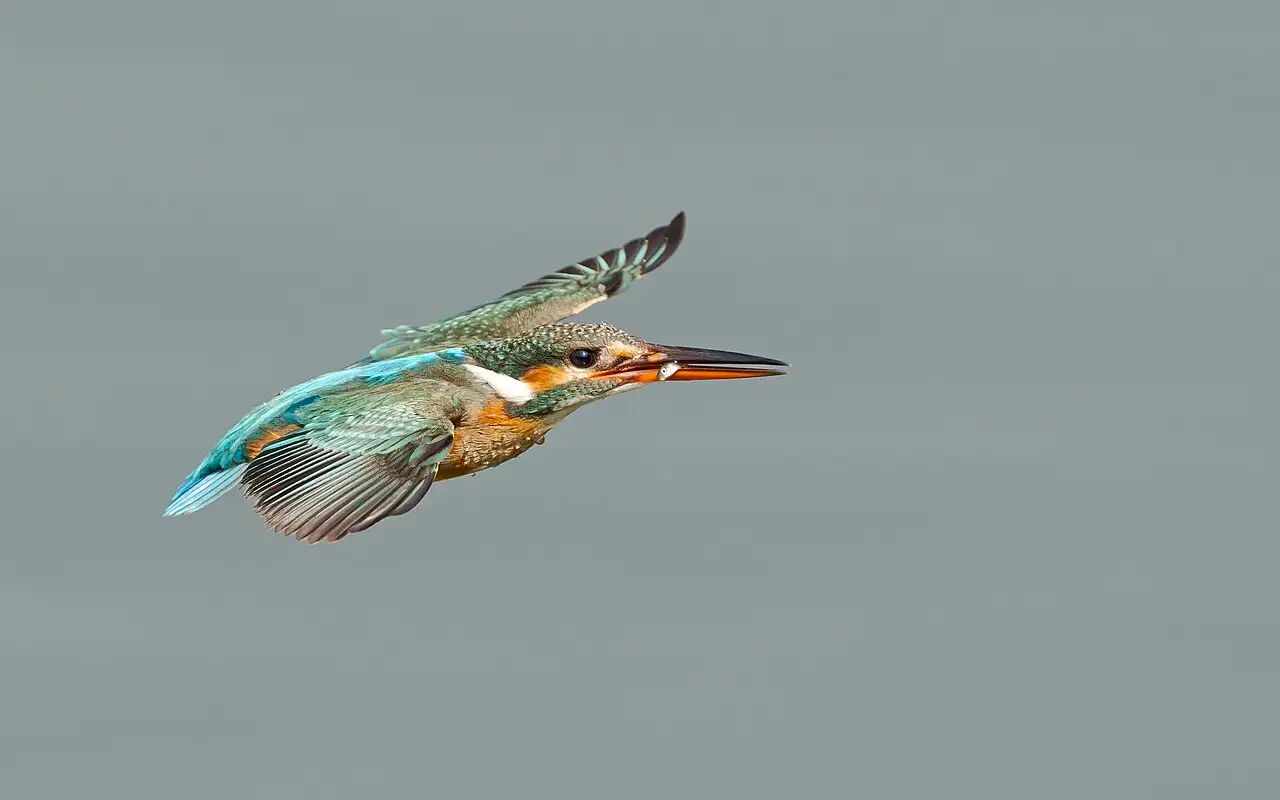
The kingfisher flies low, direct and fast. It makes few manoeuvres and its wingbeats are very quick, almost buzzing. It changes gear only to fish: it plunges down with its wings pressed to its body.
Flight typeDirect, low and fast
It waits motionless on a branch above the water. When it sees the fish, it plunges down with its wings pressed to its body.
It dives for an instant, catches the fish with its bill and comes out propelling itself with its wings.
It returns to the same branch, low, straight and with a wingbeat so quick it almost buzzes. There it bangs the fish against the branch before swallowing it.
Photo gallery of the Common Kingfisher
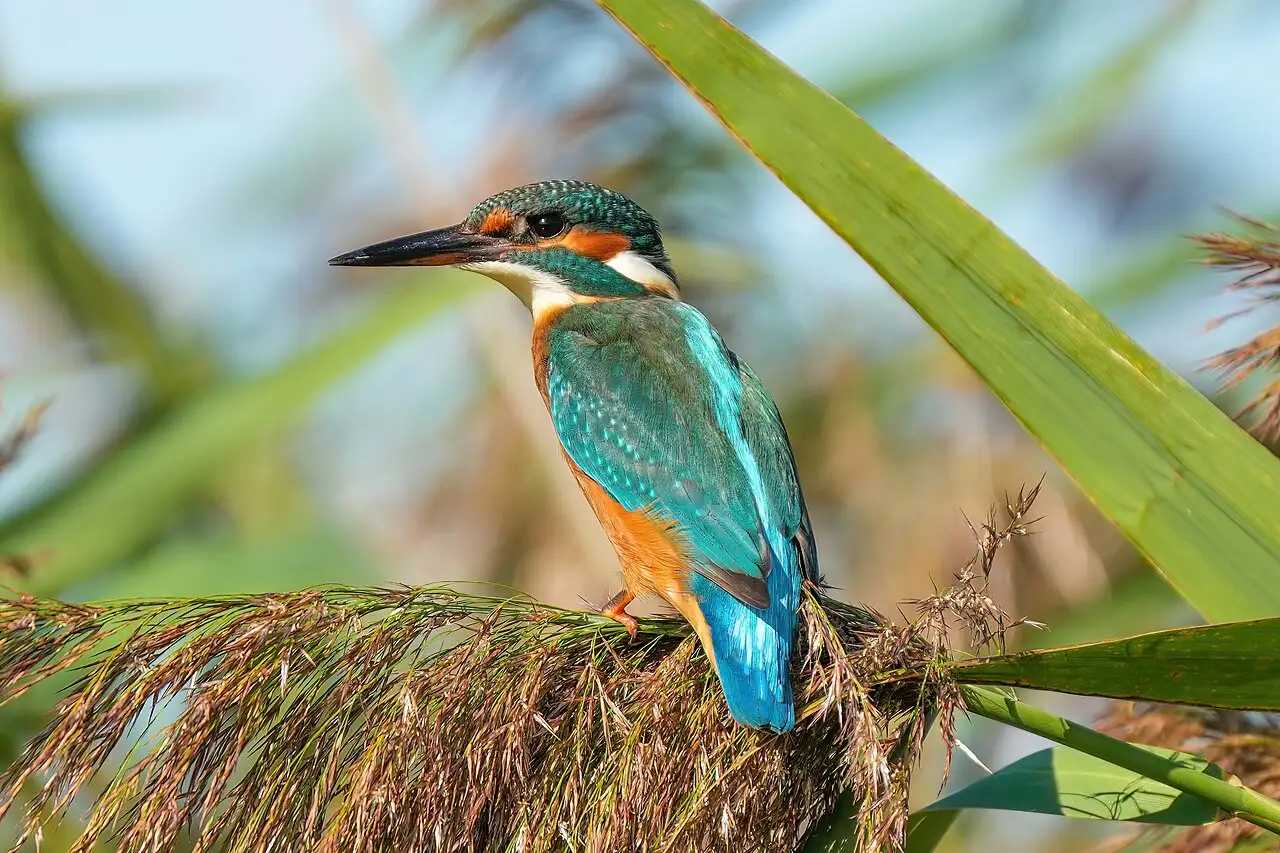
Common Kingfisher perched in profile on a reed: electric-blue back, orange belly and long, straight billPhoto: Giles Laurent, CC BY-SA 4.0Photo 1 of 4
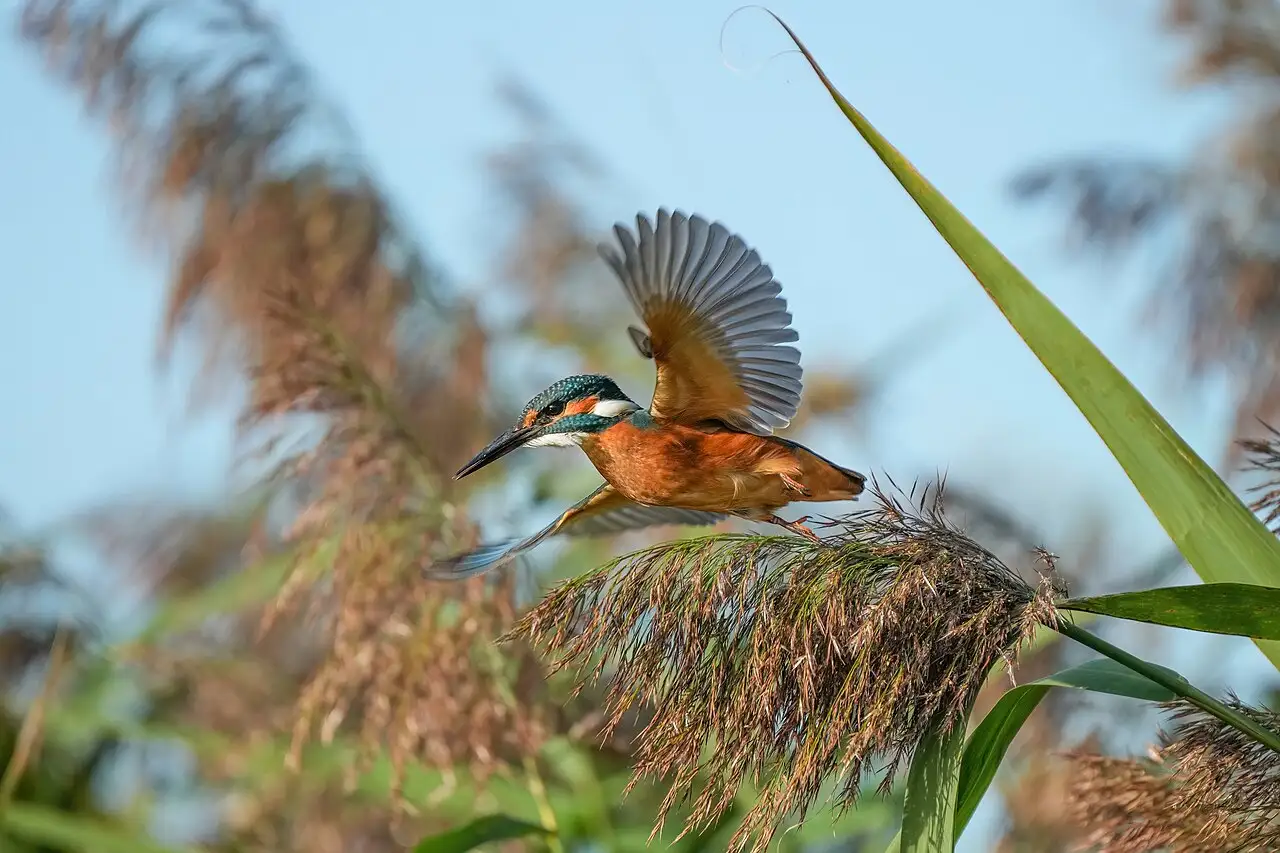
Common Kingfisher taking off from a reed with wings raised: the orange belly and the short, rounded wings can be seenPhoto: Giles Laurent, CC BY-SA 4.0Photo 2 of 4
Common Kingfisher in flight, straight and low, with a fish in its billPhoto: Prasan Shrestha, CC BY-SA 4.0Photo 3 of 4
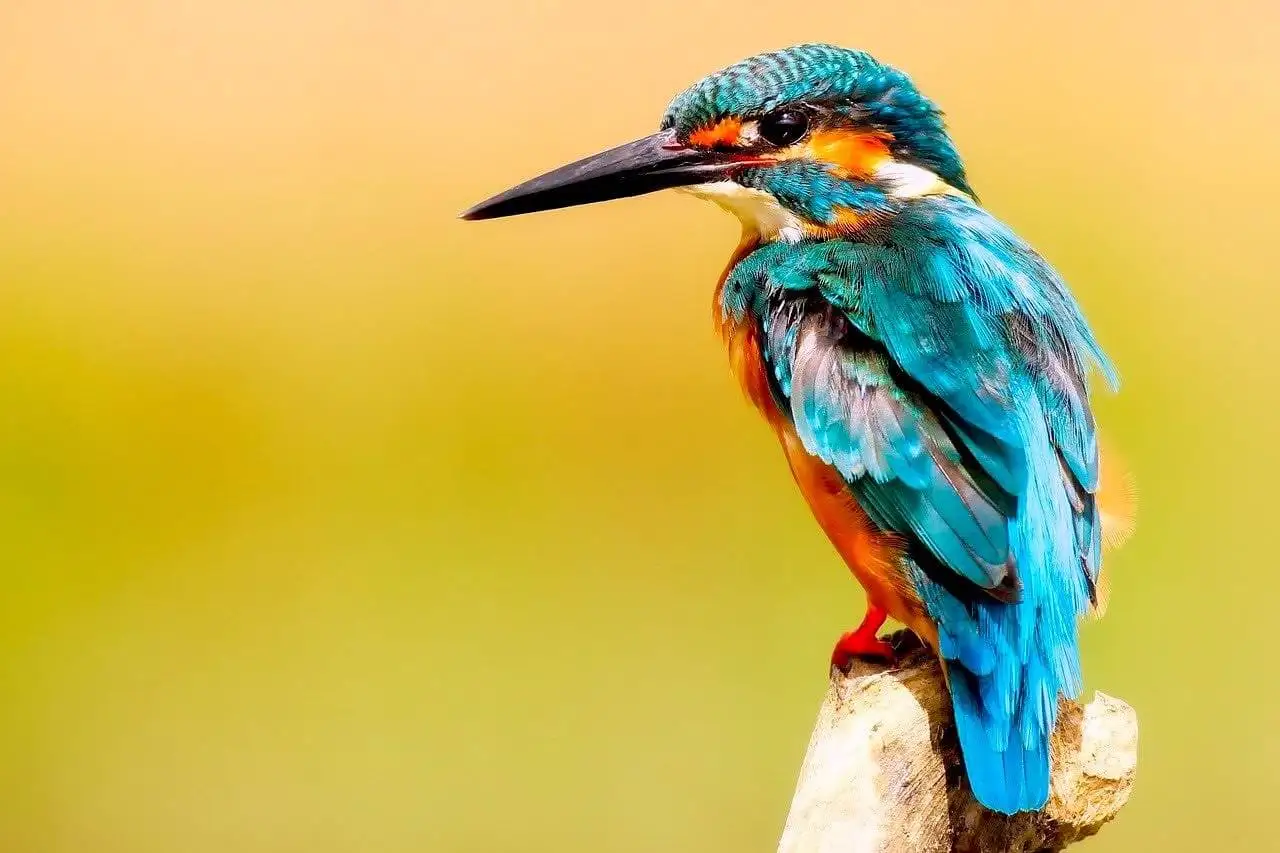
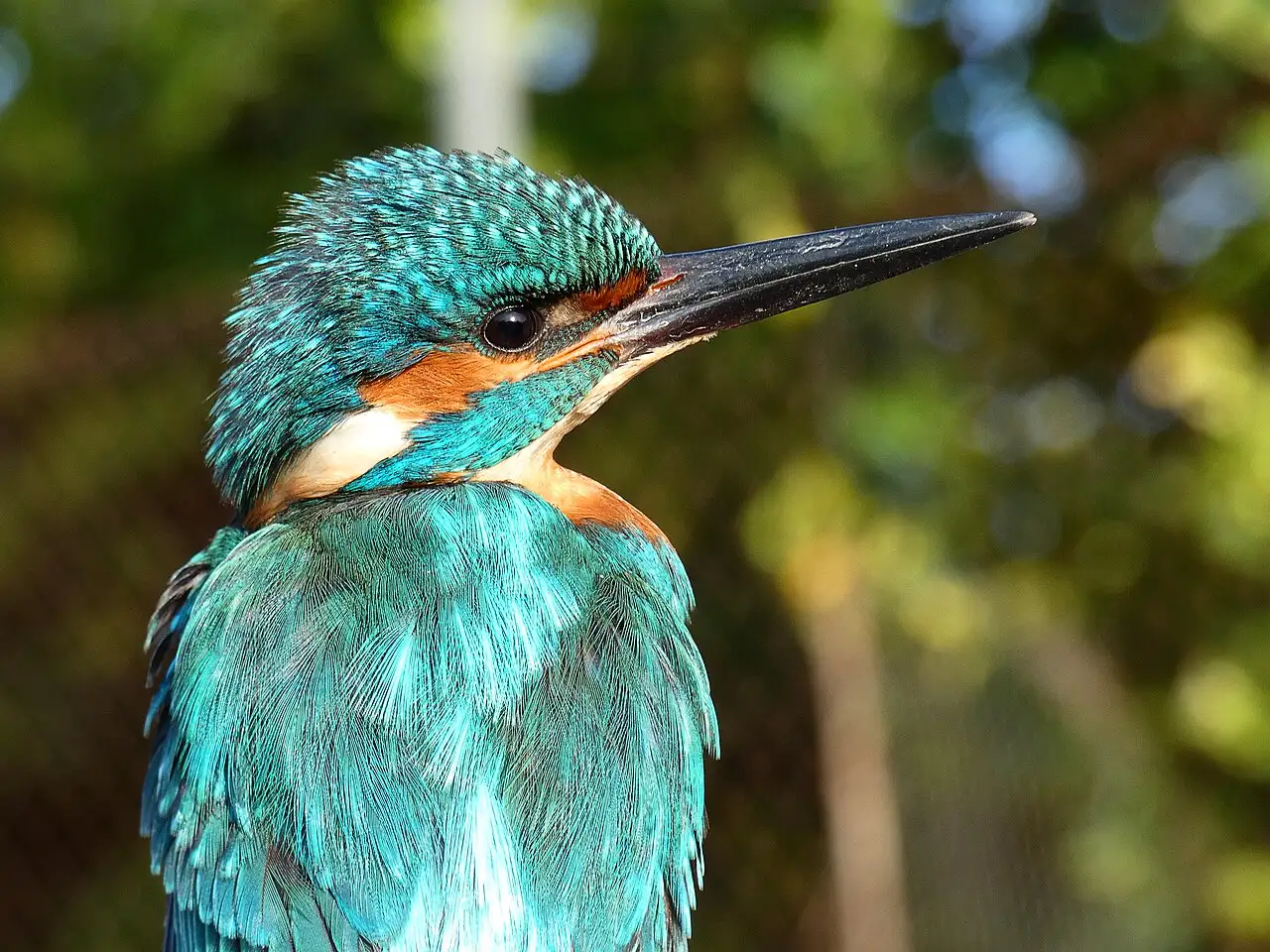
Head of a Common Kingfisher in profile: blue crown with bars, orange patch on the cheek and black billPhoto: Daniel Rodríguez Alegre, CC BY 4.0Photo 4 of 4
1 / 4
Identification of the Common Kingfisher
The kingfisher is a fairly small bird, so small that it surprises people the first time they see it. Its vivid colours are no hindrance to going unnoticed, even on the water under the shade of the foliage. It is usually its call, together with the cobalt-blue flash of its back, that lets us pick it out, sometimes from quite close.
The kingfisher’s head is quite large compared with its body. Its crown is blue, in bright barring. The cheek has a white and orange patch, separated from the chin, also white, by another blue patch. The bill is black, and the female’s also shows a red base on the underside, the only appreciable evidence of sexual dimorphism.
Its underparts are rusty orange, and the upperparts are electric blue with greenish-blue tones, somewhat more matt in juveniles. At the end of the head, a band of intense blue, lighter and brighter, begins and reaches the tail.
Its legs are small and red, black in juveniles.
Young birds show a bright colour, tending to turquoise green, instead of the adults’ intense blue.
Habitat and distribution of the Common Kingfisher
It is distributed over most of Europe, reaching in the north as far as Scotland, the Baltic and southern Scandinavia. In summer the kingfisher visits the north and east of Europe, from where it moves south-west when winter comes.
It usually settles beside rivers and marshy areas. Although it is undemanding about where it settles, it requires the water to be clean, preferably on the middle stretches of rivers, and the bankside vegetation to be dense, providing good perches, with abundant fish, as well as earth banks in which to set its nests. In those suitable conditions, we can see kingfishers on reservoirs, lagoons, rivers, marshes, cattle ponds and irrigation ditches.
In winter, they also appear on canals and coasts. It avoids altitudes above 1,000 metres and shuns arid ones. Occasionally, the kingfisher visits garden ponds containing goldfish, but they vanish at the slightest disturbance.
When winters are very hard, the kingfisher migrates, which causes great fluctuation in the population from year to year.
The kingfisher is distributed across the whole Peninsula, with a greater presence in the western regions, such as Extremadura and Castilla y León. As a breeder, it is absent from the archipelagos.
Areas where it is regularly recorded since 2010Squares of about 25 km where it is recorded regularly (occasional passage records are left out). Data from GBIF.org (243,366 records, retrieved October 2026); outline from Natural Earth.
Etymology of the Common Kingfisher
Alcedo: «alcedo, inis», in Latin, kingfisher. atthis: comes from Latin «atthis, idis» and means «nightingale, swallow».
Population of the Common Kingfisher
It is a declining species. About 24,152 birds were counted in Spain in 2018 (III Atlas) and a fall of 50.1 % between 1998 and 2018 is calculated according to the SACRE programme, which has led to its being classed as Endangered in the 2021 Red Book of the Birds of Spain1. In Europe there are estimated to be between 50,000 and 190,000 breeding pairs, and on the Iberian Peninsula between 4,000 and 7,000 had been calculated.
Nest of the Common Kingfisher
The kingfisher builds a deep, tube-shaped tunnel lined with fish bones. They are usually situated in soft earth cliffs near bodies of water.
Courtship and breeding of the Common Kingfisher
It makes 1 or 2 broods, rarely 3, between spring and summer. The female lays between 4 and 8 white eggs, incubated by both members of the pair for 19 to 21 days. The chicks will be fed in the nest for 23 to 27 days. Meanwhile, sometimes, the pair makes a second clutch in another nest before the first one fledges.
Diet of the Common Kingfisher
The kingfisher is mainly a fish-eating species: it feeds on fish, tadpoles and adult amphibians, and on small aquatic invertebrates, such as aquatic larvae and insects, which it hunts by spectacular dives, dropping from its perch or from mid-air. It also eats crustaceans and molluscs.
Curious facts about the Common Kingfisher
The kingfisher shows a troglodyte attitude when it has to breed; that is, instead of taking the female to the orchard, it opts for the cave. It thus selects a sandy bank in which it can dig a fine cave in which to protect the clutch.
The blue of its back is not pigment: it is produced by the microscopic structure of the feathers as they reflect light, and that is why it changes with the angle we look at it from. And although we see it orange and blue, it is a bird that spends a lot of time still and silent.
The Common Kingfisher in Cabañeros
In Cabañeros we find a native population, of the nominate subspecies, sedentary in the Montes de Toledo. It is a rather unusual species in the area. In winter a few appearances have been observed at places such as El Brezoso.
Where to see the Common Kingfisher in Cabañeros
It appears on streams and in «tablas» of clean water with abundant fish. It usually breeds on earth cliffs.
When
All year round, although it is easier in winter, when birds arrive from the north and the trees are leafless.
What time
First hours of the morning, in low light and with the water calm. It is usually heard before it is seen.
Where
On streams and «tablas» of clean water with fish, such as El Brezoso. Always on a branch, reed or stone above the water.
What to look for
A blue flash crossing the water at surface level, or a tiny bird, motionless on a low branch, staring fixedly downwards.




 Also in rivers and riverbanks
 Also in rivers and riverbanks
 Also in rivers and riverbanks
 Also in rivers and riverbanks
 Also in rivers and riverbanks
 Also in rivers and riverbanks
 Same season in the park
 Same season in the park






