Monogamous during the breeding season, although cases of polygamy have been described; they do not pair for life (Wikipedia)
Lifespan
Record of 10 years and 2 months in the wild (a bird ringed in Spain and checked by the ringer)
Conservation status
LC
NT
VU
EN
CR
EW
EX
Global (IUCN)
Least Concern
Spain
Least Concern (LC) in the Red Book of the Birds of Spain; on the List of Wild Species under Special Protection, but not in the Spanish Catalogue of Threatened Species
When to see it
Resident
Months of the year when it is present
J
F
M
A
M
J
J
A
S
O
N
D
In Iberia
yes
yes
yes
yes
yes
yes
yes
yes
yes
yes
yes
yes
Breeding season
no
yes
yes
yes
yes
yes
yes
no
no
no
no
no
Song or voice of the European Stonechat
The song is brief, high and repetitive, and consists of a short, grating trill. Its call is characteristic: a short click, repeated insistently, «chac-chac».
SongEuropean Stonechat
0:00 / 0:25
10 kHz5
The sonogram draws the sound: time runs from left to right, and the higher a trace sits, the higher the note.Recording by Alexander Kurthy, Wikimedia Commons (xeno-canto XC86886) (CC BY-SA 4.0).
Flight of the European Stonechat
It likes to perch in prominent places and has a fast, direct flight, with strong wingbeats. The white patches on the scapular area are very visible in flight.
Flight typeFast and direct, with strong wingbeats
It likes to perch in prominent places, from where it leaves with a short click, «chac-chac», repeated insistently.
Fast, direct flight, with strong wingbeats. The white patches on the scapular area are very visible in flight.
It lands again on another prominent spot in the open area.
Photo gallery of the European Stonechat
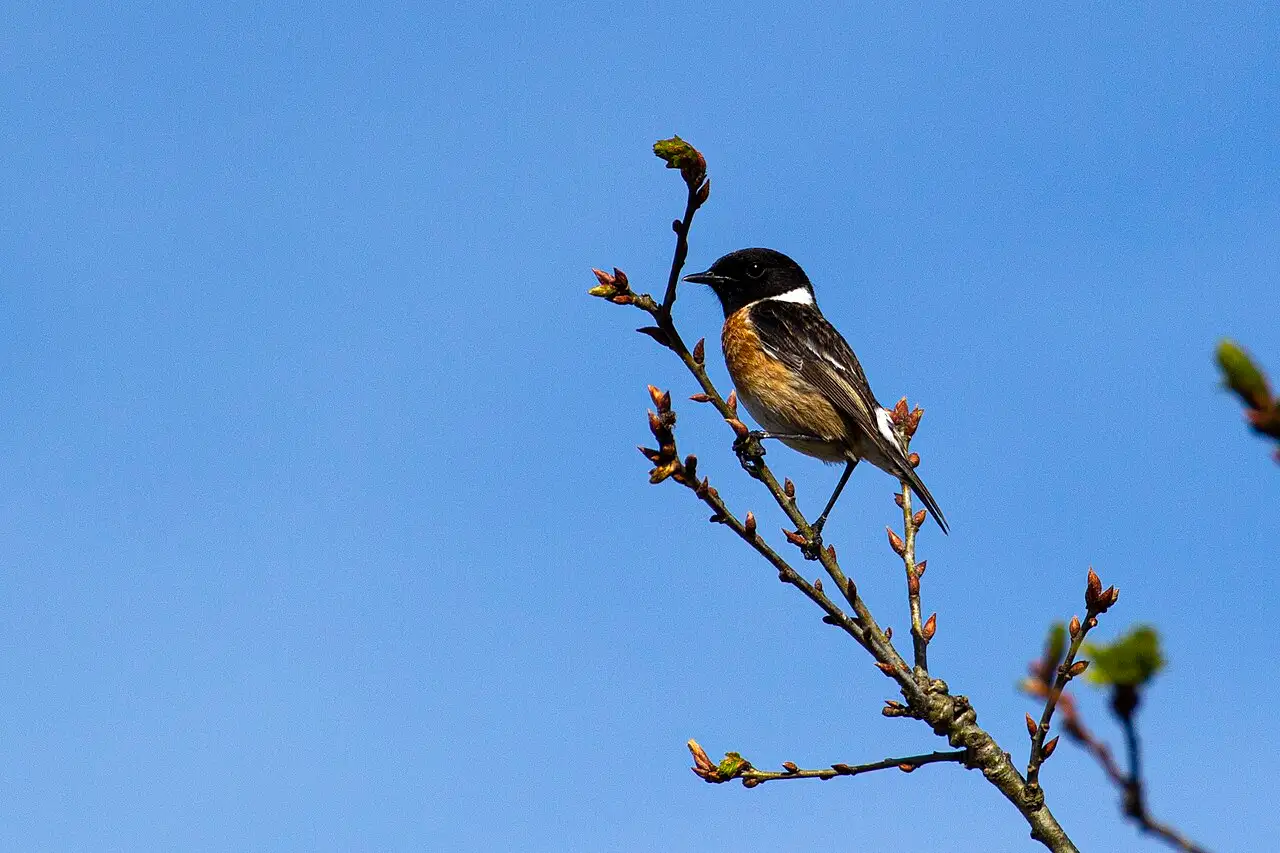
Male European Stonechat perched on top of a leafless branch against the blue sky, with black head, a white patch on the neck and orange breastPhoto: Bene Riobó, CC BY-SA 4.0Photo 1 of 4
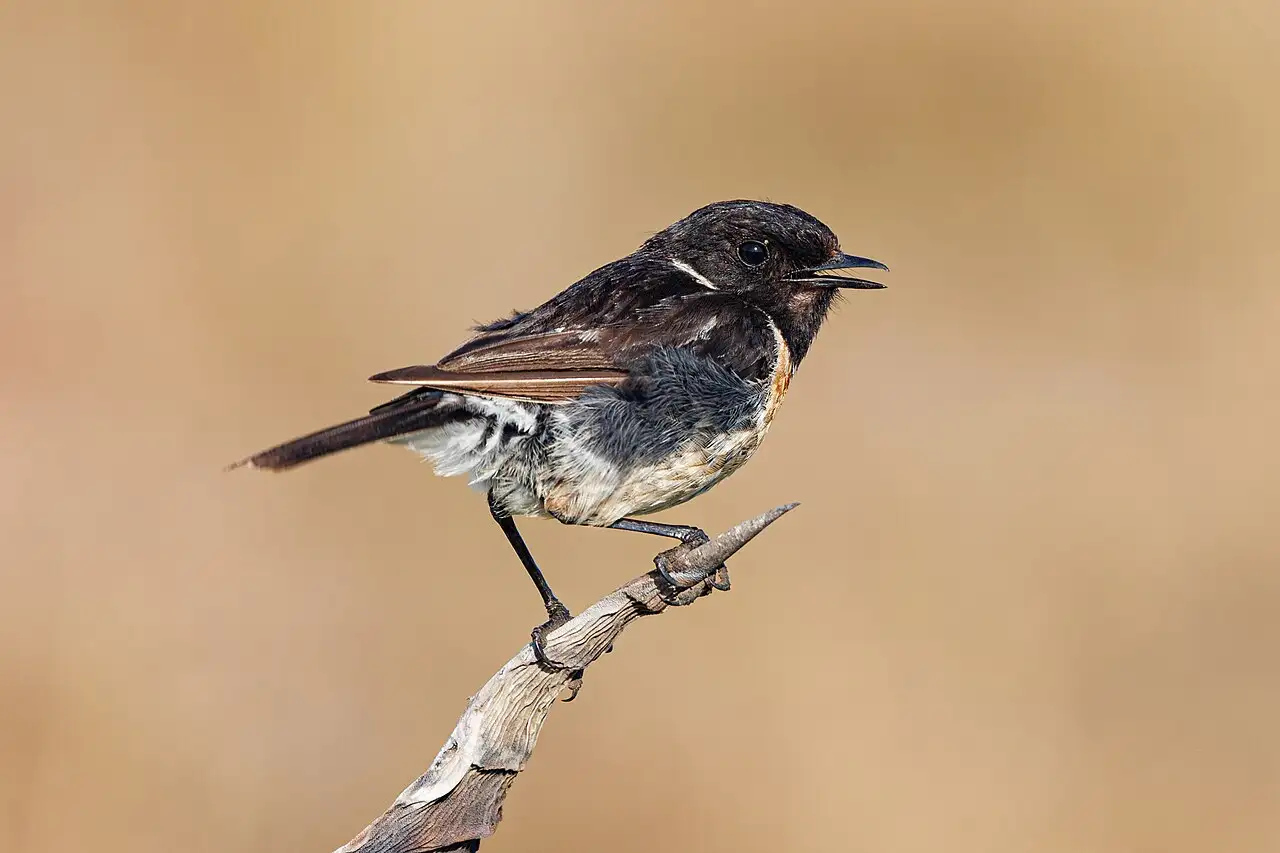
Male European Stonechat with open bill on a dry branch, with black head and whitish breastPhoto: Hobbyfotowiki, CC0Photo 2 of 4
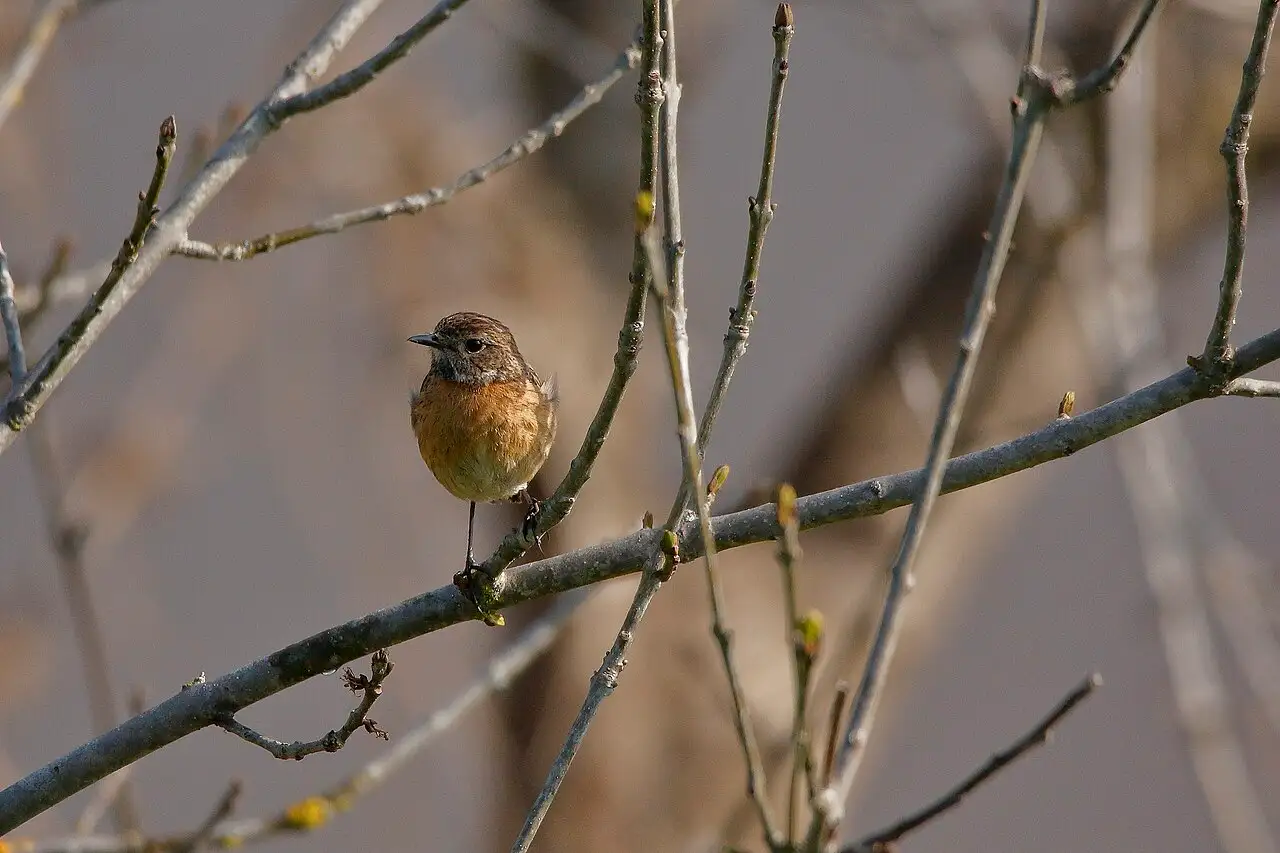
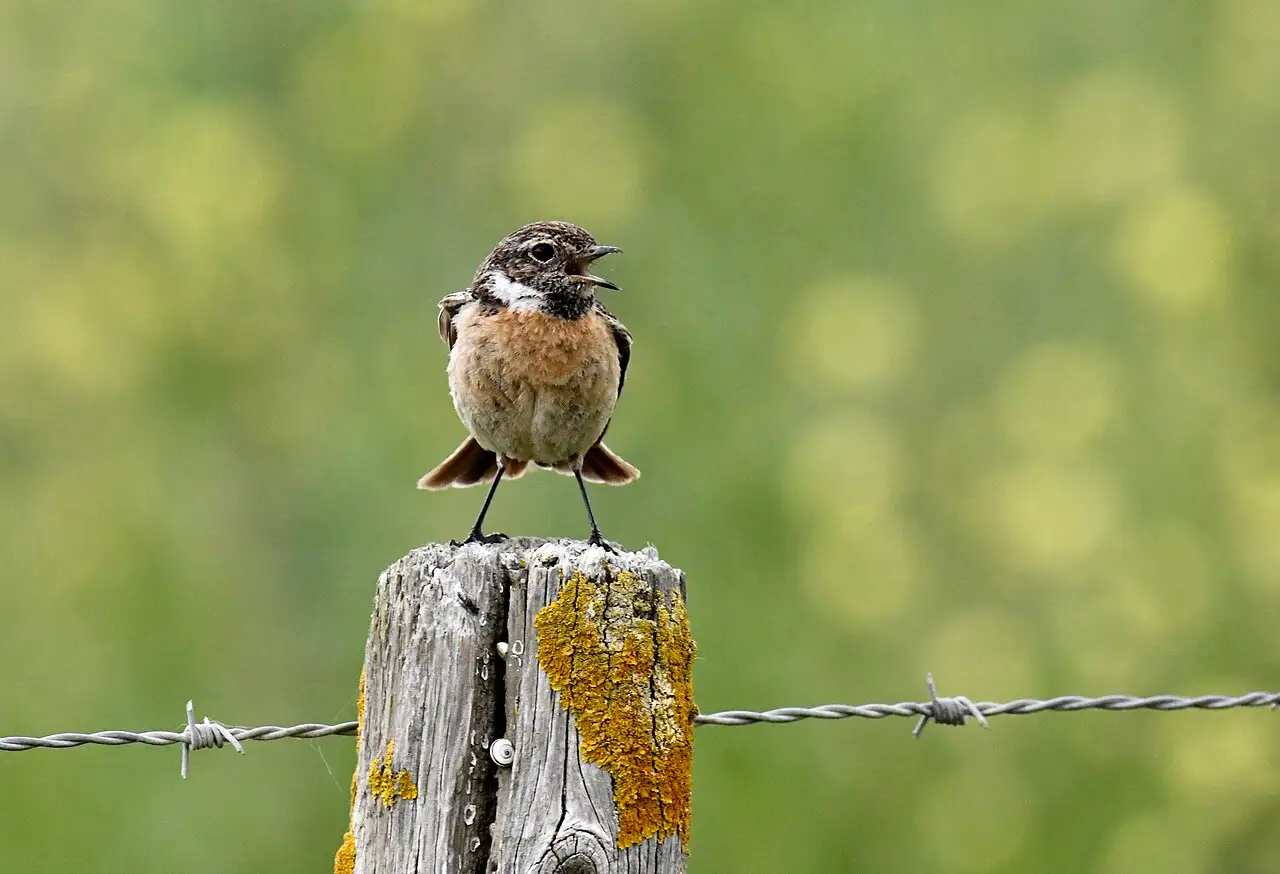
The stonechat is a small, plump-looking bird, with a rounded head, short dark wings and tail, and white patches on the scapular area, very visible in flight. The males sport a very showy pattern, in which the black head contrasts with the orange breast, and the whitish rump with the dark tail in adults. Females and juveniles show a pattern similar to the male’s, although they are browner.
This bird likes to perch in prominent places and has a fast, direct flight, with strong wingbeats.
Adult male
Black head and orange breast.
Whitish rump against the dark tail.
White patches on the scapular area.
Female and young bird
Pattern similar to the male’s, but browner.
Habitat and distribution of the European Stonechat
It has a wide but very uneven distribution across Europe, Asia and Africa: it is widespread in sub-Saharan Africa and in temperate latitudes of the western Palearctic, the Arabian Peninsula and central Asia. Twenty-five subspecies have been described, but recent genetic studies find insufficient differences between all of them, so its subspecific status remains to be reviewed.
It is distributed continuously and widely across the whole Iberian Peninsula and the Balearics, and is absent from the Canaries, Melilla and some areas of the Ebro depression, La Mancha, the Guadalquivir valley and the Iberian south-east. In Spain two subspecies are recognised: «hibernans», which lives in the north-west of the peninsula, and «rubicola», which occupies the rest of the Peninsula and the Balearics.
It is typical of open areas: scrub formations, farmland, woodland clearings, mosaics of crops or pastures with scattered shrubs. Its highest densities have been recorded in thyme heaths, farmland and heathland in the warmest parts of the Peninsula. It is found from sea level up to 2,100 metres in the Sierra Nevada.
Iberian populations are resident or partly migratory: birds from the colder areas leave them in winter to head for warmer spots in the Iberian south or North Africa. The Peninsula receives birds from western Europe that winter in the south-western quadrant, in the Balearics and around the Mediterranean arc. Pre-breeding migration is detected between February and April, peaking at the end of February, and post-breeding between September and November, peaking in October.
Areas where it is regularly recorded since 2010Squares of about 25 km where it is recorded regularly (occasional passage records are left out). Data from GBIF.org (629,528 records, retrieved October 2026); outline from Natural Earth.
Etymology of the European Stonechat
According to Wikipedia, «Saxicola» means «dweller among the rocks», from the Latin «saxum» («rock») and «incola» («inhabitant»), and «rubicola» combines «rubus» («brambles») with «incola». The English name of the species, «stonechat», comes from its call, which sounds like two stones knocked together. It is also known as «tarabilla europea»; in other languages it is «bitxac comú» in Catalan, «chasco europeo» in Galician, «pitxartxar burubeltza» in Basque and «European stonechat» in English1.
Population of the European Stonechat
The Iberian population has been assessed at 6,820,682 individuals, a figure noticeably lower than that recorded two decades ago. The abandonment of cultivated areas, with the resulting reforestation and disappearance of open spaces, as well as agricultural intensification and the use of herbicides and pesticides, could lie behind this negative trend.
It is a common and widely distributed bird, although with a declining trend, so it is recommended to assess the species’ evolution in the future1. The main risk for its populations could come from agricultural intensification and the homogenisation of farmland environments through the removal of hedgerows and field margins, the use of plant-protection products and the reforestation of marginal land.
Nest of the European Stonechat
It nests on the ground, among the vegetation, often sheltered by a shrub. The nest is a small cup of grasses and dry leaves.
Courtship and breeding of the European Stonechat
Although it is a monogamous species, cases of polygamy have been described. The breeding season runs from February to July, and it can lay up to three clutches a year. The female lays two to seven bluish, finely speckled eggs, and incubates them alone for 13–14 days. Both parents look after the chicks, which fledge at 14 days and can then be tended by the parents for another week.
Diet of the European Stonechat
It eats small and medium-sized invertebrates, mainly insects. The diet may also include some seeds and fruits.
Curious facts about the European Stonechat
Its English name recalls its call, which sounds like two stones knocked together. According to EURING, the ringed bird that lived longest, in Spain, reached 10 years and 2 months; AnAge gives 8.8 years for the species in the broad sense.
The European Stonechat in Cabañeros
The habitat pages of this website do not mention it. GBIF.org records 207 observations of the European Stonechat (Saxicola rubicola) in Cabañeros and its surroundings; another 47 are listed under the old name of Saxicola torquatus.
Where to see the European Stonechat in Cabañeros
In Cabañeros and its surroundings, all year.
When
All year: in Spain it is resident or partly migratory, and in winter birds arrive from western Europe.
What time
In good light, in open areas with scrub, farmland, woodland clearings and pastures with scattered shrubs.
Where
On prominent spots, from where it keeps watch and sings.
What to look for
Look for the male's black head and orange breast, the white scapular patches and the «chac-chac» click.



 Same family
 Same family
 Same family
 Same family
 Same order
 Same order
 Same order
 Same order





