The chicks are cared for and fed by both parents and become independent at about a month old
Lifespan
Record of 6 years and 2 months according to EURING (a bird ringed in Spain and checked by a ringer)
Conservation status
LC
NT
VU
EN
CR
EW
EX
Global (IUCN)
Least Concern
Spain
Least Concern (LC) in the Red Book of the Birds of Spain; on the List of Wild Species under Special Protection, but not in the Spanish Catalogue of Threatened Species
When to see it
Resident
Months of the year when it is present
J
F
M
A
M
J
J
A
S
O
N
D
In Iberia
yes
yes
yes
yes
yes
yes
yes
yes
yes
yes
yes
yes
Breeding season
no
no
no
yes
yes
yes
yes
no
no
no
no
no
Song or voice of the Common Firecrest
It consists of the quick repetition of a thin, high note of growing intensity, ending in a brief trill. The call is a thin, high whistle.
SongCommon Firecrest
0:00 / 0:19
10 kHz5
The sonogram draws the sound: time runs from left to right, and the higher a trace sits, the higher the note.Recording by Benoît Van Hecke, xeno-canto XC531032 (Francia) (CC BY-SA 4.0).
Flight of the Common Firecrest
It is a plump, greenish little bird that moves through the vegetation of cool, damp woods, where it looks for small invertebrates.
Flight typeShort and restless, among the branches
Essentially a woodland bird, it prefers cool, damp woods, above all of conifers and deciduous trees, at mid-mountain altitude.
At first glance it is a plump, greenish bird, with a bright green back and dark wings crossed by two whitish bars.
It feeds on small invertebrates, especially springtails, aphids and spiders.
Photo gallery of the Common Firecrest
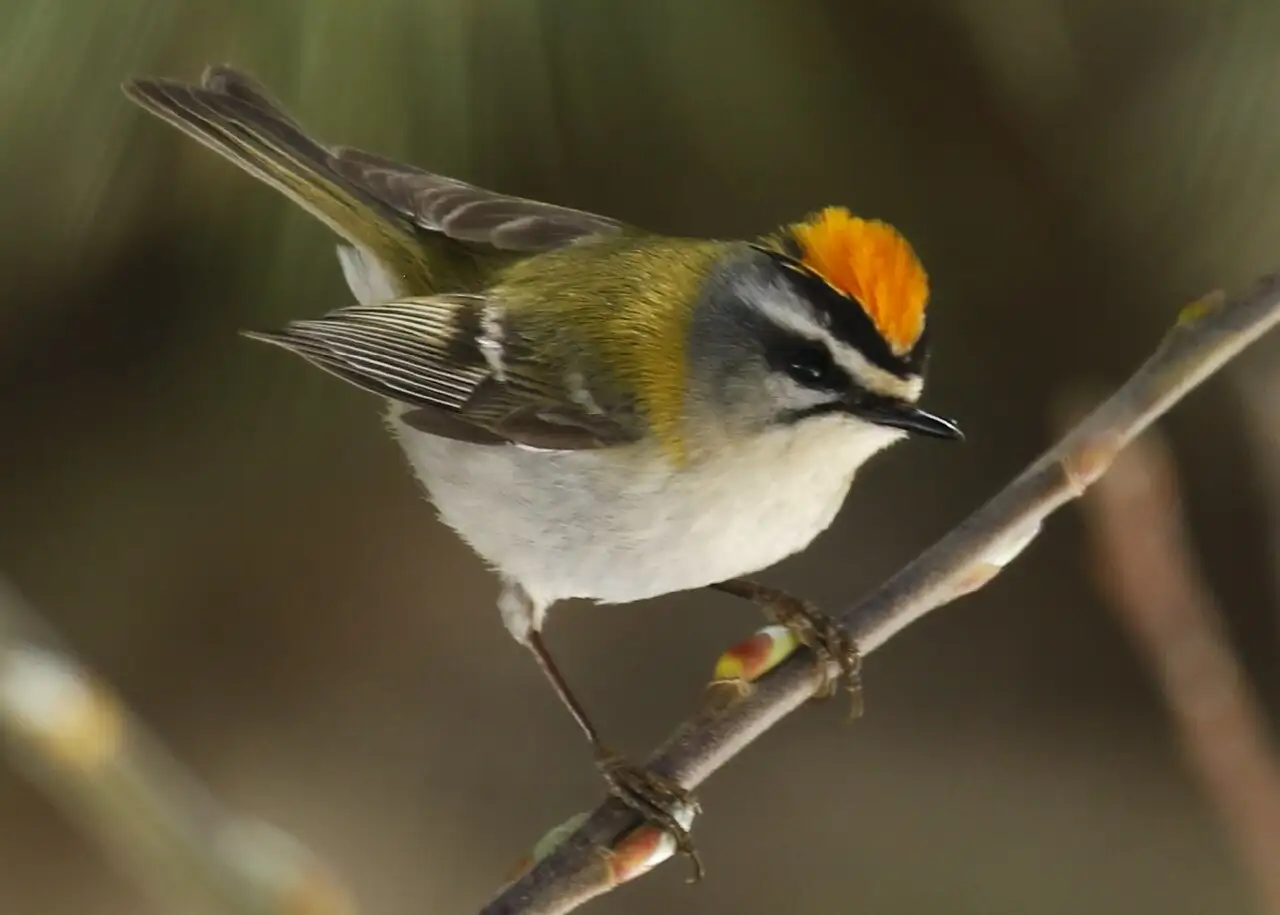
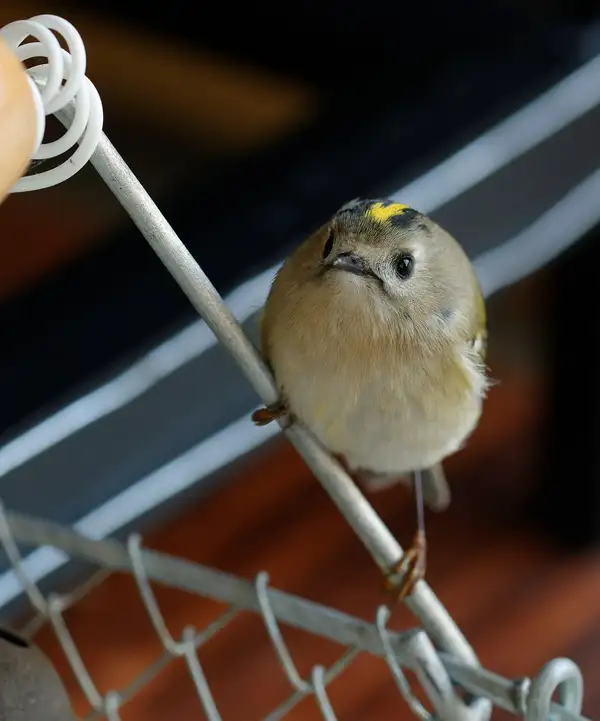
Male Common Firecrest perched on a thin branch, with orange crown, white eyebrow and black eye-stripe, green back and whitish wing barsPhoto: TonyCastro, CC BY-SA 4.0Photo 1 of 4
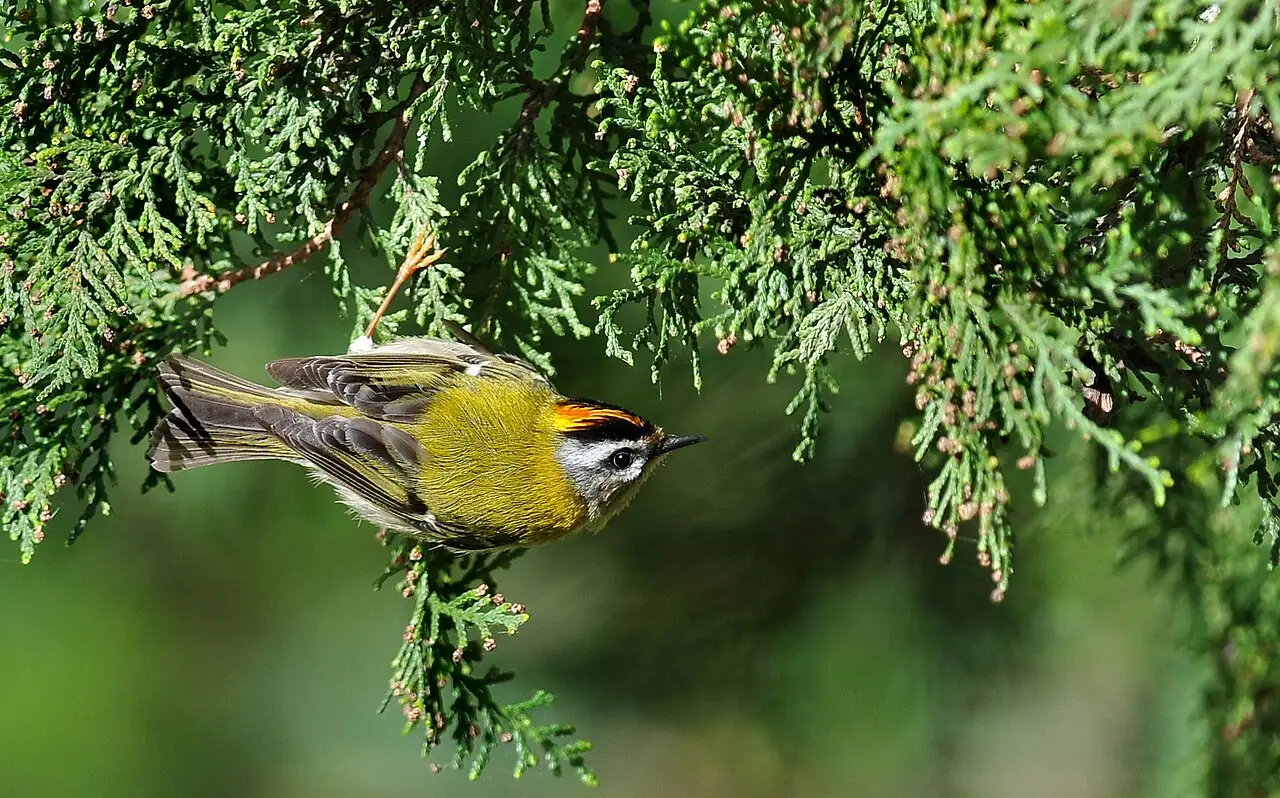
Common Firecrest among the green boughs of a conifer, in profile, with orange crown and greenish backPhoto: Olivença, CC BY-SA 3.0Photo 2 of 4
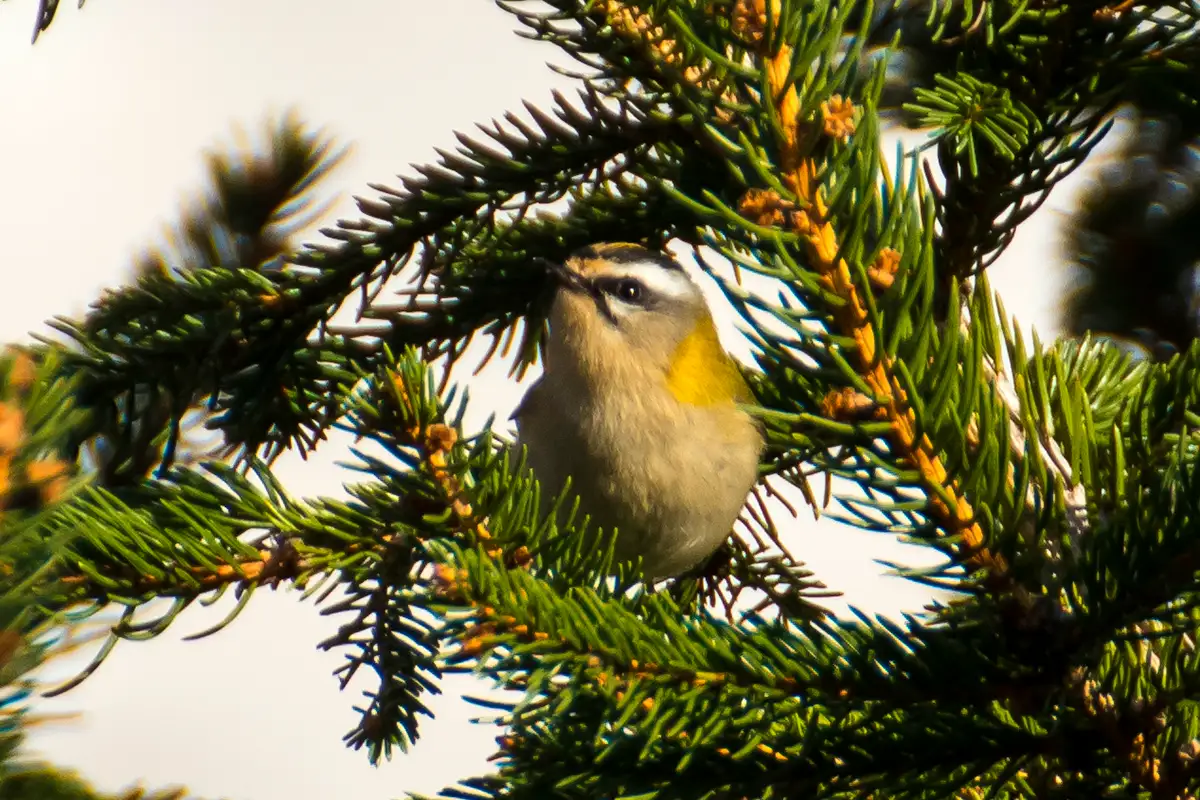
Common Firecrest among fir needles, looking upwards, with its orange crown in viewPhoto: Bene Riobó, CC BY-SA 4.0Photo 3 of 4
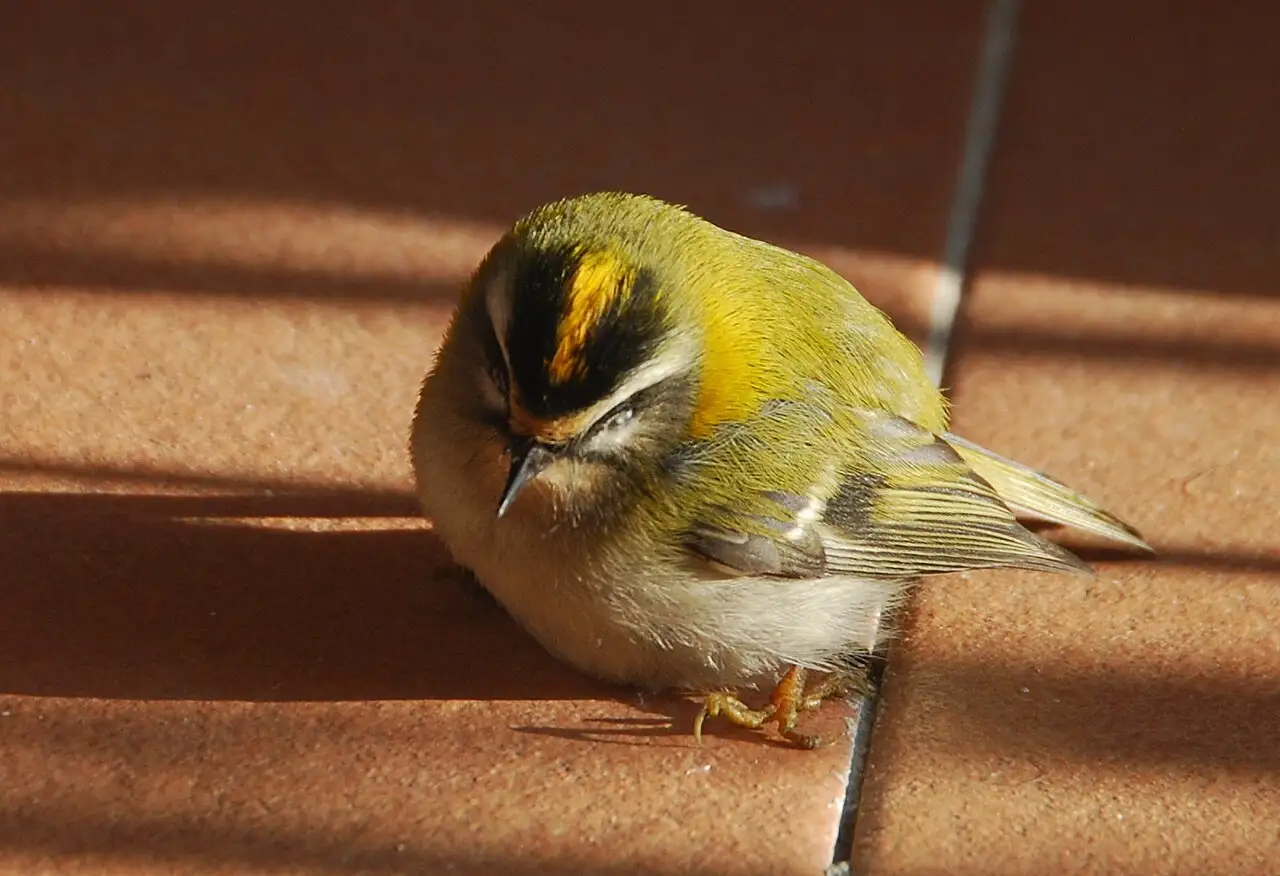
Common Firecrest perched on some orange tiles, with orange crown streaked with black and pale bellyPhoto: Ksarasola, CC BY-SA 3.0Photo 4 of 4
1 / 4
Identification of the Common Firecrest
The Common Firecrest is one of the tiniest birds of the European avifauna. At first glance it looks like a plump bird, greenish in tone, with the head adorned by a characteristic pattern of stripes. The back is bright green, contrasting with the dark wings, crossed by two whitish bars. The underparts are pale, with slight orange tones on the male’s breast. It also has a black eye-stripe and a white half-ring around the lower part of the eye.
Male
Orange crown, flanked by a black band and a marked white eyebrow.
Female
Yellow crown, with the same head pattern.
Habitat and distribution of the Common Firecrest
Its distribution is confined to the western Palearctic. It is continuous across central and southern Europe, north-west Africa and Asia Minor, and absent from northern latitudes and the far east. Several subspecies are recognised: «balearicus» lives in the Balearics and «ignicapilla» on the Peninsula.
In Spain it occurs continuously in the cool, damp parts of the northern half: Galicia, the Cantabrian Range, the Iberian System, the Basque Mountains, the Pyrenees, the Central System and other inland ranges. In the southern half it is restricted to mountain areas with damp or high-altitude woods in the interior and the south, especially in Cádiz. It is widespread in the Balearics and absent from the Canaries, Ceuta and Melilla.
It is an essentially woodland species, with a marked preference for cool, damp formations, and is common in mid-mountain woods. It lives mainly between 500 and 1,000 metres, although it reaches 2,000 in the Sierra Nevada. It occupies a wide variety of woods, but is more frequent in conifers (pine woods, juniper woods) and deciduous trees (oak woods, Portuguese oak woods, cork oak woods, riverside groves).
The Peninsula and the Balearics receive wintering birds of European origin, from partly migratory populations that spend the winter around the Mediterranean arc, and the Iberian populations move to milder areas at lower altitude. Autumn passage is detected between September and December, peaking in October, and pre-breeding passage between February and April, with the largest numbers at the end of February.
Areas where it is regularly recorded since 2010Squares of about 25 km where it is recorded regularly (occasional passage records are left out). Data from GBIF.org (214,896 records, retrieved October 2026); outline from Natural Earth.
Etymology of the Common Firecrest
According to Wikipedia, «Regulus» is a diminutive of the Latin «rex» («king») and refers to the orange or yellow crests of the adults; the epithet «ignicapilla» comes from the Latin «ignis» («fire») and «capillus» («hair»). It was described by Temminck in 1820 as «Sylvia ignicapilla». In other languages it is called «bruel» in Catalan, «estreliña riscada» in Galician, «erregetxo bekainzuria» in Basque and «common firecrest» in English1.
Population of the Common Firecrest
In the 2021 European Red List of Birds the European breeding population is estimated at between 9,120,000 and 16,300,000 mature individuals, with an increasing trend. In Spain the population is calculated at between 2,370,451 and 2,990,851 individuals, with the highest abundances in Castilla y León, Catalonia, Galicia and Aragón, and trends seem very positive in recent years, according to the SACRE programme (1998–2018). It is not considered threatened, and it may have benefited from the recovery of forest areas; it can be negatively affected by fires and by the use of insecticides against pests in woodland.
Nest of the Common Firecrest
The nest, built by the female, is a spherical, half-closed cup made of mosses and lichens, and is placed on a twig in the upper part of a tree or shrub.
Courtship and breeding of the Common Firecrest
The breeding season runs from April to July and it can lay two clutches a year. The clutch consists of 7 to 12 small eggs, white or cream with variable speckling. Incubation lasts 14–16 days and is the female’s sole responsibility. The chicks, cared for and fed by both parents, can fly at 22–24 days and become independent at about a month old.
Diet of the Common Firecrest
Its diet is based on small invertebrates, especially springtails, aphids and spiders.
Curious facts about the Common Firecrest
At nine centimetres, the crests are among the tiniest birds of our avifauna, and of the two species present in Spain the Common Firecrest is the more widespread1. EURING lists a bird ringed in Spain that lived 6 years and 2 months.
The Common Firecrest in Cabañeros
The habitat pages of this website do not mention it. GBIF.org records 69 observations of the Common Firecrest in Cabañeros and its surroundings.
Where to see the Common Firecrest in Cabañeros
In Cabañeros and its surroundings, all year round, in cool woods and groves.
When
All year; in winter birds of European origin also arrive (autumn passage from September to December and pre-breeding passage from February to April).
What time
In good light, above all when it sings.
Where
In cool, damp woods, above all of conifers and deciduous trees, including riverside groves.
What to look for
Look for the orange crown with the black band and the white eyebrow; listen for the thin note that speeds up and ends in a trill.



 Same order
 Same order
 Same order
 Same order
 Same order
 Same order
 Same order
 Same order






