Males arrive at the breeding areas before females; polygamous relationships are fairly frequent
Lifespan
Record of 13 years and 8 months in the wild (a bird ringed in Germany)
Conservation status
LC
NT
VU
EN
CR
EW
EX
Global (IUCN)
Least Concern
Spain
Least Concern (LC) in the Red Book of the Birds of Spain; included in the List of Wild Species under Special Protection and not in the Spanish Catalogue of Threatened Species
When to see it
Passage migrant
Months of the year when it is present
J
F
M
A
M
J
J
A
S
O
N
D
In Iberia
no
no
no
yes
yes
yes
yes
yes
yes
yes
no
no
Song or voice of the European Pied Flycatcher
The male’s song is a rhythmic, somewhat warbling trill, with sudden changes of pitch after a two-syllable sequence. The alarm call is a repeated, nervous, short, metallic «pik, pik, pik». The recording, from the British Library, was made at Yarner Wood (Devon, England).
SongEuropean Pied Flycatcher
0:00 / 0:25
10 kHz5
The sonogram draws the sound: time runs from left to right, and the higher a trace sits, the higher the note.Recording by British Library, Wikimedia Commons (CC BY-SA 4.0).
Flight of the European Pied Flycatcher
It is a consummate insect-eater, with great manoeuvrability in flight: it catches flying insects in the air or by launching from a perch. It is a trans-Saharan migrant, and spends the winter in the tropical regions of Africa.
Flight typeHunts insects in the air, launching from a perch
It launches itself from a branch, from where it watches for flying insects, with great manoeuvrability.
It catches the insect in the air; sometimes it takes small insects from tree leaves. Its alarm call is a short, metallic «pik».
It returns to the branch, or to another nearby, to wait for the next prey. On migration passage it is very visible and appears in woods, parks and gardens.
Photo gallery of the European Pied Flycatcher
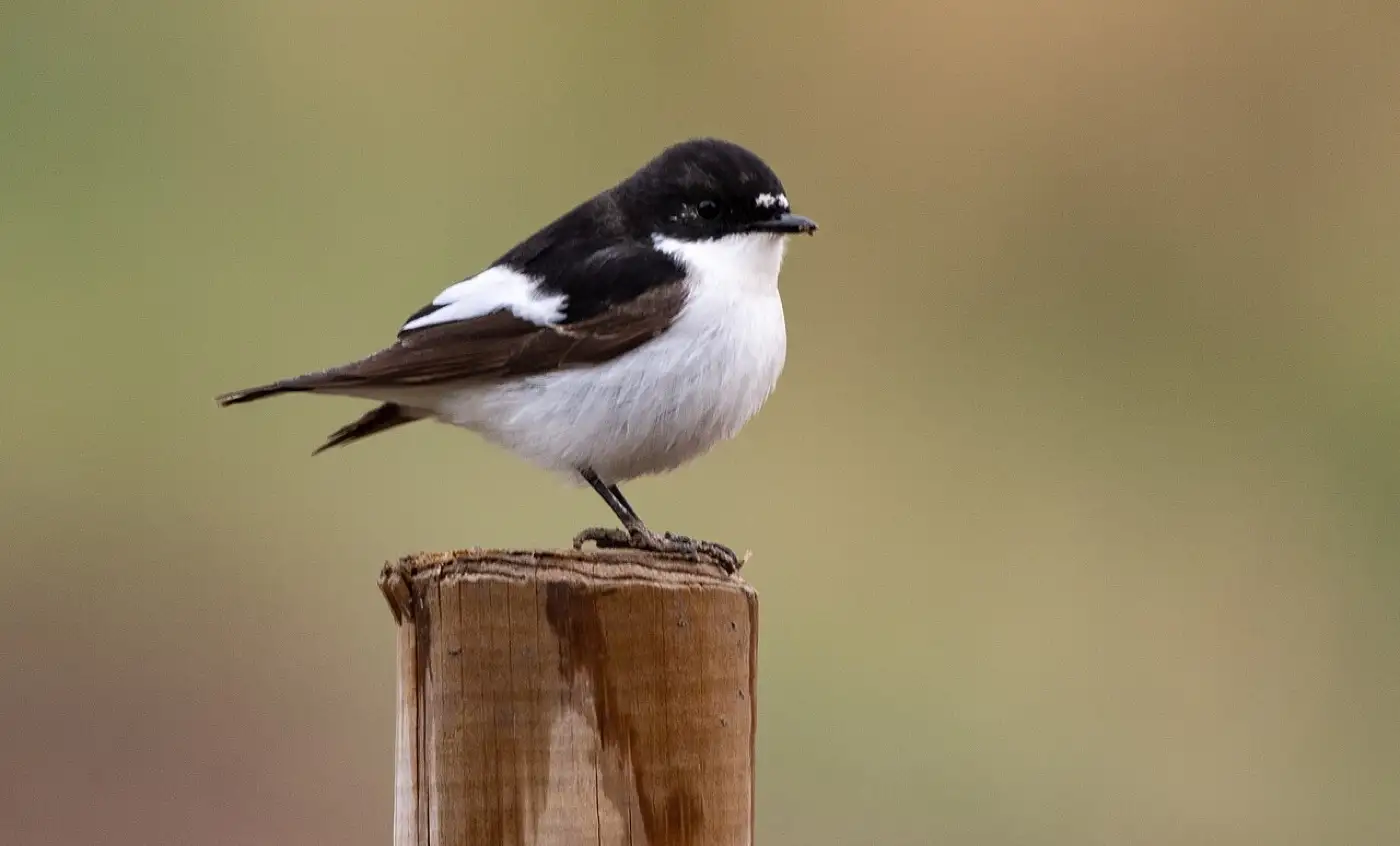
Male European Pied Flycatcher on a pole, black above and white below, with the white forehead patch and the white wing panelPhoto: Hans Ollonen, CC BY-SA 4.0Photo 1 of 4
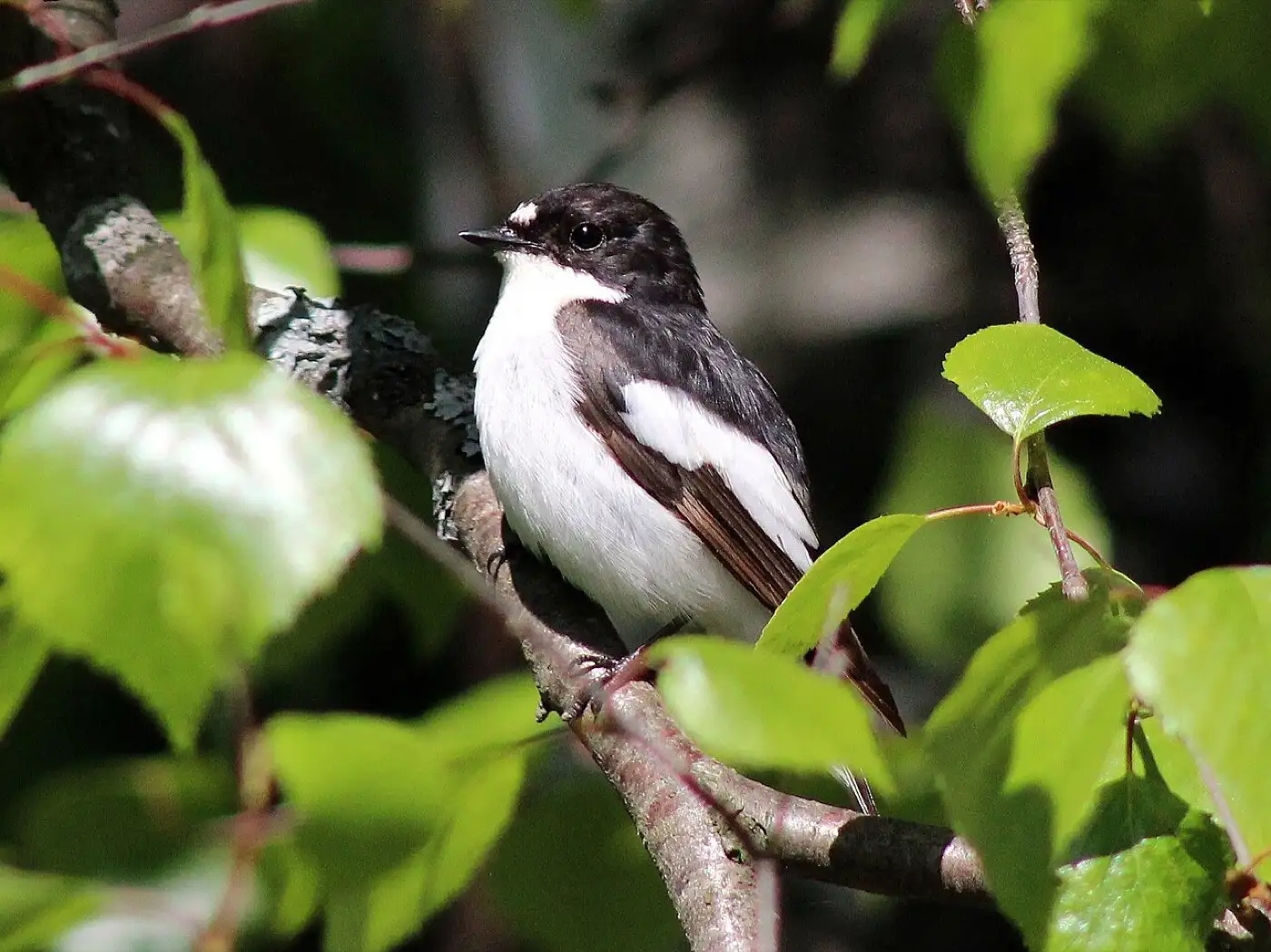
Male European Pied Flycatcher among the leaves of a birch, with white forehead and white wing panelPhoto: Estormiz, CC0Photo 2 of 4
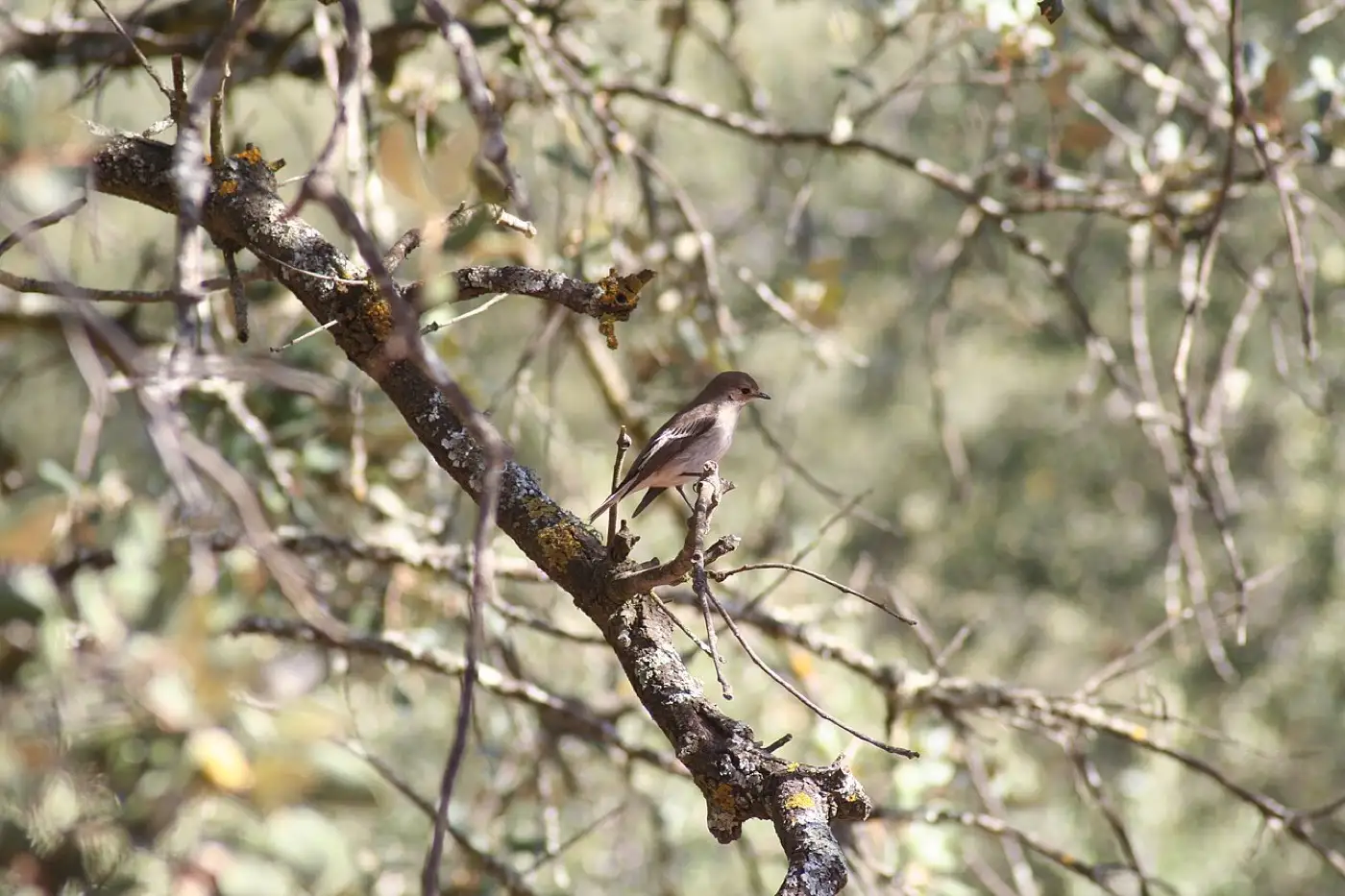
The European Pied Flycatcher is a small passerine, with a compact body, broad head and thin bill. Outside the breeding season there are no differences between the sexes in plumage: both are light brown on the back and ochre-white on the underparts, with black eyes, legs and bill.
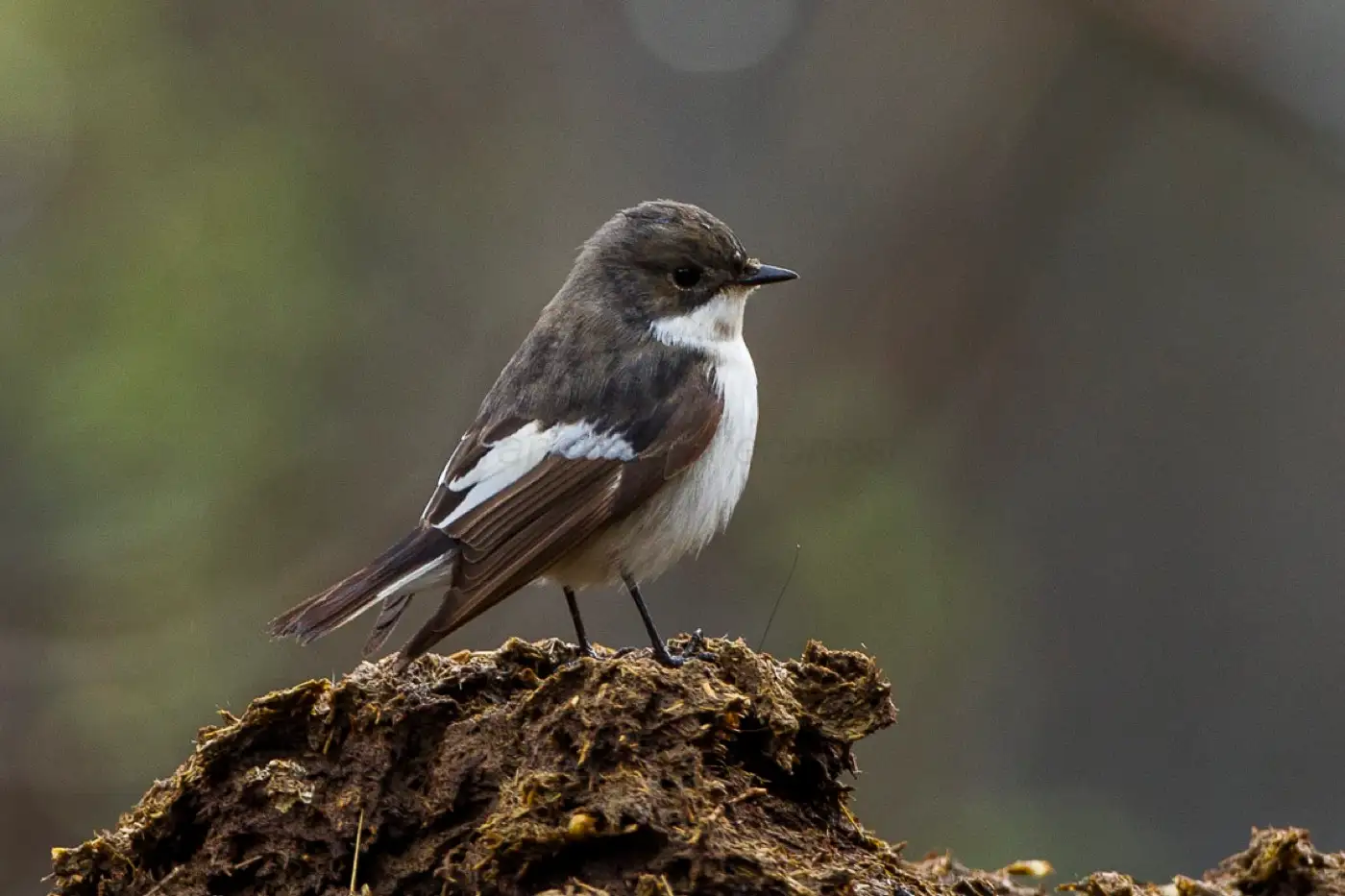
In spring, males acquire a breeding plumage black or very dark brown on the upperparts, with a striking white patch on the forehead and an extensive white panel on the wings. The underparts lighten to pure white. Some remnant of brown plumage often remains on the head or on the shoulder coverts. The female keeps the upperparts brown, lacks the white patch on the forehead and her wing panel is more discreet. Young birds just out of the nest have plumage heavily spotted with light brown and brown, with a scaly look.
Breeding male
Upperparts black or very dark brown; white patch on the forehead and extensive white panel on the wings.
Underparts pure white.
Female, non-breeding birds and young
Back brown and underparts ochre white; discreet wing panel.
Young bird heavily spotted, with a scaly look.
Habitat and distribution of the European Pied Flycatcher
The species is spread evenly across northern and central Europe and the western half of Asia. In the Mediterranean region and southern Asia it appears patchily, since it is restricted to mountain regions. Several subspecies have been described, and on the Peninsula the subspecies «iberiae» occurs.
As a breeder, in Spain it is confined to the main mountain ranges that surround the northern plateau: the Iberian System, the Central System and the Cantabrian range, with regular populations also in the Navarrese Pyrenees. Despite several observations at suitable times and places (Sierra Nevada, Sierra Morena, some areas of the Levante, Aragon or Catalonia), breeding has been confirmed only locally elsewhere. It is absent from both archipelagos, Ceuta and Melilla, where it is seen on passage. It has suffered a sharp contraction in its distribution in recent years.
It occupies preferably mature, dense woodland, above all oak woods, Scots pine woods and, to a lesser extent, closed holm oak woods. It generally breeds between 1,000 and 1,500 metres altitude, although exceptionally it exceeds 1,900. During migration passage it becomes very visible and can appear in a great variety of habitats, from the most closed woods to parks and gardens. The passage begins in September.
Areas where it is regularly recorded since 2010Squares of about 25 km where it is recorded regularly (occasional passage records are left out). Data from GBIF.org (185,526 records, retrieved October 2026); outline from Natural Earth.
Etymology of the European Pied Flycatcher
«Ficedula» is a Latin word meaning «little bird that eats figs». «Hypoleuca» comes from two Greek roots, «hypó», «under», and «leukós», «white»: the white-underneath one.
Population of the European Pied Flycatcher
In the 2021 European Red List of Birds the European breeding population is estimated at between 15,500,000 and 24,900,000 mature individuals, with a decreasing trend. For Spain there is no rigorous estimate of its population: the 1997 figures put it at 130,000–350,000 pairs, although, given the reduction of its areas and the fragmentation of population cores, they are possibly overestimated. The main threat is the loss of mature, dense woodland through inadequate forest management, which systematically removes old trees, the most suitable for nesting, and the fragmentation of the habitat by its irregular and very localised distribution. An effective measure is to put up nest boxes, which the species accepts readily.
Nest of the European Pied Flycatcher
The female makes a simple construction inside a tree hole or in a nest box. The materials are varied, such as rockrose or pine bark and dry grass.
Courtship and breeding of the European Pied Flycatcher
The breeding period begins in late April or early May, with the selection of territory by the males, who arrive at the breeding areas before the females. In the second half of May the clutch is laid, of three to seven pale blue eggs, which the female incubates for 12–14 days. The chicks are fed by both parents equally for 13–17 days, and after leaving the nest they are still fed for some time until they become independent. Polygamous relationships fairly often occur.
Diet of the European Pied Flycatcher
Its diet is made up of flying insects that it catches in the air or by launching from a perch, thanks to its great manoeuvrability in flight. Occasionally it takes small insects from tree leaves. During the autumn passage, when small fruits and insects are abundant, this website’s page on sclerophyllous forest counts it among the seasonally fruit-eating species.
Curious facts about the European Pied Flycatcher
It is a trans-Saharan migrant: they winter in the tropical regions of Africa. It readily accepts nest boxes, and putting them up is a good way of helping its populations. It is very visible on migration passage, which in autumn begins in September.
The European Pied Flycatcher in Cabañeros
This website’s page on the sclerophyllous forest speaks of its «famous migration passage» in autumn through the woods of Cabañeros, together with the Common Redstart: both are seasonally fruit-eating, while small-fruited species ripen and small insects abound. Afterwards, with the start of the olive harvest, this group is replaced by other, larger fruit-eaters, such as the thrush.
Where to see the European Pied Flycatcher in Cabañeros
In the sclerophyllous woods of Cabañeros, during the autumn passage.
When
On passage: from September, in the autumn passage; on the Peninsula it is seen from April to October.
What time
Throughout the day; it lets itself be seen hunting from the branches.
Where
In woods with small fruits and insects, and also in parks and gardens during migration.
What to look for
A little black-and-white bird, with white forehead and a white panel on the wing, which sets out from a branch to catch an insect and returns to it.
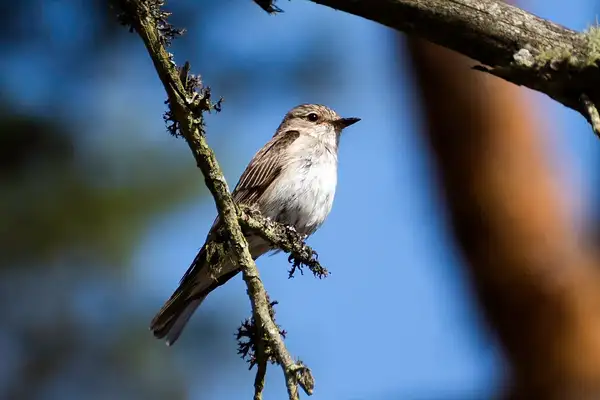
Somewhat larger than the Pied Flycatcher, with a bulky head and thin bill, with greyish tones on the back and whitish on the belly, with no striking pattern, only a faint streaking on the head, throat and breast. They are similar in appearance1.
Photo: Bene Riobó, CC BY-SA 4.0
Collared Flycatcher
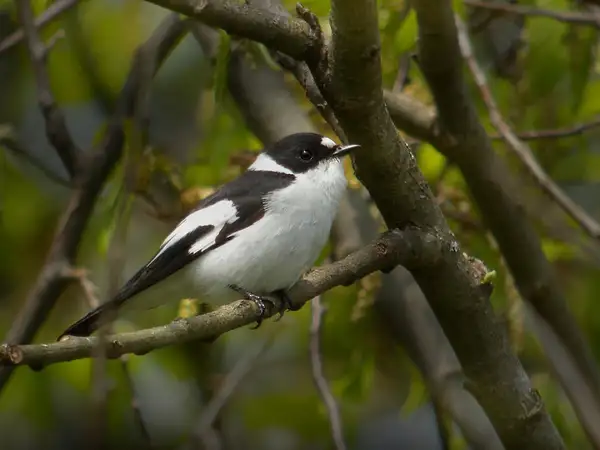
Ficedula albicollis
How to tell them apart
Very like the Pied Flycatcher, with which it sometimes hybridises. The adult male in spring plumage has a complete white collar, which extends over the back of the neck and towards the nape. In other plumages identification in the field is difficult. It is occasional in Spain.
Photo: Frank Vassen, CC BY 2.0
Other birds
Birds related to the European Pied Flycatcher or sharing its habitats in Cabañeros.



 Same family
 Same family
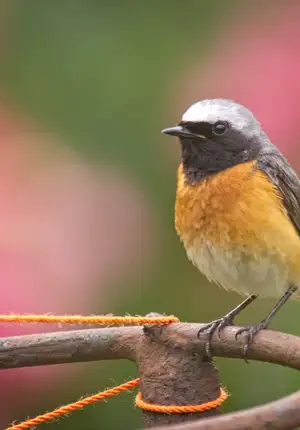 Same family
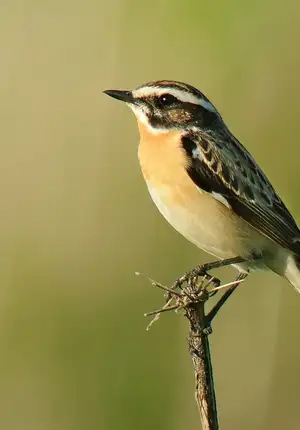 Same family
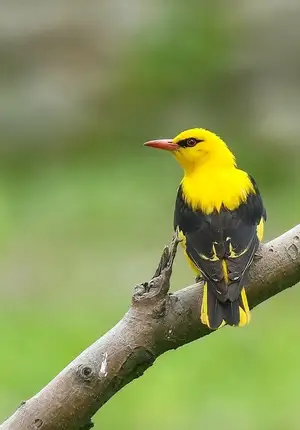 Also in sclerophyllous woodland
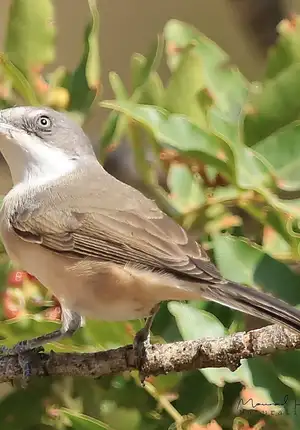 Also in sclerophyllous woodland
 Also in sclerophyllous woodland
 Also in sclerophyllous woodland






