Record of 10 years and 3 months in the wild (a bird ringed in Italy)
Conservation status
LC
NT
VU
EN
CR
EW
EX
Global (IUCN)
Least Concern
Spain
Included in the List of Wild Species under Special Protection; not in the Spanish Catalogue of Threatened Species
When to see it
Resident
Months of the year when it is present
J
F
M
A
M
J
J
A
S
O
N
D
In Iberia
yes
yes
yes
yes
yes
yes
yes
yes
yes
yes
yes
yes
Breeding season
no
no
yes
yes
no
no
no
no
no
no
no
no
Song or voice of the Short-toed Treecreeper
All year round it calls with short, thin, powerful peeps, «tuiiiiit». In spring it builds a somewhat more elaborate phrase from the same call, which it repeats non-stop as it «creeps» over the trees. It is much easier to detect by ear than by sight. Its song is also the best feature for telling it from the Eurasian Treecreeper, almost identical in size and colour but with a different call.
SongShort-toed Treecreeper
0:00 / 0:28
10 kHz5
The sonogram draws the sound: time runs from left to right, and the higher a trace sits, the higher the note.Recording by Marie-Lan Taÿ Pamart, Wikimedia Commons (CC BY-SA 4.0).
Flight of the Short-toed Treecreeper
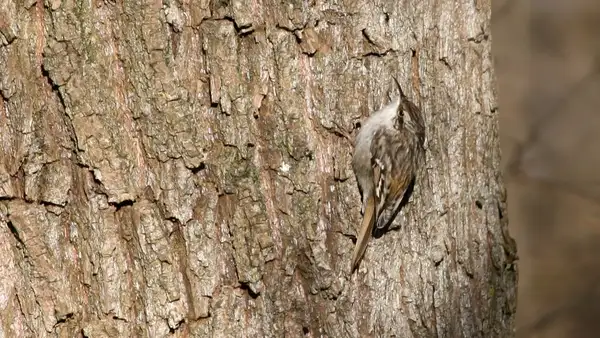
It spends much of the day pressed against the bark of trunks, and only makes short, very fast flights. It habitually climbs head upwards, propped on its long tail, whose feathers have thick shafts.
Flight typeShort, very fast and undulating, from trunk to trunk
It leaves the bark with a few quick wingbeats, after climbing head-up propped on its tail. It flies little and only over short distances.
Short, very quick, undulating flight, with rounded wings, to the base of another trunk.
It clings to the bark with its feet, props itself on its tail and starts to climb, looking for insects and spiders in the cracks.
Photo gallery of the Short-toed Treecreeper
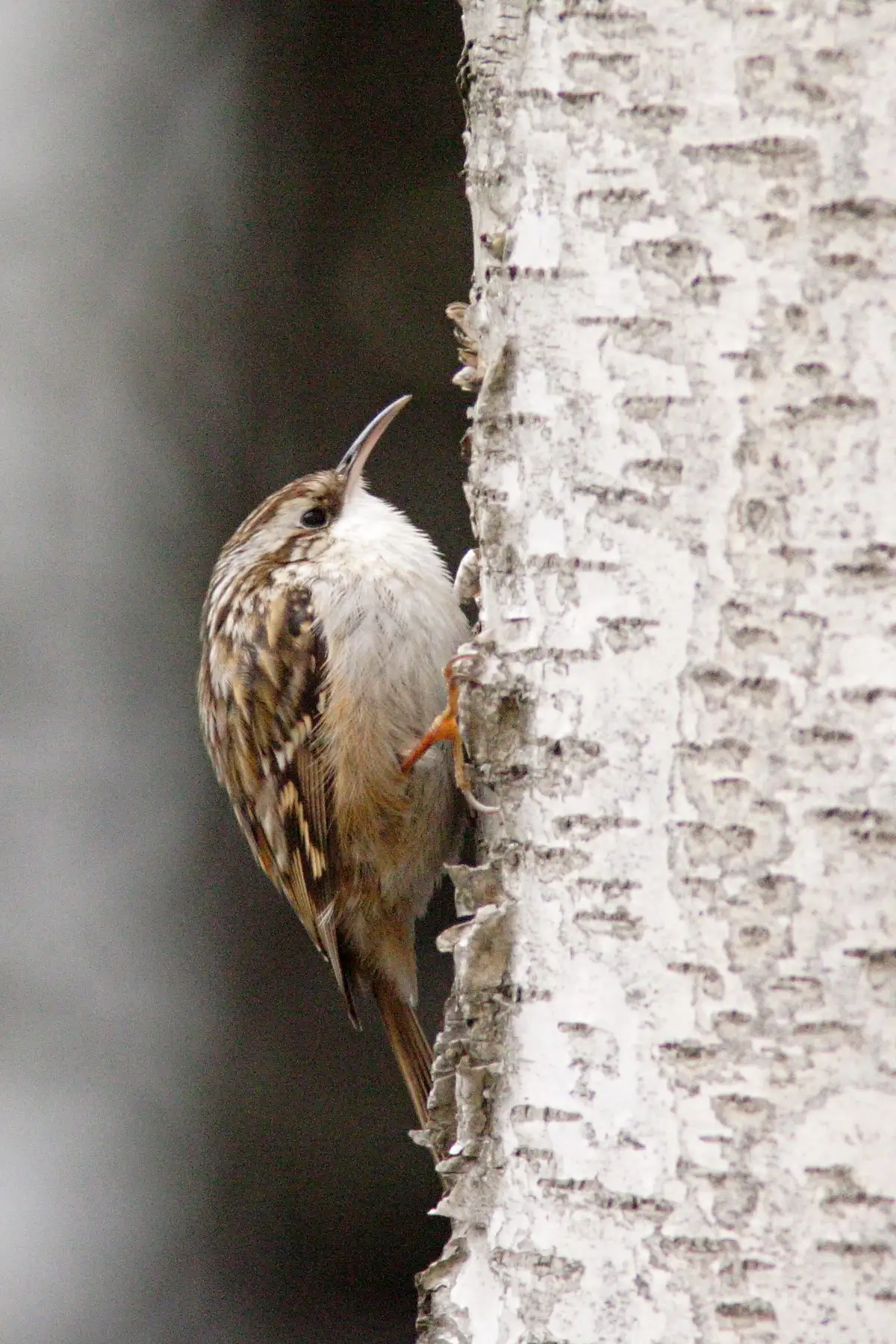
Short-toed Treecreeper climbing the pale trunk of a birch, with thin curved bill and brown-mottled backPhoto: א (Aleph), CC BY-SA 2.5Photo 1 of 4
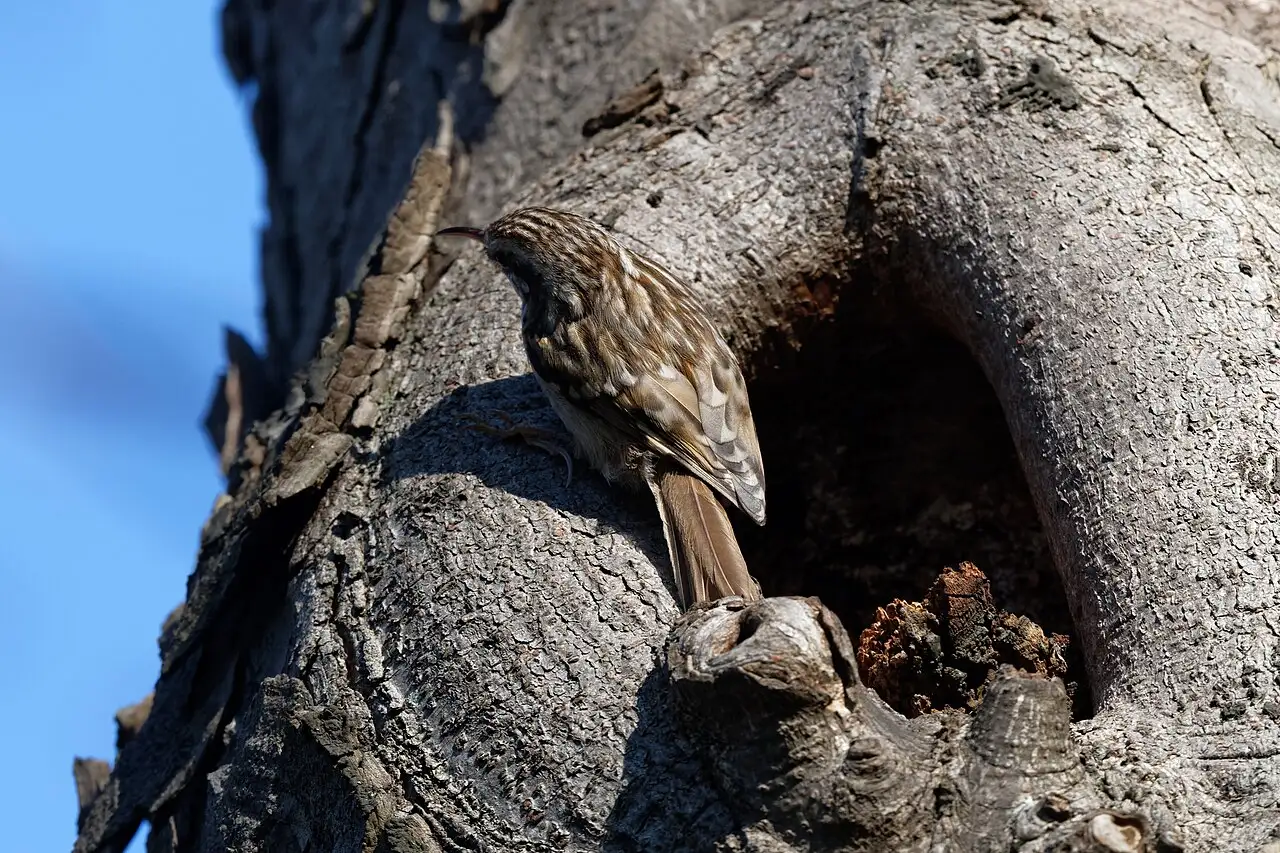
Short-toed Treecreeper coming out of a cavity in a tree trunk, its cryptic plumage blending with the barkPhoto: Marie-Lan Taÿ Pamart, CC BY 4.0Photo 3 of 4
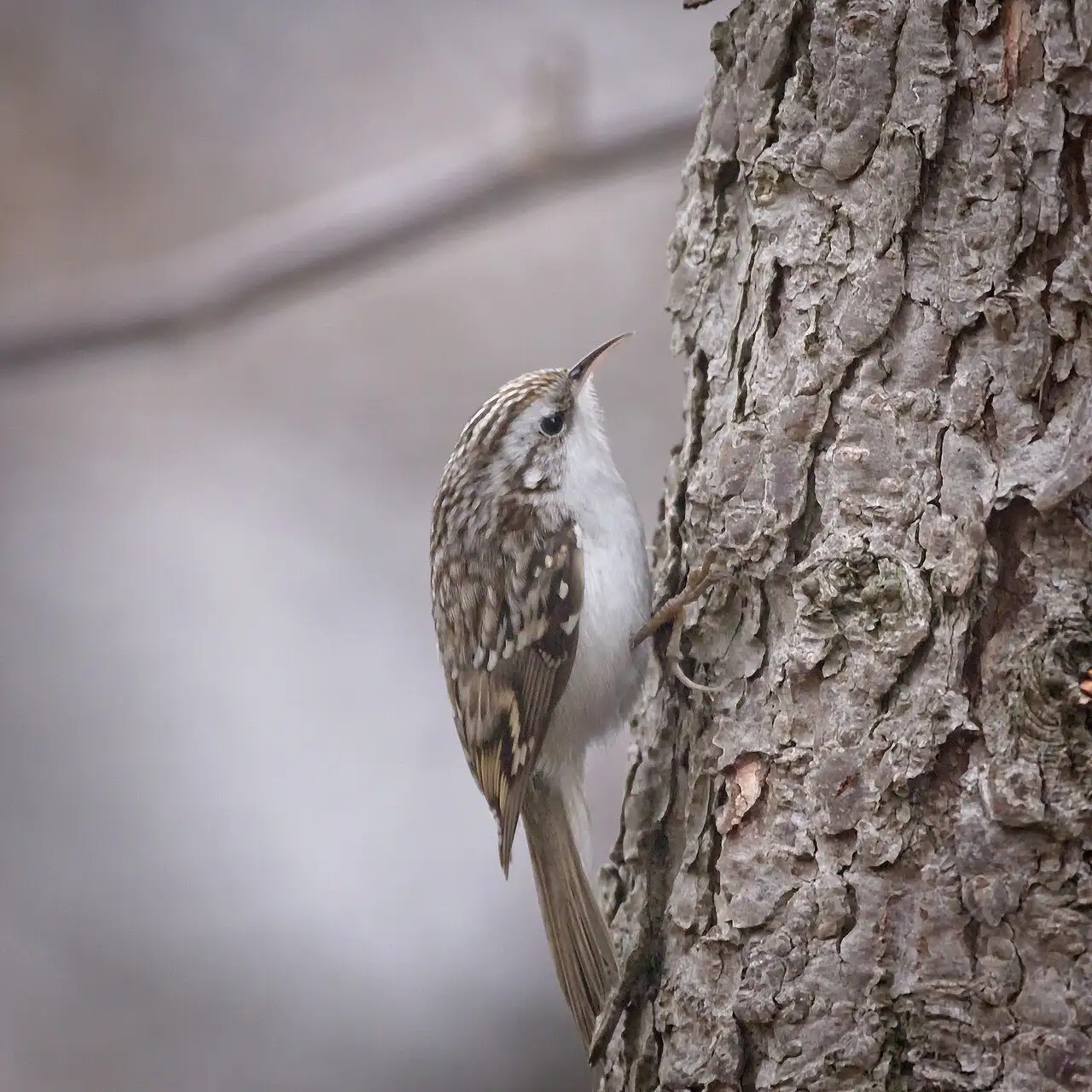
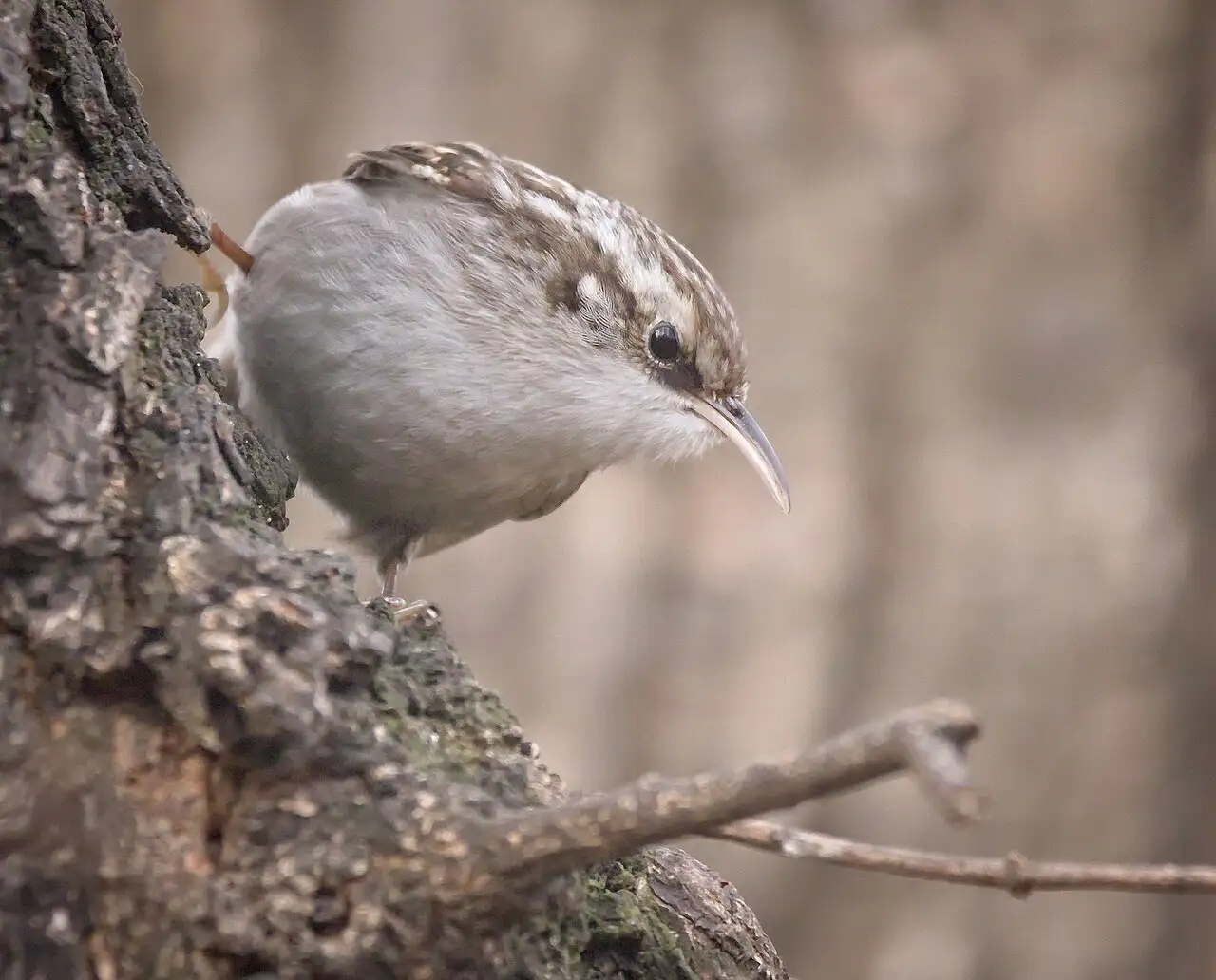
It is a tiny, insectivorous woodland bird that runs ceaselessly over tree trunks and pulls out its food with a thin, long, curved bill. Its plumage is very cryptic: the back and wings form a mosaic of browns and chestnuts of different intensity, dotted with paler grey or cream flecks, and the underparts are whitish, although they are rarely seen, because it spends the day pressed to the bark. The tail is long and brown, and its feathers have thick shafts without barbs at the tip.
Adult
Back and wings mottled with brown, chestnut and cream.
Whitish underparts; thin, long, curved bill.
Habitat and distribution of the Short-toed Treecreeper
Although it is common in Europe, it is not present in Scandinavia or Great Britain, nor in the highest areas of the Alps and other mountains. Several subspecies are described, spread across North Africa, Turkey, the eastern coast of the Black Sea and central and southern Europe.
In Spain the subspecies «brachydactyla» occupies the whole territory except the Pyrenees and almost all the Atlantic coast, where «megarhyncha» lives. It is a generalist woodland bird, quite common except where there are no trees, with the highest densities in mature pine woods and riverside woods. It is very rare or absent over wide areas of the Ebro, Guadiana, Guadalquivir, Tagus and Duero valleys, and avoids the cereal plains of the two plateaus and the arid south-east. It occupies well-developed woods, deciduous or evergreen, broadleaf or conifer, from near sea level up to 2,000 metres in the Mediterranean mountains: pine woods, holm oak woods, cork oak woods, Pyrenean oak woods, beech woods. In very dry climates it is restricted to riverside woods or shady-slope forest patches, and it prefers large mature trees, although it adapts to plantations and to large urban parks with plenty of trees. It is typically resident, with altitudinal descents in high areas when snow arrives.
Areas where it is regularly recorded since 2010Squares of about 25 km where it is recorded regularly (occasional passage records are left out). Data from GBIF.org (359,580 records, retrieved October 2026); outline from Natural Earth.
Etymology of the Short-toed Treecreeper
«Certhia» comes from the Greek «kérthios», the name of a small tree-climbing bird, and «brachydactyla» from «brachýs», «short», and «dáktylos», «toe»: «the short-toed one». The Spanish name, «agateador», alludes to the way it «gatea», or creeps, over trunks.
Population of the Short-toed Treecreeper
In the 2021 European Red List of Birds the European breeding population is estimated at between 10.1 and 16.8 million mature individuals, with an increasing trend, and the highest densities are recorded in Spain. Here a breeding population of 3,019,081 individuals is estimated, and Castilla y León, Castilla-La Mancha, Andalusia and Aragón hold 34 % of the birds. In recent years the trend has been clearly positive, possibly because of forest plantations and the abandonment of farmland, which have increased tree cover. It is classed as Least Concern. It depends on good forest management that respects the variety of tree sizes and species, and it is harmed by pesticides and the fragmentation of forest landscapes.
Nest of the Short-toed Treecreeper
The female builds the nest, with occasional help from the male. She chooses natural hollows in trunks or cracks left where bark has partly come away, and also makes use of the dense branches of raptor nests, artificial nest boxes and rock crevices. It is an irregular, loosely packed cup of dry twigs, fine roots, pine needles and bark, mixed with moss, animal fibres and grasses, and lined inside with feathers, hair and wool.
Courtship and breeding of the Short-toed Treecreeper
The breeding period starts in March and April. They may lay twice, usually six or seven white eggs, with brown and reddish spots at the broad end. The female incubates the eggs for 15 days, and the chicks, which both sexes feed, fly two or three weeks after hatching.
Diet of the Short-toed Treecreeper
It is a strict insectivore. It eats arachnids and the larvae and adults of insects, which it searches for tirelessly in the bark of trunks and branches.
Curious facts about the Short-toed Treecreeper
We almost never see it from the front: normally it is the mottled back, so like bark that it goes unnoticed. It is so easy to confuse with the Eurasian Treecreeper that only the call tells them apart with certainty, and in the Pyrenees one gives way to the other from about 1,600 metres.
The Short-toed Treecreeper in Cabañeros
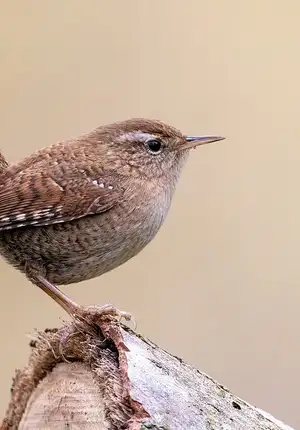
The habitat pages of this website list it in the park’s sclerophyllous woodland, among the breeding passerines of mature woodland that are insectivorous and feed in the scrub, on trunks and in crowns, together with the Great Spotted Woodpecker, Cetti’s Warbler, the Eurasian Wren, the Western Orphean Warbler and the Eurasian Golden Oriole, among others.
Where to see the Short-toed Treecreeper in Cabañeros
In the mature holm oak and cork oak woodland of Cabañeros, on the trunks of the biggest trees.
When
All year; it is resident.
What time
At any hour of the morning, but it is heard more in spring, when it sings.
Where
On the trunks of big trees, holm oaks, cork oaks and riverside trees, climbing pressed against the bark.
What to look for
A brown lump climbing the trunk, tail propped; it gives itself away with its thin peep.
Videos of the Short-toed Treecreeper
Similar species
Eurasian Treecreeper
Certhia familiaris
How to tell them apart
Extraordinarily similar, in behaviour and plumage. With plenty of experience you can see that it has paler plumage and a slightly shorter bill, but the best feature for telling it apart is the call: long, thin peeps, «chiririririrr».
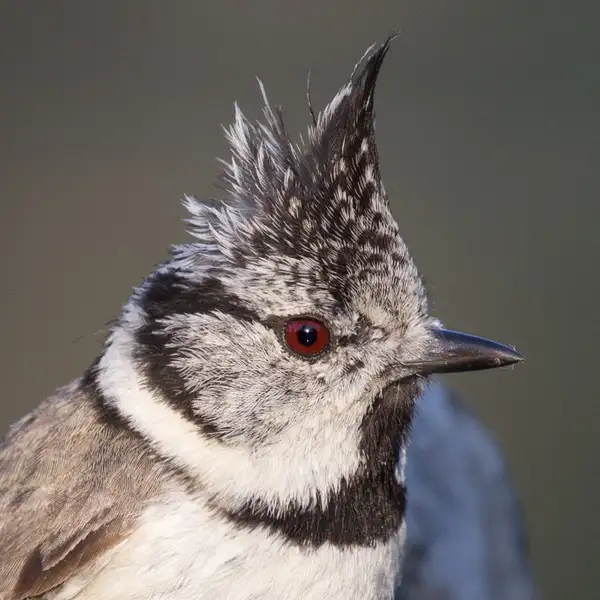
It is similar in song1. By sight there is no doubt: it has a triangular, pointed crest of black and white feathers and a face with black and white bands.
Photo: Carlos Delgado, CC BY-SA 4.0
Other birds
Birds related to the Short-toed Treecreeper or sharing its habitats in Cabañeros.



 Also in sclerophyllous woodland
 Also in sclerophyllous woodland
 Also in sclerophyllous woodland
 Also in sclerophyllous woodland
 Also in sclerophyllous woodland
 Also in sclerophyllous woodland
 Also in sclerophyllous woodland
 Also in sclerophyllous woodland






