Solitary and very territorial: it defends its patch both in the breeding season and in winter
Lifespan
Record of some 19 years in the wild
Conservation status
LC
NT
VU
EN
CR
EW
EX
Global (IUCN)
Least Concern
Spain
Included in the List of Wild Species under Special Protection; not in the Spanish Catalogue of Threatened Species
When to see it
Resident
Months of the year when it is present
J
F
M
A
M
J
J
A
S
O
N
D
In Iberia
yes
yes
yes
yes
yes
yes
yes
yes
yes
yes
yes
yes
Breeding season
no
no
yes
yes
yes
yes
yes
no
no
no
no
no
Song or voice of the European Robin
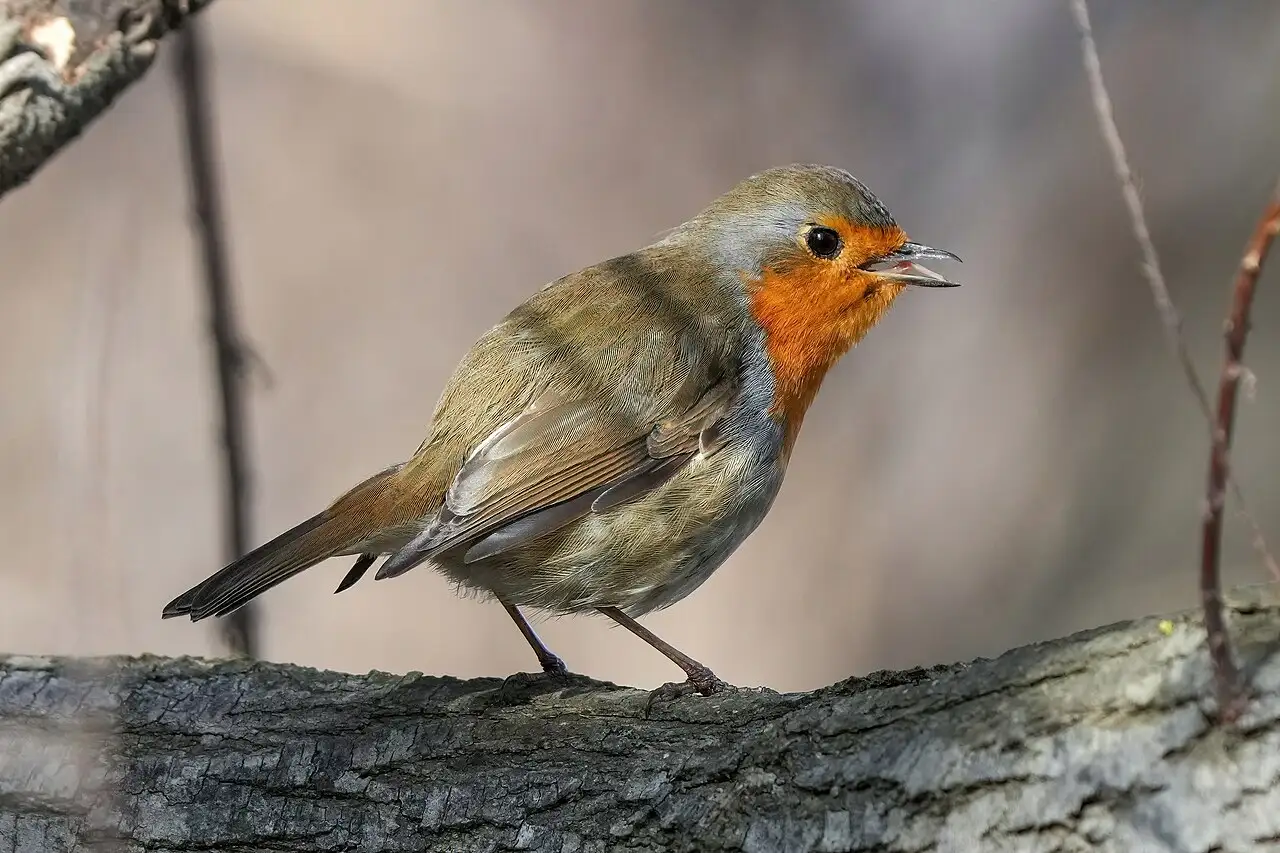
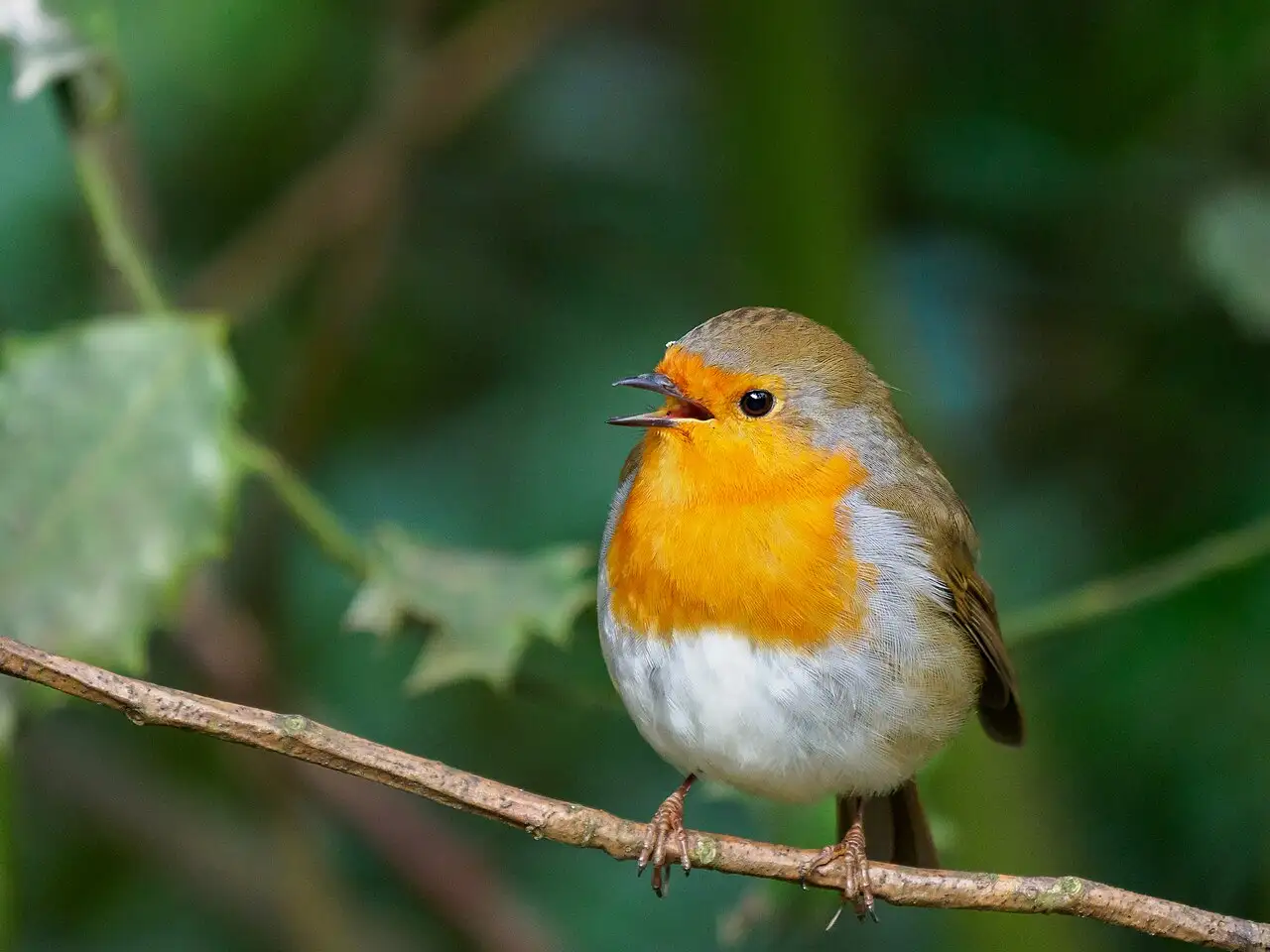
A dry call, «tac, tac», which it repeats at times, and a melodious, flowing song, made of phrases that rise and fall and that changes pitch from one to the next. It sings all day, but above all very early, before dawn, and it does so in winter too, because the fight for territory never ends.
SongEuropean Robin
0:00 / 0:24
10 kHz5
The sonogram draws the sound: time runs from left to right, and the higher a trace sits, the higher the note.Recording by Zdeněk Vermouzek, Wikimedia Commons (CC BY-SA 4.0).
Flight of the European Robin
It flies little and always near the ground, in short bursts with buzzing wingbeats and a slight rocking, from bush to bush. In the air the red of the breast is barely seen; the best thing is to wait for it perched, where it stays flicking its tail and making little bows.
Flight typeShort, low and with buzzing wingbeats
It leaves the low branch with a quick flutter. From it it watches the ground and comes down for whatever the wild boar or the gardener turns up.
Short, low flight, with buzzing wingbeats and a slight rocking, between bushes and low branches. In the air the red of the breast is barely seen.
It brakes with its tail spread and grips a low branch, where it stays flicking its tail and making little bows.
Photo gallery of the European Robin
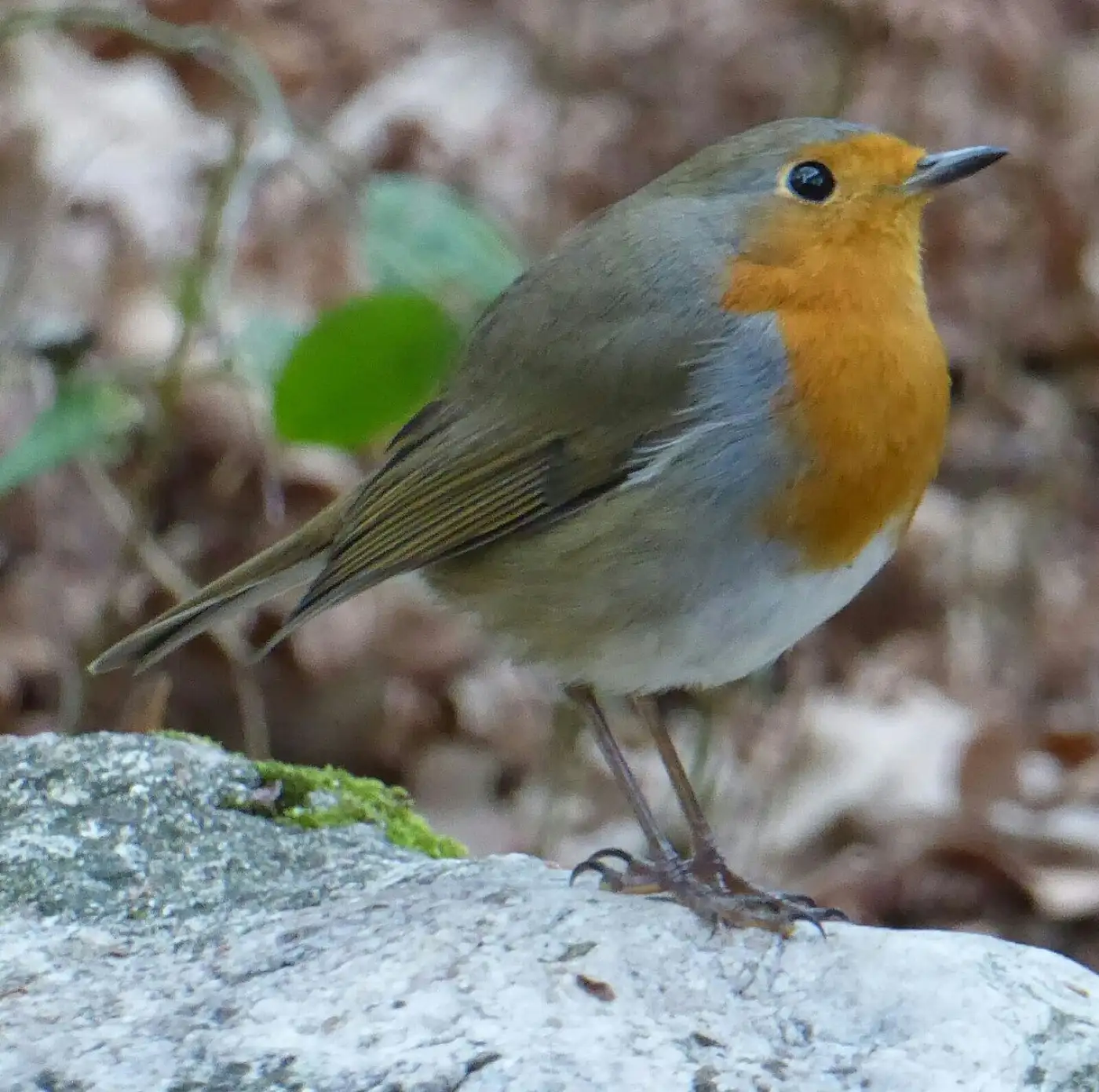
European Robin perched on a rock, in profile: orange face and breast, greenish-brown back and pale bellyPhoto: Joxemai, CC BY-SA 4.0Photo 1 of 4
European Robin singing with open bill, perched on a thick branchPhoto: Giles Laurent, CC BY-SA 4.0Photo 2 of 4
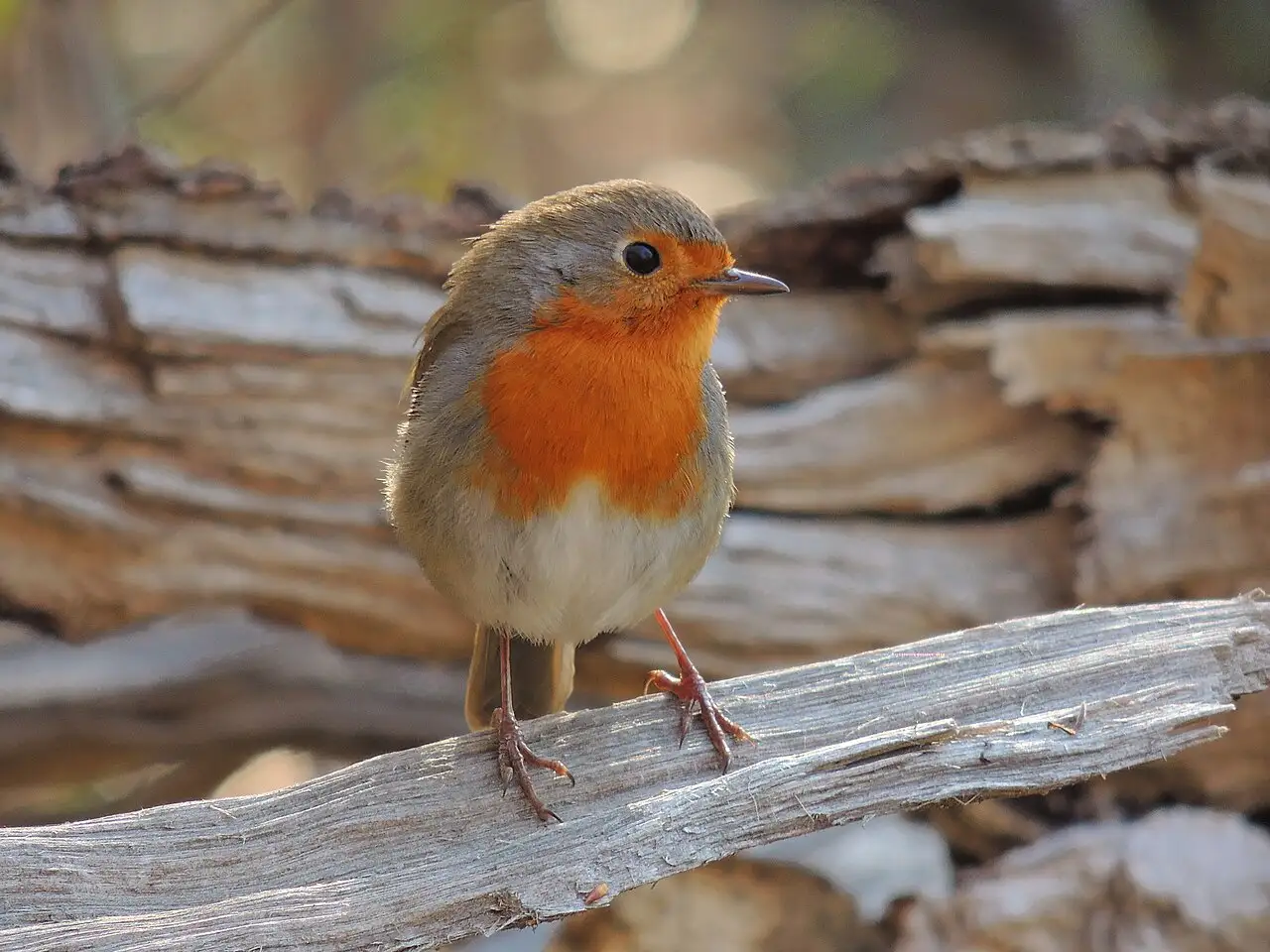
European Robin from the front, on an old trunk, with orange breast and white bellyPhoto: xulescu_g, CC BY-SA 2.0Photo 3 of 4
European Robin singing among the foliage, with a very vivid orange breastPhoto: JoachimKohler-HB, CC BY-SA 4.0Photo 4 of 4
1 / 4
Identification of the European Robin
It is a little bird of stocky build, which in winter puffs up its feathers to form a layer of warm air. Males and females are alike. What gives it away is the broad orange patch on the face, throat and breast, edged by a subtle grey band. The rest of the plumage is unshowy.
Adult
Face, throat and breast an intense orange, with a greyish border.
Back and wings greenish brown; belly dirty white.
Large, dark eye and thin bill.
Young bird
Without the orange on the breast: brown plumage speckled with yellowish spots.
The orange appears after the partial moult of late summer.
Habitat and distribution of the European Robin
It lives across the whole of Europe, on the Atlantic islands and in North Africa, and reaches through Asia as far as the Urals and the Caspian Sea. The populations of northern Europe are migratory; those of the Atlantic islands, western Europe and North Africa are sedentary.
In Spain it changes place according to the season. In winter it is very common across the whole Peninsula and avoids only the cold mountains, because our robins are joined by many arrived from central and northern Europe. In spring it concentrates in the north and moves south along the mountains, among them the Montes de Toledo and the Villuercas, and along riverside woods. It breeds in the southern half in riverside and mountain woods, and in winter it abounds in Mediterranean scrub rich in shrubs with fleshy fruits.
Areas where it is regularly recorded since 2010Squares of about 25 km where it is recorded regularly (occasional passage records are left out). Data from GBIF.org (992,564 records, retrieved October 2026); outline from Natural Earth.
Etymology of the European Robin
«Erithacus» comes from Greek «erithakos», the ancient name of a bird already cited in antiquity, and «rubecula» is the Latin diminutive of «rubeus», «reddish». It is therefore «the little reddish bird». «Petirrojo» says the same in Spanish: «red breast».
Population of the European Robin
In Spain there are some 7.1 million individuals, with wide representation in all the autonomous communities, although the highest figures are in the northern third. The trend is positive, probably through the abandonment of crops and the reforestation that follows rural abandonment. In Europe between 109 and 168 million mature individuals are estimated, and growing. It is classified as Least Concern. Like other insect-eaters, it suffers from chemical treatments against competing vegetation in olive groves, a very favourable wintering habitat for millions of birds.
Nest of the European Robin
It places it near the ground, in a natural hollow or at the base of a shrub or a tree. It is a cup of leaf litter, grasses and mosses, with the inside lined with very fine rootlets, hair and feathers.
Courtship and breeding of the European Robin
Northern or mountain populations raise one brood, and the rest make two. It may begin breeding between March and May and finishes in June or July. The female lays four to six eggs, sometimes two to eight, bluish white and with spots. She incubates them alone for 12 to 15 days and the male feeds her meanwhile. Afterwards, both care for the chicks for another 12 to 15 days in the nest, and the male goes on tending them even when the female has already started the second clutch.
Diet of the European Robin
It is insect-eating: it eats ants, beetles and spiders, which it looks for on the ground. In autumn and winter it completes its diet with fruits of bramble, elderberry, mastic, olive and wild olive, and even with the acorns that nuthatches and Great Tits break open.
Curious facts about the European Robin
It is aggressive, with its own kind and with other birds, and not only in the breeding season: in winter pairs separate and each robin defends its own territory. That is why its song does not die away in autumn. And through the Strait of Gibraltar every autumn and every spring pass the robins that winter south of the Sahara.
The European Robin in Cabañeros
The habitat pages of this website cite it among the birds of the sclerophyllous and deciduous forest. In winter, in the mature scrub, it is one of the birds that base their diet on insects from the bark and leaf litter and come to depend on the fruits of bramble, mock privet, laurustinus, wild service tree, myrtle, mastic, wild olive and strawberry tree.
Where to see the European Robin in Cabañeros
In the Mediterranean scrub and on the banks, above all in autumn and winter, when it abounds in shrubs with fruit.
When
All year round. In winter it is much easier, because ours are joined by those arrived from the north.
What time
At dawn, even before the sun comes up, which is when it sings most.
Where
In the bushes and low trunks of the scrub and the banks, at ground level, where it looks for insects among the leaf litter.
What to look for
A round, brown little bird, with intense orange breast and face, which stays perched and makes bows.
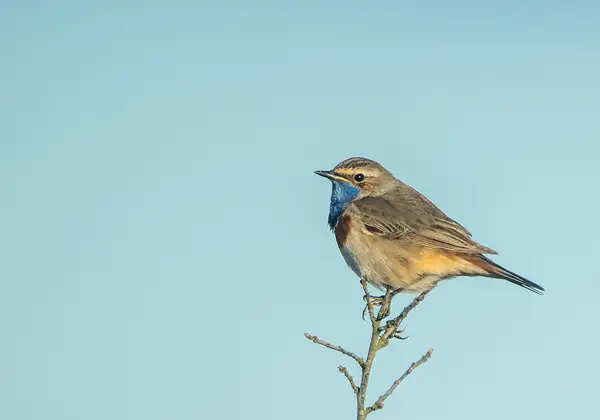
It has a blue throat with an orange or white spot, a pale eyebrow and the tail with a reddish base. It is a scarce and very discreet winter visitor, of scrub and rush beds.
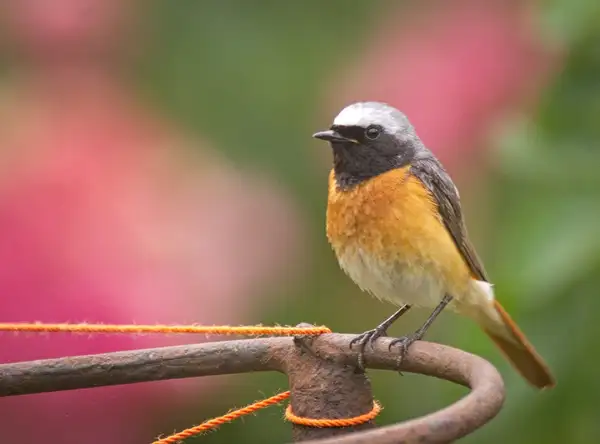
The male also has an orange breast, but has a black face, white forehead and a bright red tail, which he shakes non-stop. It passes through Cabañeros in autumn.
Photo: hedera.baltica from Wrocław, Poland, CC BY-SA 2.0
Other birds
Birds related to the European Robin or sharing its habitats in Cabañeros.



 Same family
 Same family
 Same family
 Same family
 Also in sclerophyllous woodland
 Also in sclerophyllous woodland
 Also in sclerophyllous woodland
 Also in sclerophyllous woodland





