Both parents look after the chicks, which become independent at 30 days
Lifespan
Record of 6 years and 11 months in the wild according to EURING (a bird ringed in Germany); AnAge gives 6.9 years
Conservation status
LC
NT
VU
EN
CR
EW
EX
Global (IUCN)
Least Concern
Spain
Data Deficient (DD) as a breeder in the Red List of the Birds of Spain; it is on the List of Wild Species under Special Protection, but not in the Spanish Catalogue of Threatened Species
When to see it
Summer visitor
Months of the year when it is present
J
F
M
A
M
J
J
A
S
O
N
D
In Iberia
no
no
yes
yes
yes
yes
yes
yes
yes
yes
no
no
Breeding season
no
no
no
yes
yes
yes
yes
no
no
no
no
no
Song or voice of the Whinchat
Its song, varied and melodious, is a quick series of short verses mixing warbles and accelerated trills, and sometimes it imitates other birds. The call is a «tec-tec», similar to that of other chats.
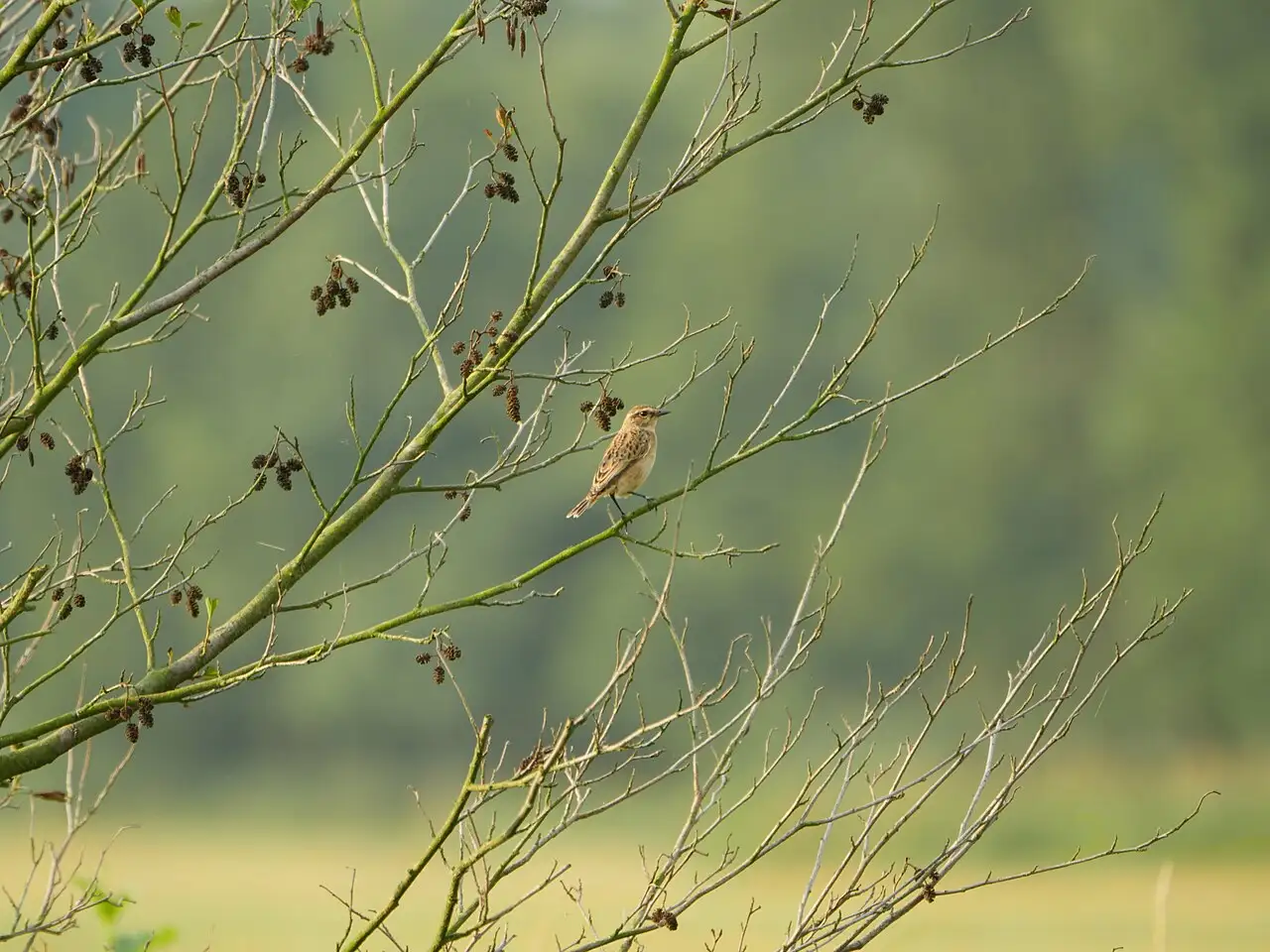
Female Whinchat, in paler colours, perched among the branches of a treePhoto: Membeth, CC0Photo 4 of 4
1 / 4
Identification of the Whinchat
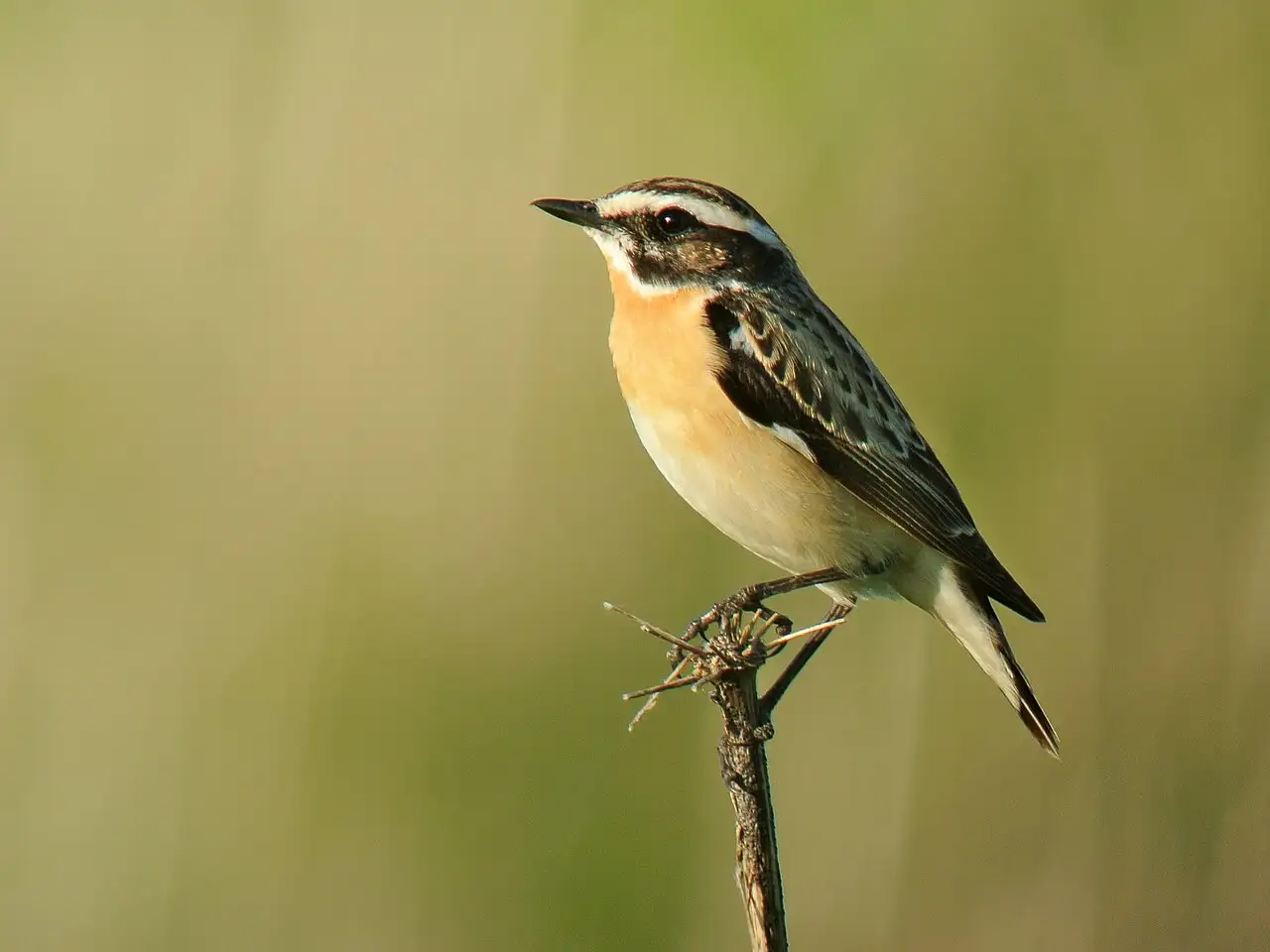
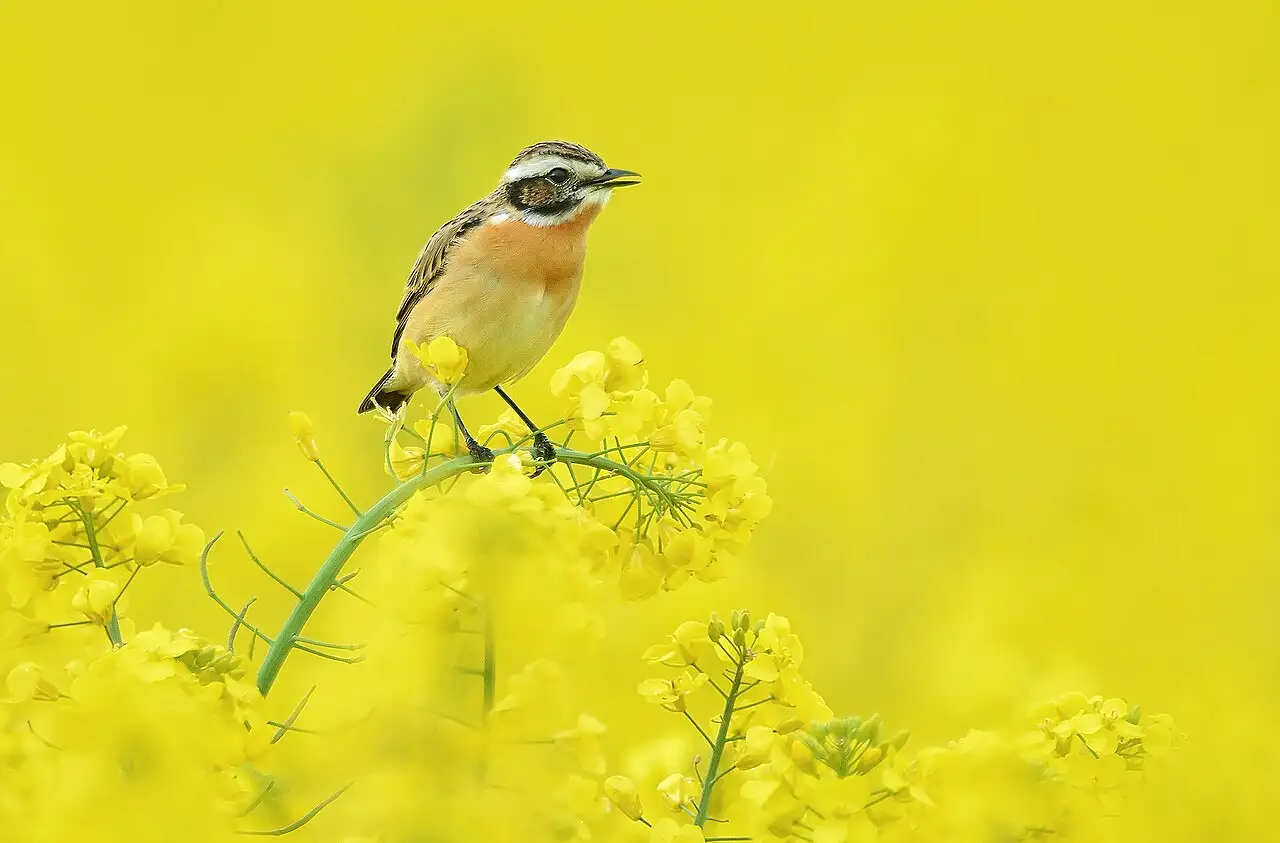
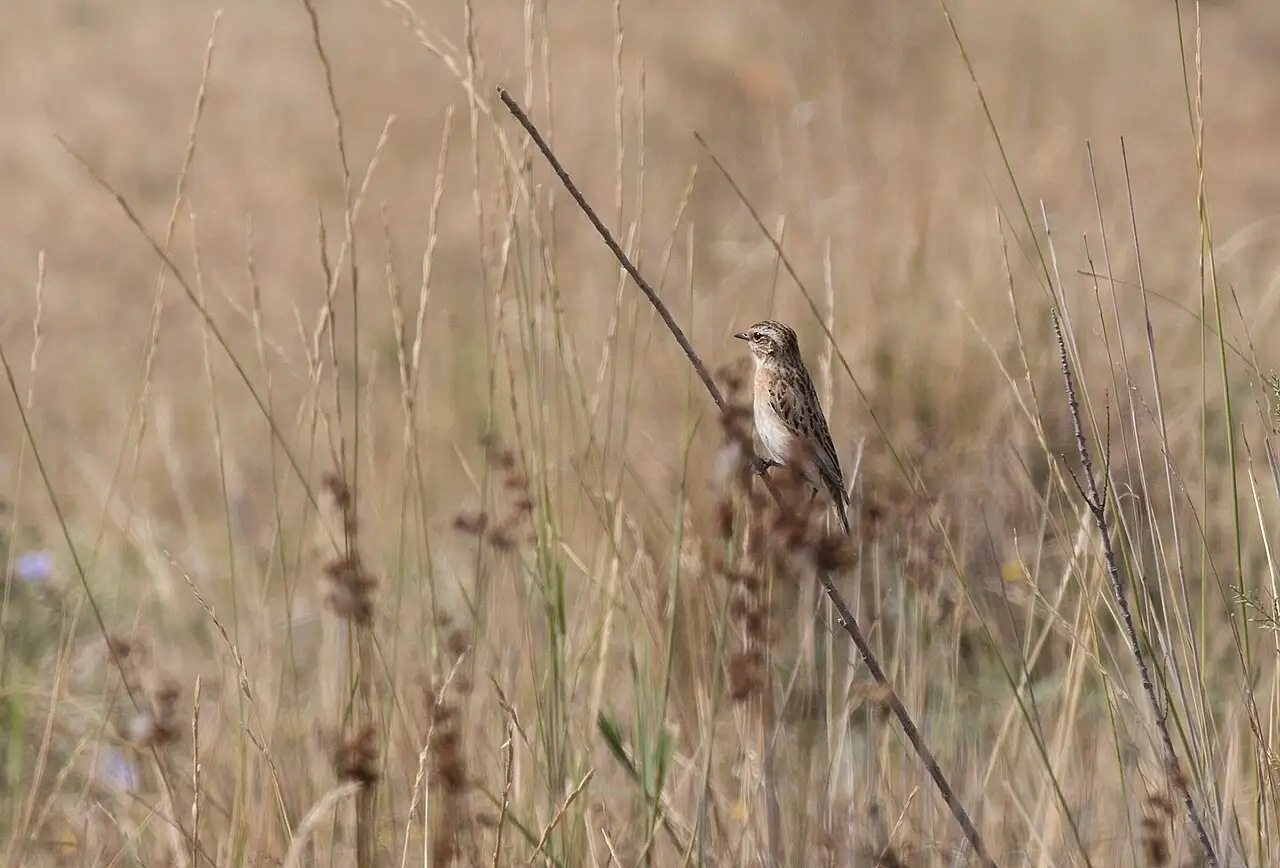
The Whinchat is a small, compact-looking bird, similar to the Stonechat, but with a pale throat, a white eyebrow and a white tail with a broad black band at the tip. The males are showier than the females: they have the throat, breast and flanks a reddish orange and the crown and cheeks darker. Females usually have a paler, less intense and less contrasting colouring.
Adult
Male: white eyebrow, dark cheeks and crown, orange throat, breast and flanks.
Female: paler and less contrasting.
White tail with a broad black terminal band.
Habitat and distribution of the Whinchat
It is widely distributed across the temperate and boreal latitudes of the western Palearctic, as far as the Urals and the Far East. In southern Europe it is more localised and scattered. It has no subspecies.
As a breeder it occupies two areas in Spain: one running from Galicia to the Basque Country, always away from the coast and with its southern limit in the Sierra de Guadarrama, and another in the Pyrenees, between Huesca and Girona. On migration it can be seen throughout the Peninsula and the Balearics.
It prefers open areas, such as pastures, heathland or mosaics of meadows and hedges, and is relatively frequent in the Cantabrian mid-mountains.
It is a trans-Saharan migrant that winters mostly in tropical Africa, although exceptionally it does so in North Africa and at a few points in the south of the Peninsula. Spring passage runs from March to June, and autumn passage from August to October, peaking in September.
Areas where it is regularly recorded since 2010Squares of about 25 km where it is recorded regularly (occasional passage records are left out). Data from GBIF.org (42,341 records, retrieved October 2026); outline from Natural Earth.
Etymology of the Whinchat
According to Wikipedia, the scientific name means «little dweller among the rocks»: «Saxicola» joins the Latin «saxum», «rock», and «incola», «inhabitant», and «rubetra» is a Latin word for a little bird. In other languages it is called «bitxac rogenc» in Catalan, «chasco norteño» in Galician, «pitxartxar nabarra» in Basque and «whinchat» in English1.
Population of the Whinchat
In the 2021 European Red List of Birds the European breeding population is estimated at between 12,900,000 and 21,400,000 mature individuals, with a decreasing trend. The Spanish one stands at 54,208 individuals, most of them in the mid-mountains of Castilla y León, although its range has shrunk a great deal; the data do not allow a clear trend to be established, which is why the Red Book lists it as «Data Deficient».
Its main threats are the alteration of its breeding habitat by the ploughing of pastures and damp meadows and the «scrubbing over» of the hills through the abandonment of traditional livestock farming and forestry plantations.
Nest of the Whinchat
It builds it on the ground, well hidden among the vegetation: a small cup of grasses and moss, interwoven with hair and other fine materials.
Courtship and breeding of the Whinchat
The breeding period runs from April to July, with one clutch a year and occasionally two. It lays two to seven bluish eggs, finely speckled with reddish brown, which the female incubates for 12–15 days. The chicks, looked after by both parents, fly at 17–19 days and are fully independent at 30.
Diet of the Whinchat
It feeds mostly on invertebrates and, to a lesser extent, on berries in autumn.
Curious facts about the Whinchat
It sometimes includes imitations of other birds in its song1. EURING lists a Whinchat ringed in Germany that lived 6 years and 11 months.
The Whinchat in Cabañeros
The habitat pages of this website do not mention it, and we have found no other published source about it in the Park. It does not breed in this part of the Peninsula, but on migration it can be seen throughout it1. GBIF.org records 31 observations of the Whinchat in Cabañeros and its surroundings.
Where to see the Whinchat in Cabañeros
In Cabañeros and its surroundings, on spring and autumn passage, on pastures and open areas with scrub.
When
On passage: from March to June and, above all, from August to October, peaking in September.
What time
By day, in open areas with scrub and hedges.
Where
In open areas: pastures, heathland and mosaics of meadows and hedges.
What to look for
Look for the white eyebrow and the orange breast, and the white tail with the black band when it flies.
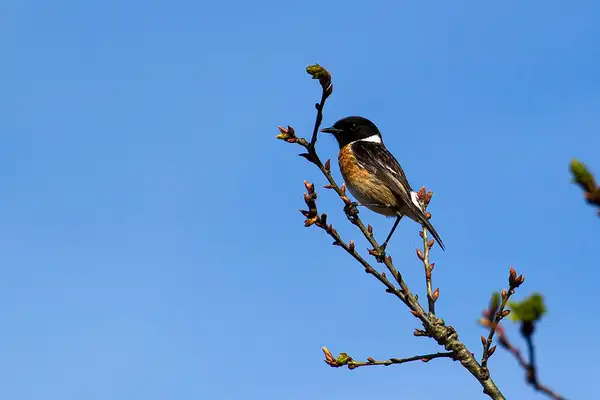
It is similar in song and physical appearance. It appears under the name European Stonechat1. The Whinchat has a pale throat, a white eyebrow and a white tail with a broad black band.



 Same family
 Same family
 Same family
 Same family
 Same order
 Same order
 Same order
 Same order






