A fluty, penetrating, long-range whistle, in short phrases that alternate with guttural notes. The call, by contrast, is harsh and tense, like the Jay’s.
SongEurasian Golden Oriole
0:00 / 0:36
10 kHz5
The sonogram draws the sound: time runs from left to right, and the higher a trace sits, the higher the note.
Flight of the Eurasian Golden Oriole
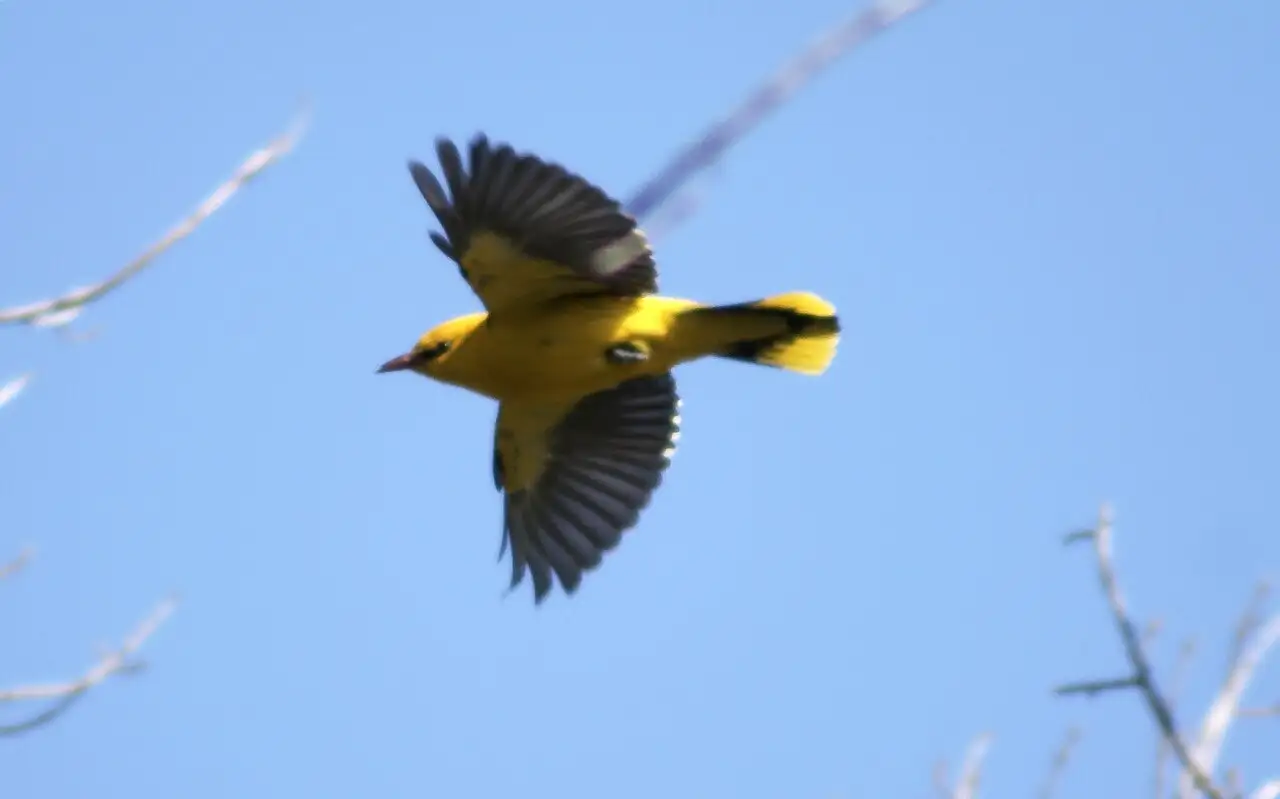
The oriole’s flight is direct and fleeting, somewhat undulating, from tree to tree, thrush-like. When it crosses a clearing it is a yellow and black flash that vanishes into the next treetop.
Flight typeDirect and undulating, from tree to tree
It drops from the tree with a few quick wingbeats. It is almost never seen: it spends its life hidden among the leaves.
It flies direct and fast, with consecutive wingbeats and a slight rocking, like a thrush. It is the only moment when the yellow and black can be seen.
It rises, brakes with its tail spread and vanishes into the crown. A few seconds later only its flute is heard.
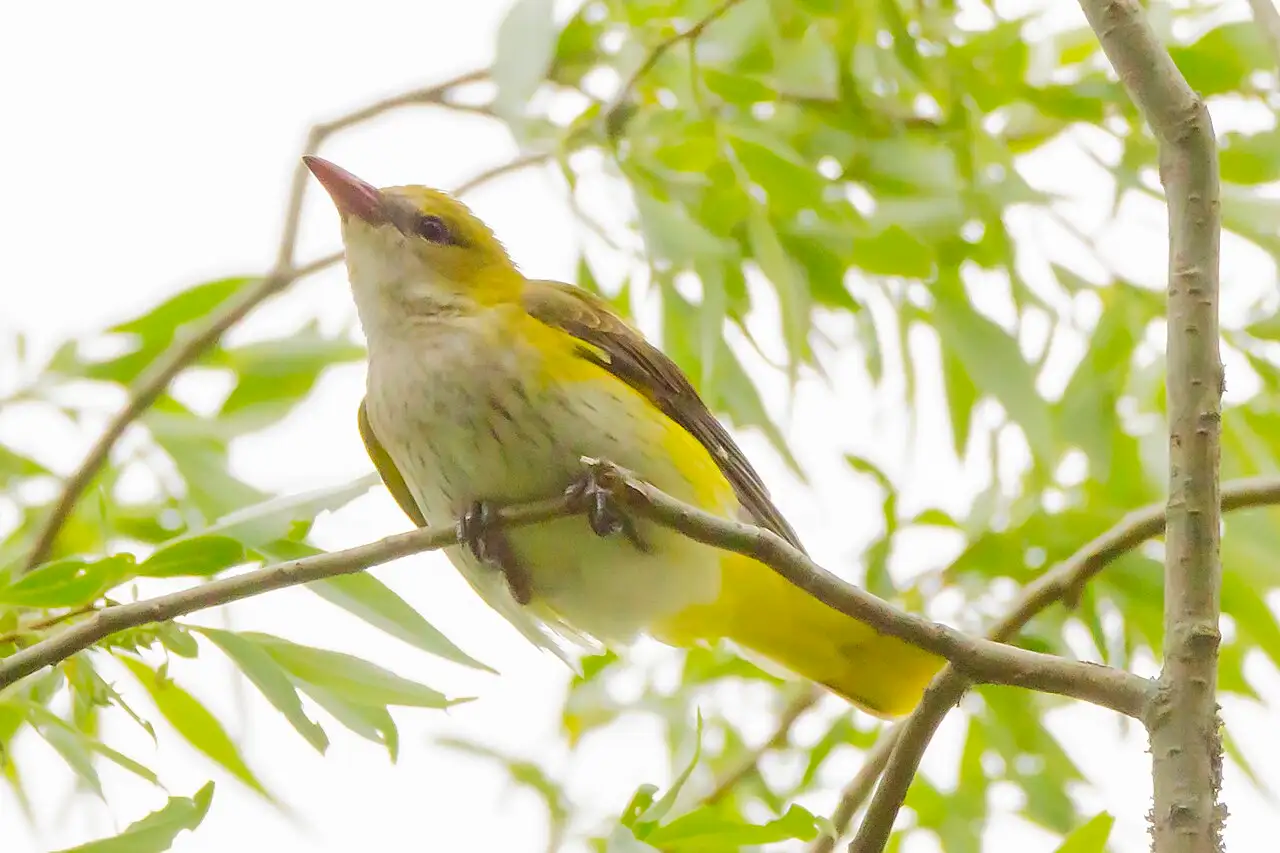
Female perched among leaves: olive green above and pale and streaked belowPhoto: Sébastien FAILLON, CC BY 2.0Photo 3 of 4
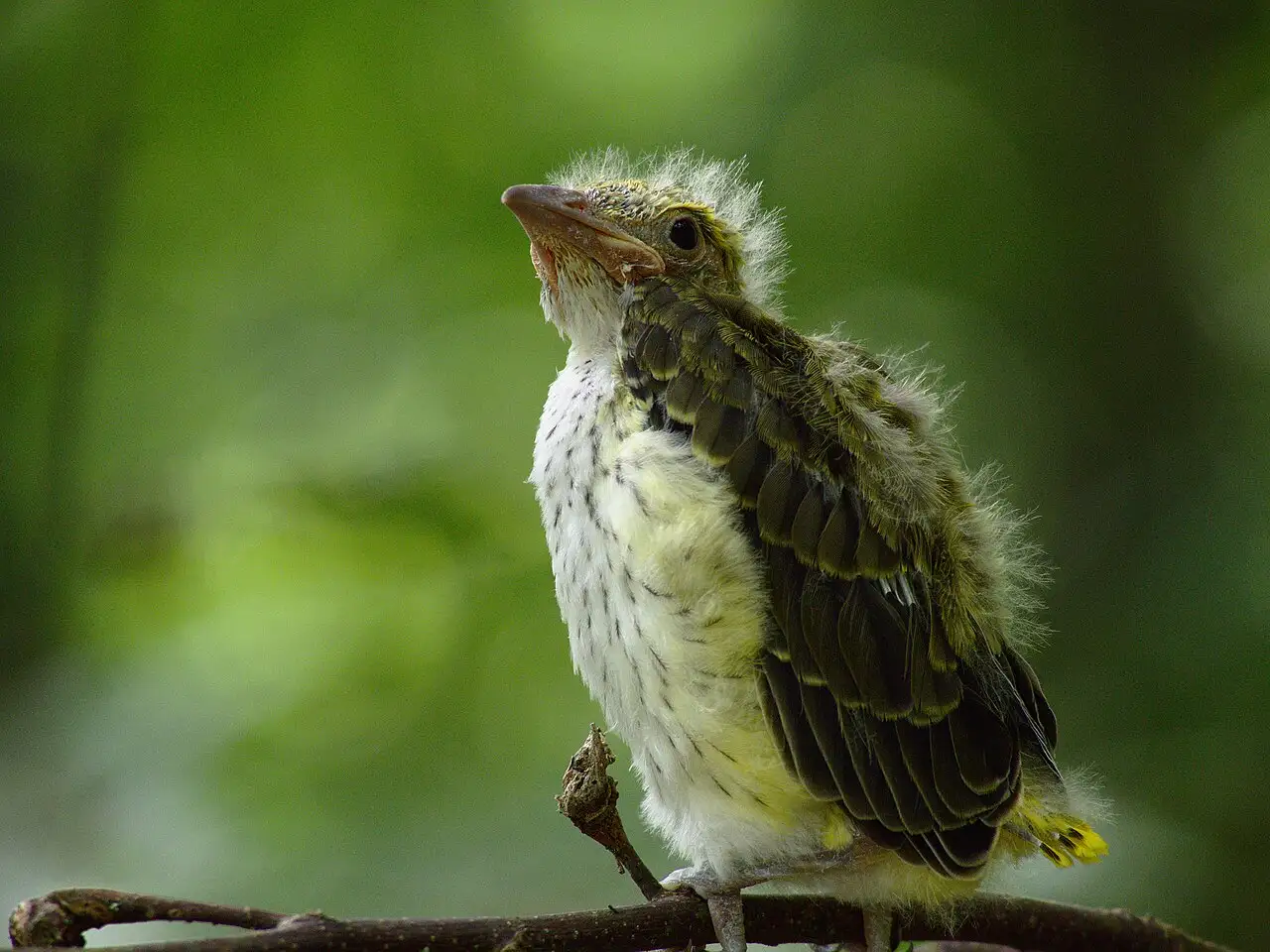
Fledgling Eurasian Golden Oriole, with down still on the head and streaked breastPhoto: Mr rookes, CC BY-SA 4.0Photo 4 of 4
1 / 4
Identification of the Eurasian Golden Oriole
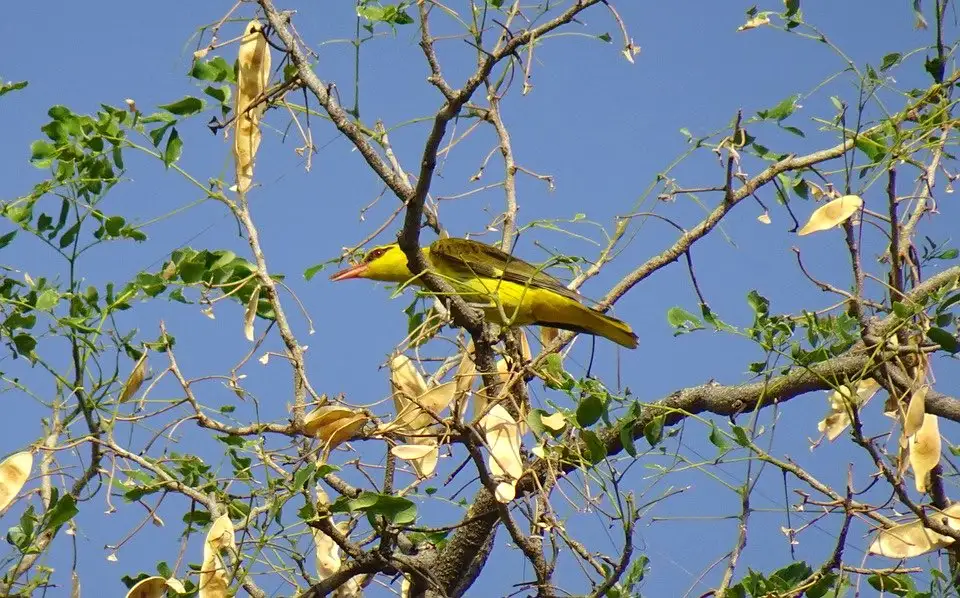
It is a fairly elusive bird that hides in the dense foliage of tree groves, concealing its bright, resplendent yellow, and giving clues to its presence thanks to its unique, energetic song. Orioles prefer areas of oaks, chestnuts and, especially, poplars. There is dimorphism between the sexes. Young birds resemble females, with a dark brown bill.
Male
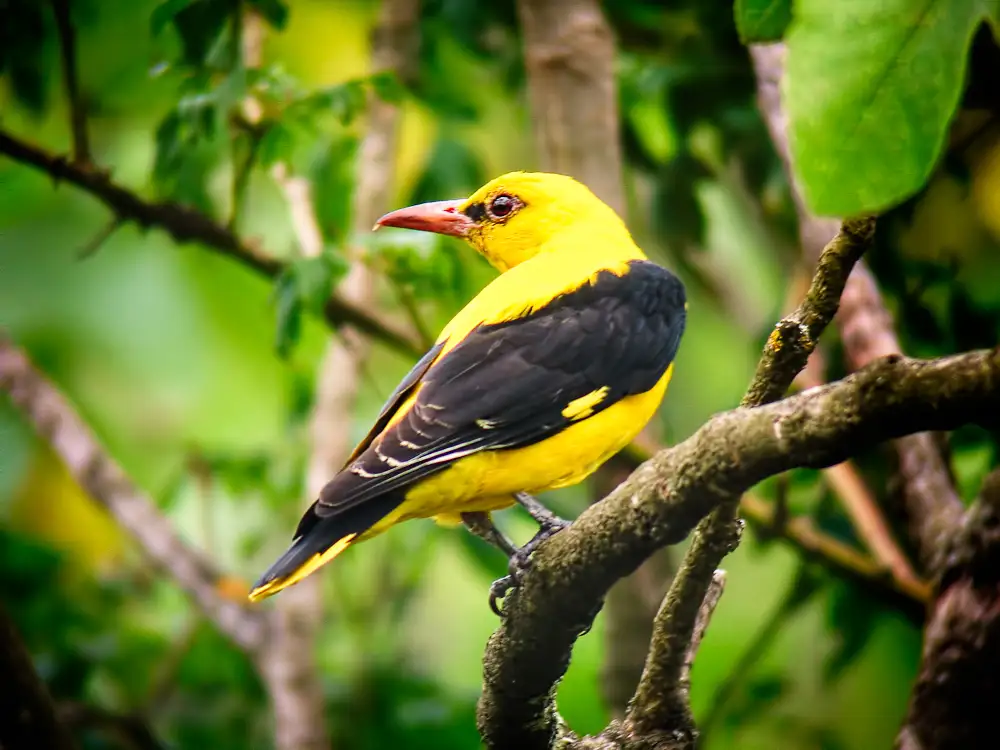
Its body is long and slender, a bright yellow, like a lemon. The bill is a bright dark red. On the head the oriole has a black mask that runs from the eye to the bill.
Its wings are black, broad and rounded, with a yellow patch at the level of the wrist.
The tail, also yellow, has a black band, the same colour as the wings.
The legs are grey.
Female
The female resembles the Green Woodpecker in flight and is told by her olive-green plumage. Yellow appears on the rear flanks and on the rump.
The underparts are in pale grey tones.
The wingtips are more pointed than the male’s.
Habitat and distribution of the Eurasian Golden Oriole
The oriole breeds in continental Europe, from the Iberian Peninsula to southern Finland. Also in the Maghreb and western Asia. When winter comes, it heads for tropical Africa and tropical Asia.
On the Peninsula, the oriole appears in every region, with less presence in the oceanic environments of the north and the dry ones of the south and south-east. In our country it is a summer visitor that can be seen from April. Males arrive about a week earlier. We find many birds in transit passing until the last days of May towards northern Europe. In August the autumn migration begins.
Although it is a very versatile bird, it is associated with deciduous woods, such as cork oak woods, poplar groves or oak woods, above all riverside ones. It lives from sea level to some 1,600 metres. We also find it in fruit plantations, dehesas, pine woods and gardens.
Areas where it is regularly recorded since 2010Squares of about 25 km where it is recorded regularly (occasional passage records are left out). Data from GBIF.org (125,840 records, retrieved October 2026); outline from Natural Earth.
Etymology of the Eurasian Golden Oriole
The origin of the Spanish word «oropéndola» comes from Latin «auri pinnŭla», which means «little feather of gold», referring to the yellow colour of its plumage.
Population of the Eurasian Golden Oriole
There are estimated to be some 5 million pairs in Europe, with greater presence in the south-eastern countries. In Spain more than a million birds are calculated and a clearly positive trend between 1998 and 20181. It is classified as Least Concern.
Nest of the Eurasian Golden Oriole
The oriole builds a light, shallow nest on the horizontal fork of a branch at a great height. It is made of grass and strips of bark. It usually lays a clutch of 3 to 5 eggs between May and June.
Courtship and breeding of the Eurasian Golden Oriole
The oriole’s breeding period runs between May and August. It makes only one clutch, unless the brood fails. The female is in charge of building the nest, which is shaped like a small cup and which she places in a fork of small branches at a great height. The oriole lays between three and five cream-white eggs with dark spots. Both members of the pair incubate the eggs for about 16 days. The chicks, after being fed for two weeks, leave the nest.
Diet of the Eurasian Golden Oriole
The oriole feeds on invertebrates that it catches in the foliage of the dense crown of trees, such as beetles, grasshoppers, flies, crickets and, above all, caterpillars. At the end of summer and in autumn it also eats wild fruit, a food rich in sugars that gives it enough energy to face the autumn migration, such as berries, figs, cherries, blackberries, etc.
Curious facts about the Eurasian Golden Oriole
It is hunted by other birds of prey such as falcons (Falco vespertinus, Falco eleonorae, Falco concolor, Falco biarmicus, Falco tinnunculus), Booted Eagle (Hieraaetus pennatus), Red Kite (Milvus milvus) and Black Kite (Milvus migrans).
The Eurasian Golden Oriole in Cabañeros
The oriole is a fairly common breeding bird in Cabañeros. It is a trans-Saharan migrant that arrives in late April. In late August the post-breeding migration takes place. It is a bird very defensive of its territory that has inspired some sayings:
Little mother oriole, I can take on all the birds bar the royal eagle, and even that one does not frighten me.
Popular saying
Where to see the Eurasian Golden Oriole in Cabañeros
It usually appears in wooded environments, near riverside groves and shaded slopes.
When
From late April to late August. It is in May and June, with males singing in full breeding fervour, that it is best heard.
What time
First hours of the morning, when it sings from the tops of trees; at midday it falls silent and hides.
Where
In riverside groves and wooded and shaded environments, above all near poplars, ash trees and other riverside trees.
What to look for
Rather than seeing it, listen for it: a clear, powerful flute high in a tree. With luck, a yellow and black flash crossing a clearing.
Videos of the Eurasian Golden Oriole
Similar species
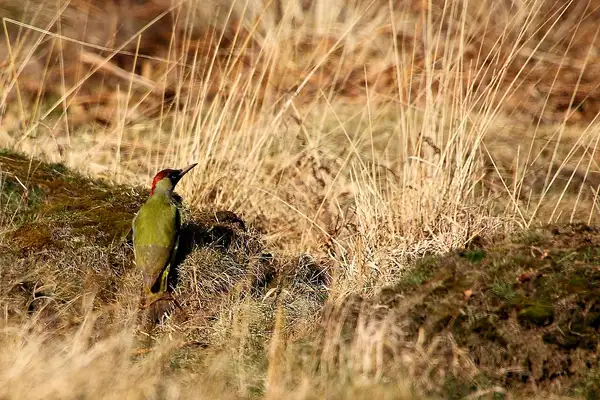
Eurasian Green Woodpecker
Picus viridis
How to tell them apart
The female oriole resembles it in flight: also green and yellowish. But the Iberian Green Woodpecker is larger, with a red head, a straight bill and a flight in great waves. It climbs trunks.



 Also in sclerophyllous woodland
 Also in sclerophyllous woodland
 Also in sclerophyllous woodland
 Also in sclerophyllous woodland
 Also in sclerophyllous woodland
 Also in sclerophyllous woodland
 Also in sclerophyllous woodland
 Also in sclerophyllous woodland






