Solitary and territorial; lives in pairs during breeding
Lifespan
Record of almost 6 years in the wild
Conservation status
LC
NT
VU
EN
CR
EW
EX
Global (IUCN)
Least Concern
Spain
Included in the List of Wild Species under Special Protection; Endangered in the Red Book of the Birds of Spain 2021
When to see it
Summer visitor
Months of the year when it is present
J
F
M
A
M
J
J
A
S
O
N
D
In Iberia
no
no
yes
yes
yes
yes
yes
yes
yes
no
no
no
Breeding season
no
no
no
yes
yes
yes
yes
no
no
no
no
no
Song or voice of the Woodchat Shrike
When it feels threatened or wants to intimidate an intruder, it gives harsh, very rapid, closely spaced clicks, «chart-chart-chart», reminiscent of magpies’. It is a shy bird with an unremarkable voice, and we almost always detect it more by the clicks than by a real song.
SongWoodchat Shrike
0:00 / 0:15
10 kHz5
The sonogram draws the sound: time runs from left to right, and the higher a trace sits, the higher the note.Recording by Sternanita3, Wikimedia Commons (CC BY-SA 4.0).
Flight of the Woodchat Shrike
It flies low and direct, from one perch to another, with quick flaps and a brief glide. In flight, with wings and tail spread, it shows a handsome black-and-white pattern, with the white patches of the wings and the white edges and base of the tail.
Flight typeLow and direct, from perch to perch
It leaves the branch or wire where it was watching, low down, with quick wingbeats and the long tail behind.
It crosses almost at ground level, with quick wingbeats and a brief glide, and the white patches on the wings and the white edges of the tail can be seen.
It shoots up suddenly to the top of a shrub or a wire, from where it goes on watching the ground.
Photo gallery of the Woodchat Shrike
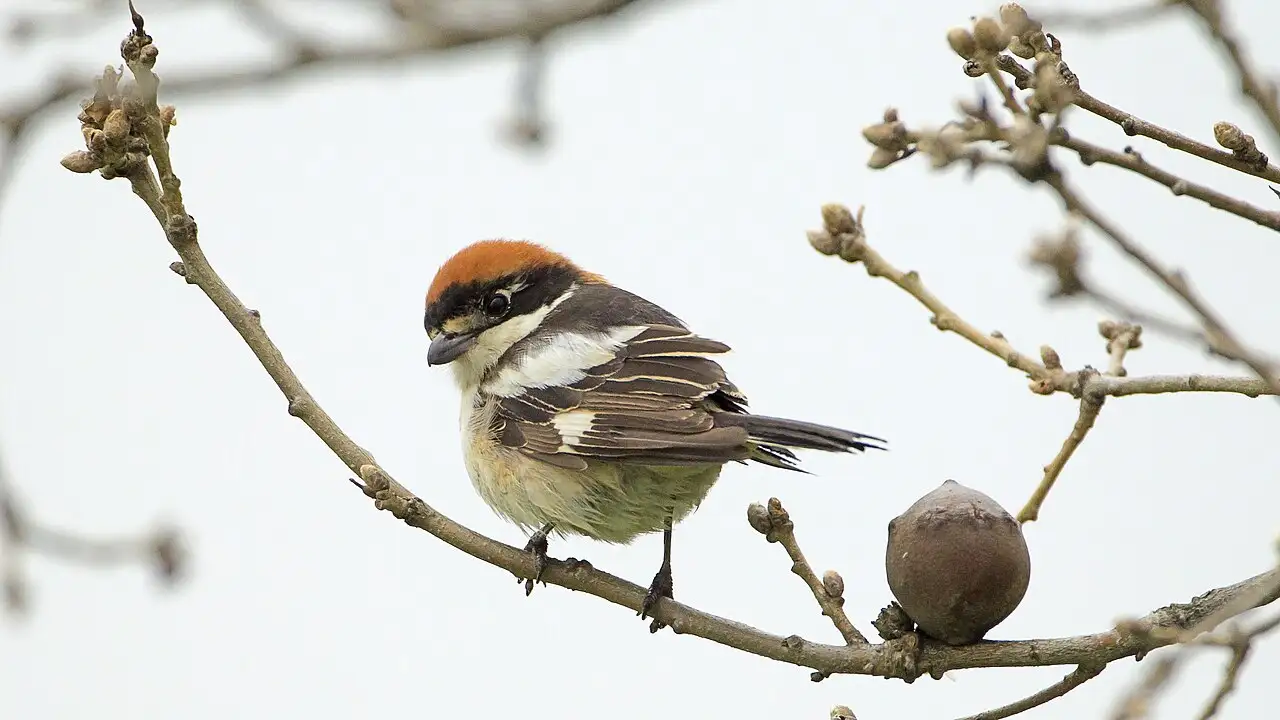
Woodchat Shrike perched on a leafless branch, in profile: chestnut head, black eye-mask and black back with white patchesPhoto: Juan lacruz, CC BY-SA 4.0Photo 1 of 4
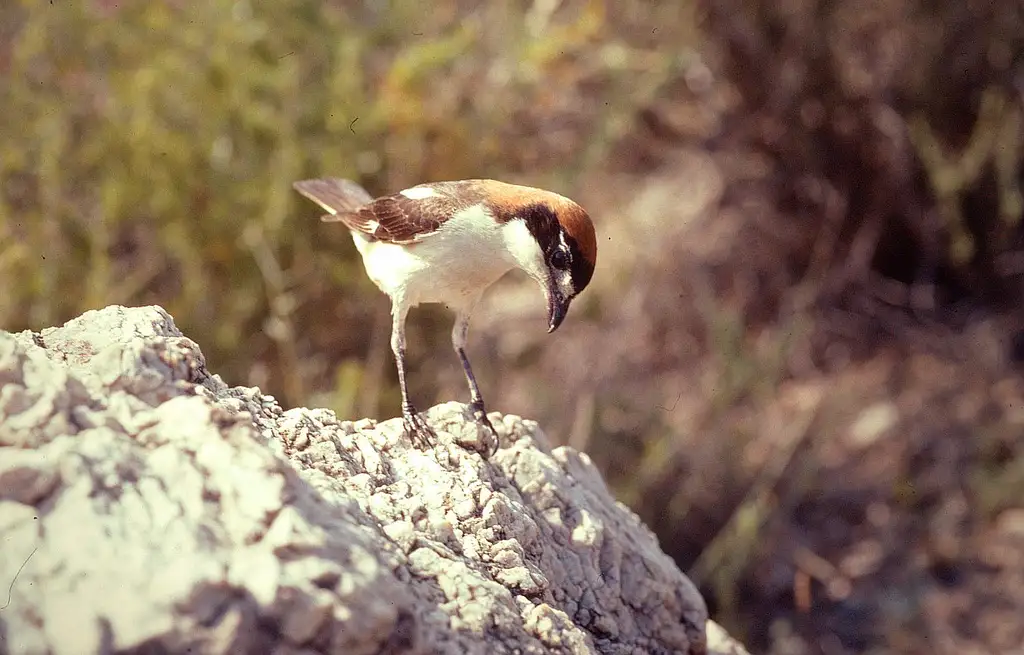
Woodchat Shrike on a rock, watching the ground, with chestnut head and white breastPhoto: Trebol-a, CC BY-SA 4.0Photo 2 of 4
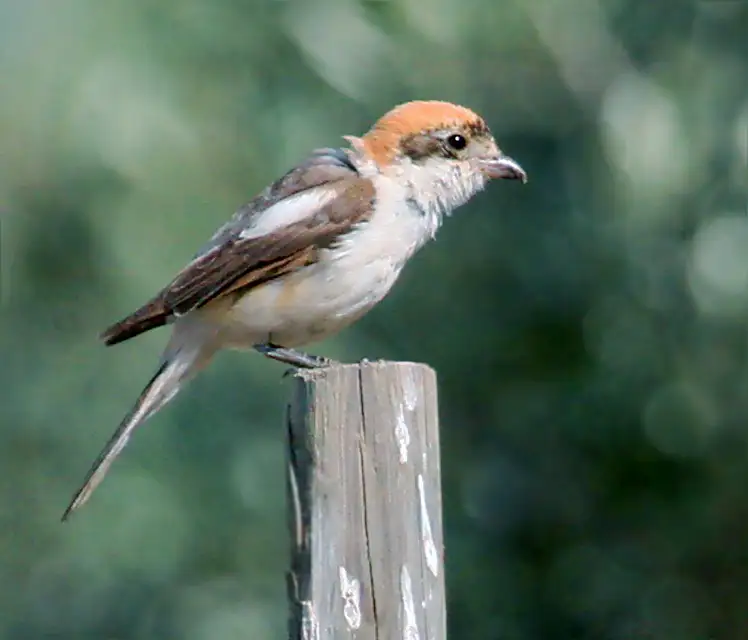
Woodchat Shrike at the top of a post, with long tail and chestnut capPhoto: Muchaxo, CC BY-SA 2.0Photo 3 of 4
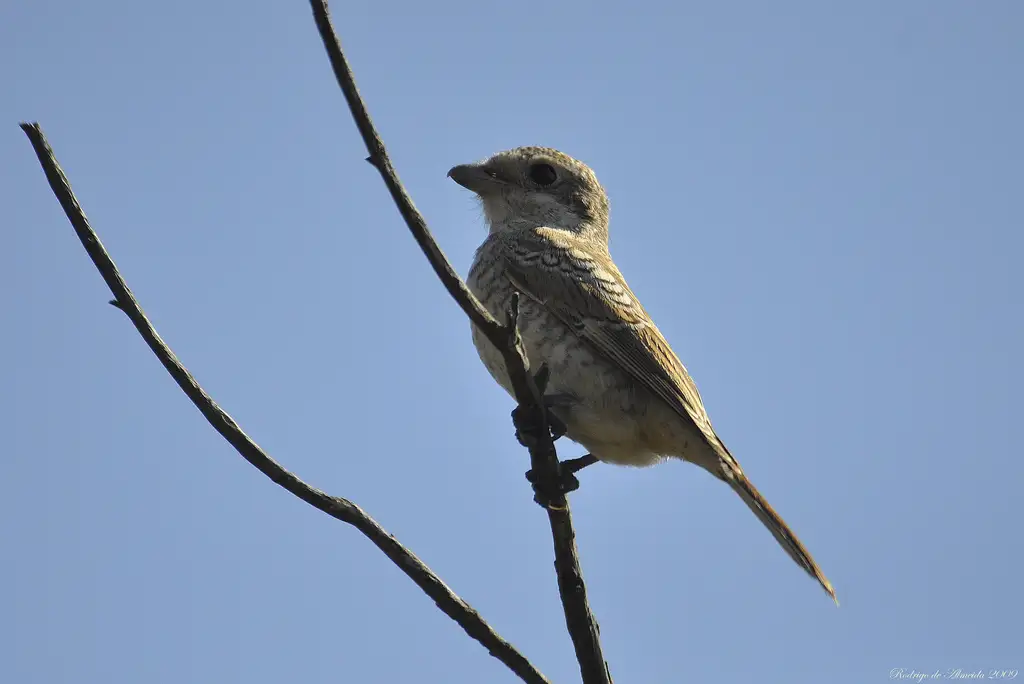
Young Woodchat Shrike, with greyish-brown streaked plumage, perched on a branch against the skyPhoto: Rodrigo Saldanha de Almeida, CC BY 2.0Photo 4 of 4
1 / 4
Identification of the Woodchat Shrike
It is characterised by its bulky head tinged with red and by the black mantle with large white patches on the wings. The tail is also black, except at the edges and base. From a long distance and perched it is very recognisable by the contrast between the dark upperparts and the ivory white of the throat, breast and belly. Close up you can see the long tail and the black, broad, short, hooked bill.
Adult
Reddish-chestnut head, with black eye-mask.
Black mantle and tail, with white patches on the wings.
Ivory-white throat, breast and belly.
Young bird
Very similar to that of the Red-backed Shrike, but with a pale patch at the base of the primary feathers.
It does not have the reddish-chestnut rump.
Habitat and distribution of the Woodchat Shrike
It is distributed across most of the European and African countries around the Mediterranean basin and across the Asian territories between Turkey and the Caspian Sea. All European and North African populations migrate and cross the Sahara after breeding, and spend the winter in the African savannas and in Saudi Arabia.
In Spain it appears in spring over almost the whole territory, except the Canaries, and is rare in the damp regions of the north. It reaches the Peninsula between March and May and leaves during summer and early autumn. It is a typical bird of open Mediterranean landscapes with scattered trees and scrub, and reaches its highest densities in holm oak and cork oak dehesas with plenty of grass and, therefore, without excessive grazing pressure. It also lives in scrub with abundant cover, river groves, olive groves, almond groves, pastures and cereal plains with trees and bushes.
Areas where it is regularly recorded since 2010Squares of about 25 km where it is recorded regularly (occasional passage records are left out). Data from GBIF.org (145,193 records, retrieved October 2026); outline from Natural Earth.
Etymology of the Woodchat Shrike
«Lanius» is «butcher» in Latin, from its habit of impaling prey, and «senator» is «senator». «Common» (the Spanish «común») sets it apart from the other shrikes, the Iberian Grey and the Red-backed, which also live in our fields.
Population of the Woodchat Shrike
In Spain there are somewhat under 3 million birds, but it is estimated to have lost 50 % of its population since 1998. In Europe between 3.8 and 6.2 million individuals are estimated, with a decreasing trend, and it has died out in some countries of central Europe. It is classed as Endangered in the Red Book of the Birds of Spain 2021. The abandonment of extensive livestock farming, which lets scrub cover the grasslands, the indiscriminate use of pesticides, both here and in Africa, hunting pressure and droughts caused by climate change are its main problems.
Nest of the Woodchat Shrike
The female, with the male’s help, builds a broad cup from very fine, flexible twigs, herbaceous stems, moss and even spiders’ webs, and lines it with hair, wool and feathers. It likes to place it in thorny bushes, such as wild roses, or in dense shrubs and small trees, such as junipers and kermes oaks, and more rarely on the horizontal branches of a tree.
Courtship and breeding of the Woodchat Shrike
It begins between April and May, soon after arriving at the breeding territory; the birds are thought to arrive already paired from Africa. It raises one or two broods. The clutch consists of five or six eggs of very varied colours, greenish, whitish, buff or pinkish, always with dark spots that often form a ring at the broad end. Incubation lasts a little over two weeks, and the female is fed by the male. Afterwards, both parents feed the chicks for three weeks.
Diet of the Woodchat Shrike
It eats mainly insects, especially beetles, and completes its diet with other arthropods, small mammals and reptiles. It impales some prey on thorny bushes, though less than the Iberian Grey and Red-backed Shrikes.
Curious facts about the Woodchat Shrike
Shrikes have a reputation as «butchers» because they impale prey on thorns, hence their Latin name, «Lanius». And Woodchat Shrikes are thought to arrive from Africa already paired.
The Woodchat Shrike in Cabañeros
The habitat pages of this website list it among the breeding birds of the dehesas, where it is an abundant species, together with the Iberian Grey Shrike.
Where to see the Woodchat Shrike in Cabañeros
In the park’s dehesas, on the bushes and high branches from which it scans.
When
From March or April to September. In summer, with the young, they are easier to see.
What time
First thing in the morning and last thing in the afternoon, when it hunts most.
Where
Perched at the top of a bush, fence, wire or wall, in dehesas with plenty of grass.
What to look for
A bird with a chestnut head, black eye-mask and white breast, which scans from a perch and drops to the ground.
Videos of the Woodchat Shrike
Similar species
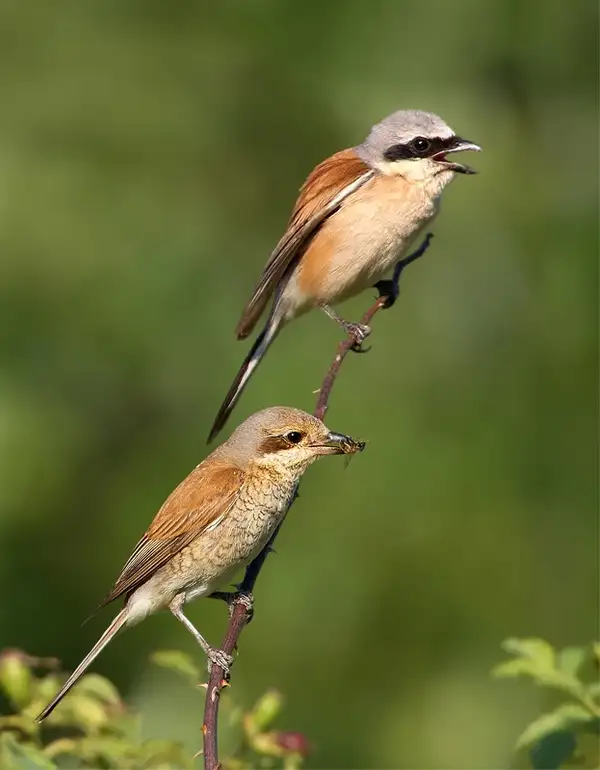
Red-backed Shrike
Lanius collurio
How to tell them apart
The male has a grey head, not chestnut, a black eye-mask and a reddish-chestnut back. Young birds look very similar, but have the reddish-chestnut rump.



 Same family
 Also in dehesas (wood pasture)
 Also in dehesas (wood pasture)
 Also in dehesas (wood pasture)
 Also in dehesas (wood pasture)
 Also in dehesas (wood pasture)
 Also in dehesas (wood pasture)
 Also in dehesas (wood pasture)






