Wingspan compared with a person with arms outstretched.
Length
26–31 cm
Wingspan
66–72 cm
Weight
90–200 g
Social life
Colonial, in colonies of up to hundreds of pairs
Lifespan
About 6 years on average in the wild
Conservation status
LC
NT
VU
EN
CR
EW
EX
Global (IUCN)
Least Concern
Spain
Vulnerable (Red Book of the birds of Spain) and under special protection
Castilla-La Mancha
Vulnerable
When to see it
Summer visitor in Cabañeros
Months of the year when it is present
J
F
M
A
M
J
J
A
S
O
N
D
In Iberia
no
yes
yes
yes
yes
yes
yes
yes
yes
yes
no
no
In Cabañeros
no
yes
yes
yes
yes
yes
yes
no
no
no
no
no
Breeding season
no
no
no
yes
yes
yes
yes
no
no
no
no
no
Song or voice of the Lesser Kestrel
Rapid series of two or three hoarse, high, somewhat strident cries, which in the colony never stop for a moment.
CallLesser Kestrel
0:00 / 0:30
10 kHz5
The sonogram draws the sound: time runs from left to right, and the higher a trace sits, the higher the note.
Flight of the Lesser Kestrel
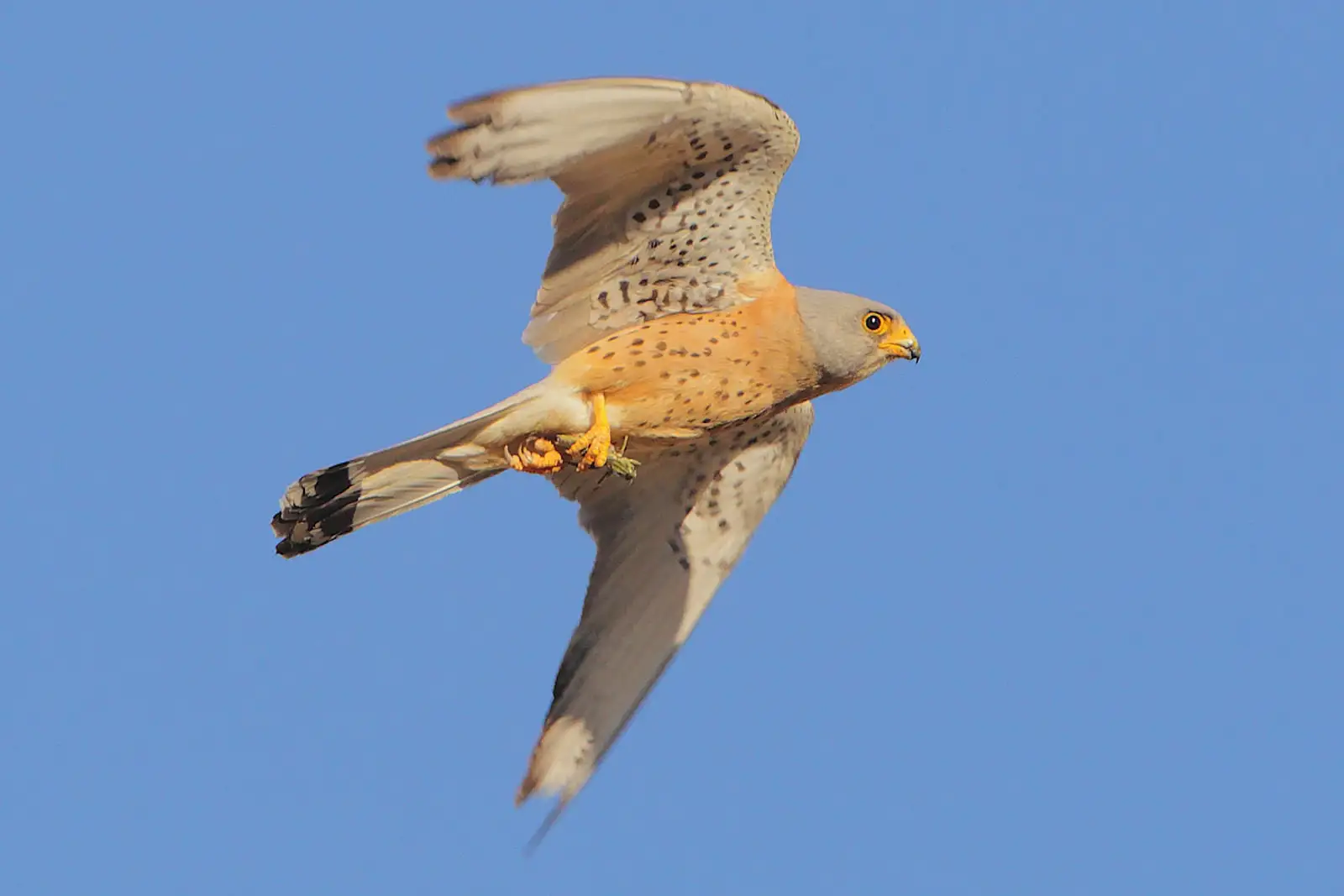
Its flight is light and fast, with agile flaps. Like its cousin the Common Kestrel, it also hovers, but lower and with a shorter, straight-edged tail. When it hunts in a group, at dusk, several can be seen hovering at once over the same field.
Flight typeHoverer
It ranges over the terrain at low height, with quick wingbeats and short glides, alert to any movement.
It stops facing the wind and hangs nailed in the air: the wings beat fast, the tail spread and the head perfectly still. If it does not like what it sees, it drops down a step.
It folds its wings and drops, thrusting its talons forward at the last moment onto the mouse or the grasshopper.
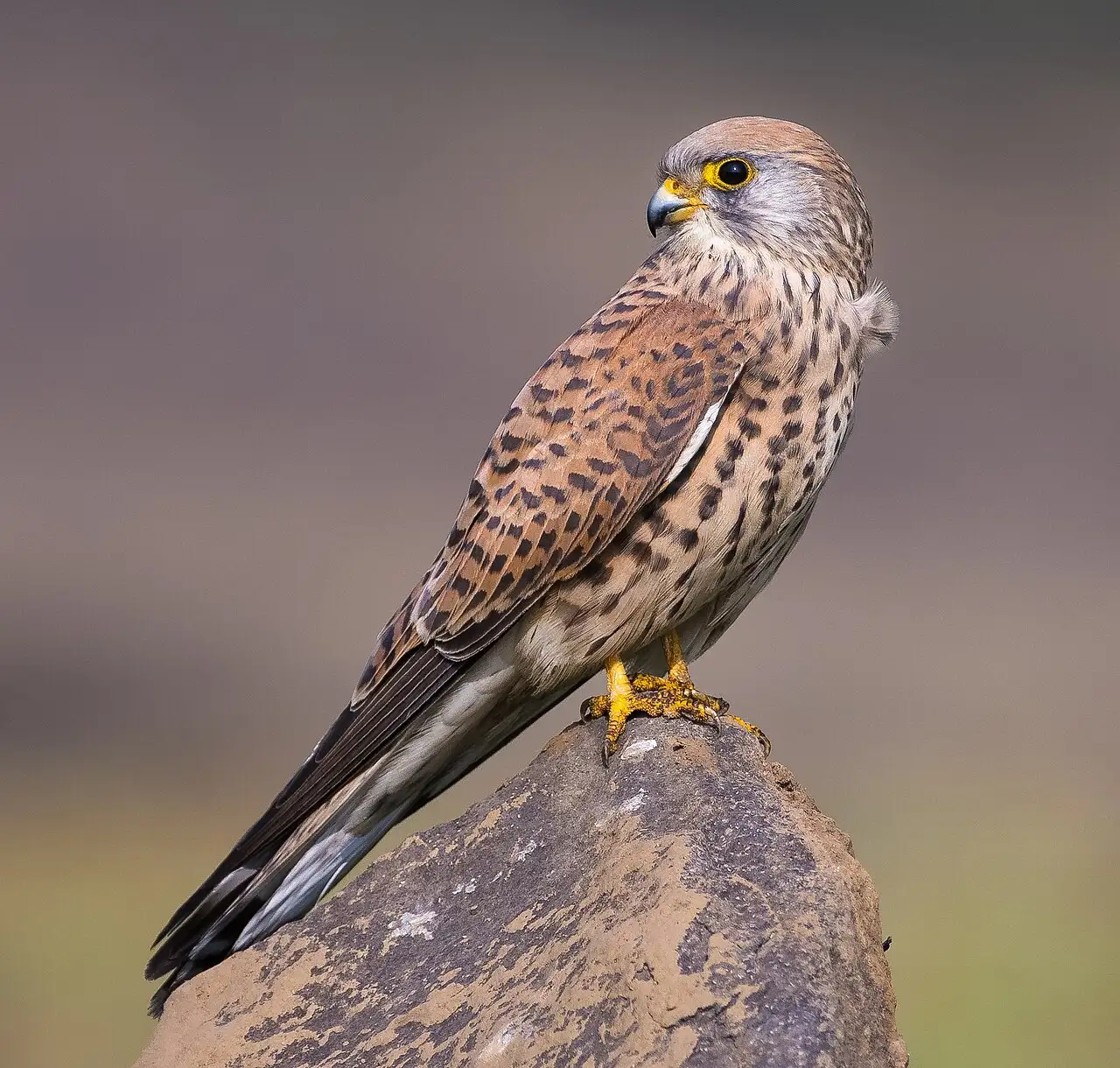
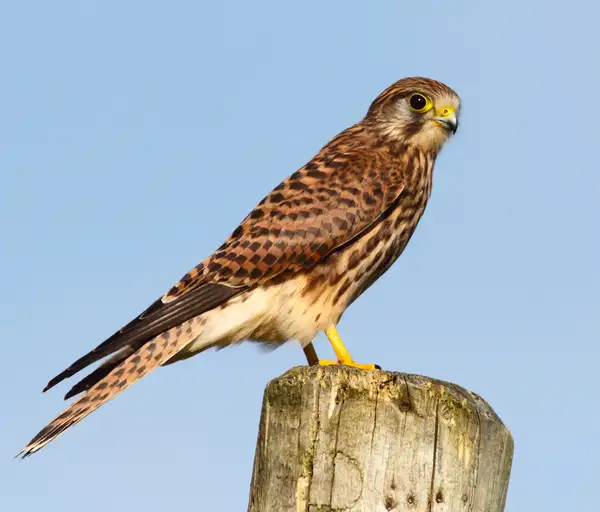
Female perched: brown head and the whole body streaked and spottedPhoto: Sumeet Moghe, CC BY-SA 4.0Photo 2 of 4
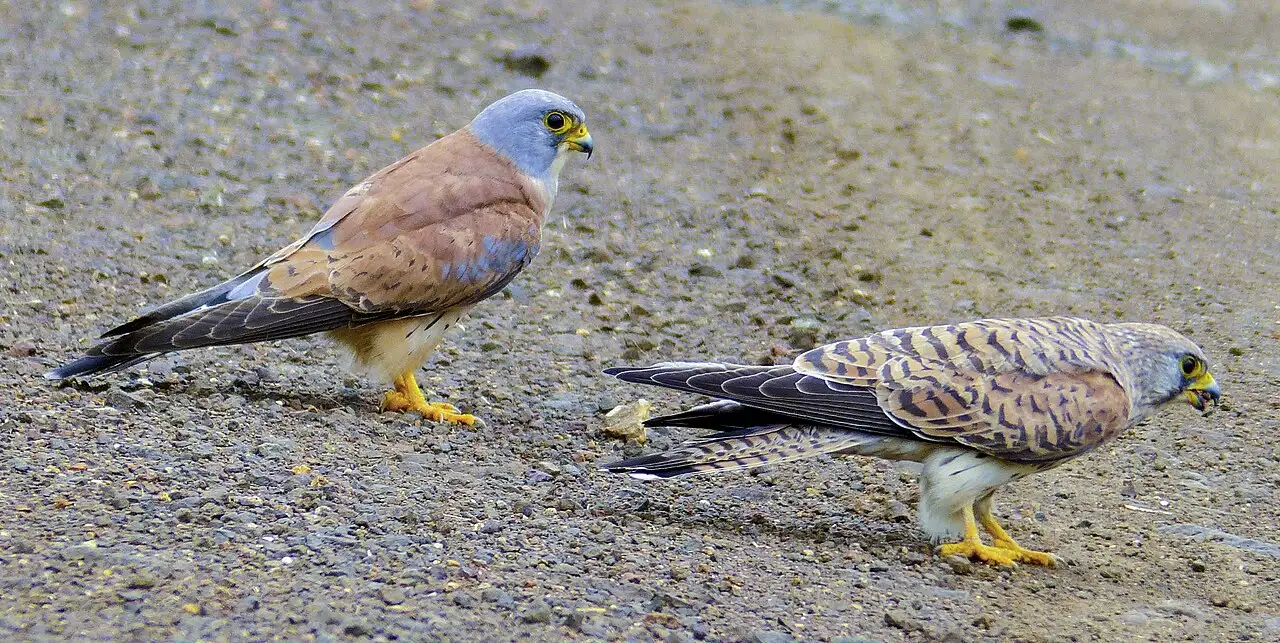
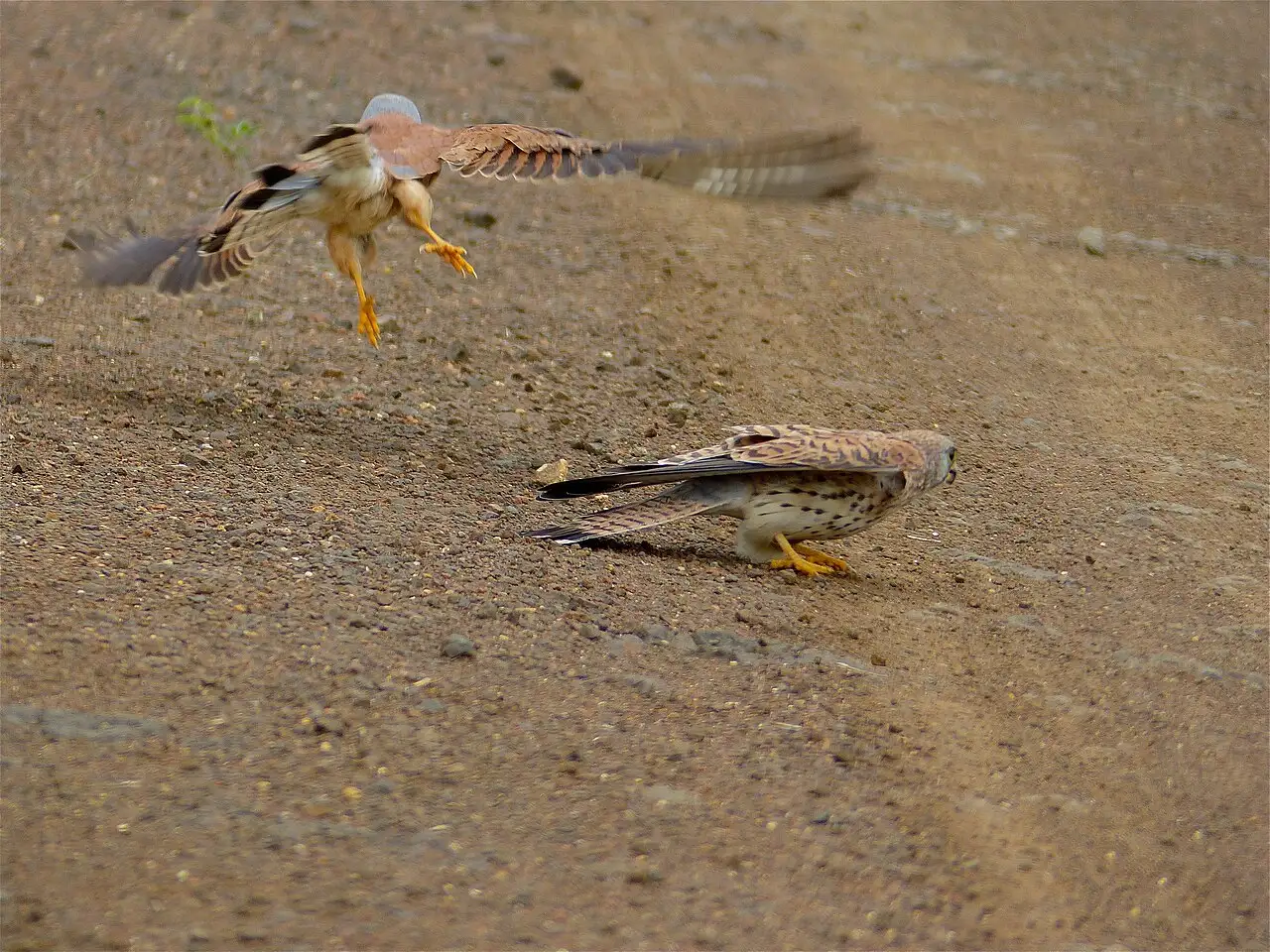
Pair on the ground: the male, on the left, with grey head and bluish coverts; the female, streakedPhoto: Bernard DUPONT from FRANCE, CC BY-SA 2.0Photo 3 of 4
Its pattern and colours are similar to those of the Common Kestrel. The most evident difference is seen on the male’s back, which has no spots. Females are harder to tell apart. Although it is smaller than its relative, in fact the smallest of our falcons, it has a sturdier shape and shorter wings. Its claws are white, instead of black.
The Lesser Kestrel is a more sociable bird, which usually breeds in populous colonies. It is a threatened species whose population in Europe has fallen greatly in recent decades.
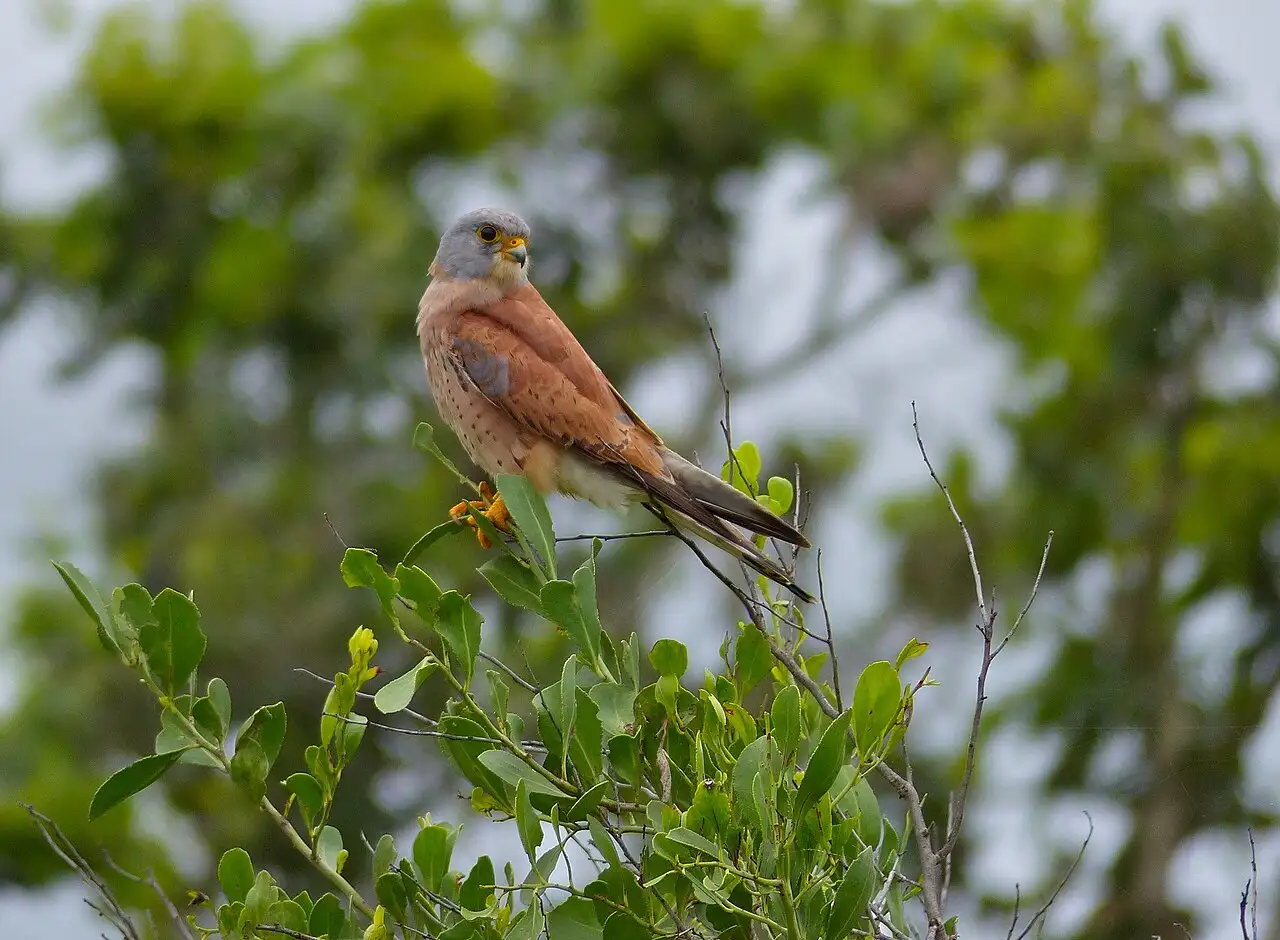
Male
On the breast it has small, fine spots, on a warm cream background with soft pink tones.
Unlike the Common Kestrel, its back is spotless and a bright reddish brown.
The head and coverts are bluish grey. It has no moustache. The cere and the eye-ring are yellow.
Its tail is also bluish grey with a black band at the tip, with 3 central tail feathers longer than the rest.
The outer side of the wings shows 3 colours: the tips or flight feathers are dark, the secondaries bluish grey and the coverts the same brown that joins the back.
The underside of the wings is white.
Female
Very similar in appearance to the Common Kestrel, with duller, more uniform tones. Its back has black bands.
The upperparts are reddish brown, darker than the underparts, spotted with dark marks.
The head is brown, with a pale patch on the cheek.
Its outer wings are dark.
The tail has the same shape as the male’s, somewhat broader, and is also tipped with a black band, followed by a series of parallel dark lines, on a soft cream background that gets paler towards the rump.
Habitat and distribution of the Lesser Kestrel
In the past, the Lesser Kestrel frequented towers, farmhouses, castles and so on (hence it is said to be urban) near crops and large livestock farms, places full of insects to feed on. The decline of rural work and country life has contributed to its decline. However, in recent years numerous conservation initiatives and plans have been carried out successfully to ensure its survival.
The breeding area extends from northern China, through the Asian steppes and the Near East, to western Europe, and also in North Africa. Its wintering area lies in sub-Saharan Africa.
On the Iberian Peninsula it is distributed in the south-western half, although there are records in the Ebro valley. The main populations are in Extremadura, Andalusia and the Castiles. It is a summer visitor. In the north of the peninsula we can see birds that make a stop before continuing their migration south, and roosts of thousands of birds can form. Some adult males spend the winter in the south of the peninsula.
The Lesser Kestrel usually inhabits open areas with low tree density, such as dehesas, pastures or extensive crops, in general farming and livestock areas. These are usually places with human constructions where they can set up their breeding colonies. When wintering, it also opts for open places, such as savannas and grasslands.
Areas where it is regularly recorded since 2010Squares of about 25 km where it is recorded regularly (occasional passage records are left out). Data from GBIF.org (68,852 records, retrieved October 2026); outline from Natural Earth.
Etymology of the Lesser Kestrel
Its scientific name comes, on the one hand, from the Latin term «falco-onis», meaning falcon and itself coming from «falx-falcis», which is «sickle, scythe», in reference to its hook-shaped talons or the shape of its silhouette in flight; and on the other, from the reference to the German ornithologist J. A. Naumann, who, although he took an interest in birds at first for hunting purposes, is a pioneer in their study. He was also the father of Johann Friedrich Naumann, in whom he instilled this passion for birds and who is considered the founder of scientific ornithology in Europe, whose key and most important work is the Natural History of the Birds of Germany, published between 1820 and 1880.
Population of the Lesser Kestrel
About 10,900 breeding pairs are estimated in Spain (Third Atlas of Breeding Birds), which is a fall of between 28 % and 40 % compared with the start of the millennium1. In Castilla-La Mancha the last coordinated national census, in 2016, counted 2,994 pairs. And that is much better than feared: at the end of the 1980s we were close to 4,000 pairs in the whole country, when in the middle of the 20th century there were nearly 100,000. Thanks to the restoration of colonies and to the «primillares», the little houses built for them to breed in, the species has stabilised, although it is still listed as Vulnerable.
Nest of the Lesser Kestrel
It does not build a nest: it uses hollows and ledges in roofs, towers, farmhouses and castles, and settles in somewhat dense colonies. It makes a single brood between April and July, of 2 to 6 eggs.
Courtship and breeding of the Lesser Kestrel
When the breeding season approaches, the Lesser Kestrel settles in colonies, sometimes made up of hundreds of pairs, which set up in all kinds of buildings, from farm structures to large old buildings, such as castles.
It shows cave-dwelling habits, settling in small cavities and cracks in buildings, also in crevices of rocks and clay cliffs or on hillsides. At the end of April, the female lays the eggs, whitish with abundant reddish-yellow spots. She herself does the incubation, although the male relieves her at certain moments, and it lasts between 28 and 29 days. The chicks hatch and are fed by both parents for almost another month, when they take their first flights.
Diet of the Lesser Kestrel
It is basically insectivorous: it hunts in the air or on the ground after fluttering, especially grasshoppers, crickets and locusts. Also beetles, scorpions and centipedes. In general, all kinds of medium and large invertebrates, and sometimes a vertebrate, such as lizards and small rodents. They tend to hunt in a group and do not usually range further than a kilometre and a half from the colony.
Curious facts about the Lesser Kestrel
In Málaga any small bird of prey that is not a large eagle is called «primilla». And the species’ name is a naturalist’s: Naumann, the German pioneer of ornithology who, curiously, began looking at birds through his liking for hunting them.
The Lesser Kestrel in Cabañeros
It is a summer visitor that arrives in Cabañeros in mid-February. The chicks hatch in June and leave the colonies in the last week of July.
The Lesser Kestrel colony house at Casa Palillos
The park has two «primillares», one beside the Casa Palillos visitor centre and another at La Alcornoquera. In the one at Casa Palillos there is a nest box with cameras inside and out, lent to SEO/BirdLife’s monitoring programme, which streams live on its YouTube channel (seo.org/camaras). What the park newsletters tell (all the newsletters) (in Spanish):
They return in February from sub-Saharan Africa and leave again at the end of summer. They are faithful: a female ringed there in 2018 came back in 2023, and the female in the box in 2025 had been born in that same colony house in 2019.
2023: 4 eggs in the box, of which 3 chicks were raised.
2024: 17 occupied nests (15 at Casa Palillos and 2 at La Alcornoquera) and 50 chicks ringed on 20 June. That summer a male brought two Saga pedo to the nest, the largest orthopteran in Europe (up to 120 mm), a relative of crickets and grasshoppers, listed as vulnerable and with only two records in Cabañeros, from 2006 and 2018. The chicks ate it.
2025: 36 chicks ringed on 30 June, 31 at Casa Palillos and 5 at La Alcornoquera.
2026: 34 chicks ringed, 20 at Casa Palillos and 14 at La Alcornoquera.
A Common Kestrel comes close to the boxes from time to time. To avoid confusing them, look at the claws: white in the Lesser Kestrel, black in the Common.
Where to see the Lesser Kestrel in Cabañeros
It can be seen in the dehesas and on the raña while it eats orthopterans and other insects. It currently breeds on the raña, near Casa Palillos.
When
From mid-February to the end of July, which is when they are in the colonies; then they disperse.
What time
First thing in the morning and last thing in the afternoon, when they go out to hunt and the colony can be heard.
Where
On the raña, near Casa Palillos, and in the nearby dehesas and pastures, where it hunts grasshoppers.
What to look for
A small kestrel that hovers at low height; if a male, with a plain reddish back and grey head. There is almost always more than one.
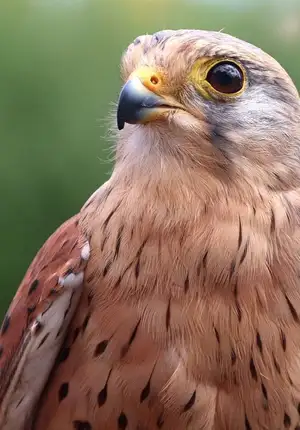
Somewhat bigger and longer-tailed. The male has a spotted back, black moustache and black claws. It lives alone or in pairs, not in colonies, and is here all year.
«Desde el parque» newsletter, Cabañeros NP (OAPN): January–February 2023 to May–June 2026 (the Casa Palillos and La Alcornoquera colony houses). All the newsletters.
Jiménez García-Herrera, José. (2017). Aves de Cabañeros y su entorno. Madrid, Spain: Ecohábitat.



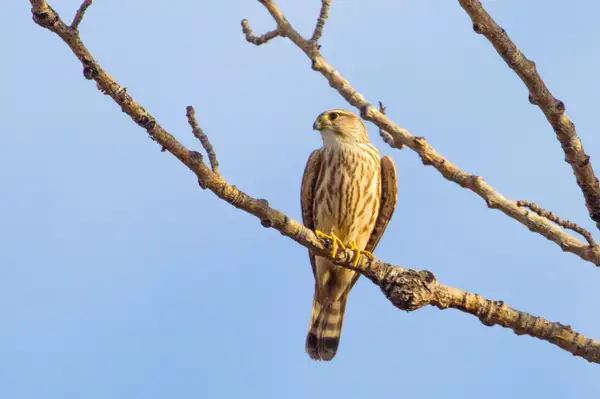
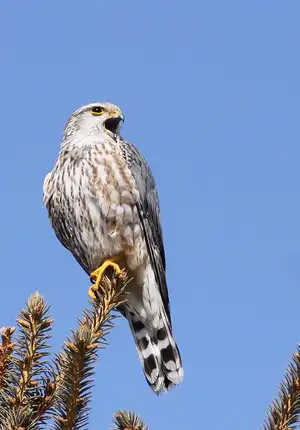 Same family
 Same family
 Same family
 Same family
 Also in grasslands and rañas
 Also in grasslands and rañas
 Also in grasslands and rañas
 Also in grasslands and rañas





