Of very restless, nervous temperament, with discreet, skulking habits
Lifespan
EURING lists a bird ringed in Spain that lived 6 years and 9 months
Conservation status
LC
NT
VU
EN
CR
EW
EX
Global (IUCN)
Least Concern
Spain
Least Concern (LC) as a breeder in the Red Book of the Birds of Spain; on the List of Wild Species under Special Protection, but not in the Spanish Catalogue of Threatened Species
When to see it
Summer visitor
Months of the year when it is present
J
F
M
A
M
J
J
A
S
O
N
D
In Iberia
yes
yes
yes
yes
yes
yes
yes
yes
yes
yes
yes
yes
Breeding season
no
no
yes
yes
yes
yes
yes
no
no
no
no
no
Song or voice of the Spectacled Warbler
Its song is short, quick phrases, of high, melodious sounds, which end in rapid warbles; the call is a prolonged, repeated «trrr»1. The recording (song) is by Esperanza Poveda and was made in Tierra de Molina (near Embid), Guadalajara, Castilla-La Mancha (xeno-canto XC1040826, quality A). It lasts 9 seconds and is a trimmed section of the original, without repeating or lengthening, from which we have removed the bass below 300 Hz, reduced the background noise and adjusted the volume; neither pitch nor speed has been changed.
It is a partial migrant: most Iberian populations are summer visitors and in winter move to warmer areas of North Africa, although in the south-east there are partly migratory populations and those of the Canaries are sedentary1. The pre-breeding passage runs from March to May, with peaks in early April, and the post-breeding one from August to October, with peaks in early September.
Flight typeDiscreet, among low vegetation
It lives in treeless, open, dry landscapes, with scattered, low shrubs, such as thyme scrub, gorse thickets or heaths.
Its song is short, quick phrases, of high, melodious sounds, which end in rapid warbles.
Very restless and nervous by temperament, and of very discreet habits, it moves hidden among low vegetation and is hard to see.
Photo gallery of the Spectacled Warbler
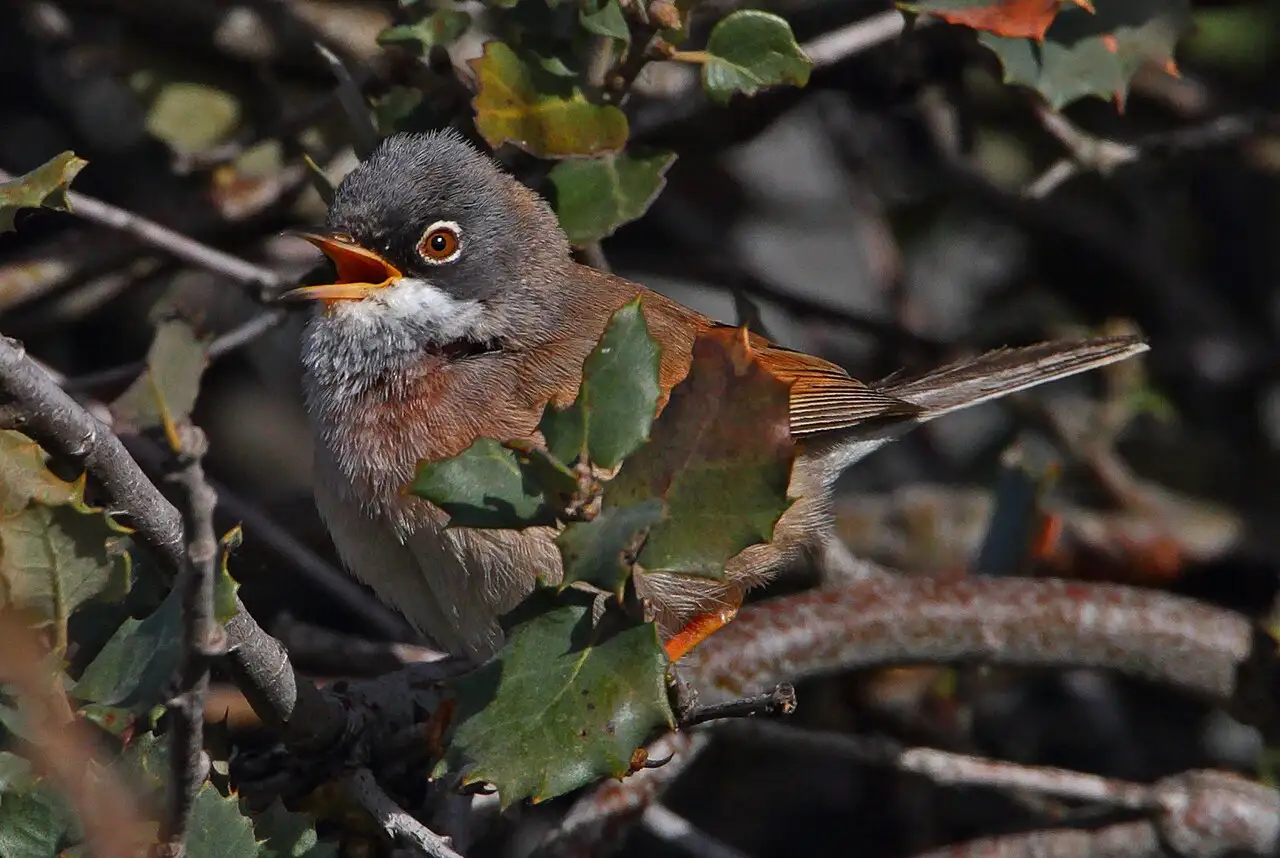
Spectacled Warbler with open bill among shrub leaves, with grey head, white throat, eye with pale ring and rufous wingsPhoto: Juan Lacruz, CC BY-SA 3.0Photo 1 of 4
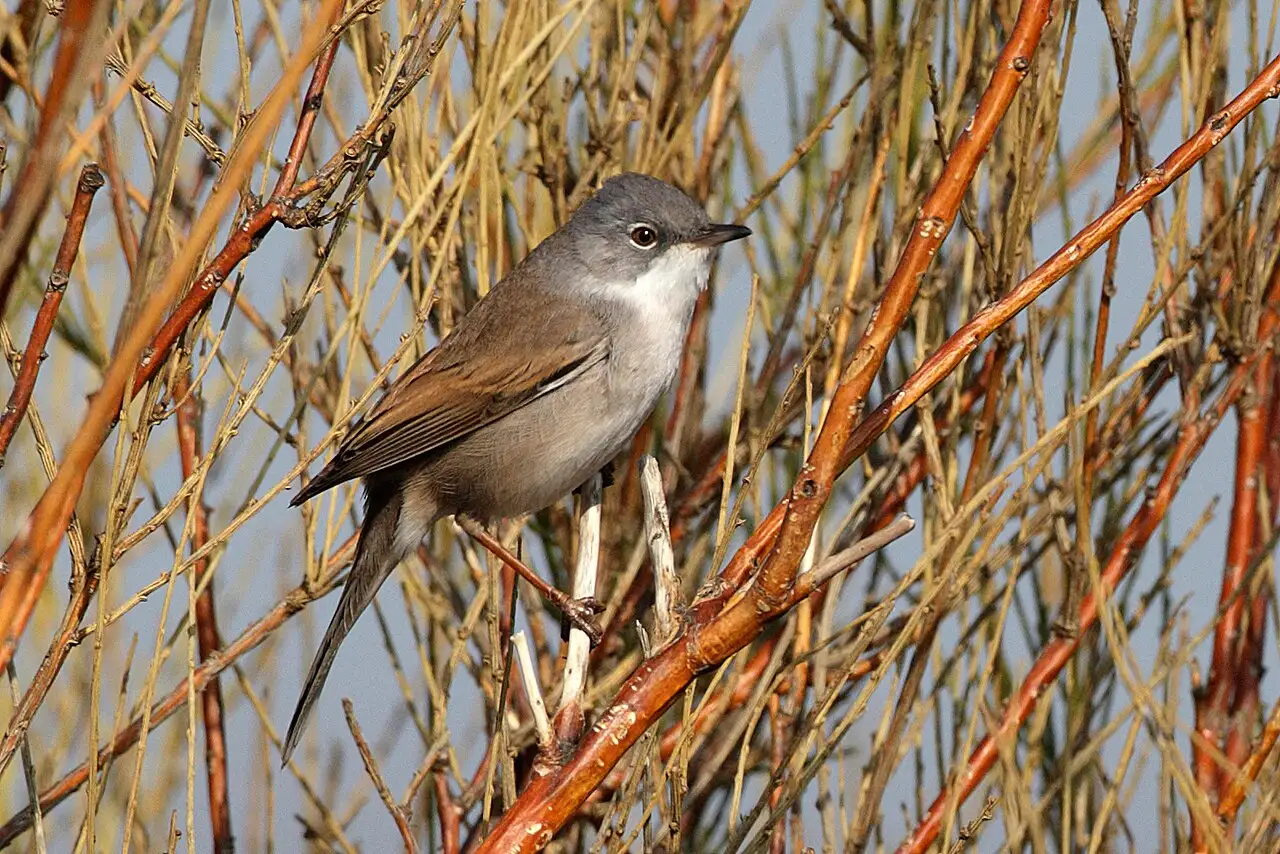
Spectacled Warbler in profile among dry orange stems, with greyish-brown back and pale breastPhoto: Juan Lacruz, CC BY-SA 3.0Photo 2 of 4
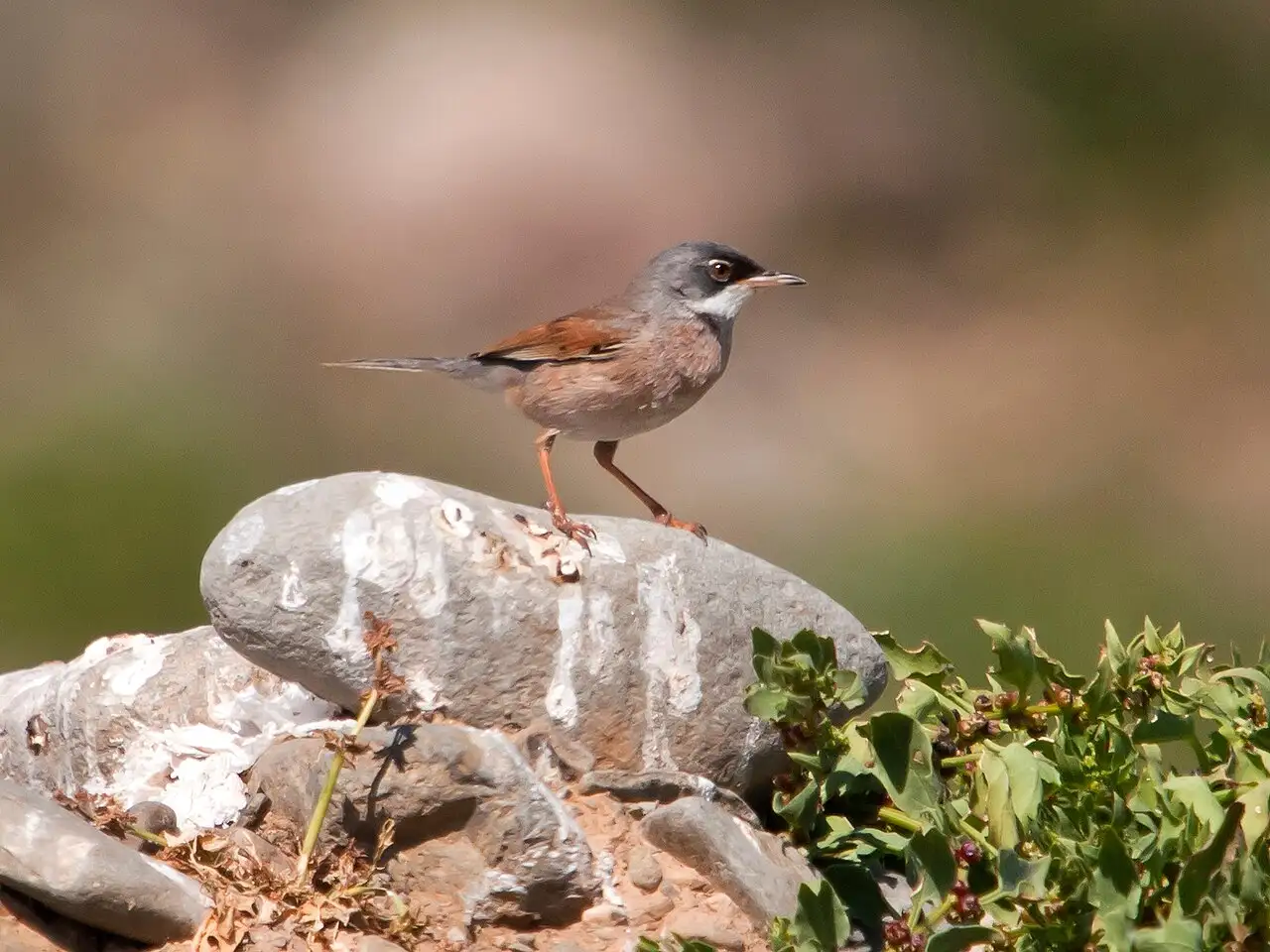
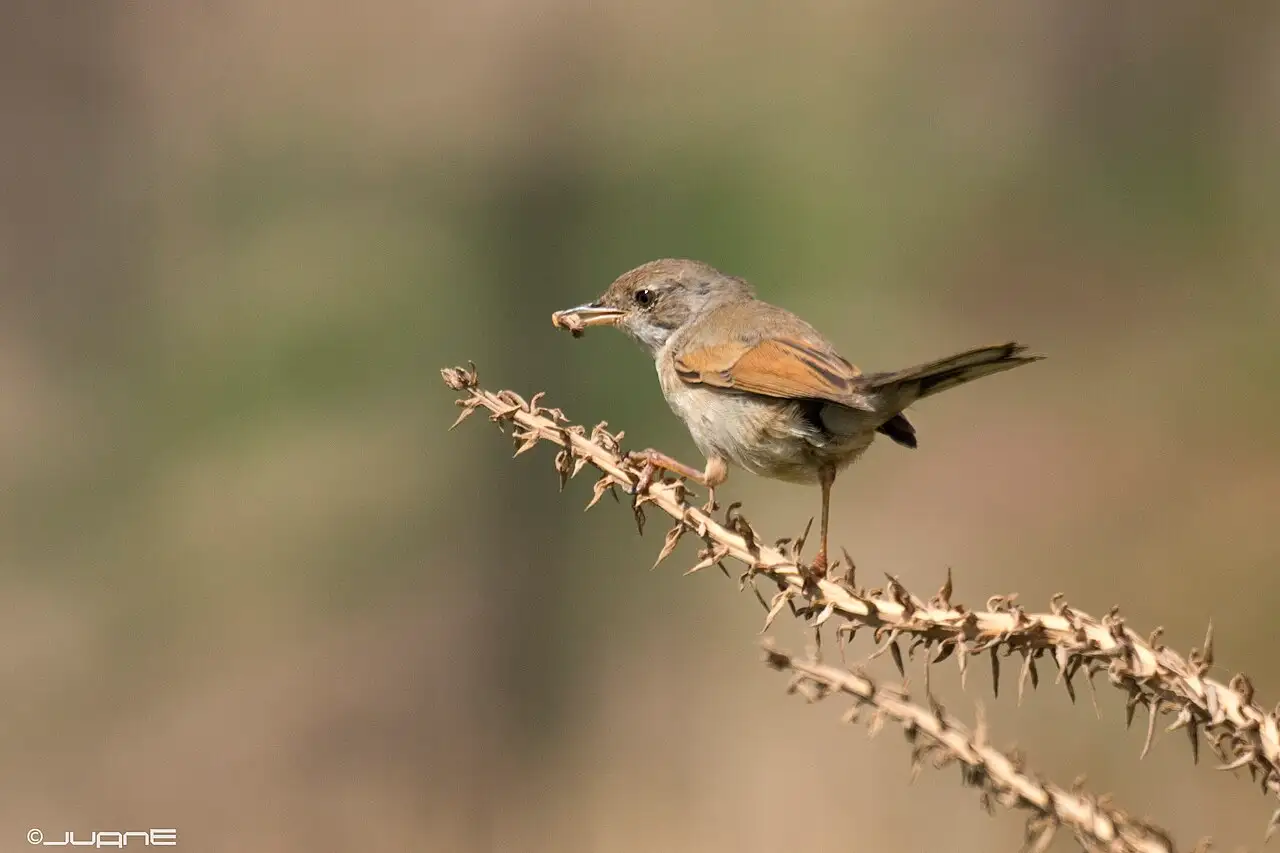
This species looks like a small version of the Common Whitethroat, from which it differs, besides its smaller size, by having redder, shorter wings and a more contrasting head colouring. Males show pink tones on the underparts, a greyish-brown back, grey head, white throat and white eye-ring. Females are similar, although the head has more reddish-brown tones. Young birds have a colour pattern like the female’s, but paler. Of very restless, nervous temperament, it has very discreet, skulking habits, so it is hard to observe as it moves hidden among low vegetation.
Male
Pink underparts, greyish-brown back, grey head, white throat and white eye-ring.
Wings redder and shorter than in the Common Whitethroat.
Female and young bird
Female: similar, with more reddish-brown tones on the head.
Young bird: pattern like the female’s, paler.
Habitat and distribution of the Spectacled Warbler
It breeds in the countries around the western Mediterranean, both in Europe (Portugal, Spain, France and Italy) and in North Africa (Morocco, Algeria and Tunisia). There are isolated populations on various Atlantic archipelagos (the Canaries, Cape Verde and others), the Near East and Cyprus. Two subspecies are recognised: «orbitalis», in the Canaries, and «conspicillata», in the rest of Spanish territory.
In Spain it is widely distributed across the Peninsula, although in a scattered and uneven way: more continuously in the east and south of Andalusia, the moors of the Iberian System, the Ebro valley, the northern plateau (above all Soria and Burgos), the south of Zamora and the Tagus depression in Extremadura1. In the Canaries it is frequent on all the islands and especially abundant on the easternmost; in the Balearics it is a more localised and scarcer bird. It does not breed in Ceuta or Melilla.
It lives in treeless, open, dry landscapes, with scattered, low shrubs, such as thyme scrub, gorse thickets or heaths, and it also occupies saltmarsh vegetation on the edges of marshes and salt lagoons. The highest densities occur in mosaics of semi-arid grassland and scrub and in low scrub formations. It is found from sea level up to 1,800 metres on the moors of the Iberian System, or 2,000 in Tenerife.
It is a partial migrant: most Iberian populations are summer visitors and in winter move to North Africa, although some birds possibly reach south of the Sahara; those of the Canaries are sedentary.
Areas where it is regularly recorded since 2010Squares of about 25 km where it is recorded regularly (occasional passage records are left out). Data from GBIF.org (6,139 records, retrieved October 2026); outline from Natural Earth.
Etymology of the Spectacled Warbler
According to Wikipedia, the species name, «conspicillata», comes from Latin «conspicillum», «a place from which one looks», which amounts to «spectacled». It is now named «Curruca conspicillata» (also «Sylvia conspicillata», the same taxon); in other languages it is «tallarol trencamates» in Catalan, «papuxa tomiñeira» in Galician, «ezkai-txinboa» in Basque and «spectacled warbler» in English1.
Population of the Spectacled Warbler
In the 2021 European Red List of Birds, the European breeding population is estimated at between 327,000 and 891,000 mature individuals, with a stable trend. For Spain a population close to 422,000 individuals is calculated, with the contingents of Castilla y León, Castilla-La Mancha and Andalusia especially significant; the Canaries have a similar number of birds to Castilla y León. The trend in Spain is stable.
It is not especially threatened, but because of the habitats it occupies it could be affected, positively or negatively, by changes in land use. The abandonment of marginal farmland has favoured the advance of the scrub that suits it, above all if some livestock use is kept up, but that agricultural intensification, overgrazing, urban development and the reforestation of moors and uncultivated land are shrinking the extent of those environments1.
Nest of the Spectacled Warbler
Male and female both take part in building it: a small cup of leaves and twigs, low down in dense vegetation, usually in a small bush or a tussock of grass.
Courtship and breeding of the Spectacled Warbler
The breeding period runs from March to July, with the possibility of two and even three clutches a year. The clutch is of two to five white or slightly greenish eggs, speckled to varying degrees. Incubation lasts 12 or 13 days and is done by both parents. The chicks, which both parents feed, fly at 11 or 12 days, although they continue to receive care until three weeks of age.
Diet of the Spectacled Warbler
It feeds mainly on invertebrates, such as ants, spiders, grasshoppers and butterfly larvae, although in spring and autumn it may eat fruit and seeds.
Curious facts about the Spectacled Warbler
Unlike most warblers, it occupies drier, more open, arid areas bare of vegetation, and the song is its most characteristic feature1. EURING lists a bird ringed in Spain at 6 years and 9 months; oiseaux.net gives a maximum longevity of 8.4 years.
The Spectacled Warbler in Cabañeros
The habitat pages of this website do not mention it, but it does appear in the bird list of the «Visitor guide to Cabañeros National Park» (OAPN, page 106). That list vouches for its presence in the Park, not that it breeds there. GBIF.org records 5 observations of the Spectacled Warbler in Cabañeros and its surroundings (under the name «Sylvia conspicillata»). Castilla-La Mancha stands out among the communities with the most birds, without specifying localities1. Only one of those observations falls within the Park boundary (according to OpenStreetMap); the rest are from the surroundings.
Where to see the Spectacled Warbler in Cabañeros
In Cabañeros and its surroundings, from spring to summer, in low scrub, thyme scrub and open gorse thickets.
When
In Spain almost all year; pre-breeding passage from March to May and post-breeding from August to October.
What time
By day, hidden among low bushes; sometimes it sings perched on top.
Where
In thyme scrub, gorse thickets, heaths, saltmarshes and mosaics of grassland and scrub.
What to look for
Look for the grey head, white throat and rufous wings; listen for the short phrases that end in a quickened warble.
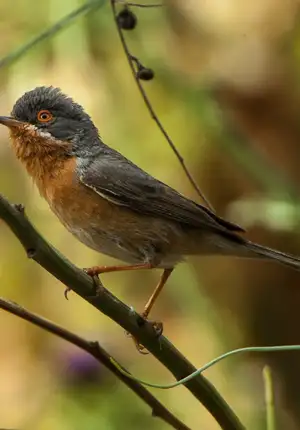
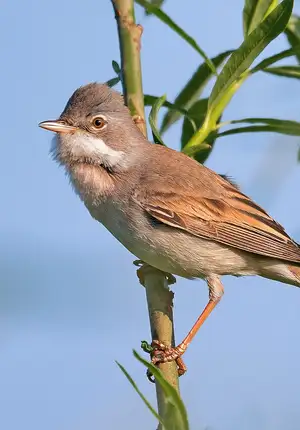
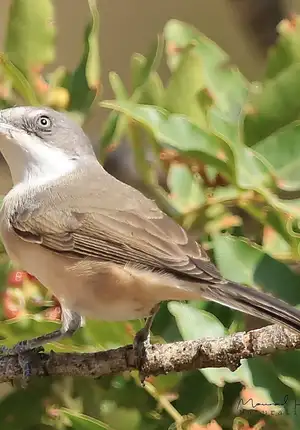
It is similar in song and physical appearance1. The Spectacled Warbler is somewhat smaller and lighter, with redder, shorter wings and a more contrasting head.



 Same family
 Same family
 Same family
 Same family
 Same order
 Same order
 Same order
 Same order






