Wingspan compared with a person with arms outstretched.
Length
70–90 cm
Wingspan
1.1–1.45 m
Weight
0.5–1.3 kg
Social life
Colonial in the breeding season, in sparse colonies and almost always of its own species; it hunts alone or in small scattered groups
Lifespan
Record of 25.4 years in the wild according to AnAge; the EURING list gives a much higher figure (see «Curiosities»)
Conservation status
LC
NT
VU
EN
CR
EW
EX
Global (IUCN)
Least Concern
Spain
Near Threatened (NT) as a breeder and as a winter visitor in the Red List of the Birds of Spain; on the List of Wild Species under Special Protection, but not in the Spanish Catalogue of Threatened Species
When to see it
Summer visitor
Months of the year when it is present
J
F
M
A
M
J
J
A
S
O
N
D
In Iberia
no
no
yes
yes
yes
yes
yes
yes
yes
yes
no
no
Breeding season
no
no
no
yes
no
no
no
no
no
no
no
no
Song or voice of the Purple Heron
In flight it gives a very hoarse, dull «aart», which recalls the croaking of frogs. The recording, from the Guadalquivir marshes, is short: barely eleven seconds with a few calls.
CallPurple Heron
0:00 / 0:11
10 kHz5
The sonogram draws the sound: time runs from left to right, and the higher a trace sits, the higher the note.Recording by Joost van Bruggen, xeno-canto XC432223 (Isla Mayor, Sevilla) (CC BY-SA 4.0).
Flight of the Purple Heron
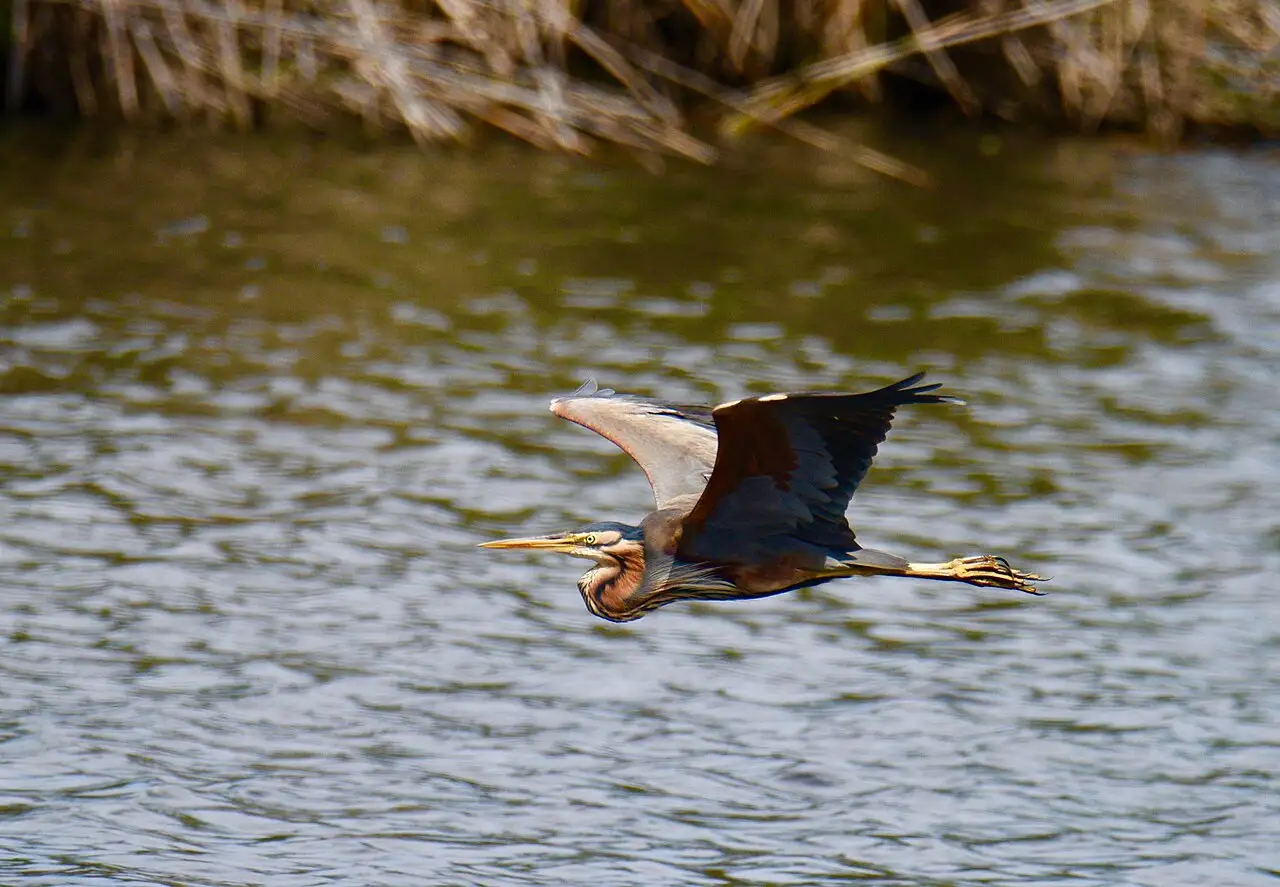
In flight it adopts the characteristic posture of herons: neck folded, wings curved and legs stretched out, sticking out behind the tail. It is smaller and darker than the Grey Heron, which also helps to tell them apart in the air.
Flight typeNeck folded, wings curved and legs stretched out behind the tail
It prefers reedbeds and cattail beds for breeding, and, for feeding, shallow water with abundant marsh or floating vegetation.
In flight it tucks the neck in, curves the wings and stretches out the legs, which stick out behind the tail; it is smaller and darker than the Grey Heron.
In flight it gives a very hoarse, dull «aart», which recalls the croaking of frogs.
Photo gallery of the Purple Heron
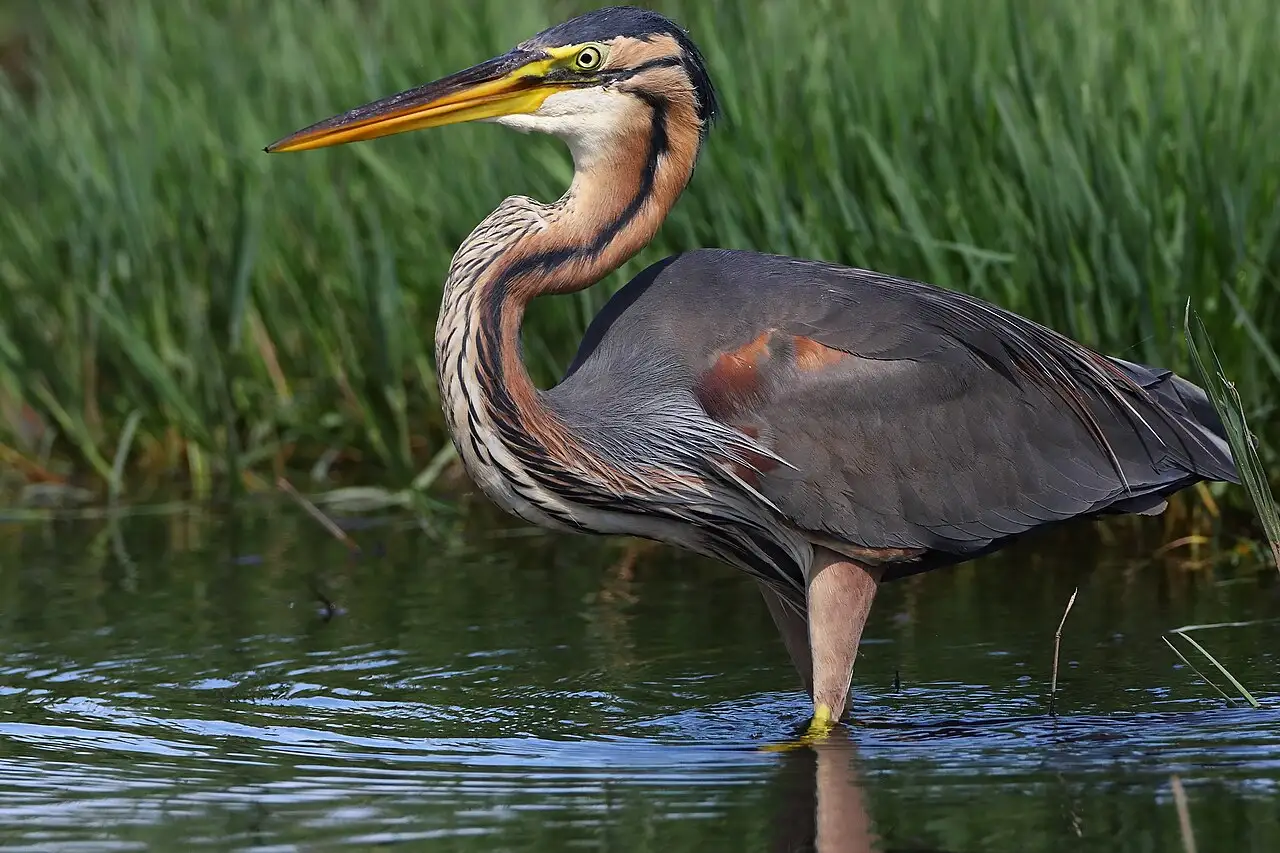
Adult Purple Heron in the water beside the vegetation, with chestnut neck striped with black, yellow bill and purple-grey bodyPhoto: José Prego from Moura, Portugal, CC BY 2.0Photo 1 of 4
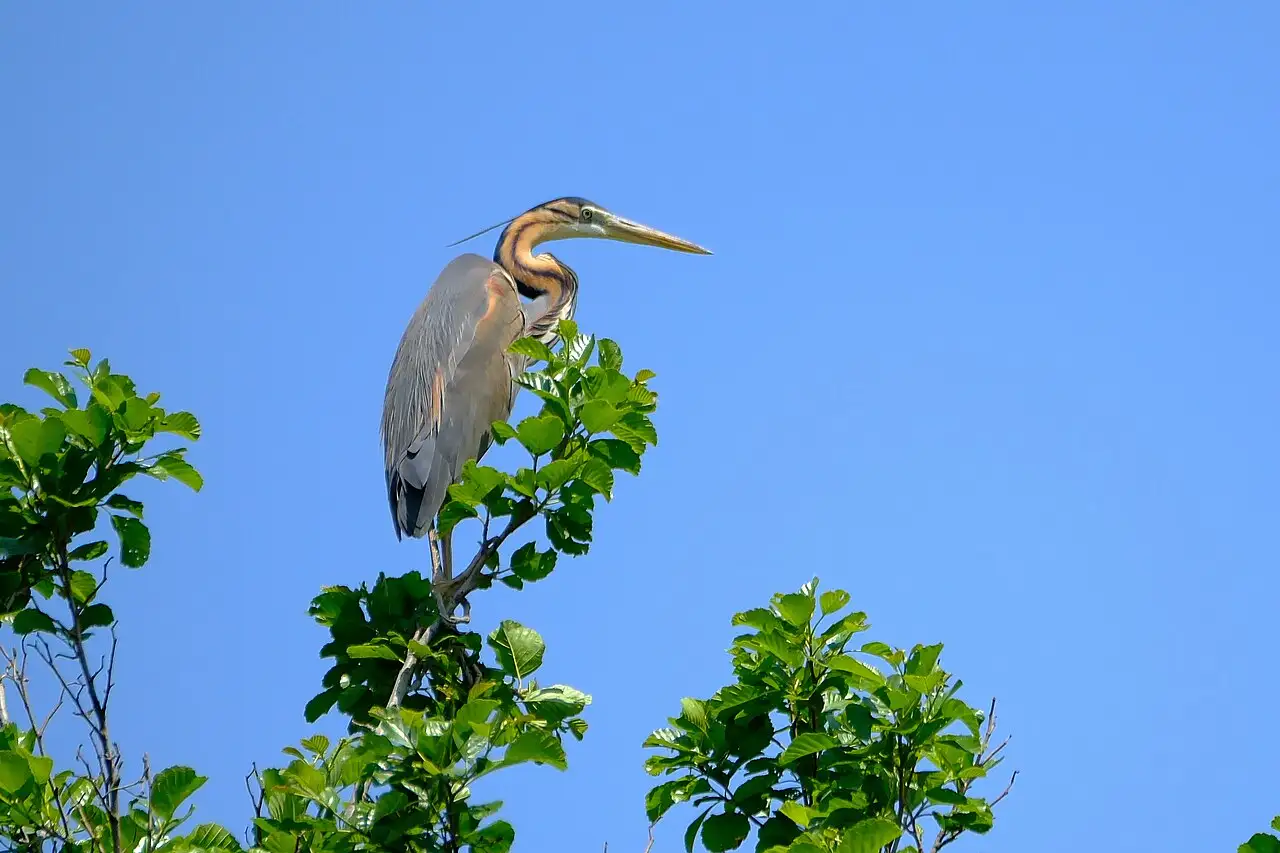
Purple Heron perched at the top of a tree against the blue sky, with long neck and yellow billPhoto: Lilu2024, CC0Photo 4 of 4
1 / 4
Identification of the Purple Heron
Males and females are very alike, although the female is somewhat smaller. In the breeding season they wear a showy pattern of chestnut, purple and grey tones, in which the black and white lengthwise bands of the neck stand out, extending into long mottled feathers, and the blackish cap with greenish iridescence, from which a pair of dark feathers spring. Underneath, the wings are very dark, and on the shoulders wine tones with purple sheen dominate. It is a very slender bird, with an extraordinarily sleek silhouette. It is quite like the Grey Heron, but its smaller size and darker overall tone give it away, both perched and in flight.
Adult
Chestnut, purple and grey tones.
Neck with black and white bands and blackish cap.
Wings very dark underneath.
Young bird
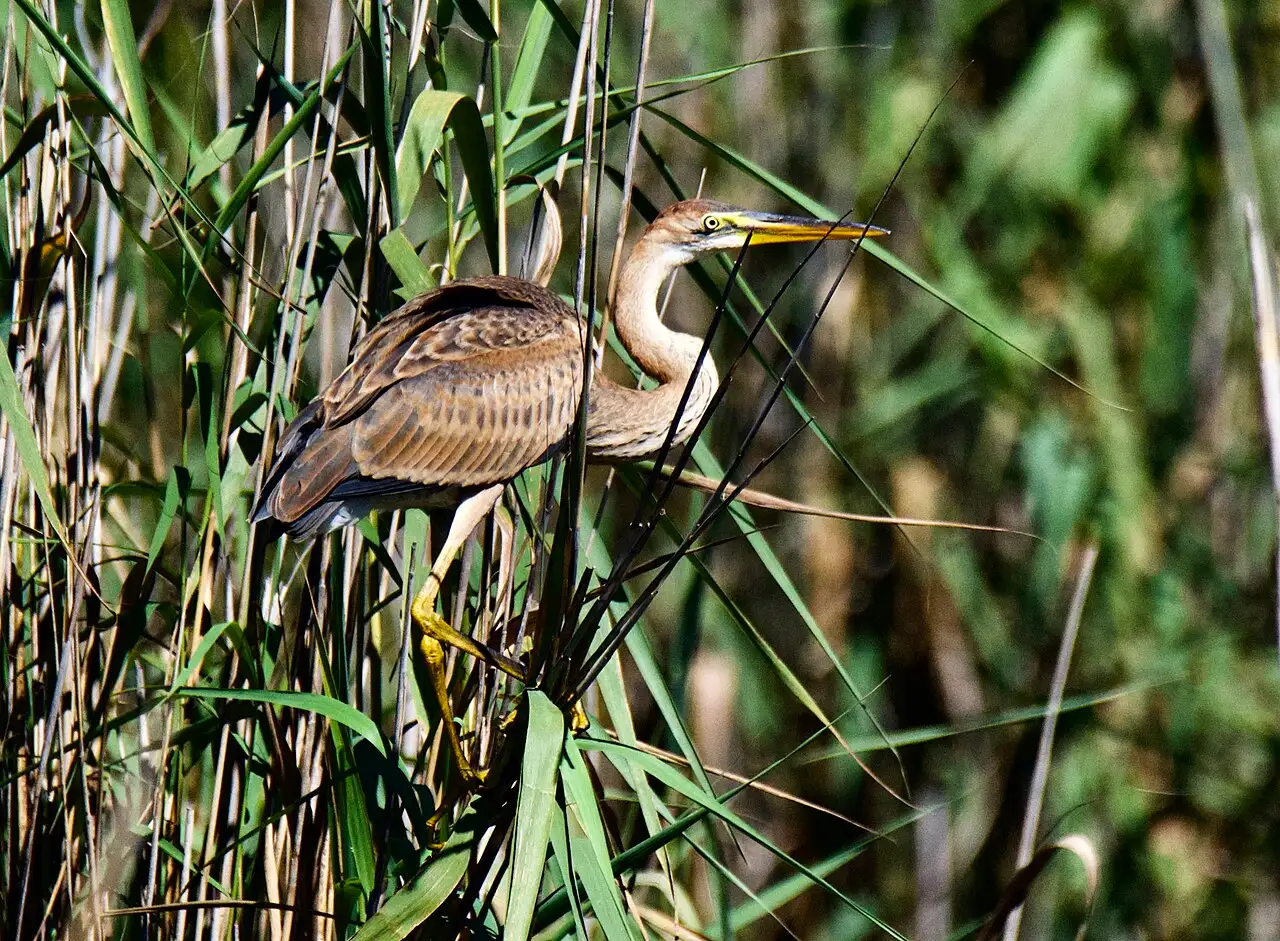
Less contrasting, without the neck lines and brownish overall.
Habitat and distribution of the Purple Heron
It has a fairly southern and restricted distribution: it occupies sites in southern Europe, southern and eastern Asia and northern and south-eastern Africa. Several subspecies are recognised, and in Spain «purpurea» breeds, that of western Eurasia and part of Africa.
In Spain its population is scattered and suffers strong ups and downs depending on the water level of the wetlands. The most important breeding areas are the Guadalquivir marshes, the Ebro delta, the Albufera of Valencia and the Ebro and Guadalquivir basins, and to a lesser extent those of the Tagus and Guadiana. There are also small cores in Madrid, Castilla y León, Castilla-La Mancha, Extremadura, Murcia, Cantabria and the Andalusian coast, and it also breeds in Mallorca.
It prefers reedbeds and cattail beds for nesting, and to feed it chooses shallow water, fresh or brackish, with abundant marsh or floating vegetation: lagoons, marshes, banks of slow rivers, reservoirs, gravel pits and even irrigation canals and rice fields.
It leaves the breeding areas between August and October and returns between April and May. Iberian birds winter in sub-Saharan Africa, and in Spain only a small number stay in winter, above all in the lower Guadalquivir, Murcia and the Tagus and Segura basins.
Areas where it is regularly recorded since 2010Squares of about 25 km where it is recorded regularly (occasional passage records are left out). Data from GBIF.org (81,354 records, retrieved October 2026); outline from Natural Earth.
Etymology of the Purple Heron
Its scientific name refers to its overall wine-purple colouring: «purpurea»1. The genus, «Ardea», is the Latin name for the heron. According to Wikipedia, Linnaeus gave it the name it still bears in 1766. In other languages it is «agró roig» in Catalan, «garza rubia» in Galician, «koartza gorria» in Basque and «purple heron» in English1.
Population of the Purple Heron
In the 2021 European Red List of Birds the European breeding population is estimated at between 57,700 and 97,300 mature individuals, with an increasing trend. In Spain, the 2011 census gave some 5,379 pairs, 70 % in the Guadalquivir marshes and another 13 % in the Ebro delta. Its trend has been positive over the last 40 years, with a notable increase in Navarre, Mallorca and the Ebro delta.
It is very vulnerable to habitat changes: dredging, channelling, burning of marsh vegetation or the destruction of reedbeds can wipe out a colony. Drought in its winter quarters and the indiscriminate use of pesticides, which has made some populations decline greatly, also affect it.
Nest of the Purple Heron
It is an untidy heap of aquatic plant stems, generally over water and well protected in the reedbed. It breeds in sparse colonies and almost always of its own species, although sometimes it joins other herons.
Courtship and breeding of the Purple Heron
Pairs form as soon as they reach the breeding sites, around March. After courtship they build the nest, and the female lays, normally in mid-April, four or five eggs, sometimes up to eight, pale bluish green, which become speckled during incubation. Both parents incubate, taking turns, for 25–30 days. The chicks hatch with long brownish down and, thanks to the parents’ care and the abundant food, at about 10 days they leave the nest for short spells to move around. At 45–50 days they are fully developed, and soon afterwards they disperse.
Diet of the Purple Heron
It prefers to hunt alone or, at most, in small scattered groups. Posted at the water’s edge, motionless and half hidden among the vegetation, it waits for prey to come within range and catches it with a quick movement of the neck; at other times it advances slowly along muddy shores, stalking. Its preferred prey are medium-sized fish, such as perch or eels, and it completes its diet with amphibians, aquatic and terrestrial insects, above all grasshoppers, and small mammals such as shrews, voles or water voles. Sometimes it raids the nests of other waterbirds, such as ducks or coots.
Curious facts about the Purple Heron
EURING’s longevity record list gives a Purple Heron ringed in the Netherlands that is said to have lived 44 years and 8 months, a figure that is badly out of line with the 25.4 years AnAge gives; the next on the list, also Dutch, reached 26 years and 8 months.
The Purple Heron in Cabañeros
The habitat pages of this website do not mention it, and we have not found any other published source on it in the Park. GBIF.org records 28 observations of the Purple Heron in Cabañeros and its surroundings.
Where to see the Purple Heron in Cabañeros
In Cabañeros and its surroundings, from March to October, in reservoirs, ponds and shores with reeds or cattails.
When
From March to October: it arrives between March and May and leaves between August and October.
What time
By day, motionless, stalking at the water's edge.
Where
In reedbeds, cattail beds, lagoons, banks of slow rivers, reservoirs and gravel pits.
What to look for
Look for its purple and chestnut tone, darker than the Grey Heron's, and the striped neck; listen for its hoarse «aart».




 Same family
 Same family
 Same family
 Same family
 Same season in the park
 Same season in the park
 Same season in the park
 Same season in the park






