Alone or in pairs; very territorial and aggressive towards other species, its own kind and even its fledged young
Lifespan
Record of almost 13 years in the wild
Conservation status
LC
NT
VU
EN
CR
EW
EX
Global (IUCN)
Least Concern
Spain
Included in the List of Wild Species under Special Protection; not in the Spanish Catalogue of Threatened Species
When to see it
Resident
Months of the year when it is present
J
F
M
A
M
J
J
A
S
O
N
D
In Iberia
yes
yes
yes
yes
yes
yes
yes
yes
yes
yes
yes
yes
Breeding season
no
no
no
yes
yes
yes
no
no
no
no
no
no
Song or voice of the Eurasian Nuthatch
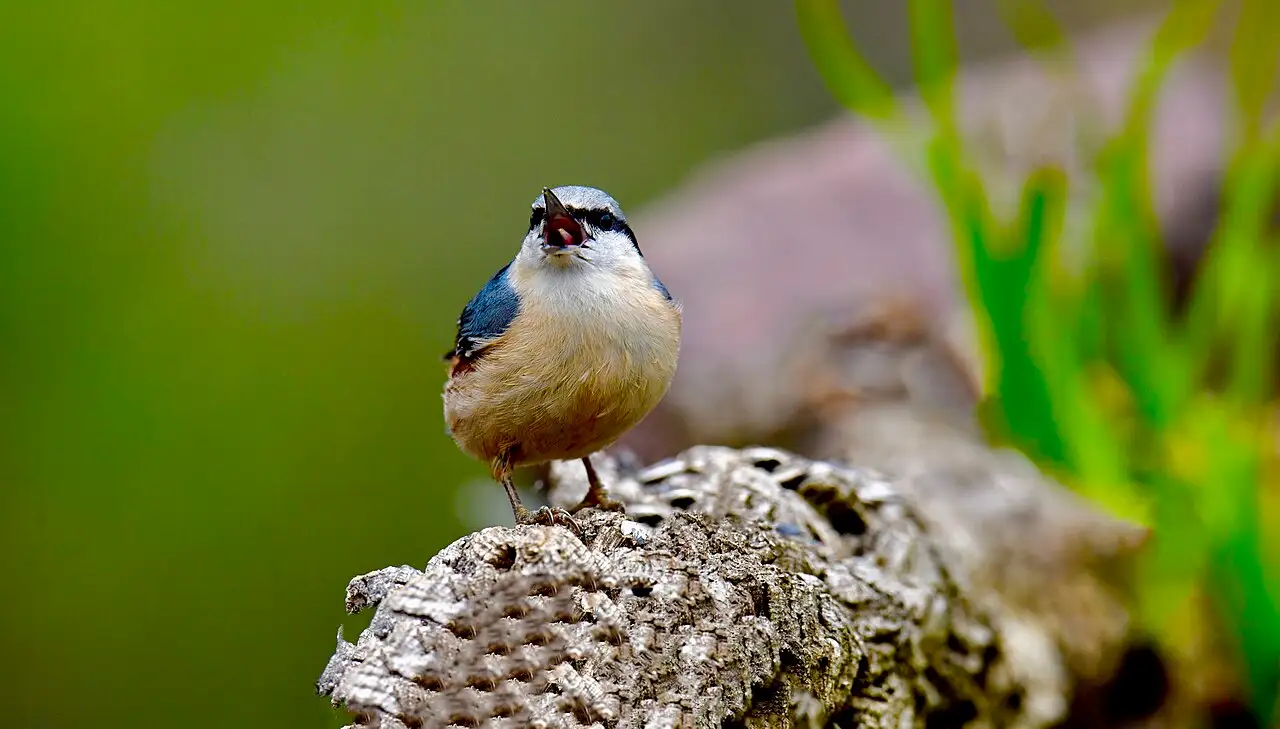
It often calls with deep, short sounds, repeated very quickly, «chuic-chuic-chuic», «choc-ro-ro-roc», or spaced out, «chuuuiiic». In spring it strings those notes into long series of whistles that rise and repeat like a trill, and are heard long before the bird is seen.
SongEurasian Nuthatch
0:00 / 0:14
10 kHz5
The sonogram draws the sound: time runs from left to right, and the higher a trace sits, the higher the note.Recording by Alexander Kürthy, Wikimedia Commons (CC BY-SA 4.0).
Flight of the Eurasian Nuthatch
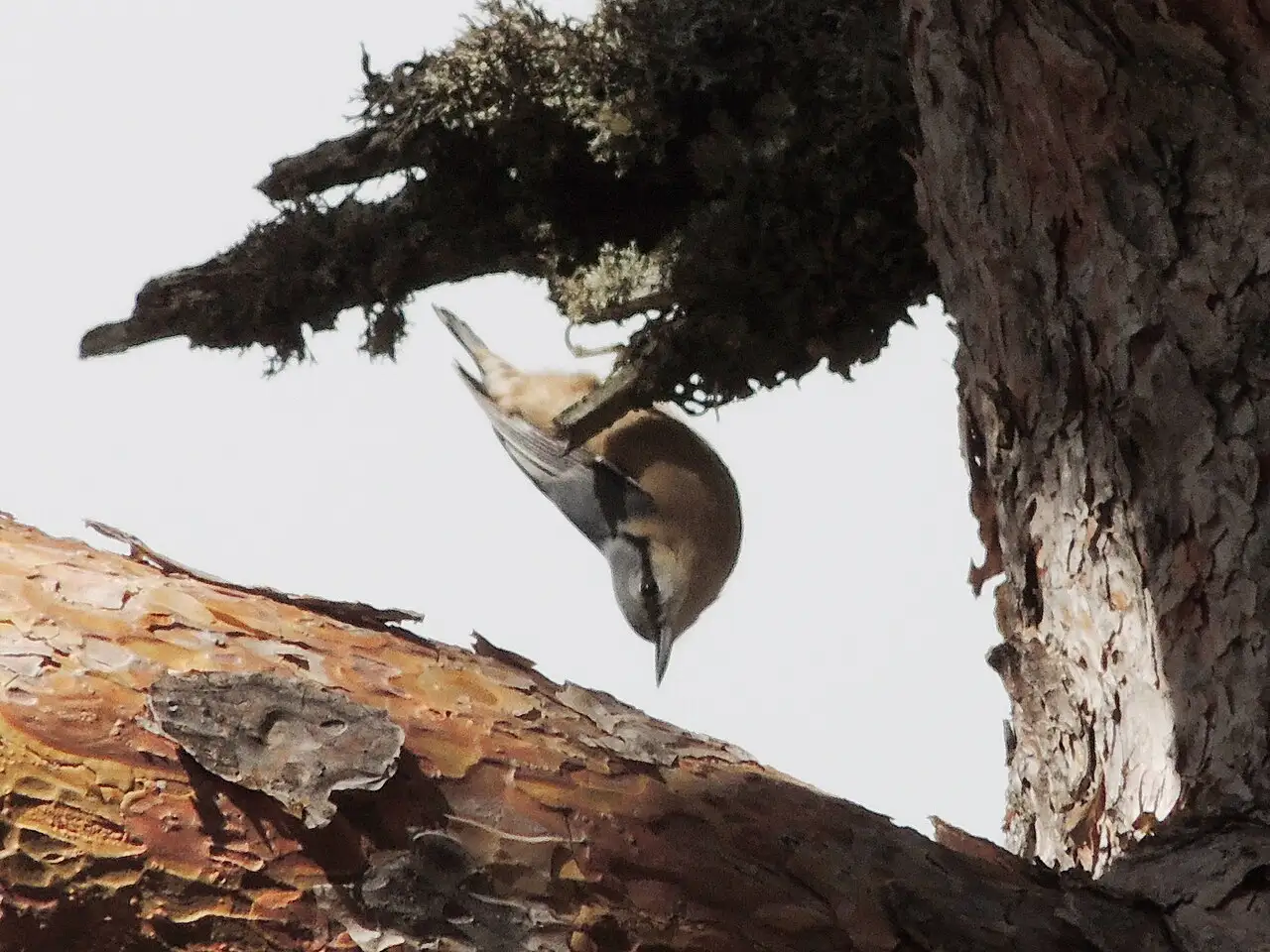
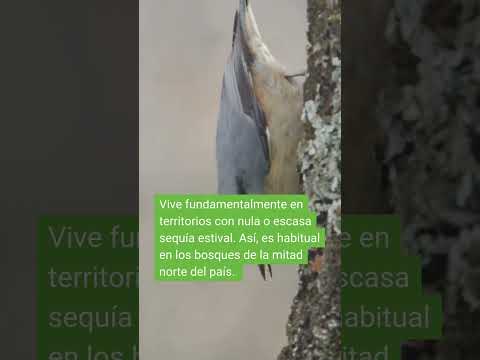
It flies little: short, undulating trips, with quick wingbeats, from one trunk to another. We almost always see it pressed to the bark, climbing in a spiral and even head downwards, something no other bird of our woods does so easily.
Flight typeShort and undulating, from trunk to trunk
It drops from the trunk with a few quick wingbeats, almost without warning. It is the only bird that goes down a trunk head first.
Short, undulating flight, with quick wingbeats, short tail and rounded wings, from trunk to trunk.
It brakes with its tail spread and clings to the bark with its feet, ready to climb or descend.
Photo gallery of the Eurasian Nuthatch
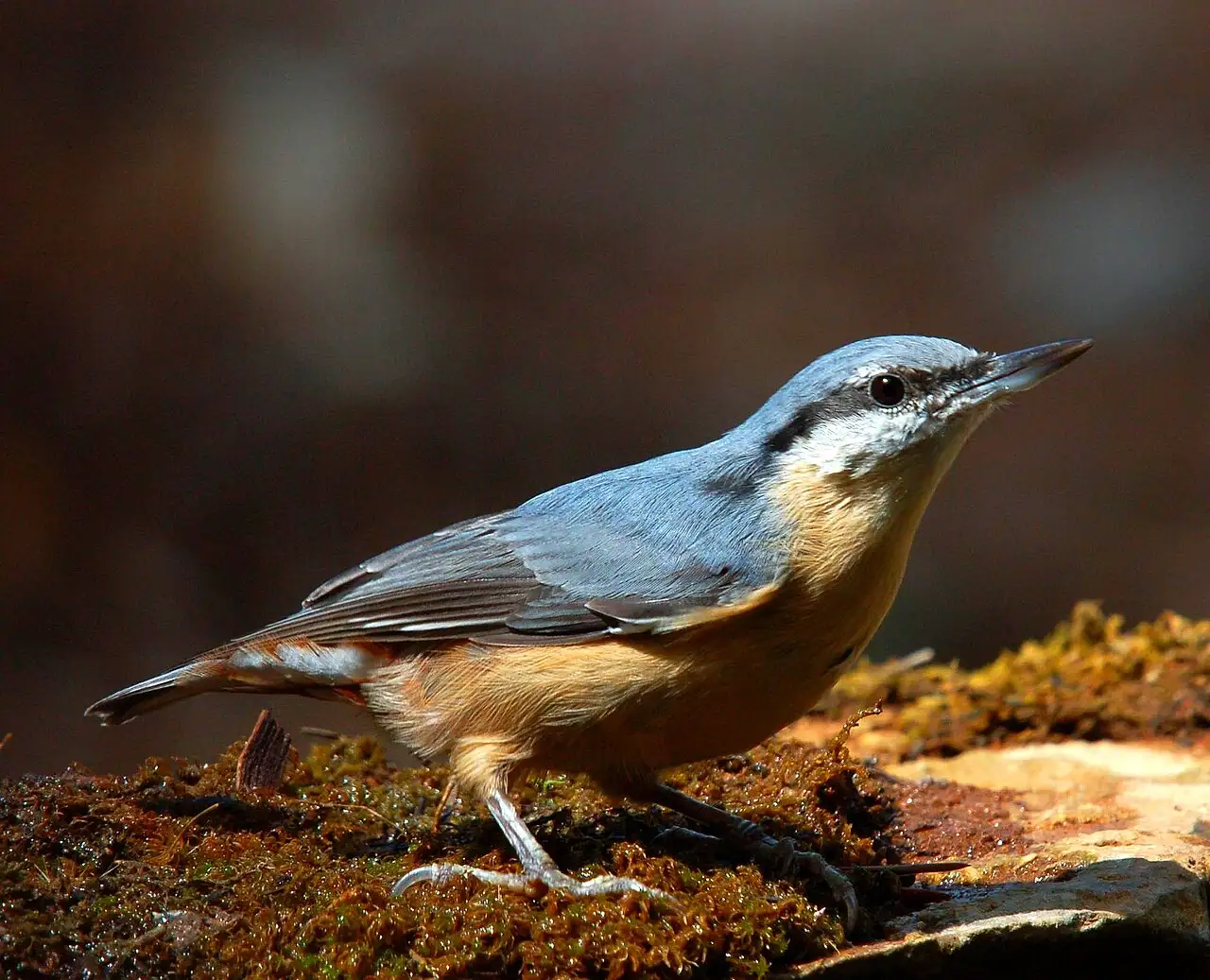
Eurasian Nuthatch on a mossy trunk, in profile: blue-grey back, black eye-mask and orange bellyPhoto: rjime31, CC BY-SA 2.0Photo 1 of 4
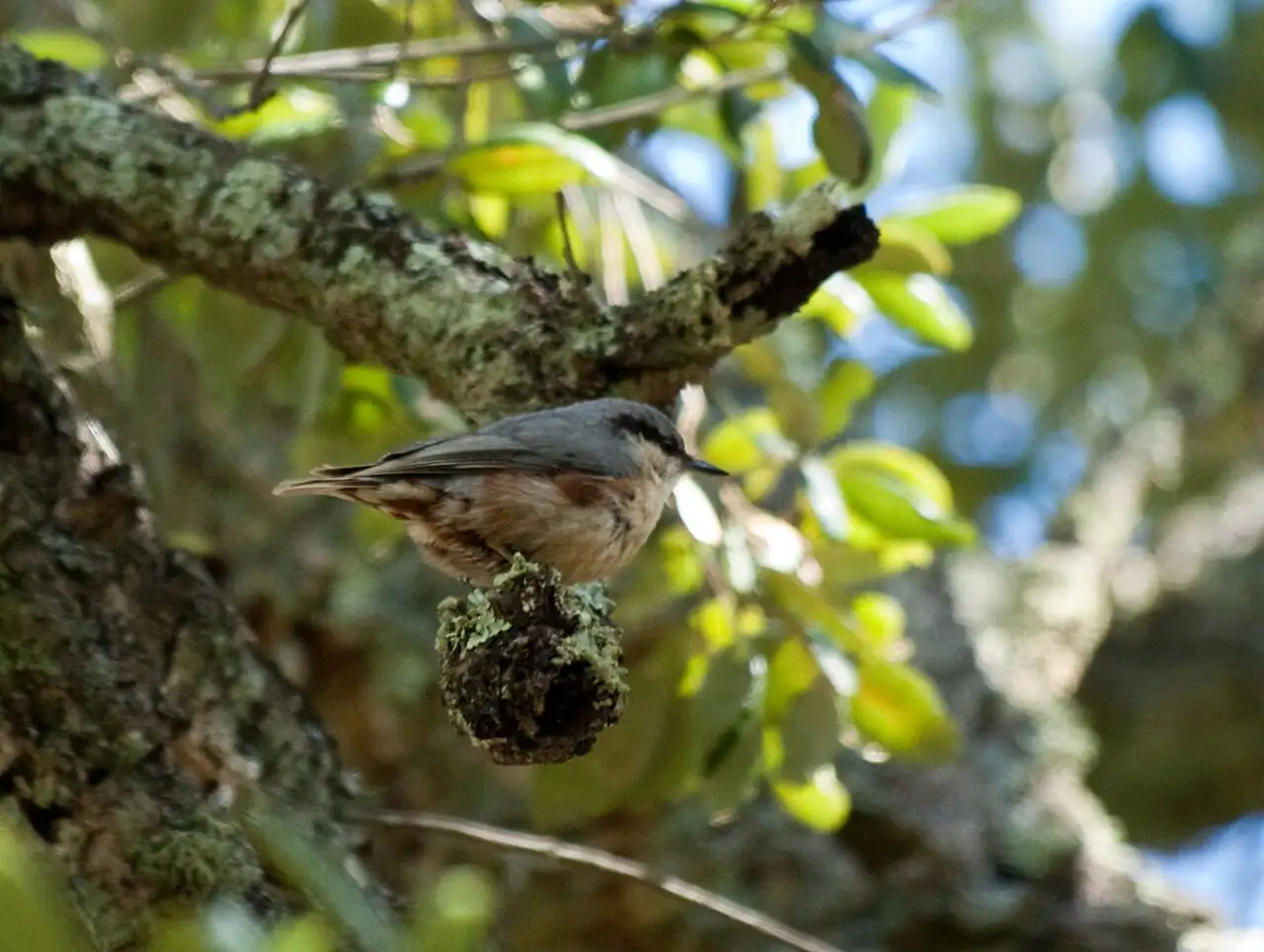
Eurasian Nuthatch of the Iberian subspecies «hispaniensis», perched on a lichen-covered branch, photographed in HuelvaPhoto: hhhalberto, CC BY 2.0Photo 2 of 4
Eurasian Nuthatch going down a branch head first in the Fuenfría valleyPhoto: Fernando Lisón Martín, CC BY 2.0Photo 3 of 4
It is recognised by three features: its bluish colour, that it has no neck and that it moves pressed to trunks and branches, even head downwards. It is a small bird, the size of a sparrow, with sturdy legs, a very thick head and a long, strong bill.
Adult
Blue-grey on wings, back and tail.
Underparts faintly orange, more intense in males.
The male also has maroon patches on the flanks and under the tail.
Habitat and distribution of the Eurasian Nuthatch
It is distributed across extensive temperate zones of Europe and Asia, from Japan to the Peninsula, and also occurs in North Africa. In Europe it is very common, although it is scarce in Scandinavia, does not reach Ireland and is scarce on the Mediterranean coast.
In Spain there are two subspecies: «caesia», in the Pyrenees and other northern regions, and «hispaniensis», in the centre and south. It lives where there is almost no summer drought, so it is common in the woods of the northern half and, further south, scarcer and limited to cool montane areas, except in the south-west, where it comes down to sea level. It needs woods with mature trees and avoids plantations of poplar, pine and eucalyptus. It reaches its highest densities in deciduous woods of oak and Portuguese oak, and secondarily occupies holm oak and cork oak woods. In Mediterranean territories it can spread into dry, low areas sheltered by riverside woods. It is essentially sedentary.
Areas where it is regularly recorded since 2010Squares of about 25 km where it is recorded regularly (occasional passage records are left out). Data from GBIF.org (162,933 records, retrieved October 2026); outline from Natural Earth.
Etymology of the Eurasian Nuthatch
«Sitta» comes from the Greek «sitte», an ancient name for a bird that climbs trees, and «europaea» is «of Europe». The Spanish «trepador» alludes to its habit of climbing trunks, and «azul» to the colour of its back.
Population of the Eurasian Nuthatch
In Spain there are about 1,042,433 individuals, with the largest share in Castilla y León. Between 1998 and 2018 its trend was a moderate increase, possibly through the recovery of woods after the abandonment of farming. In Europe between 19 and 34.7 million mature individuals are estimated, stable. It is listed as Least Concern. Being strictly a woodland bird, it disappears with fires, is affected by forest fragmentation, above all in the southern half, where it needs larger territories than in the north, and is sensitive to forestry operations, which prevent large trees from growing.
Nest of the Eurasian Nuthatch
It chooses natural holes or artificial nest boxes and takes over old woodpecker nests. When the hole is too wide, it narrows the entrance with mud. The female builds the nest with scales of pine bark or leaf litter.
Courtship and breeding of the Eurasian Nuthatch
It usually lays a single clutch, starting in April or May; sometimes it starts earlier and has two broods. It lays six to nine eggs, white with reddish or purple speckles, and incubates them for 13 to 18 days. The chicks leave the nest and their parents’ territory at three or four weeks.
Diet of the Eurasian Nuthatch
It eats arachnids and insects, above all adults and larvae of beetles, butterflies and flies. It also feeds on seeds and fruits, with a special fondness for pine nuts and hazelnuts.
Curious facts about the Eurasian Nuthatch
It is the only bird of our woods that goes down trunks head first. And the acorns it splits with its bill are not wasted: robins, tits and others make use of the remains.
The Eurasian Nuthatch in Cabañeros
The guide on this website cites it among the birds of the deciduous woodland of Cabañeros, at a lower density than the tits, the Common Chaffinch and the robin.
Where to see the Eurasian Nuthatch in Cabañeros
In the deciduous woodland and in the park’s holm oak and cork oak woods with old trees.
When
All year; it does not migrate and stays in its territory even in hard winters.
What time
In the morning, when it sings and moves most; it is heard long before it is seen.
Where
Pressed to the bark of old oaks, holm oaks and cork oaks, going up and down the trunk and thick branches.
What to look for
A blue-grey bird with a black eye-mask, going down the trunk head first.




 Also in deciduous woodland
 Also in deciduous woodland
 Also in deciduous woodland
 Also in deciduous woodland
 Also in deciduous woodland
 Also in deciduous woodland
 Also in deciduous woodland
 Also in deciduous woodland






