Record of almost 11 years in the wild (a bird ringed in the United Kingdom)
Conservation status
LC
NT
VU
EN
CR
EW
EX
Global (IUCN)
Least Concern
Spain
Included in the List of Wild Species under Special Protection; not in the Spanish Catalogue of Threatened Species
When to see it
Resident
Months of the year when it is present
J
F
M
A
M
J
J
A
S
O
N
D
In Iberia
yes
yes
yes
yes
yes
yes
yes
yes
yes
yes
yes
yes
Breeding season
no
no
no
yes
yes
yes
yes
no
no
no
no
no
Song or voice of the Eurasian Blackcap
A very melodious and varied song, made of long, fluty phrases, which joins quick stretches with slower, more musical ones and gains in intensity. The call is an insistent «chec-chec-chec». It is one of the songs most heard in cool woodlands, and it almost always comes from a bush that does not let you see the singer.
SongEurasian Blackcap
0:00 / 0:28
10 kHz5
The sonogram draws the sound: time runs from left to right, and the higher a trace sits, the higher the note.Recording by Carlos Andre, Wikimedia Commons (CC BY-SA 4.0).
Flight of the Eurasian Blackcap
It flies little and low, in short, undulating stretches, from shrub to shrub, with quick wingbeats. The usual sight is of it among the branches, looking for insects or eating fruit.
Flight typeShort and undulating, from shrub to shrub
It leaves the bush with a quick flutter and a dry call, «chec-chec». We almost always hear it before we see it.
Short, undulating flight, with quick wingbeats, from one shrub to another. The grey of the body and, in the male, the black cap can be seen.
It brakes with its tail spread and slips in among the branches, where it goes on looking for insects or fruit.
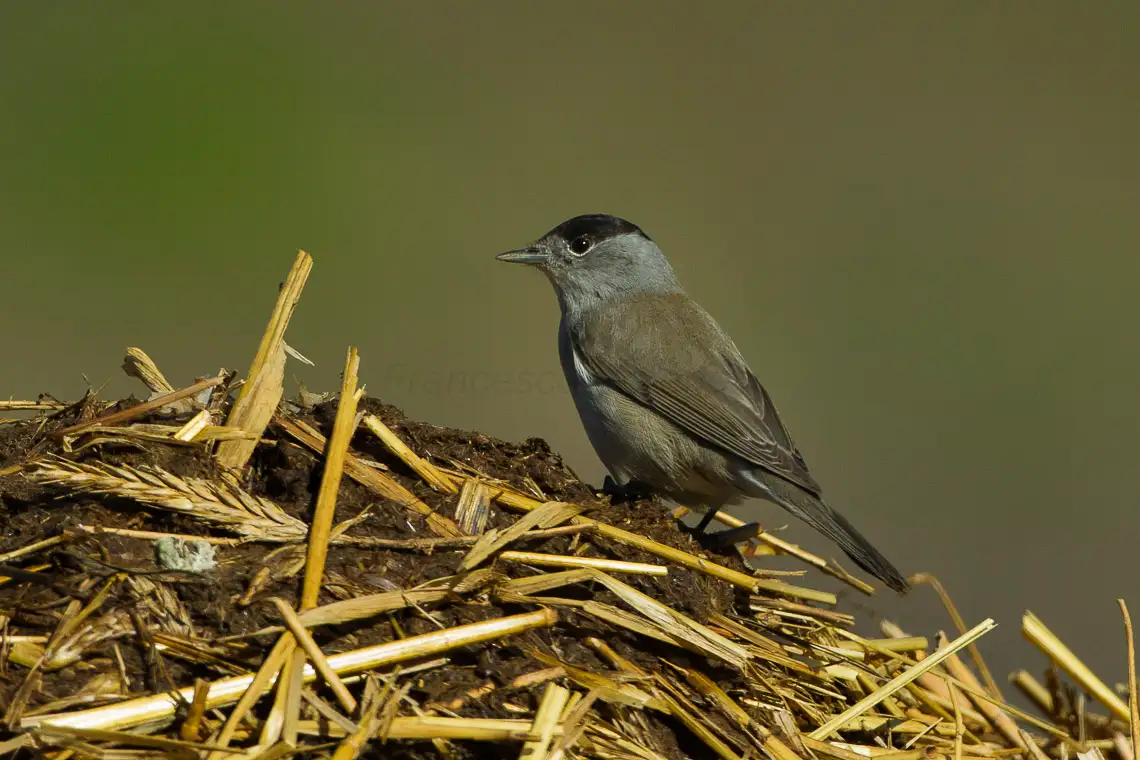
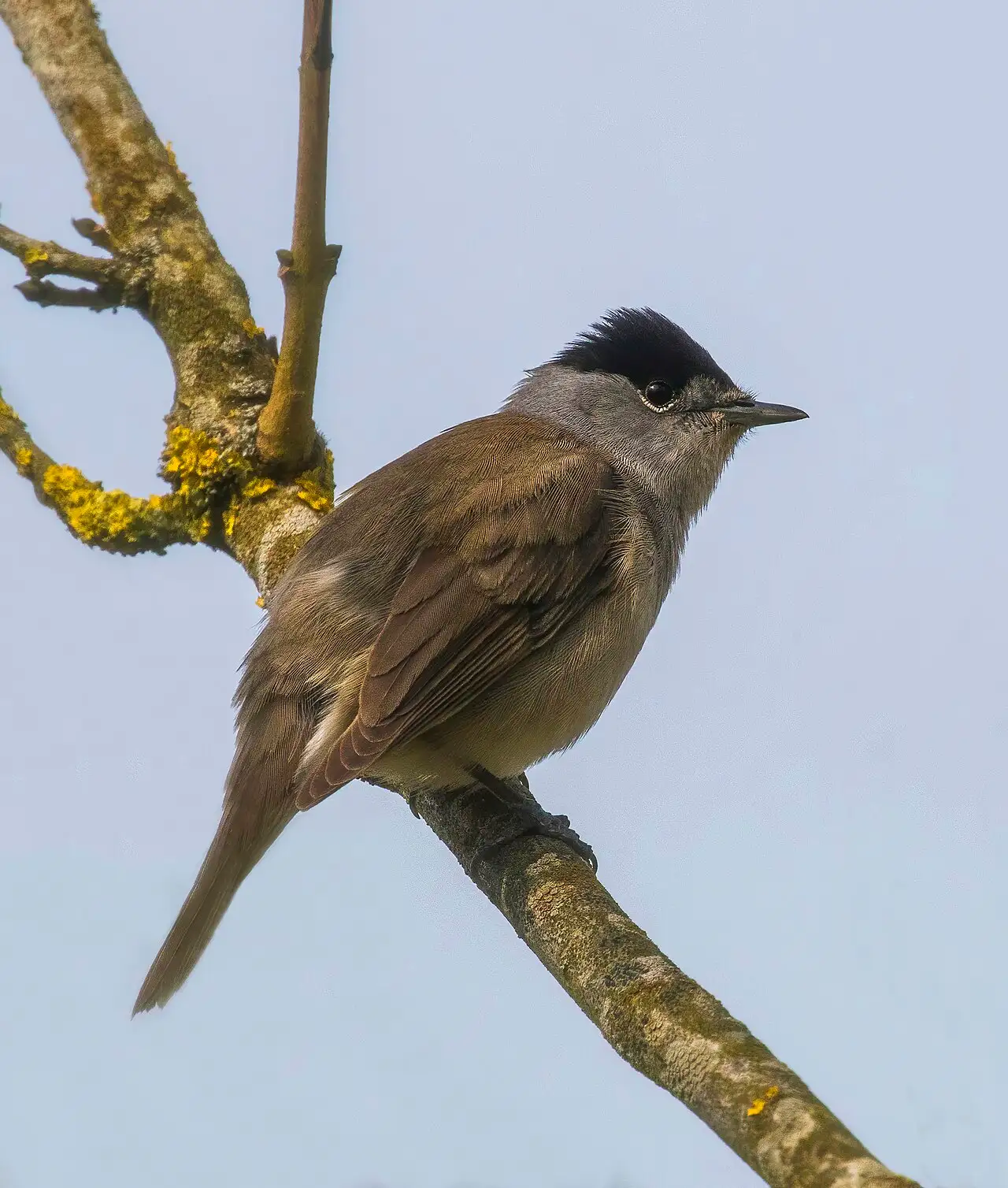
Male Eurasian Blackcap perched on a branch, with black cap and greyish-brown backPhoto: Charles J. Sharp, CC BY-SA 4.0Photo 2 of 4
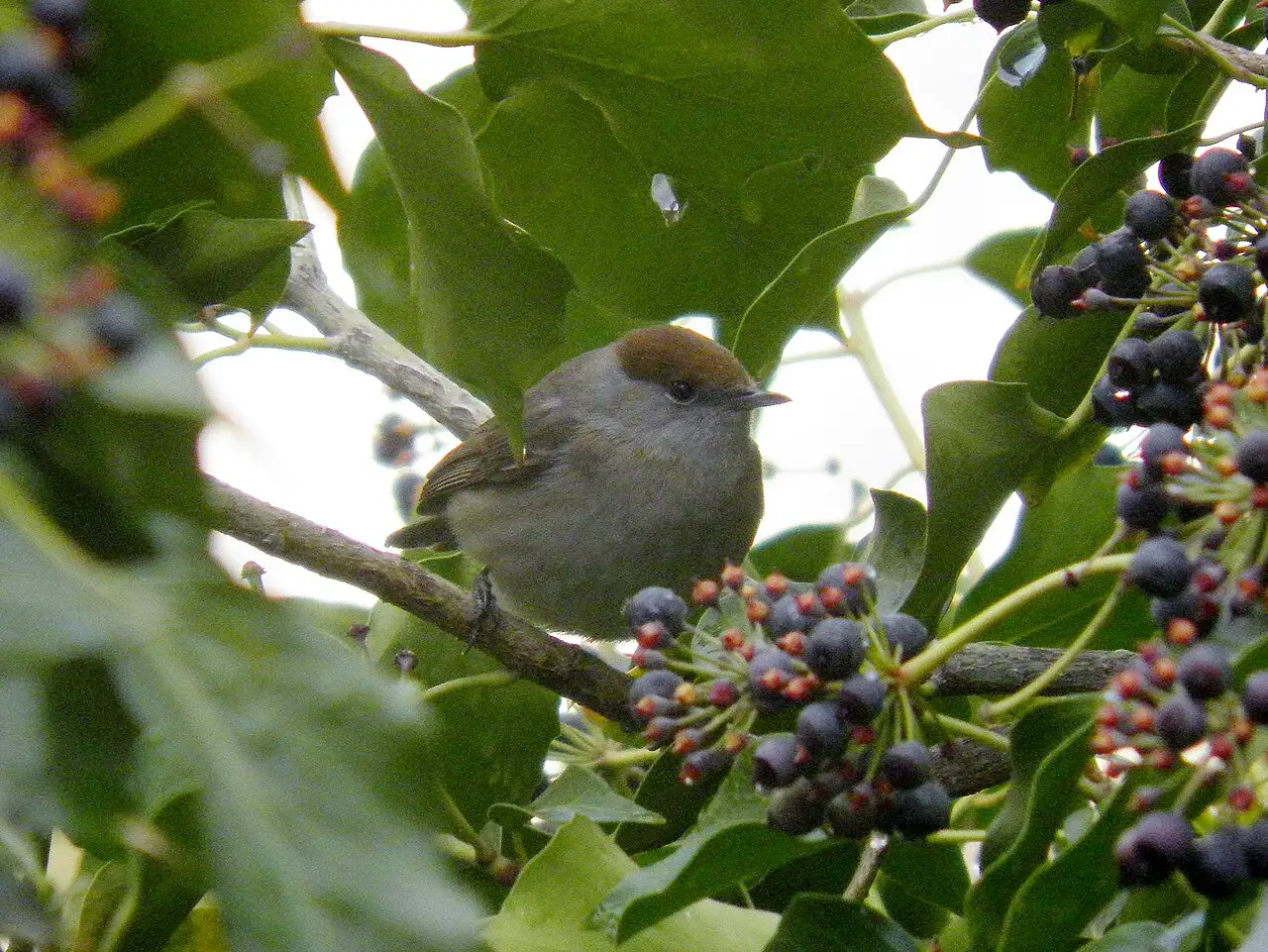
Female Eurasian Blackcap with chestnut cap, among the branches and fruits of an ivyPhoto: Alfonso Mora, CC BY-SA 4.0Photo 3 of 4
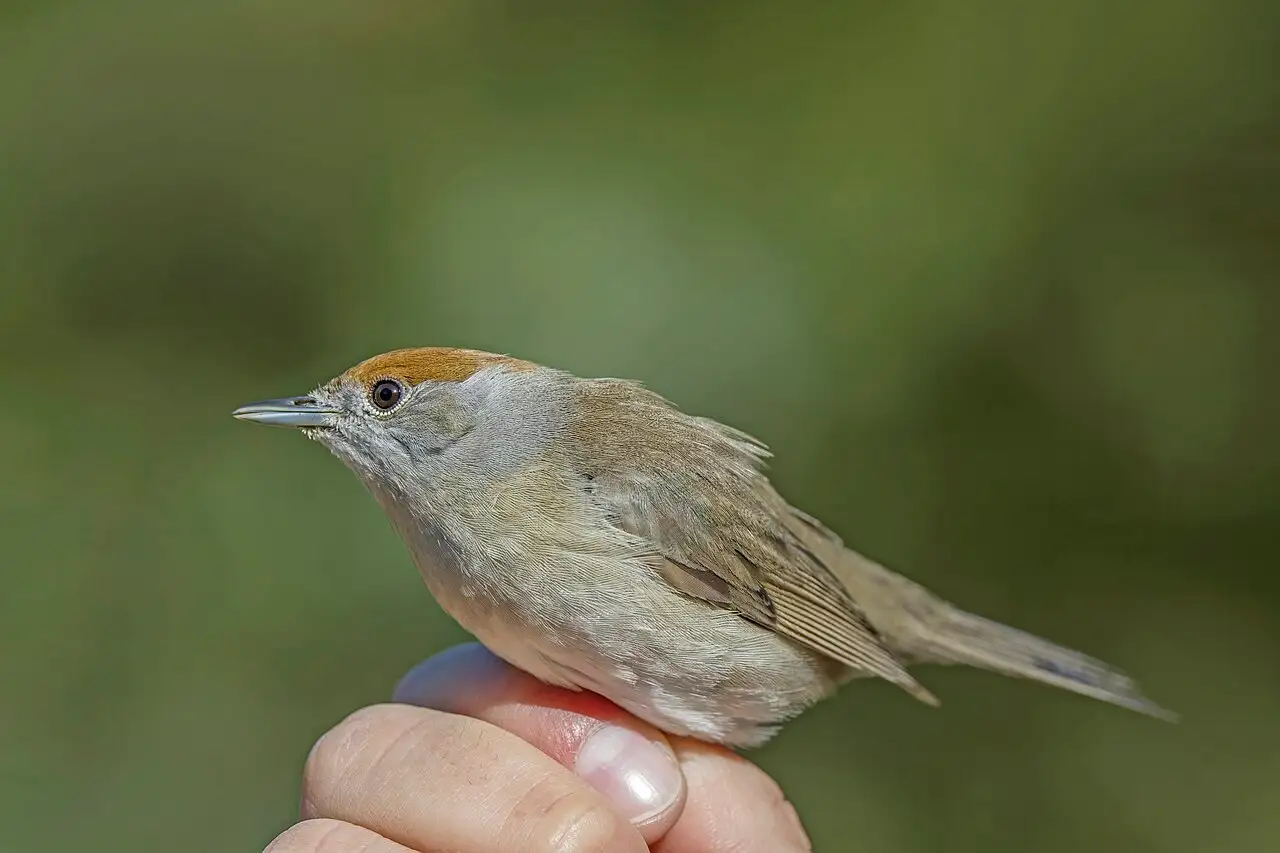
Ringed female Eurasian Blackcap held in the hand, with chestnut cap and thin billPhoto: Charles J. Sharp, CC BY-SA 4.0Photo 4 of 4
1 / 4
Identification of the Eurasian Blackcap
It is a medium-sized warbler, of more compact and robust look than almost all its relatives, although very similar in size and silhouette to the Garden Warbler. Like that species, and unlike most warblers, it lacks the whitish throat and outer tail feathers. It is a greyish tone overall, although the female shows more reddish-brown tints on the wings and underparts.
Male
Black cap.
Grey above and paler below.
Female and young bird
Chestnut cap.
The female, with more reddish-brown tints on wings and underparts.
Habitat and distribution of the Eurasian Blackcap
It is a common species, widespread across Europe, central Asia and North Africa, and appears more patchily around the Black Sea. Several subspecies are recognised; three live in Spain: «atricapilla», widespread in the northern half, «heineken», in the southern half and the Canaries, and «paulucii», restricted to the Balearics.
In Spain it is widely spread across the whole Peninsula, the Balearics and the western Canary Islands; it is absent or scarce in the deforested and more arid areas of the south-east and in the great expanses of steppe or treeless crops of Extremadura and both plateaus. It is a woodland species of cool, damp environments, with the highest abundances in riverside groves, oak woods and holm oak woods with good undergrowth and clearings; it also appears in pine woods, parks and gardens and in mosaics with shrubby hedges. Its movements are complex: the populations of central and northern Europe are trans-Saharan migrants, and in much of Spain it is resident, with partly migratory populations in the north. Spain is a stopover and wintering ground for a large proportion of the Blackcaps of western Europe, with the pre-breeding passage from February to April and the post-breeding one from September to November.
Areas where it is regularly recorded since 2010Squares of about 25 km where it is recorded regularly (occasional passage records are left out). Data from GBIF.org (857,434 records, retrieved October 2026); outline from Natural Earth.
Etymology of the Eurasian Blackcap
«Sylvia» comes from Latin «silva», «forest», «wood», and «atricapilla», from «ater», «black», and «capillus», «hair»: «the black-haired one». It is the male’s cap that gives the species its name in Spanish.
Population of the Eurasian Blackcap
In Spain some 6 million individuals are estimated, with the highest concentrations in the regions of the northern half, and with clearly positive trends according to the SACRE programme between 1998 and 2018. In Europe between 38 and 88.4 million birds are estimated, with an increasing trend. It is classified as Least Concern. It does not seem to suffer any major threats, although pesticides and the destruction of riverside groves and of the fringes of trees and shrubs in farmland may affect it.
Nest of the Eurasian Blackcap
The male starts several rudimentary nests, and the female chooses one and finishes it. They are small cups of twigs and leaves, lined with hair and feathers, usually low down, in the thicket of a shrub or tree.
Courtship and breeding of the Eurasian Blackcap
The breeding season runs from April to July and it may make two clutches a year. The clutch consists of two to seven eggs, normally four to six, pinkish white with variable speckles, which both parents incubate for 11 or 12 days. The chicks, which both feed, can fly at 8 to 14 days.
Diet of the Eurasian Blackcap
In the breeding season it eats mainly invertebrates. In autumn and winter it can eat a lot of fruit, of many kinds: blackberries, figs, mastic and wild olive berries, among others.
Curious facts about the Eurasian Blackcap
Spain is a stopover and wintering ground for a large part of the Blackcaps of western Europe, so in winter our woods and olive groves fill with Blackcaps arrived from the north.
The Eurasian Blackcap in Cabañeros
The habitat pages of this website cite it among the birds of the mature scrub of the sclerophyllous forest which, in winter, base their diet on insects from the bark and leaf litter and come to depend on the fruits of the bramble, the mock privet, the laurustinus, the wild service tree, the myrtle, the mastic, the wild olive and the strawberry tree, together with the European Robin, the Spotless Starling and the Song Thrush.
Where to see the Eurasian Blackcap in Cabañeros
In the sclerophyllous woodland and riverside groves of Cabañeros, with good undergrowth.
When
All year round; in winter, with the arrivals from the north, it is more numerous. The spring passage runs from February to April and the autumn one from September to November.
What time
At dawn and first thing in the morning, when it sings most.
Where
In the undergrowth and fruiting bushes, low down, and in clearings of the woodland and riverside groves.
What to look for
A greyish, compact bird, with a black cap (male) or chestnut one (female), and a fluty song that comes out of a bush.
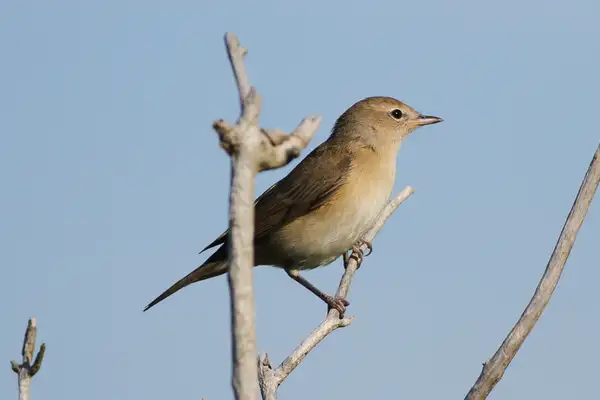
Very similar in size and silhouette, and also without white on the throat or tail, but a uniform brown and with no cap, with a discreet look and no marked features.
Photo: Ron Knight from Seaford, East Sussex, United Kingdom, CC BY 2.0
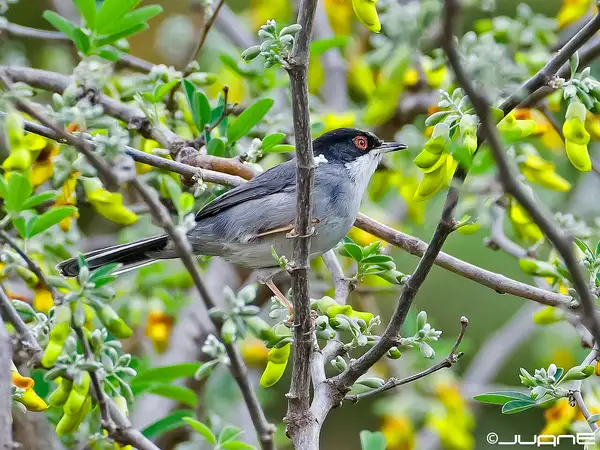
The male has a black head down to the throat, a red eye-ring and a long, dark tail with white feathers. It is one of the warblers that make up the scrub community of Cabañeros.
Photo: Juan Emilio from Las Palmas de Gran Canaria, Spain, CC BY-SA 2.0
Other birds
Birds related to the Eurasian Blackcap or sharing its habitats in Cabañeros.



 Same family
 Same family
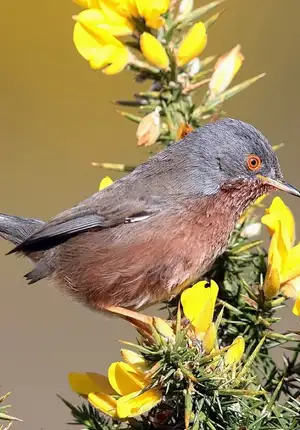 Same family
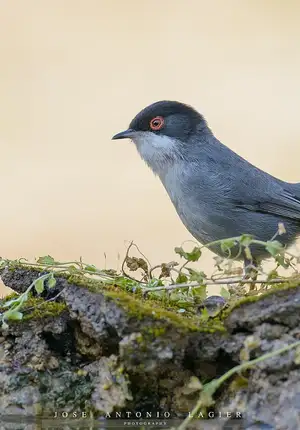 Same family
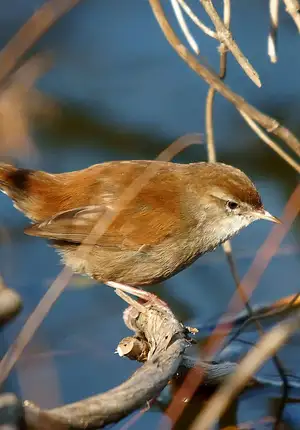 Also in sclerophyllous woodland
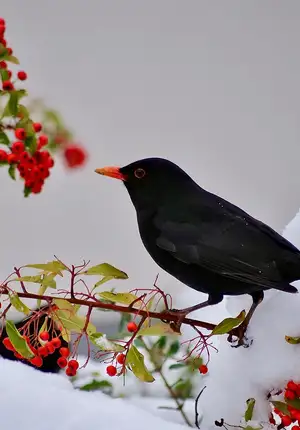 Also in sclerophyllous woodland
 Also in sclerophyllous woodland
 Also in sclerophyllous woodland






