Wingspan compared with a person with arms outstretched.
Length
76–96 cm
Wingspan
1.8–2.3 m
Weight
2.9–6 kg
Social life
In pairs; each pair usually has two or three nest platforms in its territory, which it alternates
Lifespan
Record of 36 years and 1 month in the wild (a bird ringed in Sweden)
Conservation status
LC
NT
VU
EN
CR
EW
EX
Global (IUCN)
Least Concern
Spain
Near Threatened (NT) in the Red Book of the Birds of Spain; included in the List of Wild Species under Special Protection and not in the Spanish Catalogue of Threatened Species
When to see it
Resident
Months of the year when it is present
J
F
M
A
M
J
J
A
S
O
N
D
In Iberia
yes
yes
yes
yes
yes
yes
yes
yes
yes
yes
yes
yes
Song or voice of the Golden Eagle
It is generally a silent species, although it can give a thin, flute-like whistle, both in flight and when perched.
WhistleGolden Eagle
0:00 / 0:19
10 kHz5
The sonogram draws the sound: time runs from left to right, and the higher a trace sits, the higher the note.Recording by Bicheando Natura, Wikimedia Commons (Vídeo de YouTube, con atribución).
Flight of the Golden Eagle
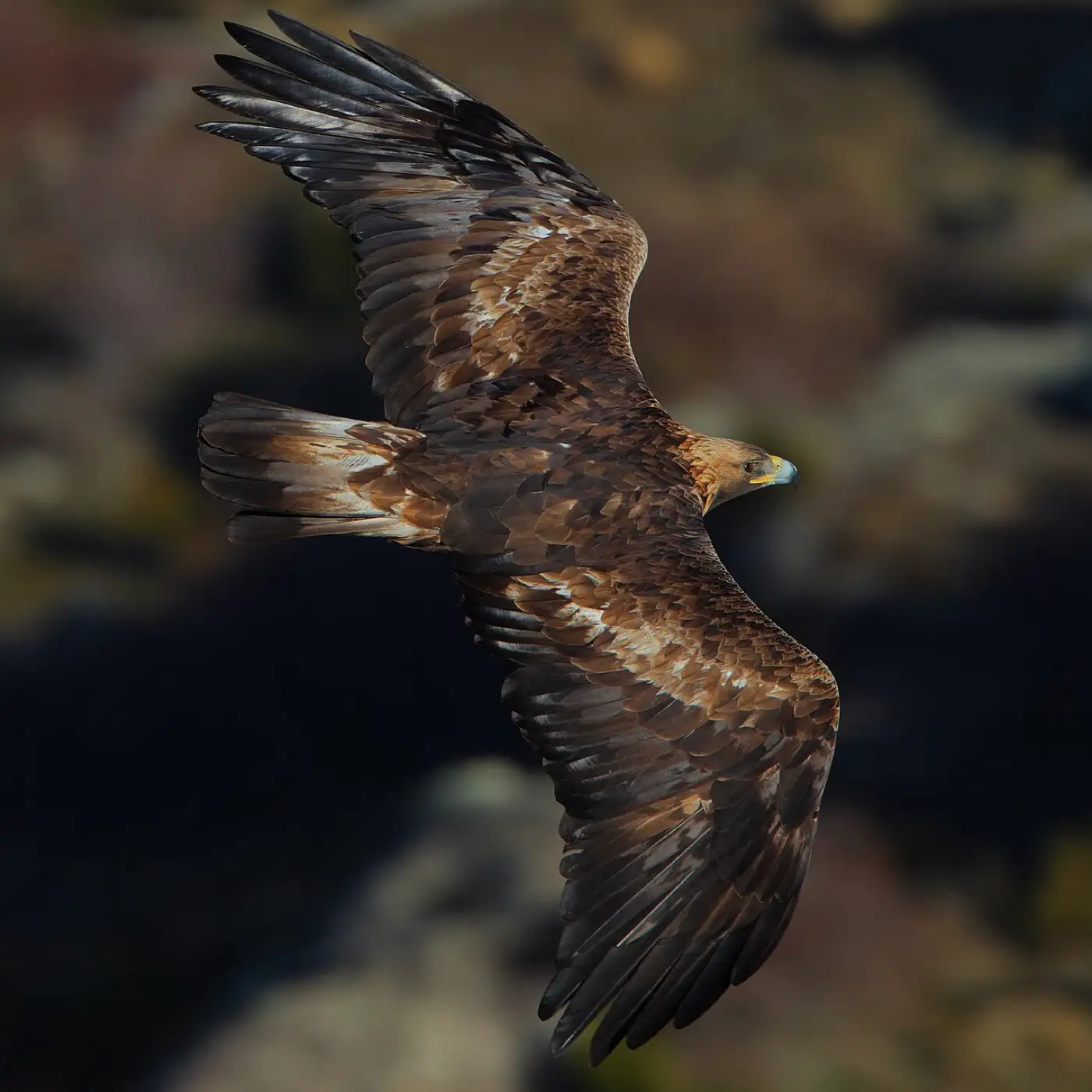
Its very well-proportioned silhouette is defined by long, broad wings with a very rounded trailing edge and a striking narrowing at the armpit, and a long tail. Seen in flight, at a distance it looks very dark, with the flight feathers and tail slightly paler.
Flight typeGlides over broken terrain, with long, broad wings
It climbs in circles with long, broad wings, with a very rounded trailing edge and a striking narrowing at the armpit, and the long tail.
It quarters the broken terrain in search of rabbits, hares, pigeons and partridges. From a distance it looks very dark, with the flight feathers and tail somewhat paler.
When it spots prey, it drops down and catches it; it also makes use of carrion. It is a silent species, which sometimes gives a thin, fluty whistle.
Photo gallery of the Golden Eagle
Golden Eagle in flight seen from below, with long, broad wings open and a long tailPhoto: Juan Lacruz, CC BY 3.0Photo 1 of 4
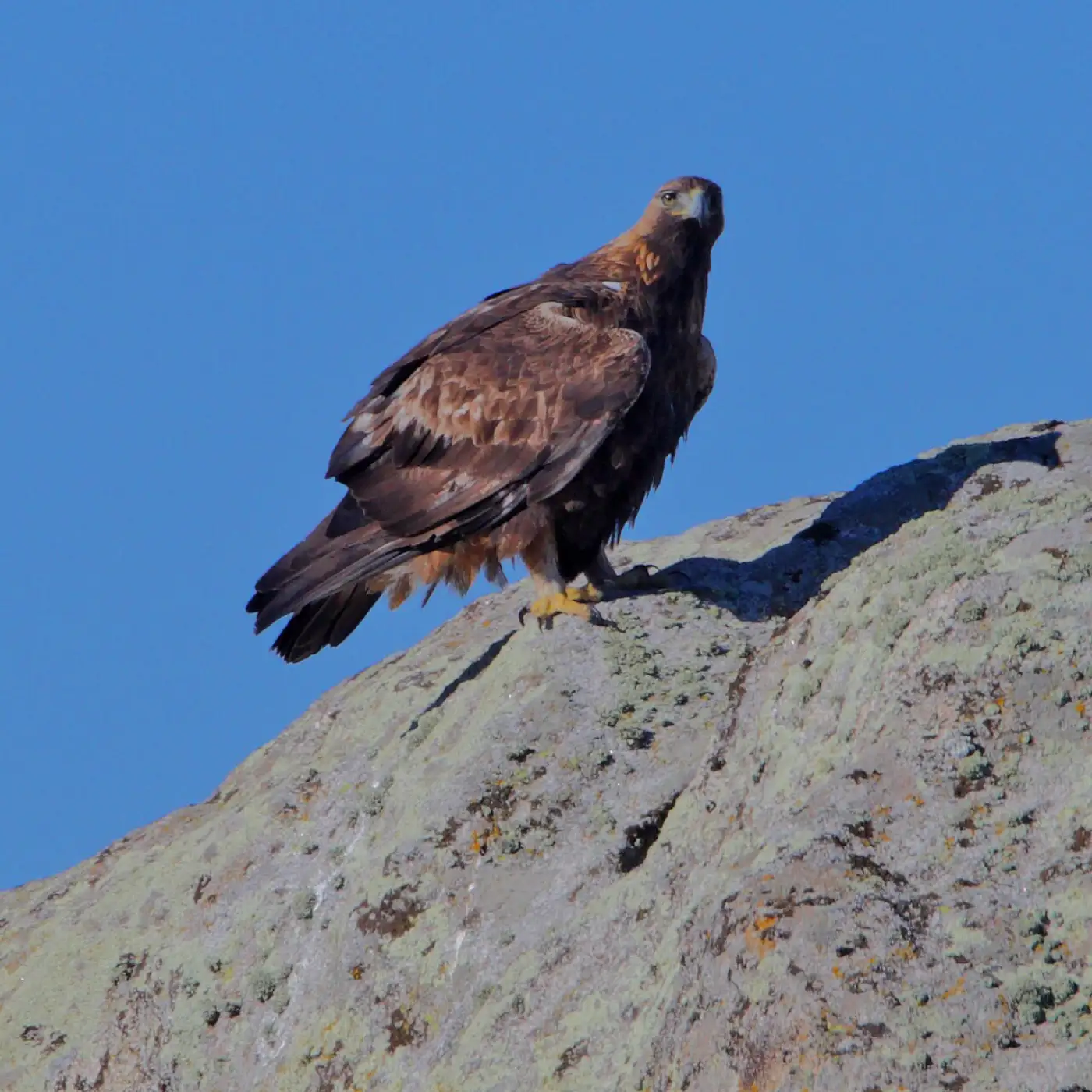
Golden Eagle perched on a rock, with dark brown plumage and a paler napePhoto: Juan Lacruz, CC BY-SA 3.0Photo 2 of 4
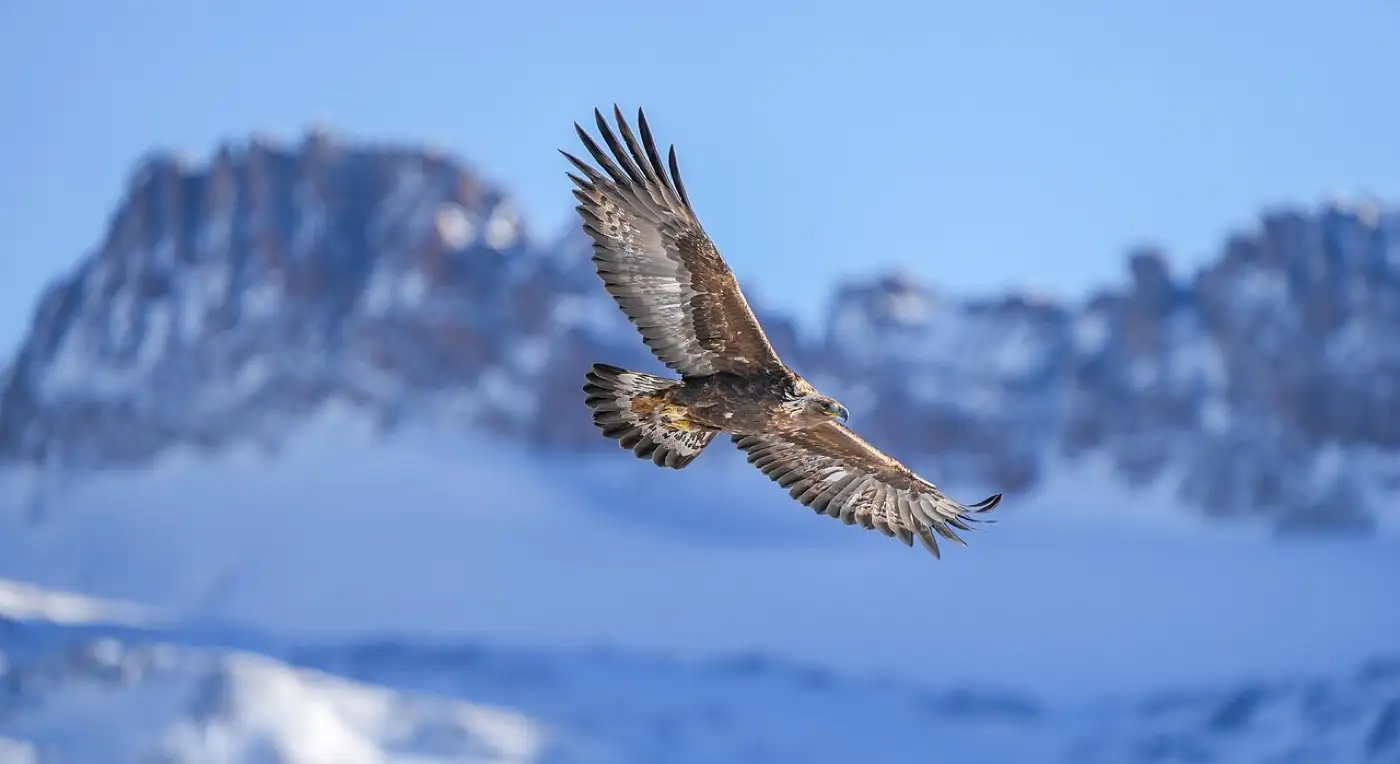
Golden Eagle in flight against a background of snowy mountains, wings spreadPhoto: Giles Laurent, CC BY-SA 4.0Photo 3 of 4
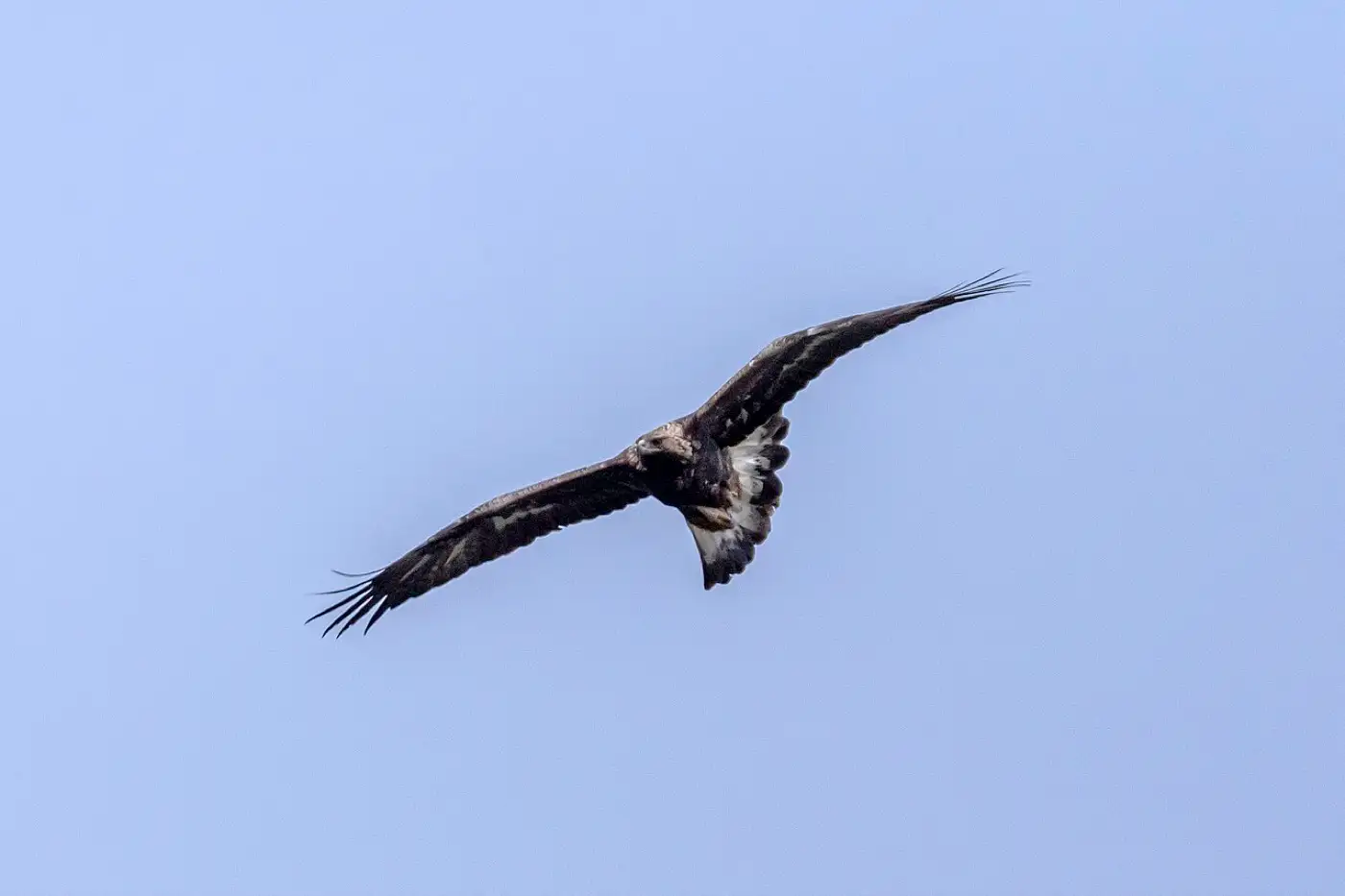
Golden Eagle in flight against the blue sky, with long wings outstretched and a long tailPhoto: Bene Riobó, CC BY-SA 4.0Photo 4 of 4
1 / 4
Identification of the Golden Eagle
It is a large bird of prey and the biggest of the Iberian eagles. The adult has an overall very dark brown colouring, with more golden tones on the leading edge of the wings, the nape and the neck. Seen in flight, at a distance it looks very dark, with the flight feathers and tail slightly paler.
Its very well-proportioned silhouette is defined by long, broad wings with a very rounded trailing edge, with a striking narrowing at the armpit, and a long tail. The young bird of the year is very dark, almost black, and in flight a white patch on each wing stands out, together with a broad white area over much of the tail, ending in a black terminal band. Through successive moults this strongly contrasting pattern fades, until the definitive adult plumage is reached at five or six years of age.
Adult
Very dark brown, with golden tones on the front of the wings, the nape and the neck.
Flight feathers and tail slightly paler.
Young bird of the year
Almost black, with white patches on the wings.
Much of the tail white, with a black terminal band.
Habitat and distribution of the Golden Eagle
It is distributed across the whole northern hemisphere, through Eurasia and North America, with some populations in North Africa and as far south as Ethiopia. It has several subspecies.
In Spain it occupies much of the country, but is absent from the Canaries and the Balearic Islands and from large regions of the Peninsula: Mediterranean coastal areas, the Guadalquivir valley, southern Extremadura, the northern plateau, the Cantabrian coastal strip and almost all of Galicia. It is not found in Ceuta or Melilla either. The most extensive and continuous breeding populations are in the group formed by the Pyrenees–Pre-Pyrenees, the Ebro depression and the Iberian System, in the north-east of the peninsula, and in the Betic ranges, Sierra Morena and the Montes de Toledo, in the southern quadrant. The two subspecies in Spain are «chrysaetos», in the Pyrenean area, and «homeyeri», in the rest of the Peninsula.
It is associated mainly with mountain areas or sierras of rugged relief, with rocky cliffs and crags to nest on, although occasionally it can nest in very large trees. It occupies a great variety of habitats, as long as there is broken terrain and quiet areas to breed.
On the Peninsula it is resident: breeding birds are sedentary, while young and immature birds make dispersive movements.
Areas where it is regularly recorded since 2010Squares of about 25 km where it is recorded regularly (occasional passage records are left out). Data from GBIF.org (51,871 records, retrieved October 2026); outline from Natural Earth.
Etymology of the Golden Eagle
«Aquila» is the Latin word for «eagle», which perhaps derives from «aquilus», «dark-coloured». «Chrysaetos» is the ancient Greek name for the golden eagle and comes from «khrysós», «gold», and «aetós», «eagle»: the golden eagle, for the tones of the nape.
Population of the Golden Eagle
In the 2021 European Red List of Birds the European breeding population is estimated at between 19,200 and 25,600 mature individuals, with an increasing trend. Spain holds one of the most numerous populations on the continent, and with recent increases in most of its range it could approach 2,000 pairs in 2021. To this is added a non-breeding population of between 2,500 and 3,000 individuals, so the total Spanish population could be put at a minimum of 6,000 to 6,830 individuals. Threats include habitat loss to infrastructure, public works and housing developments; shooting and poisoning on hunting estates; nest robbing or destruction; and electrocution on power lines. Even so, its expansion is being helped by a change in human attitudes, and newly formed pairs are starting to nest in habitats more altered by people than those of the classic pairs.
Nest of the Golden Eagle
The nest is generally located on crags (in 90 % of cases), between 200 and 2,200 metres above sea level; 10 % of pairs, and up to 40 % in areas short of cliffs and rich in food, such as the Ebro valley, put it in trees, above all pines, holm oaks and cork oaks. It is a solid structure of branches, lined with grasses and even wool, which can reach 2 metres high and up to 1.5 metres across; nests in trees are usually bigger. Both parents build it over about four to eight weeks, although the female does most of the work. Each pair usually has several nests in its territory, which it reuses periodically.
Courtship and breeding of the Golden Eagle
The breeding cycle begins at the end of January with the courtship display. Laying takes place from the end of February to the end of March and consists of one to three matt white eggs with reddish-brown spots. Incubation is by the female alone and lasts 41–45 days. The chicks are cared for by both parents and watched continuously by the female, with some help from the male, until 14 days; both adults feed them until they are 30 days old, and from then on they feed themselves. Depending on the supply of prey, there may be facultative siblicide. The plumage develops fully in about 67–80 days, and after leaving the nest the young stay tied to the adults about three months more before dispersing.
Diet of the Golden Eagle
Its very varied diet includes mammals (above all rabbits and hares), birds (pigeons and partridges above all, but also other species) and reptiles (lizards and snakes). It also eats carrion.
Curious facts about the Golden Eagle
The Golden Eagle is the mightiest of our eagles and one of the most widespread birds of prey in the world. The young bird is almost black, with white patches that disappear with moults, and does not reach adult plumage until five or six years. In Sweden the ring number of a bird of more than 36 years was read.
The Golden Eagle in Cabañeros
This website’s page on sclerophyllous woodland lists it among the raptors of the vegetated sierras of Cabañeros, together with the Spanish Imperial Eagle, the Booted Eagle, the Cinereous Vulture and the Short-toed Snake Eagle, which is a summer visitor. SEO/BirdLife also shares a video recorded in Cabañeros National Park, «Golden Eagle attacking a stork».
Where to see the Golden Eagle in Cabañeros
In the vegetated sierras of Cabañeros, over the sclerophyllous scrub.
When
All year: it is resident.
What time
Throughout the day, gliding over the relief.
Where
In broken terrain with crags and quiet areas, over the sierras.
What to look for
A big, very dark brown eagle, with a golden nape, long, broad wings and a long tail.
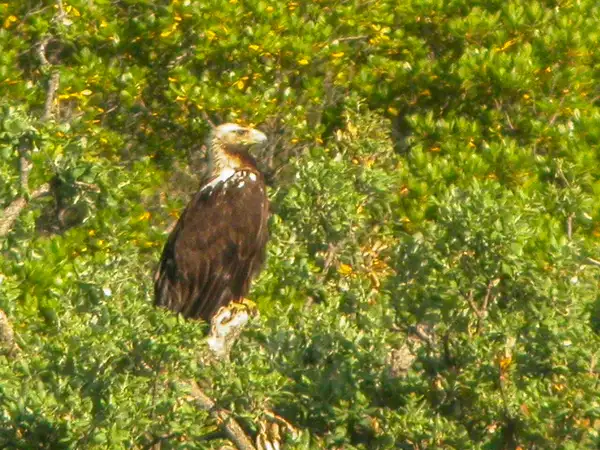
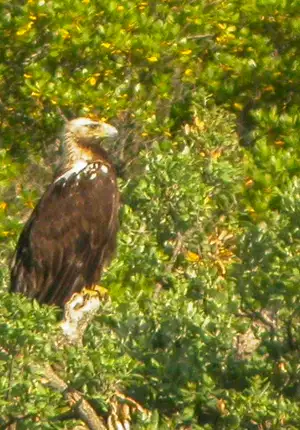
They are similar in appearance1. The Imperial has a very dark brown tone, with whitish shoulders and pale nape and sides of the head; its wings are long and relatively rectangular, and the tail long but not as long as in the Golden Eagle, and somewhat narrow.
Photo: Francesco Veronesi, CC BY-SA 2.0
Other birds
Birds related to the Golden Eagle or sharing its habitats in Cabañeros.



 Same family
 Same family
 Same family
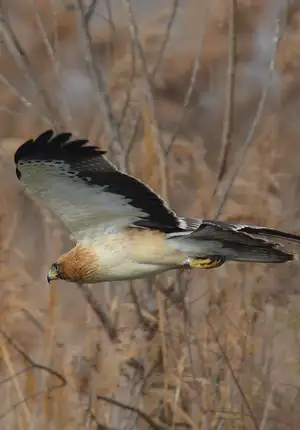 Same family
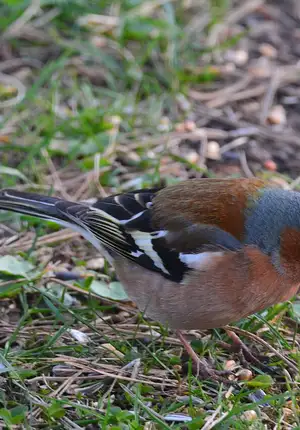 Also in sclerophyllous woodland
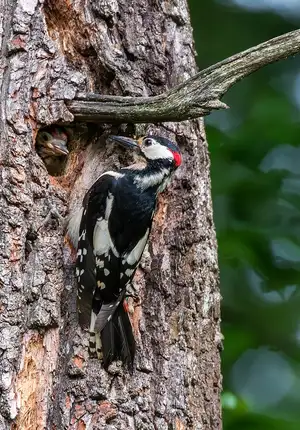 Also in sclerophyllous woodland
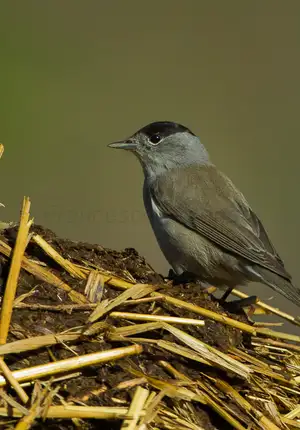 Also in sclerophyllous woodland
 Also in sclerophyllous woodland






