Wingspan compared with a person with arms outstretched.
Length
42–51 cm
Wingspan
1.1–1.35 m
Weight
0.5–1 kg
Social life
Pairs up in the breeding season
Lifespan
Record of almost 24 years in the wild (a bird ringed in Spain)
Conservation status
LC
NT
VU
EN
CR
EW
EX
Global (IUCN)
Least Concern
Spain
Included in the List of Wild Species under Special Protection; not in the Spanish Catalogue of Threatened Species
When to see it
Summer visitor
Months of the year when it is present
J
F
M
A
M
J
J
A
S
O
N
D
In Iberia
no
no
yes
yes
yes
yes
yes
yes
yes
no
no
no
Breeding season
no
no
no
yes
yes
yes
no
no
no
no
no
no
Song or voice of the Booted Eagle
Its most characteristic sound is a shrill, flute-like cry, «fli fli fli fli». Our recording is short and has some background noise, but the series of notes can be heard well.
CryBooted Eagle
0:00 / 0:03
10 kHz5
The sonogram draws the sound: time runs from left to right, and the higher a trace sits, the higher the note.Recording by Bubulcus, Wikimedia Commons (CC BY 3.0).
Flight of the Booted Eagle
It is a bird of prey with agile flight, long, narrow wings and slender lines. On returning to its territory it makes spectacular display flights that strengthen the pair bond, and it hunts in open areas close to woodland.
Flight typeAgile glider, over thermals and woodland
It climbs in circles on the warm air over the scrub, with long, narrow wings open and tail fanned. In this pale phase the white of the underparts and the almost black flight feathers can be seen.
It ranges agilely, at mid-height, over the clearings and edges of the woodland, watching for medium-sized birds, rabbits and lizards.
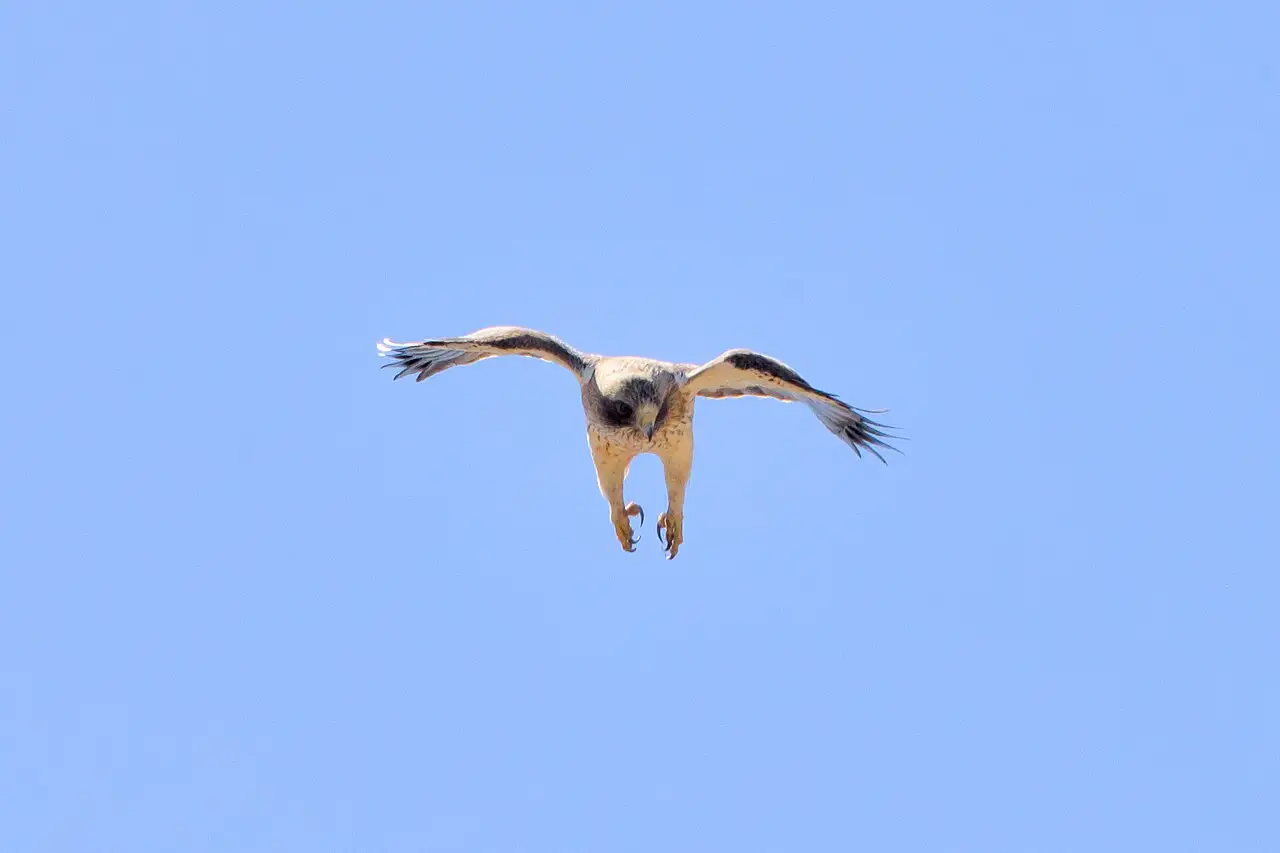
It closes its wings and launches itself at the bird or rabbit it has spotted, talons first.
Photo gallery of the Booted Eagle
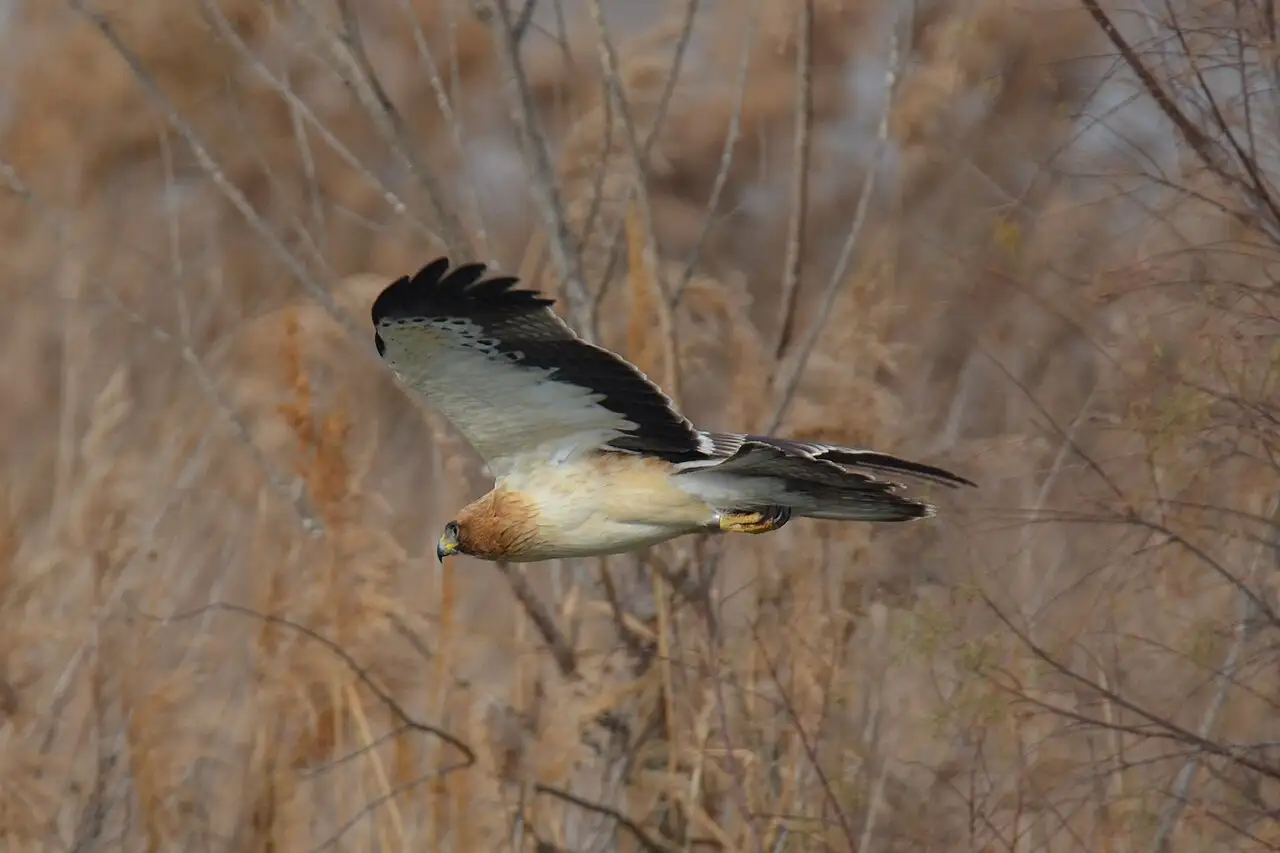
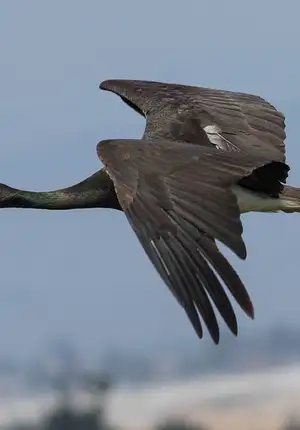
Pale-morph Booted Eagle in low flight over a reedbed, wings arched, pale belly and dark flight feathersPhoto: Domènec Leal Martínez, CC BY-SA 4.0Photo 1 of 4
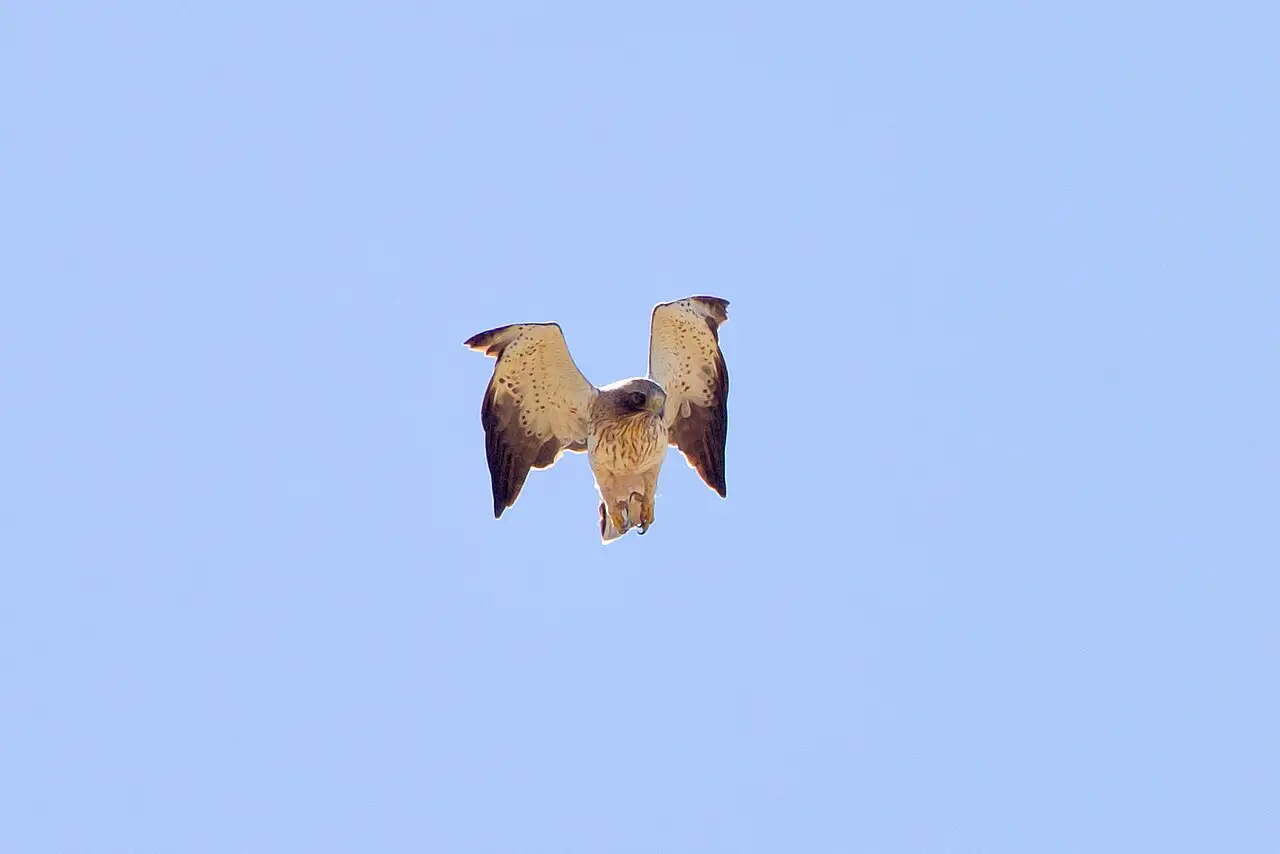
Pale-morph Booted Eagle seen from the front and below, wings swept back and pale marks by the neckPhoto: Juan Lacruz, CC BY-SA 3.0Photo 2 of 4
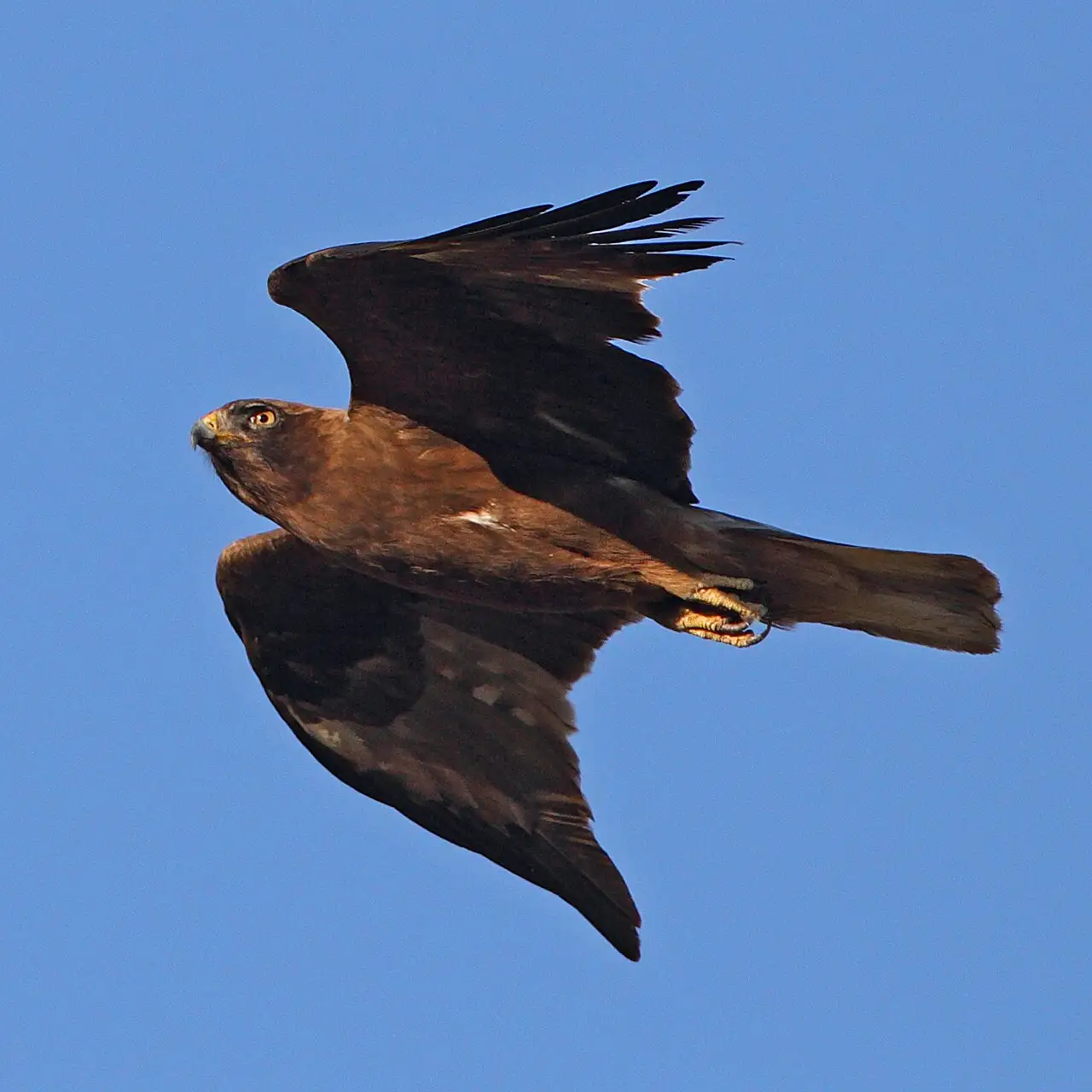
Dark-morph Booted Eagle in flight, with chestnut plumage and wings openPhoto: Juan Lacruz, CC BY-SA 4.0Photo 3 of 4
Pale-morph Booted Eagle in flight, seen from the front, with feathered legs hanging below the bodyPhoto: Juan Lacruz, CC BY-SA 3.0Photo 4 of 4
1 / 4
Identification of the Booted Eagle
It is a medium-sized bird of prey, with slender lines, long, narrow wings, tarsi feathered down to the claws and agile flight. It shows two completely different plumages, one pale, much more frequent, and one dark, as well as intermediate colourings. This has nothing to do with sex or age. Above, all morphs are the same, with a pale rump, striking white scapular feathers and a pattern of golden, brownish and brown feathers.
Pale morph
Almost white underparts, with throat and breast variably streaked.
Almost black flight feathers and greyish tail.
Dark morph
Chestnut tones of varying intensity on the underparts, which lead it to be mistaken for the Black Kite or the female Western Marsh Harrier.
Young bird
Wing coverts with pale edges, and breast and throat more streaked than adults.
Wings narrower than the adult’s.
Habitat and distribution of the Booted Eagle
It mainly occupies southern Europe, North Africa and southern Africa, and a strip of southern Asia reaching its far east. It winters mostly in sub-Saharan Africa and south-east Asia, and some birds stay in the Mediterranean basin. It has no subspecies.
In Spain it is widely spread across the centre and west of the Peninsula, and in many places can be the commonest raptor, especially in central Spain and in some Andalusian provinces; it is scarcer on the Cantabrian coast, in Galicia, part of Aragón and the Levante. It also breeds in the Balearics, Ceuta and Melilla, but is absent from the Canaries. It is eminently a woodland bird, but not demanding: it settles without difficulty from sea level up to about 1,600 metres in mountain pine woods, oak woods, sweet chestnut woods, cork oak woods, holm oak woods, Portuguese oak woods, riverside groves, dehesas, small isolated copses and even plantation pine woods. To breed it needs wooded spots, preferably near forest clearings, open scrub, mosaic landscapes, grassland or crops, where it gets a good part of its prey. It is a long-distance migrant: the post-breeding passage over the Strait of Gibraltar is detected mainly in September, with the females ahead while their mates finish caring for the chicks, and the return to breeding areas takes place between March and May. In recent years some birds spend the winter in the Guadalquivir marshes, the Mediterranean, Aragón, Castilla-La Mancha and Extremadura.
Areas where it is regularly recorded since 2010Squares of about 25 km where it is recorded regularly (occasional passage records are left out). Data from GBIF.org (260,931 records, retrieved October 2026); outline from Natural Earth.
Etymology of the Booted Eagle
«Hieraaetus» comes from the Greek «hierax», «hawk» or «falcon», and «aetós», «eagle»: «the hawk-eagle». «Pennatus» is «feathered» in Latin, and alludes to the feather-covered tarsi that give it the name «booted».
Population of the Booted Eagle
In the 2021 European Red List of Birds the European breeding population is estimated at between 46,600 and 60,500 mature individuals, with an increasing trend. The Spanish contingent, the most important in Europe, is put at a minimum of almost 8,000 pairs, according to the second Atlas of European Breeding Birds, although estimates vary widely. Most authors suggest that it is increasing in some areas, such as Aragón, Cantabria, Catalonia, Galicia and the Balearics, and negative trends have been detected in others, such as Alicante, Ávila, Madrid and Cantabria. It is classed as Least Concern. The main causes of unnatural mortality are collisions with and electrocution on power lines, collisions with wind turbines, illegal hunting, especially during the half-season, nest robbing, disturbance from the opening of tracks and forestry or livestock activities near nests, and organochlorine pesticides.
Nest of the Booted Eagle
Except in the Balearics, where it prefers rocky cliffs, it always places it in the fork of a tree, at a height of between 6 and 16 metres. It is a somewhat untidy structure of sticks, lined with fresh branches, which can reach 1 or 1.2 metres across and half a metre high. On resettling in its territory it builds a new nest or repairs the one it used the year before.
Courtship and breeding of the Booted Eagle
On returning to their territory, between March and May, pairs start spectacular display flights that strengthen the bond. Laying takes place between mid-April and mid-May, depending on the region, and usually consists of two white eggs, sometimes one and rarely three, which become covered in brown spots during incubation. Incubation lasts 36 to 38 days and is done mainly by the female, while the male brings prey. The chicks hatch in June and both adults tend them, although the female spends more time with them. Depending on the supply of prey, facultative siblicide is common, and only the oldest chick survives. They develop fully in about 50 to 55 days and leave the nest, although they do not become independent until two weeks later.
Diet of the Booted Eagle
In most regions birds make up the bulk of its diet, normally medium-sized ones: Common Wood Pigeons, partridges, blackbirds, thrushes, Iberian Magpies, jays, hoopoes or quails. The rabbit is the mammal it eats most and, where it is abundant, is the staple prey. It also catches reptiles, particularly ocellated lizards, and in lean times large insects, such as grasshoppers and locusts. In autumn and winter, the birds that stay prefer wet areas, with many water birds.
Curious facts about the Booted Eagle
Its plumage can be pale or dark, and this has nothing to do with sex or age. The most important contingent in Europe is here, and in central Spain and in some Andalusian provinces it can be the most abundant raptor in many places.
The Booted Eagle in Cabañeros
The habitat pages of this website list it among the breeding raptors of the sclerophyllous woodland of the Cabañeros sierras, together with the Spanish Imperial Eagle, the Golden Eagle and the Short-toed Snake Eagle, the latter a summer visitor.
Where to see the Booted Eagle in Cabañeros
In the wooded hills of the Cabañeros sierras, from spring to September.
When
From March to September: it arrives between March and May and leaves from September.
What time
In spring, on arrival, in the display flights; later, while it hunts in the clearings.
Where
Over the trees and nearby clearings, where it hunts birds and rabbits.
What to look for
A small, slender raptor, pale below with black wingtips, or all dark, with pale marks by the neck.
The dark morph of the Booted Eagle is mistaken for it. The Black Kite has a greyish, finely streaked head, somewhat reddish underparts with elongated spots and a long forked tail, which the Booted Eagle lacks.
The female is quite a bit larger and darker than the male, with chocolate-brown plumage and a yellowish or whitish head, throat and shoulders. The pale head stands out against the dark plumage.
Photo: Paco Gómez, CC BY-SA 2.0
Other birds
Birds related to the Booted Eagle or sharing its habitats in Cabañeros.



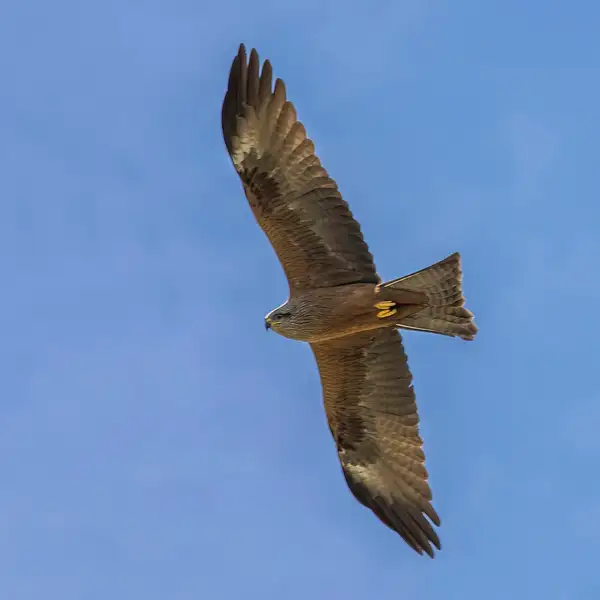
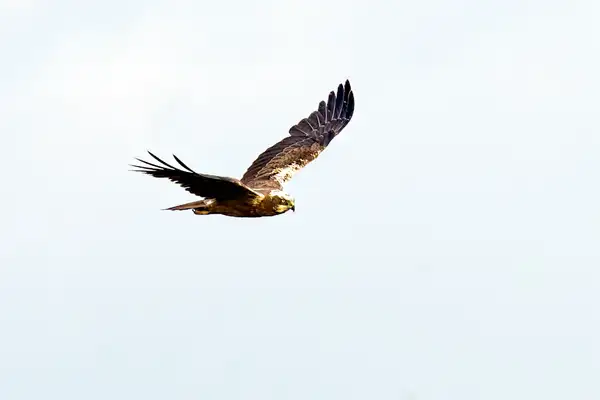
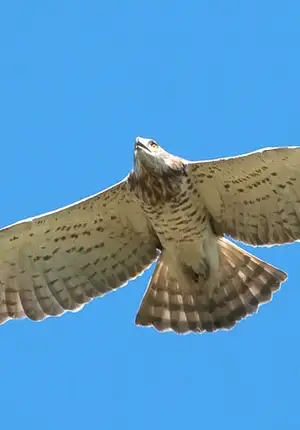 Same family
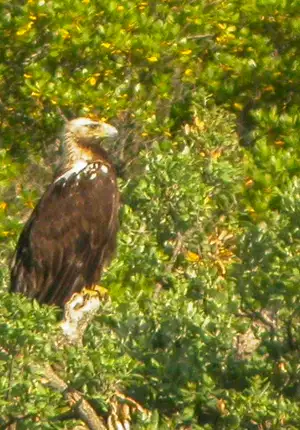 Same family
 Same family
 Same family
 Also in sclerophyllous woodland
 Also in sclerophyllous woodland
 Also in sclerophyllous woodland
 Also in sclerophyllous woodland






