Wingspan compared with a person with arms outstretched.
Length
95–110 cm
Wingspan
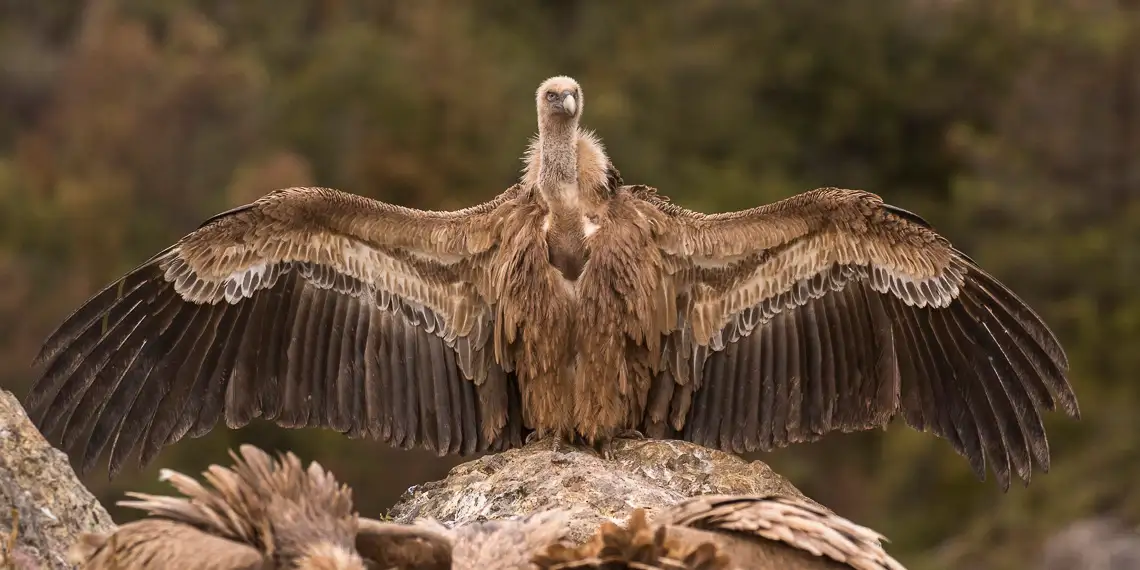
2.3–2.65 m
Weight
6–9 kg
Social life
Gregarious: it breeds, rests and feeds in groups; pairs stay together for life
Lifespan
Record of over 41 years, in captivity
Conservation status
LC
NT
VU
EN
CR
EW
EX
Global (IUCN)
Least Concern
Spain
Included in the List of Wild Species under Special Protection; not in the Spanish Catalogue of Threatened Species
When to see it
Resident
Months of the year when it is present
J
F
M
A
M
J
J
A
S
O
N
D
In Iberia
yes
yes
yes
yes
yes
yes
yes
yes
yes
yes
yes
yes
Breeding season
yes
yes
yes
yes
yes
yes
yes
yes
no
no
no
no
Song or voice of the Griffon Vulture
It is a silent bird. Only in disputes over a carcass or the best perches and roosts does it let out a long series of guttural sounds and hisses. The recording (call) is by SonoNatura and was made at Páramos del Duratón (near Burgomillodo), Segovia, Castilla y León (xeno-canto XC722566, quality A). It lasts 9 seconds and is a trimmed section of the original, without repeating or lengthening, from which we have removed the bass below 150 Hz, reduced the background noise and adjusted the volume; neither pitch nor speed has been changed.
It is an enormous glider: it hardly flaps its wings. It uses the rising currents of warm air, the thermals, to climb in circles effortlessly, and from the top it glides for kilometres, losing height little by little, to the next one. That is why we see it leave its roosts late: it needs the sun to warm the ground.
Flight typeThermal glider
It climbs in wide circles without flapping, on wings flat and broad as a board.
From above it glides for kilometres, losing height little by little, with the hand slightly drooped and almost without a flap.
When it sees it, or sees other vultures coming down, it descends in a spiral and lands with its feet forward and its wings raised.
Photo gallery of the Griffon Vulture
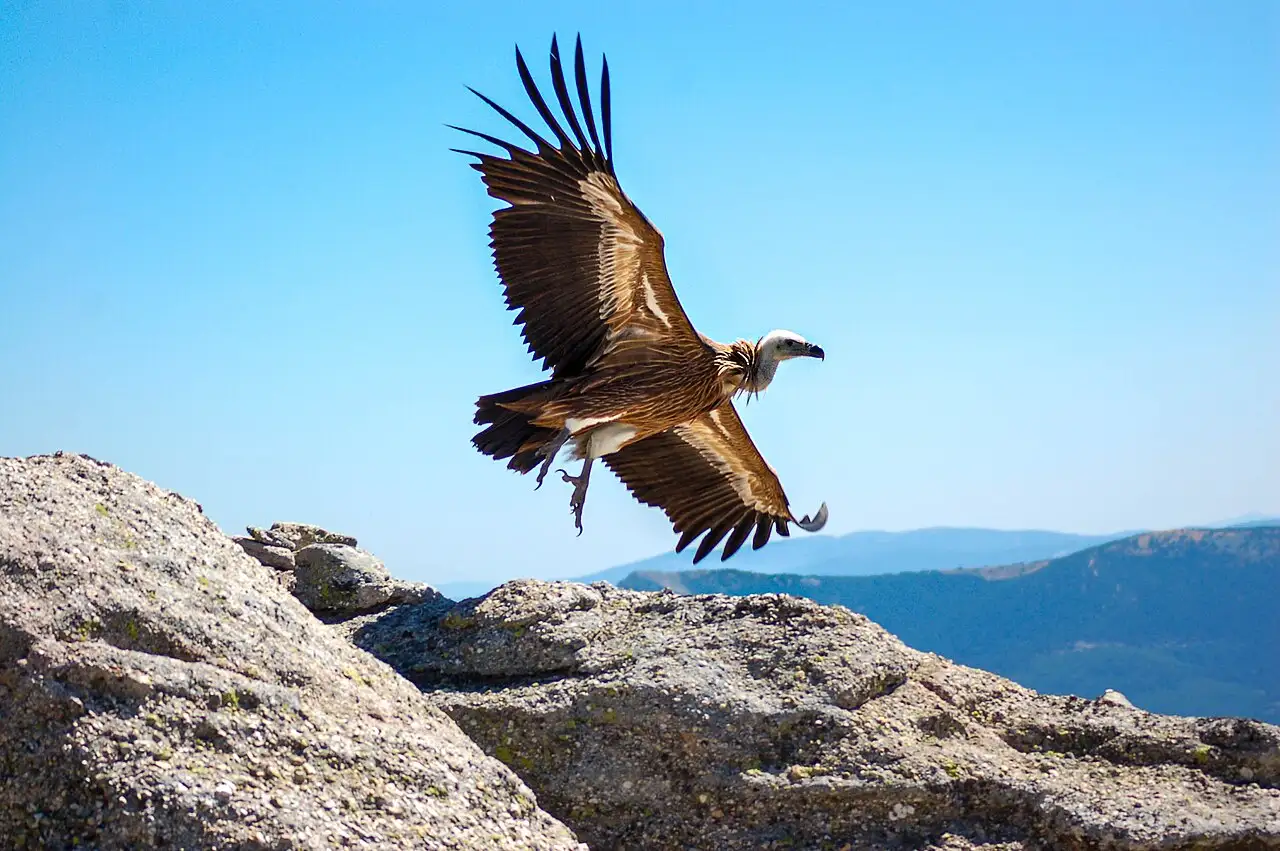
Griffon Vulture taking off from a rock, with wings spread wide and dark flight feathersPhoto: Miguel Lacalle Labado, CC0Photo 1 of 4
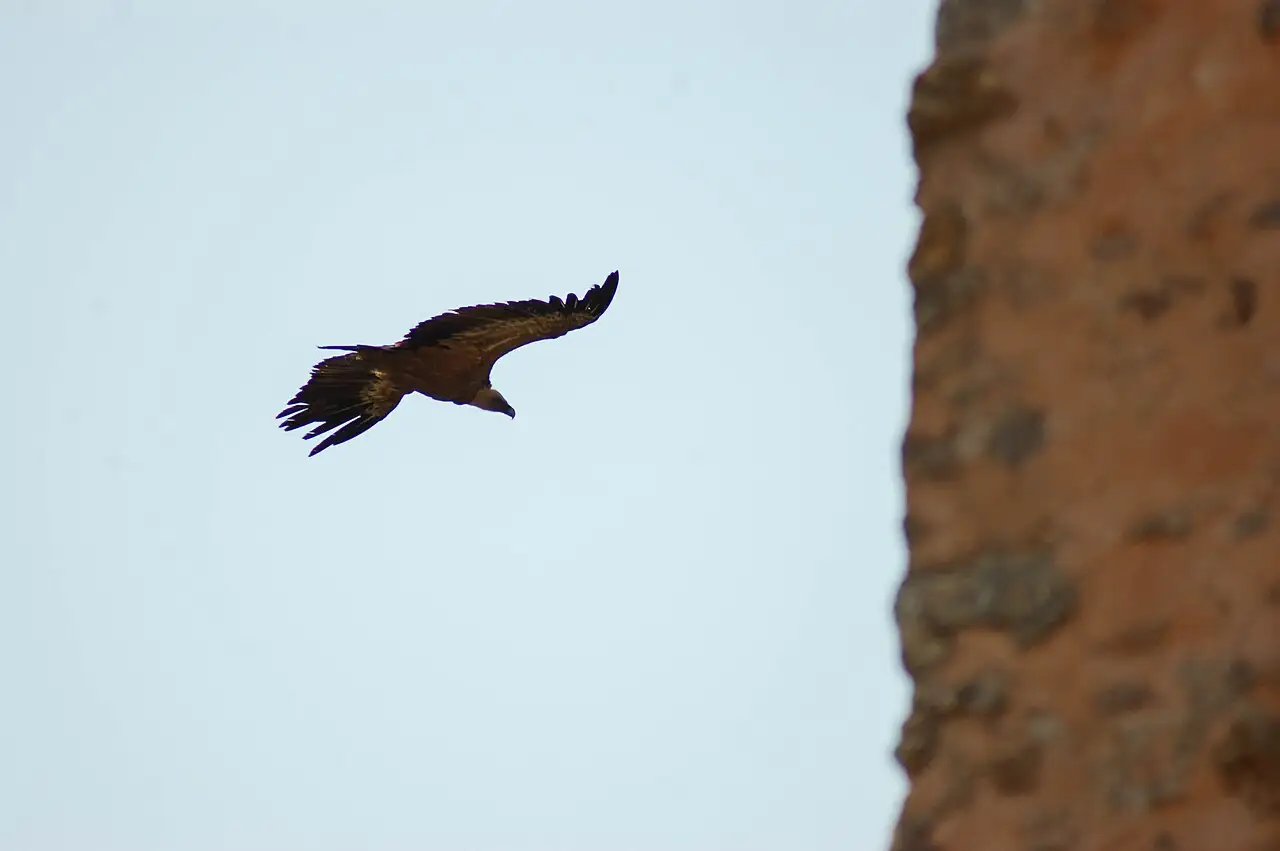
In flight, from below: the pale coverts contrast with the dark flight feathersPhoto: Miguel Lacalle Labado, CC0Photo 2 of 4
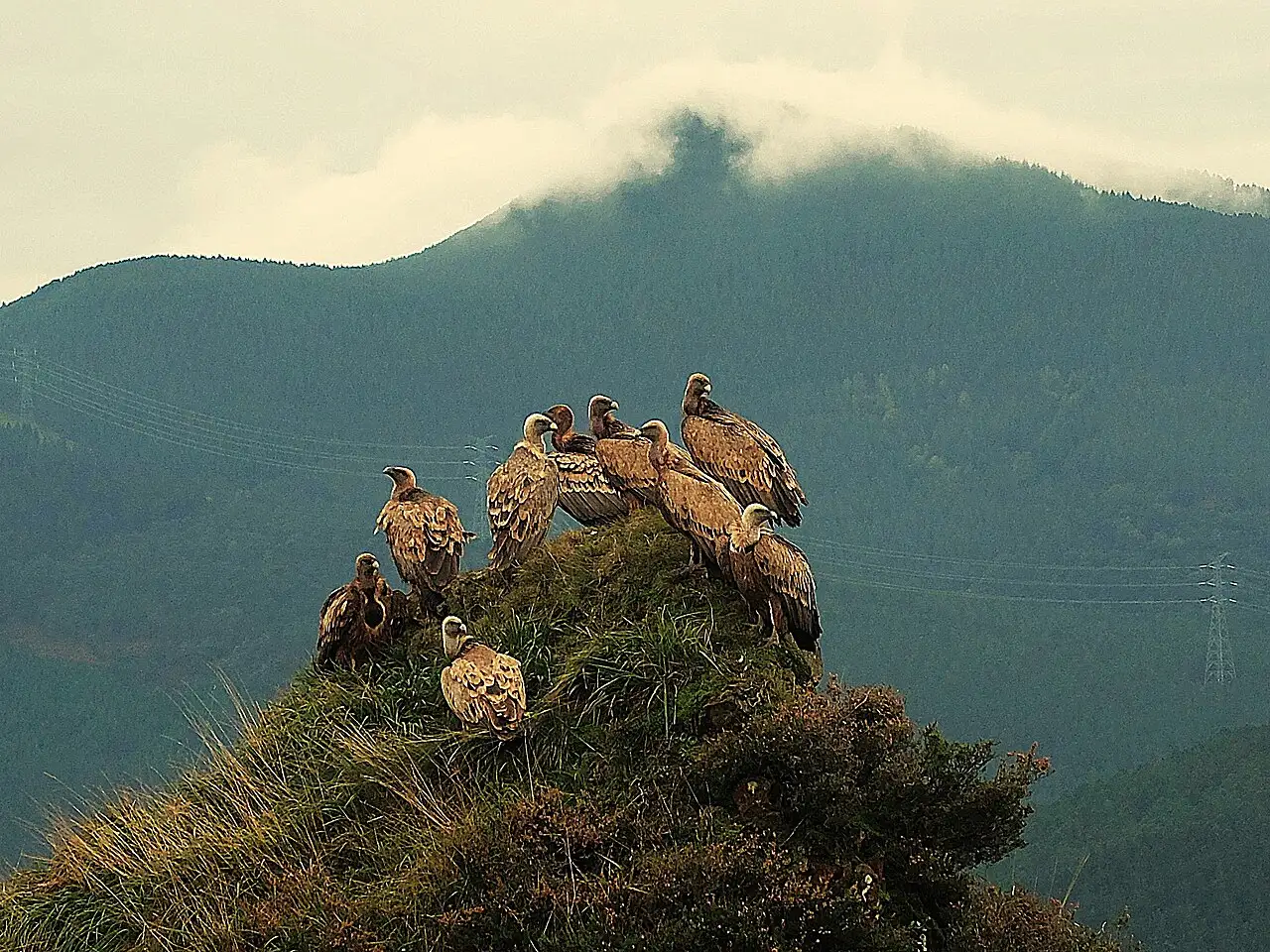
A group of Griffon Vultures perched on top of a hillPhoto: HACERCANDOME, CC0Photo 4 of 4
1 / 4
Identification of the Griffon Vulture
It is an immense, unmistakable raptor. There is hardly any difference in size or plumage between males and females; what changes is age, and it shows above all in the neck and head.
Adult
Overall greyish-brown plumage, with the back somewhat paler and dark flight feathers.
Bone-coloured bill, white, cottony ruff, yellowish or amber iris.
Straighter trailing edge of the wing and comparatively shorter tail.
Young bird
A darker reddish brown, with lanceolate feathers with fine pale streaks.
The ruff is very evident, frayed and reddish; the iris and bill are black.
The trailing edge of the wing is serrated and the tail longer. It acquires adult plumage at seven or eight years.
Habitat and distribution of the Griffon Vulture
It occupies south-western and south-eastern Europe, north-western and southern Africa, the Balkans, Turkey, Arabia, Iran, Afghanistan, Pakistan and northern India. The birds of the peninsula belong to the nominate subspecies, fulvus.
In Spain it breeds in almost all mountain ranges and on plains with river cliffs of some size, and is spread more continuously where limestone substrates dominate, although it also has excellent breeding areas on siliceous ones. It settles on rocky cliffs, in the mountains up to 2,000 metres or in river canyons; with the growth of the population, it makes more and more nests in trees. To feed it mainly uses open environments, such as farming mosaics and agricultural areas with livestock. It is absent from Galicia, the Canaries, Ceuta and Melilla.
Areas where it is regularly recorded since 2010Squares of about 25 km where it is recorded regularly (occasional passage records are left out). Data from GBIF.org (433,601 records, retrieved October 2026); outline from Natural Earth.
Etymology of the Griffon Vulture
«Gyps» comes from the Greek «γύψ» (gýps), «vulture», and «fulvus» is the Latin for «tawny», the reddish yellow of a lion’s coat, which gives the species its Spanish name, «leonado». «Buitre» comes from the Latin «vultur». It is one of the names that says it all most clearly.
Population of the Griffon Vulture
It came close to disappearing. Through poison and direct persecution, populations suffered a great decline in the first half of the 20th century, but from 1960 the recovery was rapid: from the 2,283–3,240 pairs of 1979 it went to 7,529–8,074 in 1989, and in 2018 30,946 pairs were estimated. Spanish vultures are more than 90 % of the European ones, and the 2021 European Red List puts the continent’s adults at 69,600–89,400, with an increasing trend. The largest known colony is in the Hoces del río Duratón Natural Park, with 730 pairs in 2018. It is classed as Least Concern, but poison, the legislation on livestock carcasses, wind farms and power lines still threaten it.
Nest of the Griffon Vulture
It breeds in colonies, sometimes of several hundred pairs. The nest is usually on ledges and in caves of rocky cliffs, and sometimes in a tree, on an old Cinereous Vulture or Spanish Imperial Eagle nest. When the pair builds it themselves, it is a shallow platform of sticks, straw and wool, no more than 20 or 30 centimetres high, of which little remains when breeding ends.
Courtship and breeding of the Griffon Vulture
Even in the depths of winter the vultures make courtship flights to reaffirm the bond, which is very strong and lasts a lifetime. Laying is very early, between mid-January and mid-February, and consists of a single white egg. Both sexes incubate it, for 48 to 54 days, and the single chick takes 110 to 115 days to fly. At 80–90 days it already walks on the ledge and makes short flights, but the parents look after it until the end of summer or early autumn.
Diet of the Griffon Vulture
It is a strict scavenger, specialised in large ungulates, both wild and domestic, and that is why it is so tied to extensive livestock farming. It also frequents rubbish tips. With its long, almost bare neck, covered in fine down, it explores the inside of carcasses without soiling its plumage.
Curious facts about the Griffon Vulture
When in 2008 a storm with south-westerly winds swept a flock of hundreds of vultures from Murcia as far as Mallorca, some stayed, and in 2012 the first breeding on the island was recorded. In 2021 21 pairs were counted there. And since Spain has more than nine out of ten of Europe’s Griffon Vultures, several autonomous communities have donated birds to reintroduce them in other countries. At the Strait of Gibraltar a large number of Griffon Vultures can be seen passing in October and November, and again between April and May.
The Griffon Vulture in Cabañeros
It is one of the birds of the sclerophyllous woodland of Cabañeros. Compared with its relative the Cinereous Vulture, which is more aggressive, the Griffon Vulture is more sociable and much less quarrelsome when feeding on prey, and it feeds on medium and large carrion in clear areas.
Where to see the Griffon Vulture in Cabañeros
In the sky, above all around midday, when thermals form, and perched on the crags.
When
All year: it is resident. The best dates are winter, with the courtship flights, and spring, with the chicks in the nest.
What time
From mid-morning to mid-afternoon, when the sun warms the ground and the air currents that keep it aloft form.
Where
In the clear sky, over the open areas of the park, and on the crags, where it perches.
What to look for
An enormous silhouette with long, straight wings in a «V» and a very short tail, which turns without flapping and is lost on high.
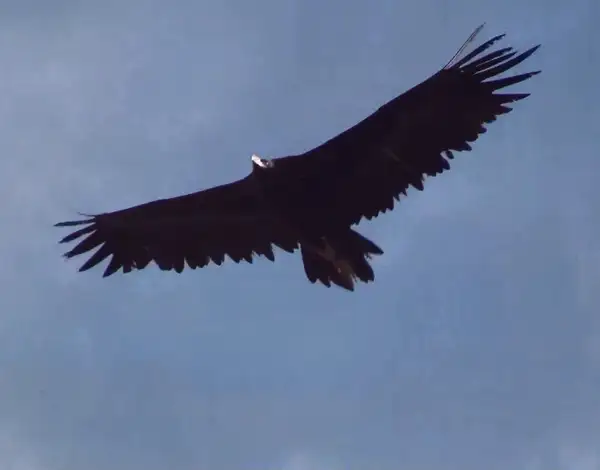
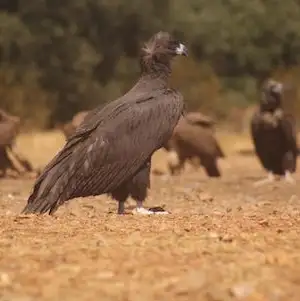
Somewhat bigger and much darker, almost all blackish brown, with wings as flat as a board and a wedge-shaped tail. It has neither the white ruff nor the tawny contrast of the coverts.



 Same family
 Same family
 Same family
 Same family
 Also in sclerophyllous woodland
 Also in sclerophyllous woodland
 Also in sclerophyllous woodland
 Also in sclerophyllous woodland






