Wingspan compared with a person with arms outstretched.
Length
80–100 cm
Wingspan
1.3–1.6 m
Weight
1.5–5.3 kg
Social life
Colonial: it may reuse the nest year after year
Lifespan
Record of 32 years and 1 month in the wild (a bird ringed in Iceland and found dead)
Conservation status
LC
NT
VU
EN
CR
EW
EX
Global (IUCN)
Least Concern
Spain
Least Concern (LC) as a winter visitor/migrant and as a breeder in the Red Book of the Birds of Spain; not on the List of Wild Species under Special Protection or in the Spanish Catalogue of Threatened Species
When to see it
Winter visitor
Months of the year when it is present
J
F
M
A
M
J
J
A
S
O
N
D
In Iberia
yes
yes
yes
yes
yes
yes
yes
yes
yes
yes
yes
yes
Song or voice of the Great Cormorant
It gives deep guttural sounds. In breeding colonies it also makes other, softer sounds: «ghoo-gho».
VoiceGreat Cormorant
0:00 / 0:25
10 kHz5
The sonogram draws the sound: time runs from left to right, and the higher a trace sits, the higher the note.Recording by Bicheando Natura, YouTube (Vídeo de YouTube, con atribución).
Flight of the Great Cormorant
In flight it interleaves brief glides between sequences of wingbeats. It spends a lot of time perched on rocks or trees, with wings open to dry its plumage.
Flight typeWingbeats with brief glides
It spends a lot of time perched on rocks or trees, with its wings open to dry its plumage, and from there it takes off.
In flight it mixes brief glides between sequences of wingbeats, over reservoirs, lagoons, rivers or the coast.
Essentially fish-eating, it catches fish, sometimes large ones, while diving; when it swims it keeps its waterline high, with three quarters of the body under water.
Photo gallery of the Great Cormorant
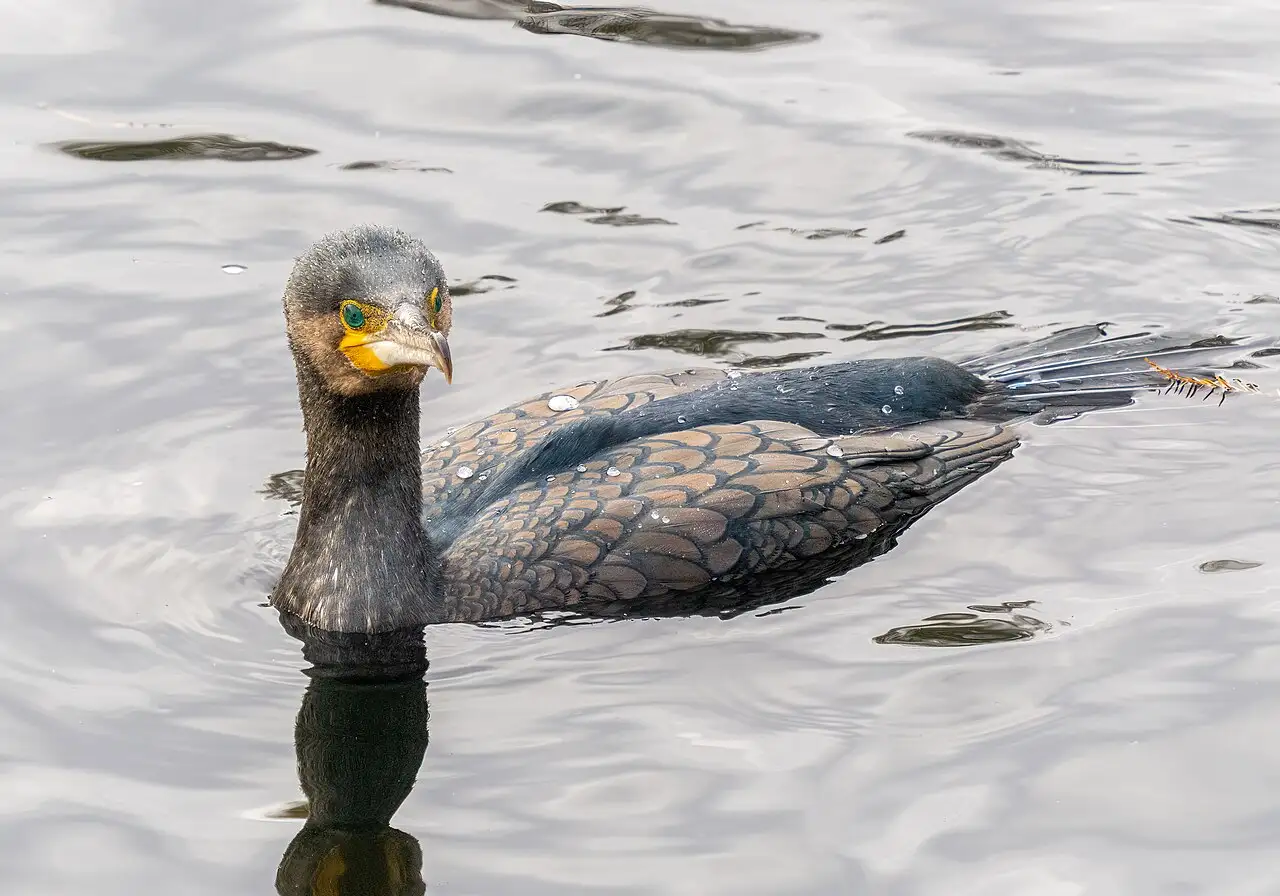
Great Cormorant swimming, with scaly black plumage, prominent grey bill and the bare yellow skin at the base of the bill and facePhoto: Rhododendrites, CC BY-SA 4.0Photo 1 of 4
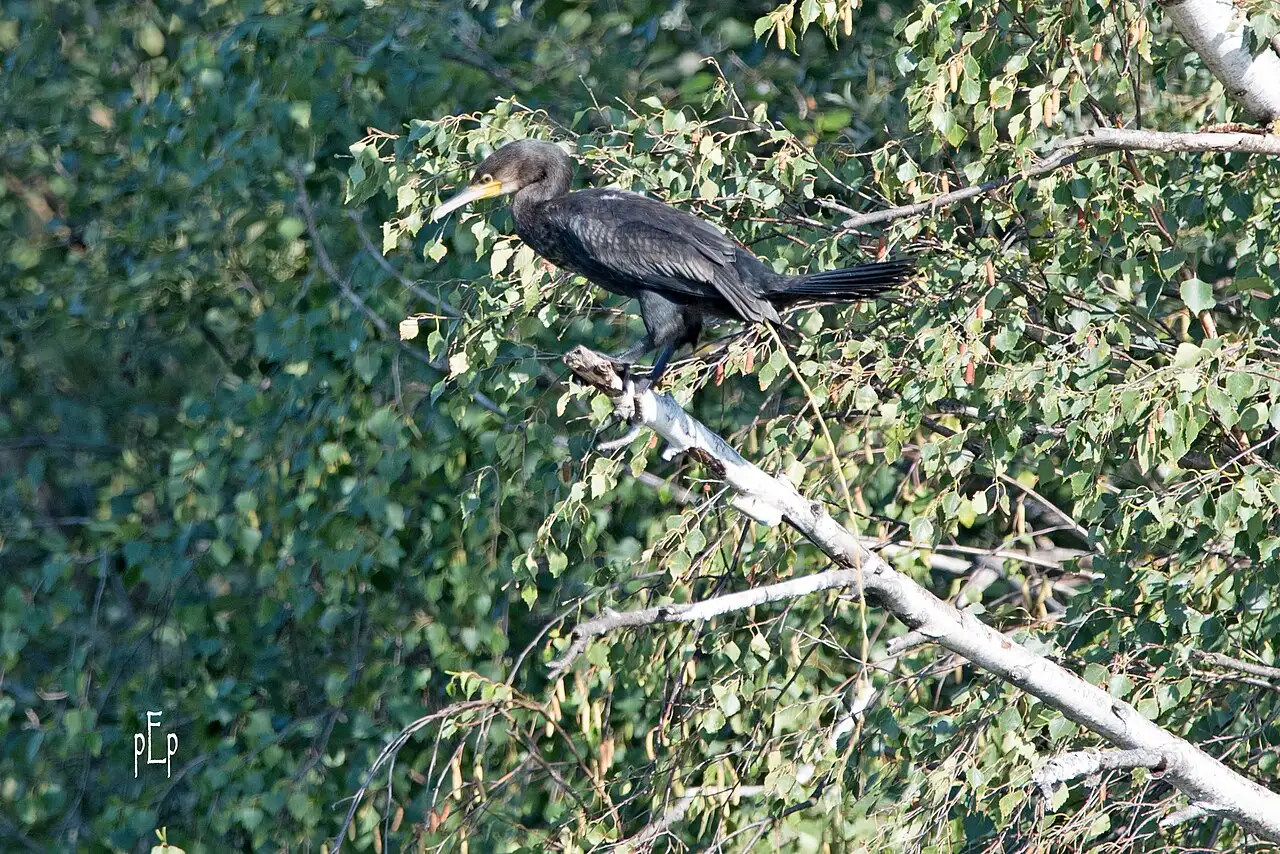
Great Cormorant perched on a branch among leaves, in profile, with grey bill with a hooked tipPhoto: Pierre-Marie Epiney, CC BY-SA 2.0Photo 2 of 4
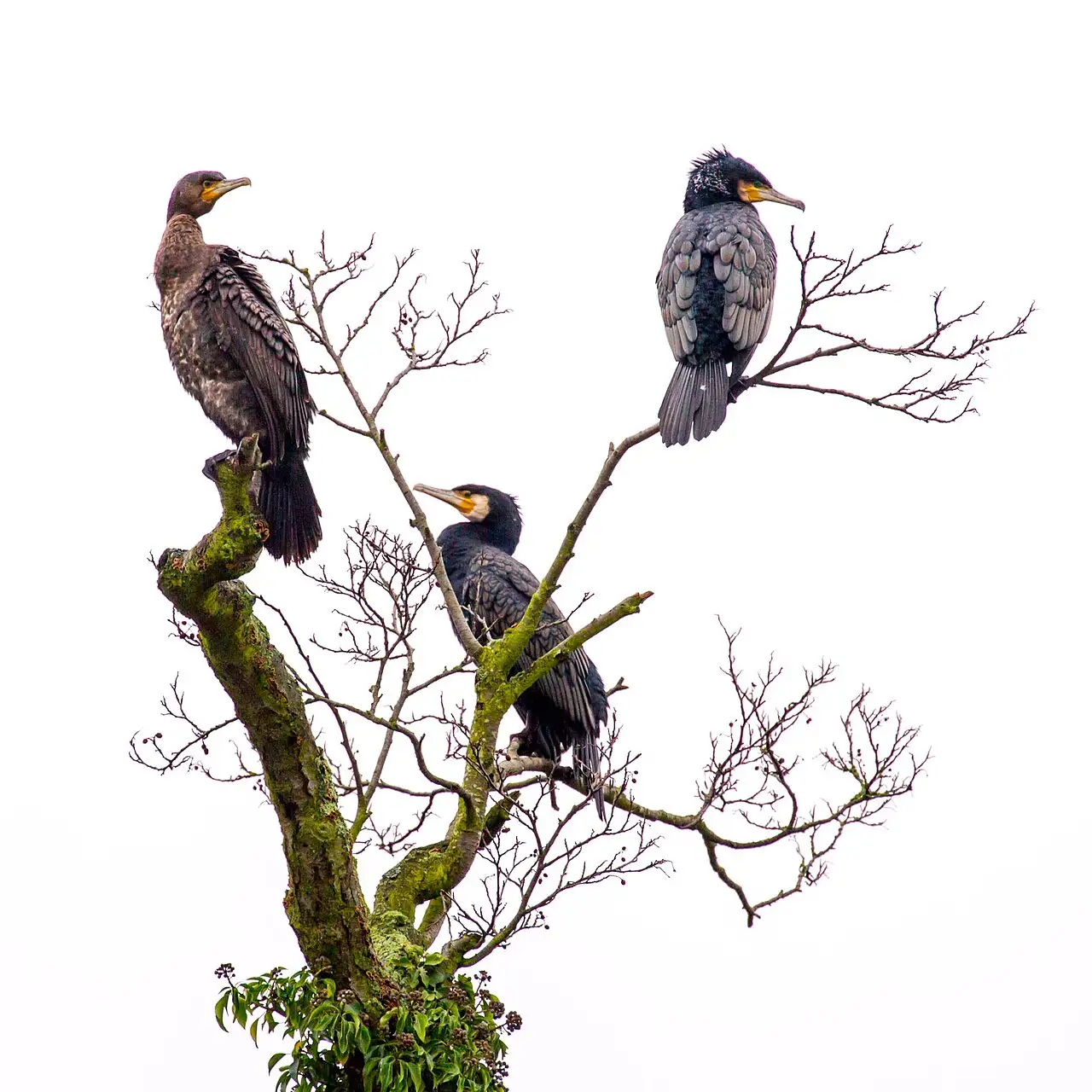
Three Great Cormorants perched in a leafless tree against the pale sky, one of them browner than the othersPhoto: Michael Palmer, CC BY-SA 4.0Photo 3 of 4
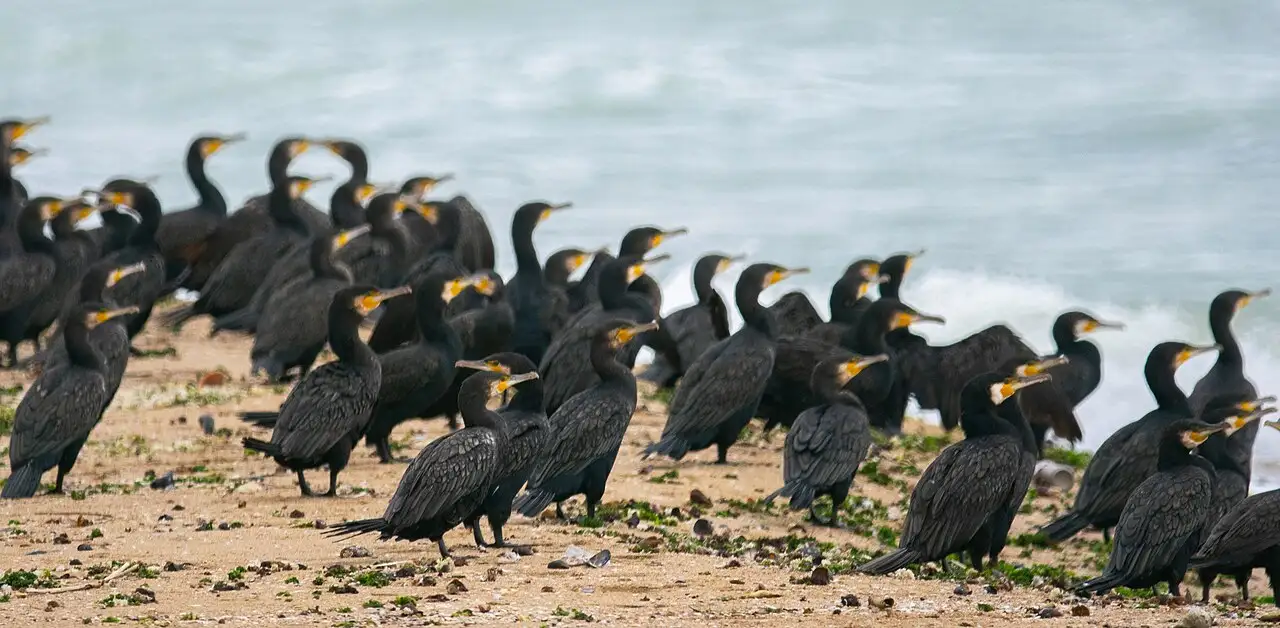
Large group of Great Cormorants on a sandy shore, beside the waterPhoto: TRinaud, CC BY 4.0Photo 4 of 4
1 / 4
Identification of the Great Cormorant
The Great Cormorant is a bird of awkward look and overall blackish colouring, except the throat, which is whitish. It has a long, thick neck, a prominent grey bill and black legs. At the base of the lower mandible it has a featherless orange-yellow area, which almost reaches the eyes. The colouring of the back feathers makes them look like scales. When swimming it keeps its waterline high, with three quarters of the body under water. It spends a lot of time perched on rocks or trees, with wings open to dry its plumage.
During the breeding period adults show white patches on the head, flanks and upper thighs, and wear a glossier plumage. Young birds have pale creamy underparts.
Adult
Blackish, with whitish throat and back feathers shaped like scales.
Prominent grey bill, with an orange-yellow featherless area.
When breeding, white patches on the head, flanks and thighs.
Young bird
Underparts pale creamy.
Habitat and distribution of the Great Cormorant
It is widely distributed, though discontinuously, across Europe, North America, Asia, Japan, Africa and even Australia. It has five subspecies, two of them in Europe: «carbo», with more liking for coastal marine environments, appears in the North Atlantic and breeds mainly in Great Britain, Ireland, France and Iceland; and «sinensis», somewhat smaller, which occupies inland waters and breeds in the rest of Europe (Germany, Denmark, the Netherlands, Poland, the Czech Republic and the western Mediterranean) and is also that of eastern Asia and Japan.
It is common in winter in most peninsular provinces, provided they have large reservoirs, lagoons or rivers with plentiful fish populations. As a breeder it is more frequent on the Cantabrian and Mediterranean coasts, with more occasional observations on inland reservoirs of the western half of the peninsula and in the Ebro basin.
It occupies preferably open water surfaces, coastal or inland, fresh or salt, as long as they have good fish populations: lakes, lagoons, reservoirs, rivers, deltas, marshes…
The two European subspecies show different migratory patterns. «Carbo» makes shorter movements and seems to be the majority in winter on the Atlantic and Cantabrian coasts; «sinensis», distributed across most of western Europe, migrates further south, to the Mediterranean and even North Africa, and is the one seen mainly on inland waters of the peninsula, both breeding and wintering.
Areas where it is regularly recorded since 2010Squares of about 25 km where it is recorded regularly (occasional passage records are left out). Data from GBIF.org (499,281 records, retrieved October 2026); outline from Natural Earth.
Etymology of the Great Cormorant
According to Wikipedia, «Phalacrocorax» comes from the ancient Greek «phalakrós» («bald») and «kórax» («raven»), and «carbo» is «coal» in Latin. In other languages it is called «corb marí gros» in Catalan, «corvo mariño grande» in Galician, «ubarroi handia» in Basque and «great cormorant» in English1.
Population of the Great Cormorant
In the 2021 European Red List of Birds the European breeding population is estimated at between 828,000 and 1,030,000 mature individuals, with an increasing trend. The species has grown greatly as a winter visitor in Iberian waters since the 1980s, when it was scarce even in places where thousands of birds are now recorded; the increase seems due to the growth of the northern European breeding population and the expansion of reservoirs. As a breeder it also keeps a positive trend: there are several colonies, some of more than 60 pairs, and in 2012 1,605 pairs were counted, a figure that is noticeably higher today.
It seems to be expanding and has no major problems. As the main threat poaching stands out, above all in wintering areas where fish farming is an important resource, and disturbance during nesting can cause clutches to be lost. Being a consummate fisher, in some areas it has come into conflict with people, who accuse it of eating fish of fishing and commercial interest.
Nest of the Great Cormorant
It usually sets the nest in trees or on reedbeds, and, on the coast, on cliffs. It is built with plant material and an upper layer of feathers, and can be reused year after year.
Courtship and breeding of the Great Cormorant
It is a colonial species. The clutch normally consists of three or four blue-green eggs, laid at 2–3-day intervals and incubated for 25–31 days; replacement clutches are frequent. Once hatched, the chicks are cared for and fed by both parents with regurgitated food, which the chick itself takes by putting its head into the parents’ bill. The young become independent at 50 days and reach sexual maturity at four or five years.
Diet of the Great Cormorant
Essentially fish-eating, it can catch large fish, which it fishes while diving.
Curious facts about the Great Cormorant
Originally it was only a winter visitor in Spain, but for some years now it has settled as a breeder on some inland reservoirs. Weight varies greatly: Wikipedia gives 1.5 to 5.3 kg depending on the subspecies, and BTO, 2.3 kg on average. According to EURING, the ringed bird that lived longest, in Iceland, reached 32 years and 1 month; AnAge gives 32.1 years.
The Great Cormorant in Cabañeros
The habitat pages of this website do not mention it. GBIF.org records 95 observations of the Great Cormorant in Cabañeros and its surroundings.
Where to see the Great Cormorant in Cabañeros
In Cabañeros and its surroundings, above all in winter.
When
All year, but above all in winter, when birds arrive from northern Europe.
What time
In good light, on large reservoirs, lagoons and rivers with plenty of fish.
Where
Perched on rocks, trees or posts, with wings open, or swimming with the body almost submerged.
What to look for
Look for the scaly black plumage, the long neck, the grey bill and the yellow skin of the face.
Videos of the Great Cormorant
Similar species
European Shag
Gulosus aristotelis
How to tell them apart
It is similar in physical appearance1: it is the other species of cormorant present in our waters.
Photo: Charles J. Sharp, CC BY-SA 4.0
Double-crested Cormorant
Nannopterum auritum
How to tell them apart
It is similar in physical appearance (it appears under the name «Phalacrocorax auritus»)1.
Photo: Hans Stieglitz, CC BY-SA 3.0
Other birds
Birds related to the Great Cormorant or sharing its habitats in Cabañeros.



 Same season in the park
 Same season in the park
 Same season in the park
 Same season in the park
 Same season in the park
 Same season in the park
 Same season in the park
 Same season in the park






