Wingspan compared with a person with arms outstretched.
Length
70–90 cm
Wingspan
1.47–1.8 m
Weight
2.8–3.9 kg
Social life
Very gregarious, especially in winter; within flocks the pairs stay together with their young, in small family groups
Lifespan
Record of 31 years in captivity according to AnAge; EURING lists a bird ringed in Germany that lived 27 years and 4 months and was shot
Conservation status
LC
NT
VU
EN
CR
EW
EX
Global (IUCN)
Least Concern
Spain
Least Concern (LC) as a winter visitor and migrant in the Red Book of the Birds of Spain, and Not Evaluated (NE) as a breeder; not on the List of Wild Species under Special Protection or in the Spanish Catalogue of Threatened Species
When to see it
Winter visitor
Months of the year when it is present
J
F
M
A
M
J
J
A
S
O
N
D
In Iberia
yes
yes
yes
no
no
no
no
no
yes
yes
yes
yes
Song or voice of the Greylag Goose
It gives a metallic honk followed by nasal, twangy notes, similar to the call of the domestic goose1. The recording (call, also in flight) is by SonoNatura and was made in the Ávila district (near El Oso), Ávila, Castilla y León (xeno-canto XC855275, quality A). It lasts 9 seconds and is a trimmed section of the original, without repeating or lengthening, from which we have removed the bass below 200 Hz, reduced the background noise and adjusted the volume; neither pitch nor speed has been changed.
In winter it crosses the sky in flocks. At the end of January or early February it leaves Spain, and on the journey north the flocks furrow the sky in their characteristic V formations.
Flight typeIn large flocks, in V formations
It is a very gregarious bird, above all in winter, and gathers to sleep and feed in large, noisy flocks.
It gives a metallic croak followed by nasal, twangy notes, like the call of the domestic goose.
When they set off north, in late January or early February, the flocks cross the sky in their characteristic V formations.
Photo gallery of the Greylag Goose
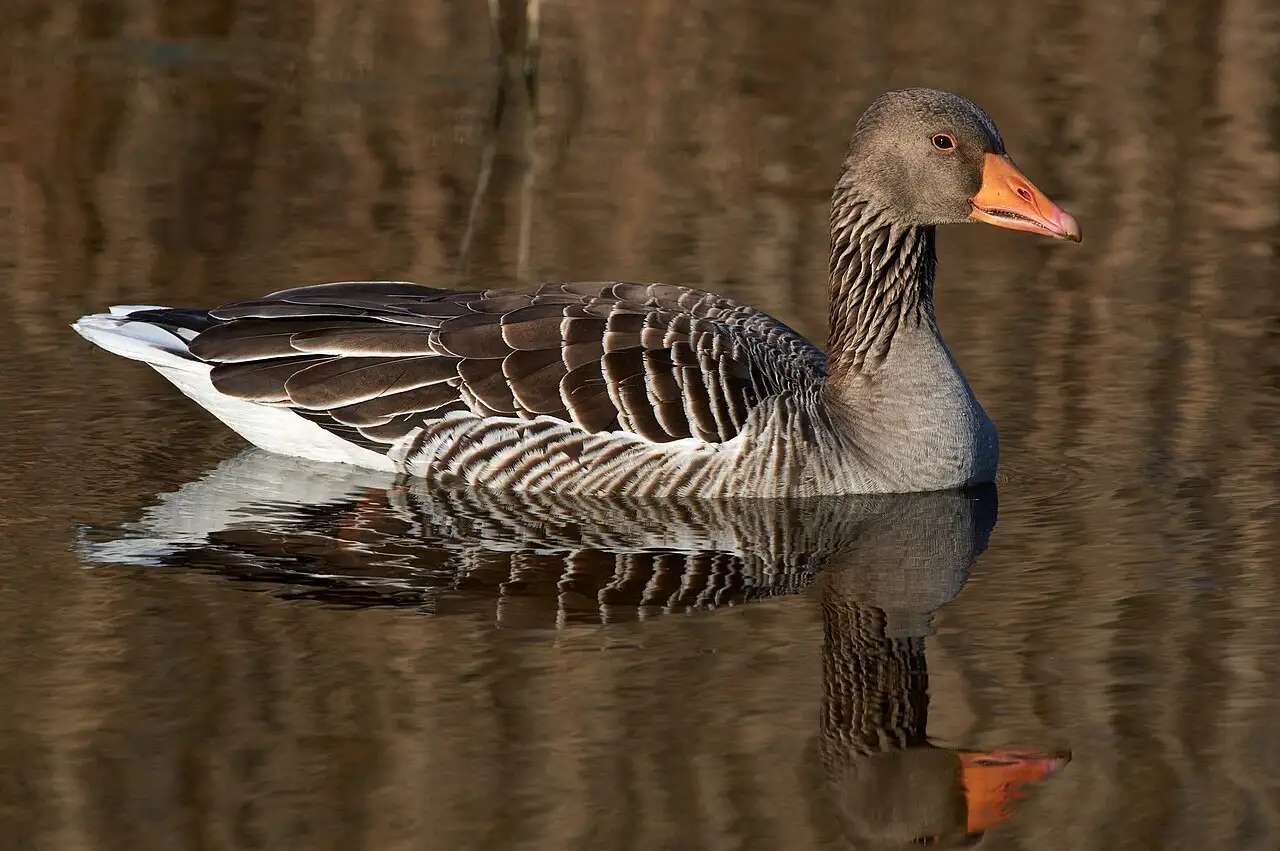
Greylag Goose swimming in profile with neck erect, orange bill and back feathers edged with cream, reflected in the waterPhoto: Hobbyfotowiki, CC0Photo 1 of 5
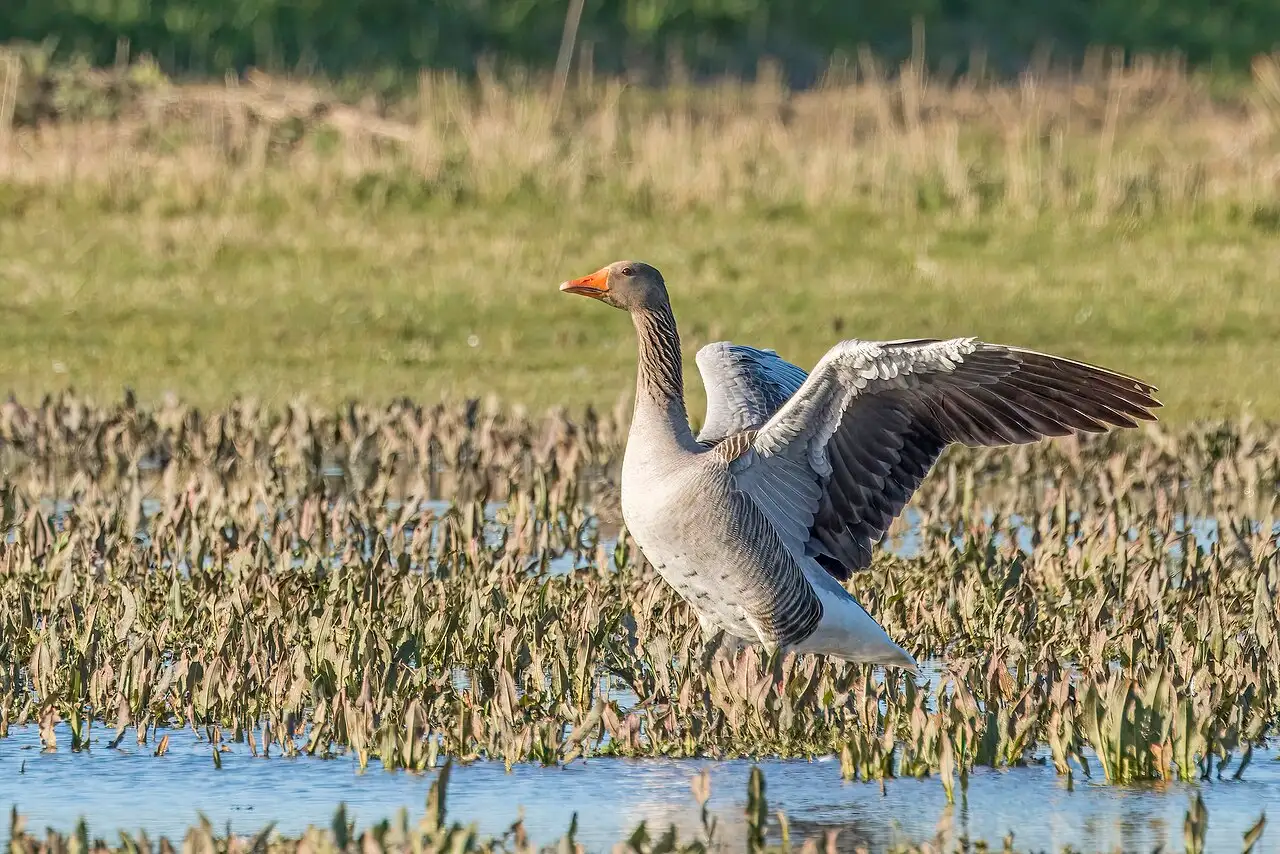
Greylag Goose in a pond with vegetation, with wings half open and orange billPhoto: Charles J. Sharp, CC BY-SA 4.0Photo 2 of 5
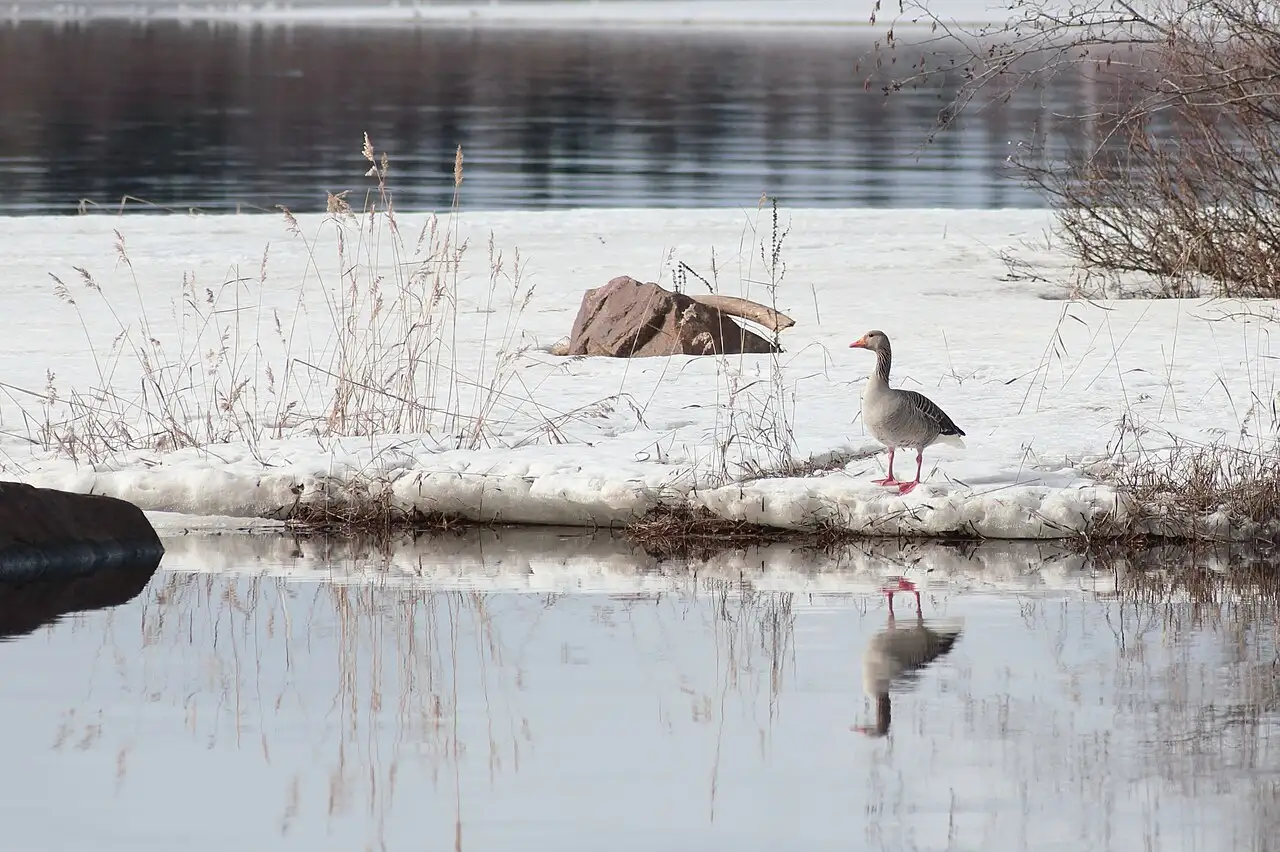
Greylag Goose standing on the ice of a shore, with its reflection in the water and dry vegetation behindPhoto: Estormiz, CC0Photo 4 of 5
Two orange-billed Greylag Geese in shallow water, with other birds in the background (Galicia)Photo: Emilio Martínez Sabarís, CC BY-NC 4.0Photo 5 of 5
1 / 5
Identification of the Greylag Goose
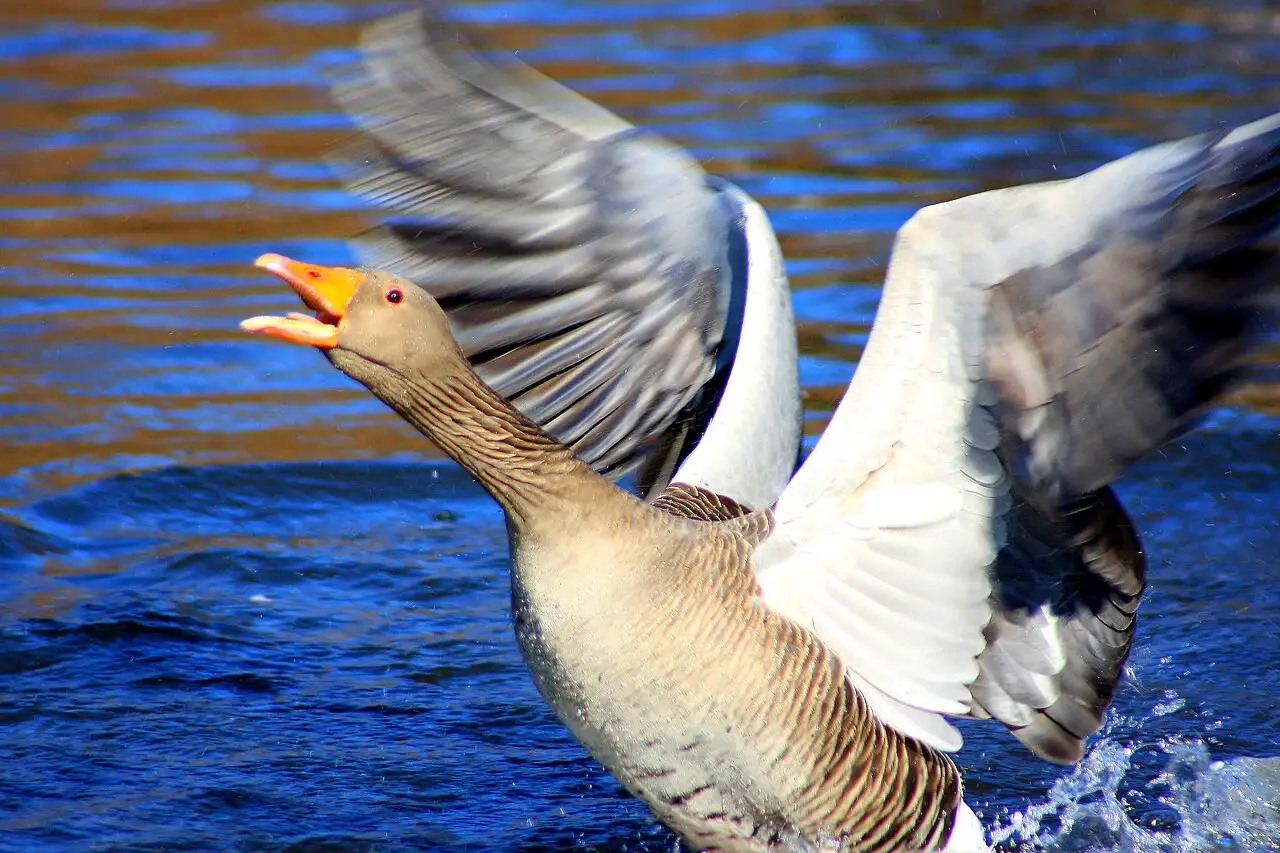
The Greylag Goose has an overall greyish tone, with the back feathers edged with cream, which gives this area a scaly look; the flanks are darker and barred with white lines. In contrast to the rest of the plumage, the vent region is pure white, and the tail is white, with a dark band at the top. Fairly robust in appearance, the only difference between males and females is the males’ larger size. The legs, short and strong, are pinkish, and the bill, conical in shape, is orange in the subspecies «anser» and pink in the race «rubrirostris».
Adult
Grey, with the scaly back of cream-edged feathers and the flanks barred with white.
Vent and tail white, with a dark band at the top of the tail.
Habitat and distribution of the Greylag Goose
It has two geographical races, spread across much of the Eurasian continent. The subspecies «anser» breeds across much of central and northern Europe, with Iceland and the north of the British Isles; «rubrirostris» breeds in eastern Europe and in central and western Asia.
On the Iberian Peninsula the non-feral Greylag Goose is exclusively a winter visitor1. The birds seen are mainly of the subspecies «anser», although some individuals of the eastern «rubrirostris» also arrive. Its main numbers are in the Guadalquivir marshes, the Villafáfila (Zamora) and La Nava (Palencia) lagoons and the Guadiana plains, in Cáceres and Badajoz; there are also small isolated cores in the centre and west of the Peninsula. Since 2007 nesting pairs have been recorded at Salburúa (Álava) and Villafáfila, and also in Doñana, although most are believed to originate from escapes of captive-bred birds that have gone feral1.
In winter it prefers open, waterlogged areas, such as marshes and shallow lagoons, although it may frequent any kind of shallow flooded ground with low vegetation, and also reservoirs and rivers surrounded by good expanses of cereal, rice fields or maize fields.
It is a wholly or partly migratory bird: an important contingent arrives in Spain from Norway, Sweden, Denmark and Germany, which it leaves in September to reoccupy around mid-March.
Areas where it is regularly recorded since 2010Squares of about 25 km where it is recorded regularly (occasional passage records are left out). Data from GBIF.org (84,321 records, retrieved October 2026); outline from Natural Earth.
Etymology of the Greylag Goose
In other languages it is called «oca comuna» in Catalan, «ganso común» in Galician, «antzara hankagorrizta» in Basque and «greylag goose» in English1. According to Jobling, «Anser» means «goose» in Latin; we have not found a source explaining the origin of the Spanish name, so we do not venture one.
Population of the Greylag Goose
In the 2021 European Red List of Birds the European breeding population is estimated at between 797,000 and 975,000 mature individuals, with an increasing trend. Spain hosts a fairly high number in winter, put at 122,000 individuals, which is a positive trend against earlier data, which showed some irregularity in wintering. Among nesters, the population has increased at Salburúa, where 11 pairs bred in 2017, and at Villafáfila, where in 2021 a minimum of 13 pairs bred on the natural lagoons.
The main threats are habitat transformation, illegal hunting and lead poisoning1.
Nest of the Greylag Goose
In northern Europe nests are on the ground, on a somewhat raised spot in waterlogged terrain, some distance from the water and surrounded by vegetation. The female builds it: an enormous heap of stems and reeds, lined with moss, grass and down. They can form small colonies, with the nests always well apart.
Courtship and breeding of the Greylag Goose
At the end of January or early February, Greylag Geese leave Spain and set off for their breeding quarters in northern Europe, in flocks in V formations. In the breeding season they are much less gregarious than in winter. The clutch is four to six eggs, although larger ones are not rare, somewhat elongated and creamy white tinged with yellow or brown. The female incubates them alone for 27–28 days, while the male stands guard, and the eggs hatch synchronously. The chicks walk as soon as their down dries and feed themselves within a few hours, but stay with the parents. At 50–60 days they already fly, although they do not leave them even during migration. All this describes the wild Greylag, wintering in Spain and breeding in northern Europe; it is not a nesting calendar for Cabañeros, and domestic or feral geese do not count.
Diet of the Greylag Goose
The diet is basically vegetarian, though very varied. It includes all kinds of tender shoots of marsh and land plants, and also stems, leaves, roots and tubers. In summer it leans towards the shoots and stems of herbaceous plants, and in winter it shows a marked preference for the tubers and rhizomes of aquatic plants. In the Guadalquivir marshes it feeds almost entirely on bulrush rhizomes.
Curious facts about the Greylag Goose
In winter, within the great flocks, a clear separation into small family groups is maintained, because pairs stay together outside the breeding season and are accompanied by each season’s young1. Its longevity record in captivity, 31 years according to AnAge, exceeds EURING’s, 27 years and 4 months for a bird shot in Germany.
The Greylag Goose in Cabañeros
The habitat pages of this website do not mention it, and we have not found any other published source on it in the Park; nor does it appear in the bird list of the «Visitor guide to Cabañeros National Park» (OAPN). GBIF.org records 9 observations of the Greylag Goose in Cabañeros and its surroundings. The Guadiana plains, in Cáceres and Badajoz, are mentioned among its great wintering cores, along with small isolated cores in the centre and west of the Peninsula1. None of those observations falls within the Park boundary (according to OpenStreetMap): all are from the surroundings.
Where to see the Greylag Goose in Cabañeros
In Cabañeros and its surroundings, only in winter and occasionally, on lagoons, reservoirs and waterlogged cereal fields.
When
In Spain from September to March: it arrives in autumn and leaves between late January and mid-March.
What time
By day, in the fields and on the water, feeding, and at dusk at the roosts.
Where
In marshes, shallow lagoons, reservoirs and rivers surrounded by cereal, rice fields or maize fields.
What to look for
Look for the V formations and the orange of the bill; listen for the metallic honk of the flocks.



 Same family
 Same family
 Same family
 Same family
 Same season in the park
 Same season in the park
 Same season in the park
 Same season in the park






