Wingspan compared with a person with arms outstretched.
Length
51–66 cm
Wingspan
79–87 cm
Weight
0.7–1.2 kg
Social life
Males and females differ greatly in the breeding season; the pair begins courtship in the wintering areas
Lifespan
Record of 27.4 years in the wild according to AnAge; EURING lists a bird ringed in France that lived 29 years and 6 months and was shot
Conservation status
LC
NT
VU
EN
CR
EW
EX
Global (IUCN)
Least Concern
Spain
Endangered (EN) as a breeder and Least Concern (LC) as a winter visitor in the 2021 Red Book of the Birds of Spain; on neither the List of Wild Species under Special Protection nor the National Catalogue of Threatened Species
When to see it
Winter visitor
Months of the year when it is present
J
F
M
A
M
J
J
A
S
O
N
D
In Iberia
yes
yes
yes
yes
no
no
no
no
yes
yes
yes
yes
Song or voice of the Northern Pintail
The male gives a high whistle, «crip-crop», with slow repetitions1. During courtship the female produces a sort of croak1. The recording (flight call) is by Stanislas Wroza and was made in Soppavann (xeno-canto XC1167897, quality A). It lasts 9 seconds and is a trimmed section of the original, without repeating or lengthening, from which we have removed the bass below 300 Hz, reduced the background noise and adjusted the volume; neither pitch nor speed has been changed. It is from Finland, not Spain.
It is a decidedly migratory duck and a regular winter visitor: the first birds begin to arrive in September, although the bulk comes later, between November and December, and the spring passage begins in mid-February and runs until April1.
Flight typeMigrant; arrives in September–December and leaves from February to April
It shows a marked preference for shallow waterlogged areas, and during winter concentrates in coastal habitats or in wetlands near the coast.
It is a slender duck, with a long neck and pointed tail; in the male the two very long central tail feathers stand out, from which its name derives.
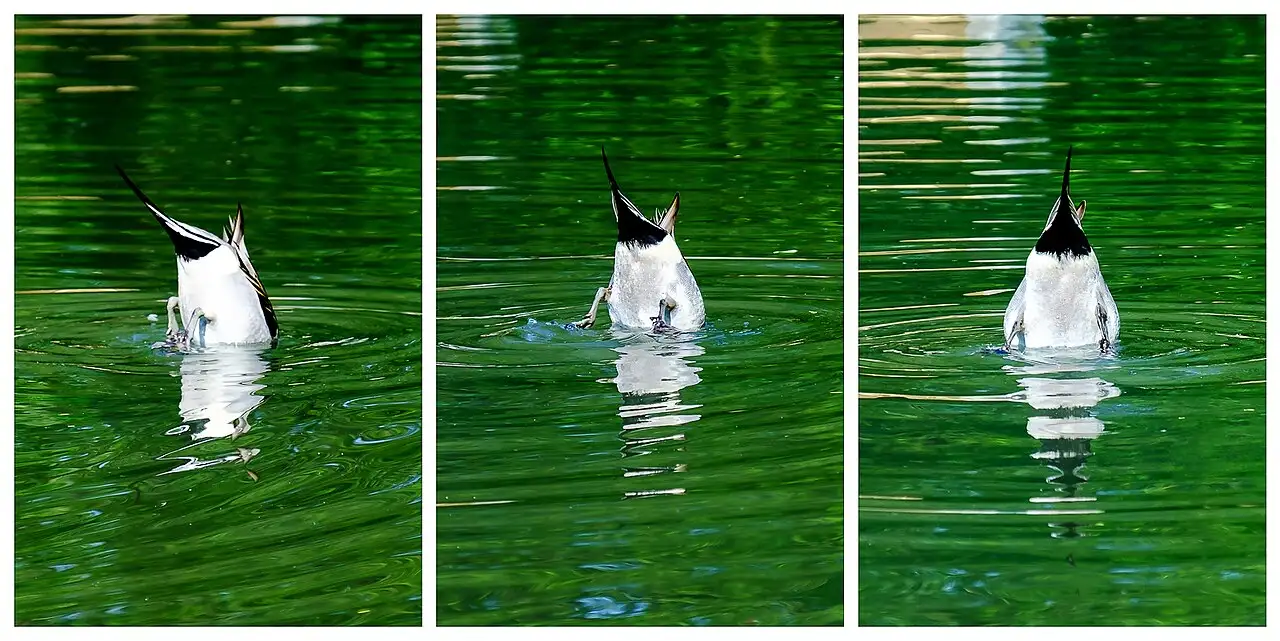
It obtains food by searching the muddy bottoms while swimming with the head and neck submerged; its long neck lets it reach down to 30 centimetres.
Photo gallery of the Northern Pintail
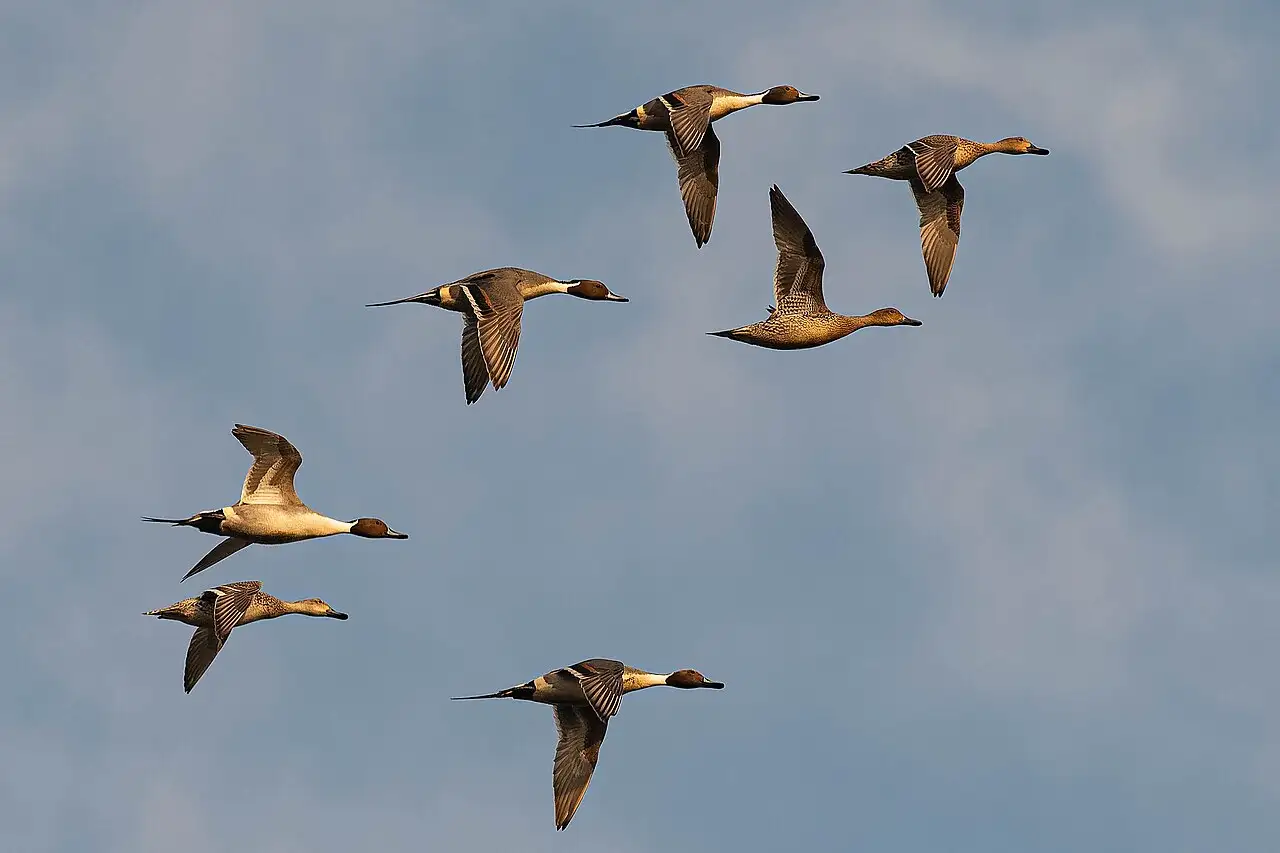
Flock of Northern Pintails in flight against a blue sky with clouds, with white-necked, pointed-tailed males and brown femalesPhoto: Hobbyfotowiki, CC0Photo 1 of 5
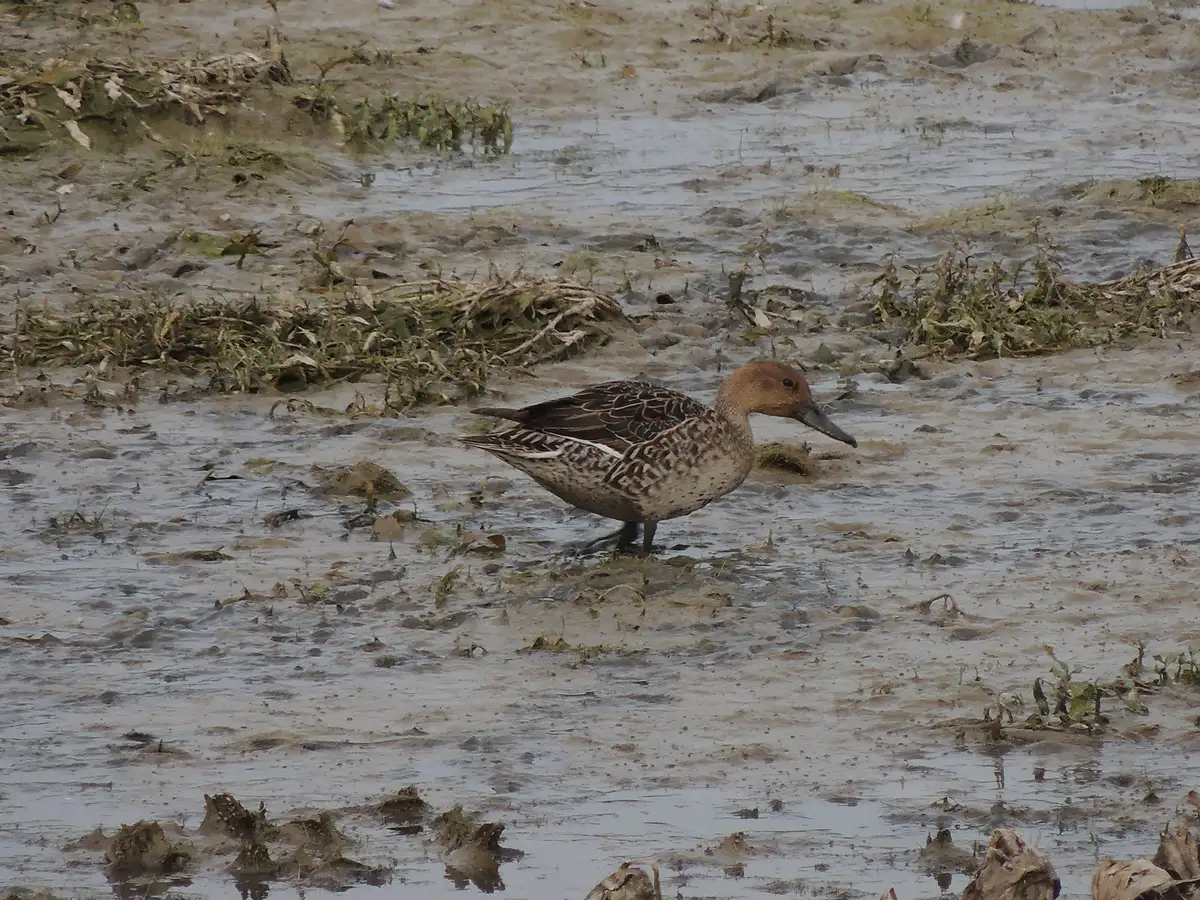
Female Northern Pintail walking on a mudflat with plant remains, with mottled brown plumage and chestnut headPhoto: Medeniacus, CC BY-SA 4.0Photo 2 of 5
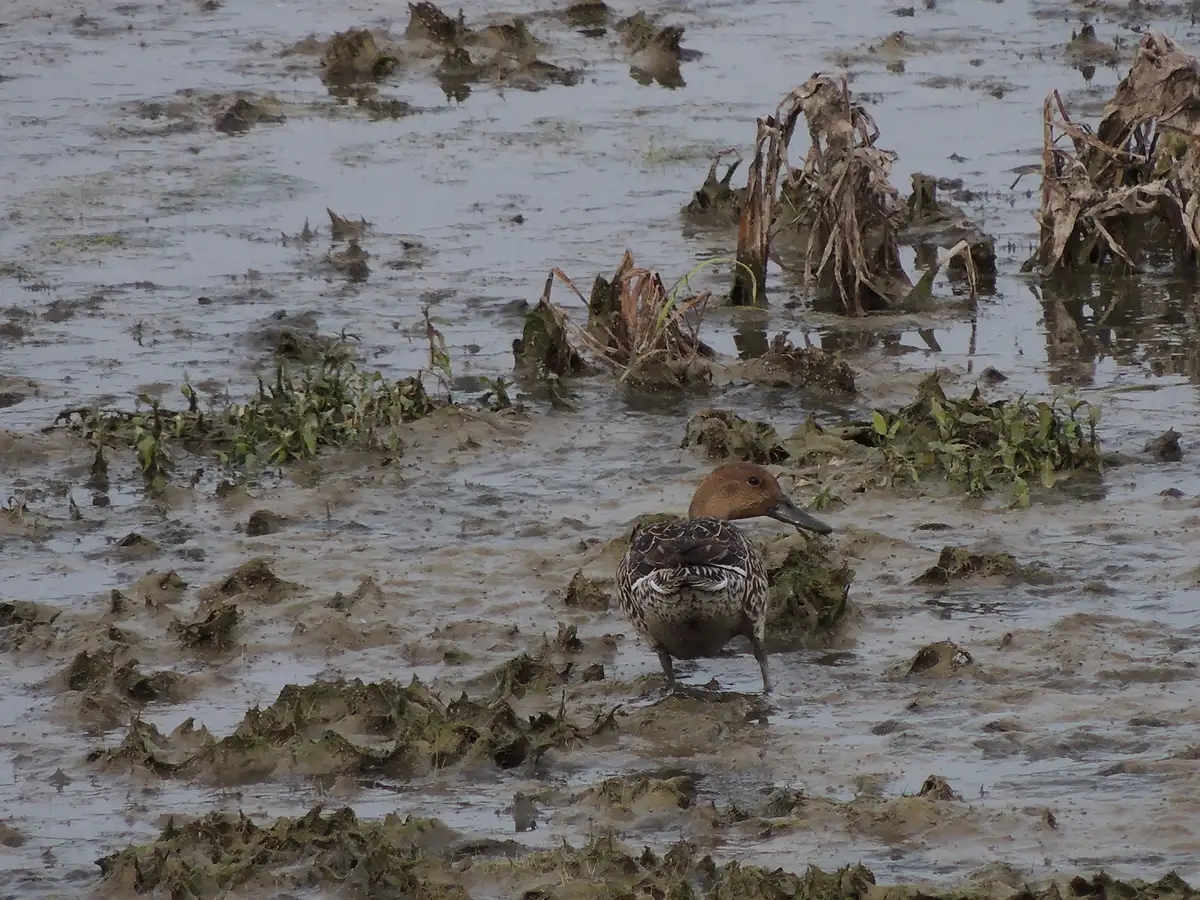
Female Northern Pintail among dry plant remains on a mudflat, with mottled brown plumagePhoto: Medeniacus, CC BY-SA 4.0Photo 3 of 5
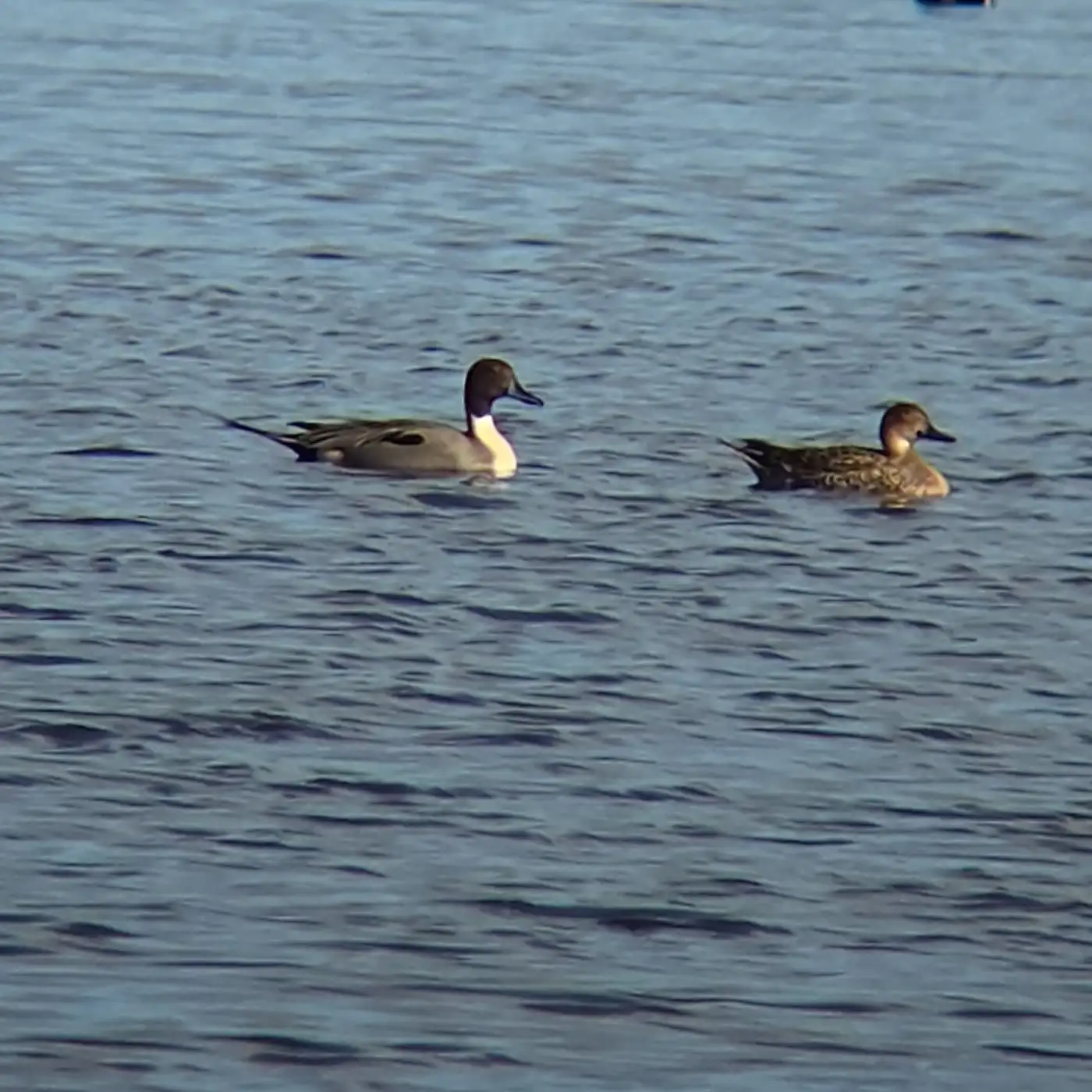
Male and female Northern Pintail swimming together, the male with brown head and neck striped with white (Catalonia)Photo: Jordi Casanovas, CC BY 4.0Photo 5 of 5
1 / 5
Identification of the Northern Pintail
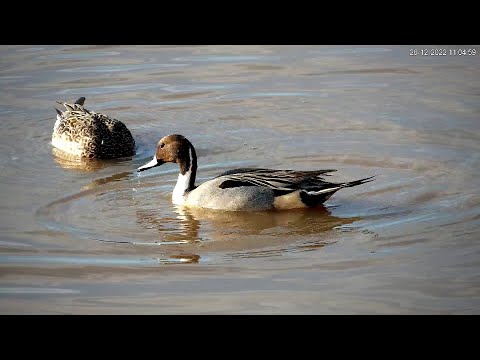
The Northern Pintail, which is also called «ánade rabudo», is a slender duck, with a long neck and pointed tail1. As in most ducks, there is a marked difference between males and females in the breeding season. Males have the head a chocolate colour, with a fine white line on both sides that joins the white of the neck and breast; the back and flanks are greyish, finely barred, the rear is black and the speculum greenish. The black, fairly long bill has blue sides. The most characteristic and striking feature is the length reached by the two central tail feathers, from which its name derives, and the wing coverts. Females, of brownish, mottled tones, with the dark brown speculum edged in white, are easily told from those of other ducks by their more slender shape and, above all, by the greater length of their tail feathers. In eclipse plumage, males are like females, but with the upper part of the wings and the scapulars longer and greyer. Young birds also resemble females, although they have paler head sides and a darker back.
Breeding male
Chocolate head with a white line on each side; neck and breast white.
Back and flanks greyish and barred, rear black, speculum greenish and two very long central tail feathers.
Female and young bird
Female: brownish and mottled, with the dark brown speculum edged in white.
Young bird: like the female, with paler head sides and a darker back.
Habitat and distribution of the Northern Pintail
Of Holarctic distribution, it breeds in northern Eurasia and North America. The subspecies «acuta» is the one that appears in Europe, where it also has isolated breeding cores in several regions of the centre and south.
In Spain it breeds occasionally in some peninsular wetlands, although the Guadalquivir marshes are the only site where it breeds with some regularity1. In winter a not very numerous contingent arrives in Spain, spread across the whole Peninsula and the Balearics but concentrated above all in the Guadalquivir marshes and, at lower densities, in the Extremaduran reservoirs of Gargáligas and Sierra Brava and the Ebro delta.
It shows a marked preference for shallow waterlogged areas. To breed it uses grasslands near bodies of water and even seasonal shallow ponds; in winter it concentrates in coastal habitats or in wetlands near the coast.
It is decidedly migratory. The first birds arrive in September, although the bulk comes between November and December, and the spring passage begins in mid-February and runs until April.
Areas where it is regularly recorded since 2010Squares of about 25 km where it is recorded regularly (occasional passage records are left out). Data from GBIF.org (46,752 records, retrieved October 2026); outline from Natural Earth.
Etymology of the Northern Pintail
It is also called «ánade rabudo», for the length of the two central tail feathers; in other languages it is «ànec cuallarg» in Catalan, «pato albelo» in Galician, «ahate buztanluzea» in Basque and «northern pintail» in English1. We have not found a source explaining the origin of the register’s name, «pato golondrino», or the scientific one, so we do not venture one.
Population of the Northern Pintail
The 2021 European Red List of Birds estimates some 310,000–401,000 pintails in Europe, with a decreasing trend. In Spain the breeding contingent is very small and marginal, some 25–30 pairs, all in the Guadalquivir marshes (III Atlas of Breeding Birds in Spain), and it could disappear in the coming years1. In winter, by contrast, the country holds a large number of birds: the 1991–2016 average is some 33,000 (2021 Red Book of the Birds of Spain), with marked variations from year to year, and the wintering population is in good health and increasing.
In the late 20th century it bred sporadically in some La Mancha wetlands and in Segovia1. The scant breeding in wet La Mancha may have vanished through the disappearance of temporary ponds by drainage and the fall of the water table1. The main threat is the alteration, destruction and transformation of wetlands, both at breeding and at wintering sites. In Doñana, the scant flooding of the marsh leaves nests within reach of wild boar and foxes and livestock. Hunting is a direct threat, because the species is not listed, and lead poisoning, from shot, another.
Nest of the Northern Pintail
The nest is always on the ground and hidden among grass, rushes or beside some bush, at a variable distance from the water. It is built by the female: a small hollow bounded by plant remains lined with down.
Courtship and breeding of the Northern Pintail
Pairs begin the courtship in their winter quarters and reach the breeding sites during April. The clutch usually consists of between seven and nine eggs, although it is not rare for there to be more, whitish, with a variable tint from greenish to greyish. The chicks hatch after 22–24 days of incubation, are able to feed themselves within a few hours of life and are tended by their mother until they have fully developed, after 40–45 days. The PIO sheet from Ávila gives clutches between April and June as a general datum for the species; breeding in Spain is scarce and localised, and is not attributed to Cabañeros.
Diet of the Northern Pintail
It is a preferably vegetarian duck, although it can also eat animal matter, especially aquatic insect larvae and molluscs. It obtains food by searching the muddy bottoms while swimming with the head and neck submerged; thanks to its long neck it reaches deeper areas, up to 30 centimetres, than other ducks of similar requirements, which can be an advantage. It also feeds on land, on cereal grain or by extracting rhizomes and tubers from the soil.
Curious facts about the Northern Pintail
It is one of the most beautiful ducks of our wetlands, unmistakable for its slender silhouette, and very scarce in the breeding period1. The longevity EURING gives, 29 years and 6 months in a bird shot in France, is somewhat more than AnAge’s 27.4 years.
The Northern Pintail in Cabañeros
The habitat pages of this website do not mention it, and we have not found any other published source on it in the Park; nor does it appear in the bird list of the «Visitor guide to Cabañeros National Park» (OAPN). GBIF.org records 4 observations of the Northern Pintail in Cabañeros and its surroundings. Among its wintering sites are cited the Extremaduran reservoirs of Gargáligas and Sierra Brava, and the La Mancha wetlands as a place of sporadic breeding in the late 20th century1. Only one of those observations falls within the Park boundary (according to OpenStreetMap); the rest are from the surroundings.
Where to see the Northern Pintail in Cabañeros
In Cabañeros and its surroundings, occasionally in winter, on reservoirs and shallow ponds.
When
In Spain from September to April; the bulk arrives between November and December.
What time
By day, swimming with the head and neck submerged in shallow water, or on land, on cereal.
Where
In marshes, reservoirs, wetlands near the coast and shallow waterlogged areas.
What to look for
Look for the male's long neck and pointed tail; listen for the «crip-crop» whistle in the courtship season.




 Same family
 Same family
 Same family
 Same family
 Same season in the park
 Same season in the park
 Same season in the park
 Same season in the park






