Very gregarious throughout the year; pair bonds range from monogamy to polygamy
Lifespan
Record of 22 years and 11 months in the wild according to EURING (a bird ringed in Denmark); AnAge gives 22.9 years
Conservation status
LC
NT
VU
EN
CR
EW
EX
Global (IUCN)
Least Concern
Spain
Least Concern (LC) as a breeder in the Red List of Birds of Spain; not on the List of Wild Species under Special Protection or in the Spanish Catalogue of Threatened Species
When to see it
Winter visitor
Months of the year when it is present
J
F
M
A
M
J
J
A
S
O
N
D
In Iberia
yes
yes
yes
yes
yes
yes
yes
yes
yes
yes
yes
yes
Breeding season
no
no
yes
yes
yes
yes
no
no
no
no
no
no
Song or voice of the Common Starling
It gives a prolonged, varied song, with a wide repertoire of whistles, clicks, screeches, trills, warbles and numerous imitations. The recording is of a male from France, made with a parabolic dish; we have trimmed and normalised it.
It has a fast, direct flight. It resembles the Common Blackbird, although it moves more upright, walking and not by hopping.
Flight typeFast and direct
Very gregarious throughout the year, in winter an important contingent of starlings from central and northern Europe arrives in Spain.
It has a fast, direct flight; it resembles the Common Blackbird, but moves more upright, walking and not by hopping.
In winter it prefers farmland, grasslands and olive groves, where its diet becomes more vegetarian, with marked fruit-eating.
Photo gallery of the Common Starling
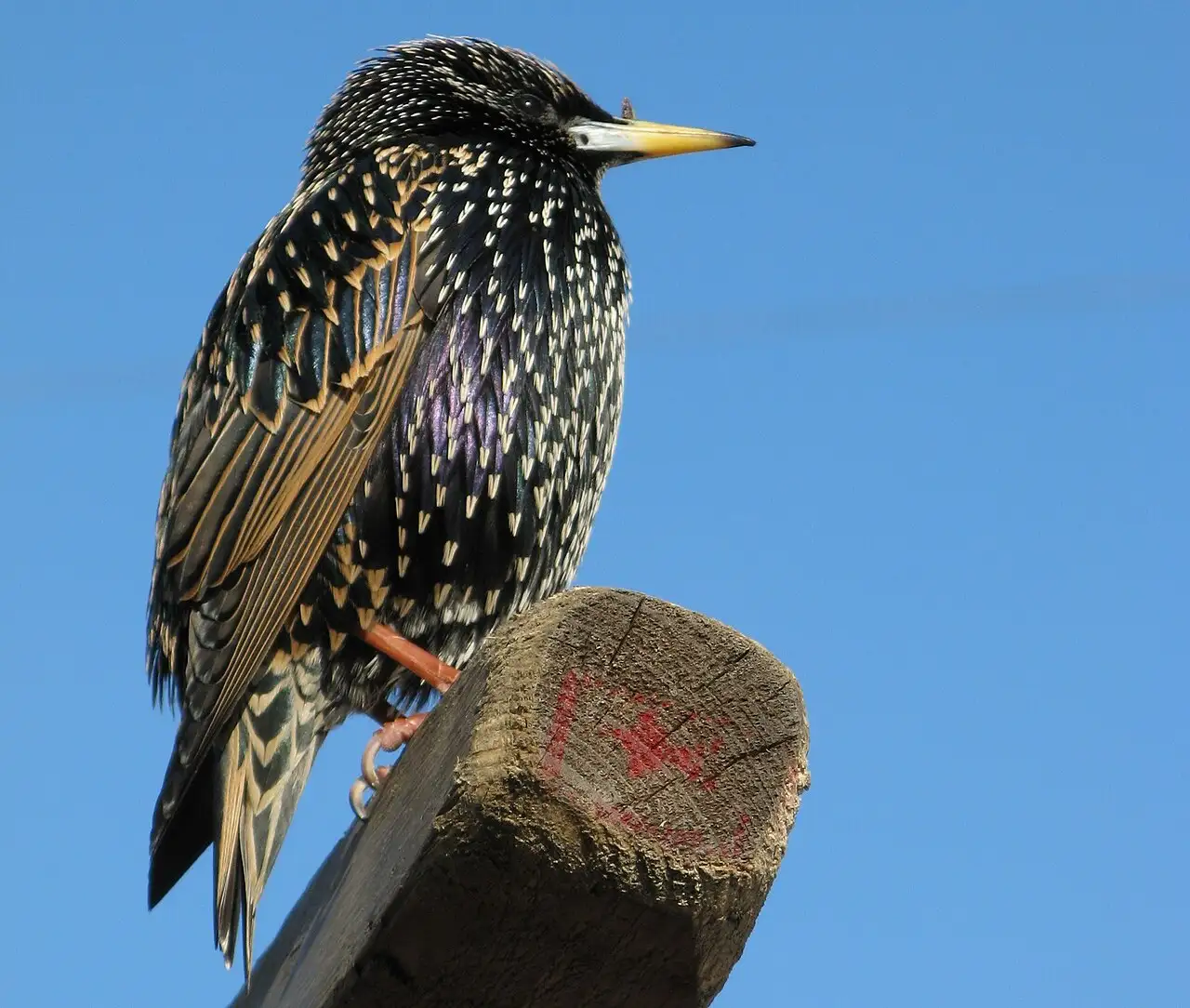
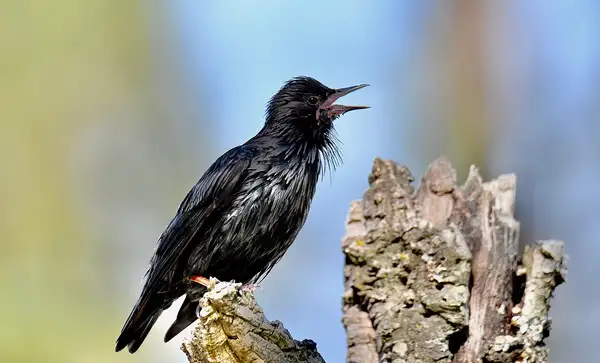
Common Starling perched on a wooden post against the blue sky, with black plumage spotted with yellowish white and a yellow billPhoto: LUZMARIA, CC BY-SA 3.0Photo 1 of 4
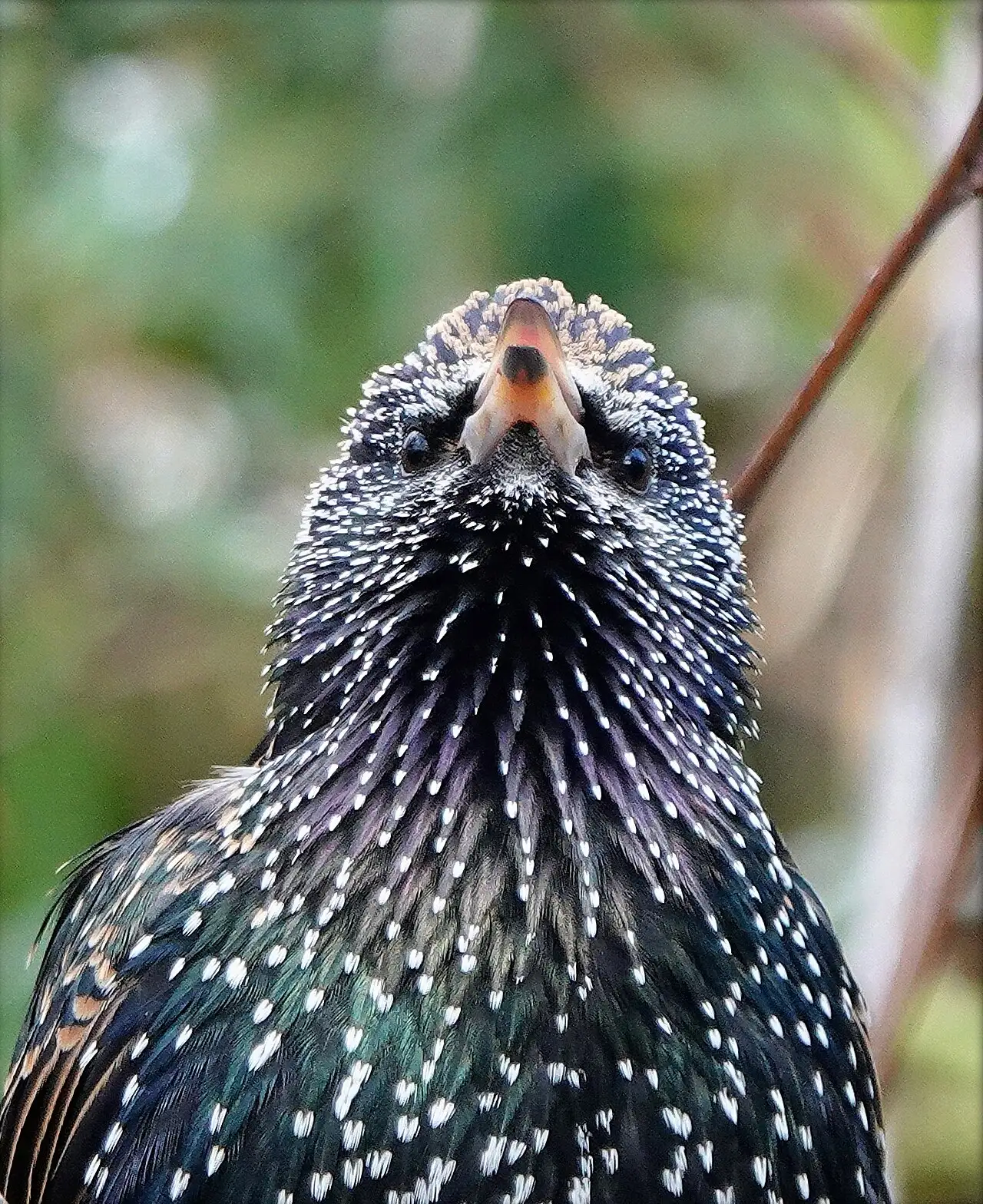
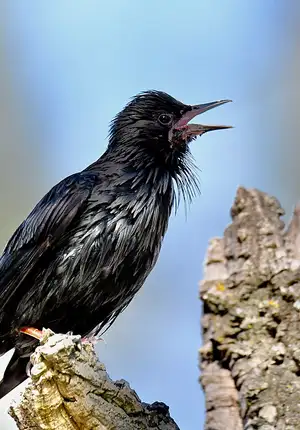
Common Starling seen from the front with open bill, showing the black plumage with violet sheen and the intense white spottingPhoto: Rolf Dietrich Brecher from Germany, CC BY 2.0Photo 2 of 4
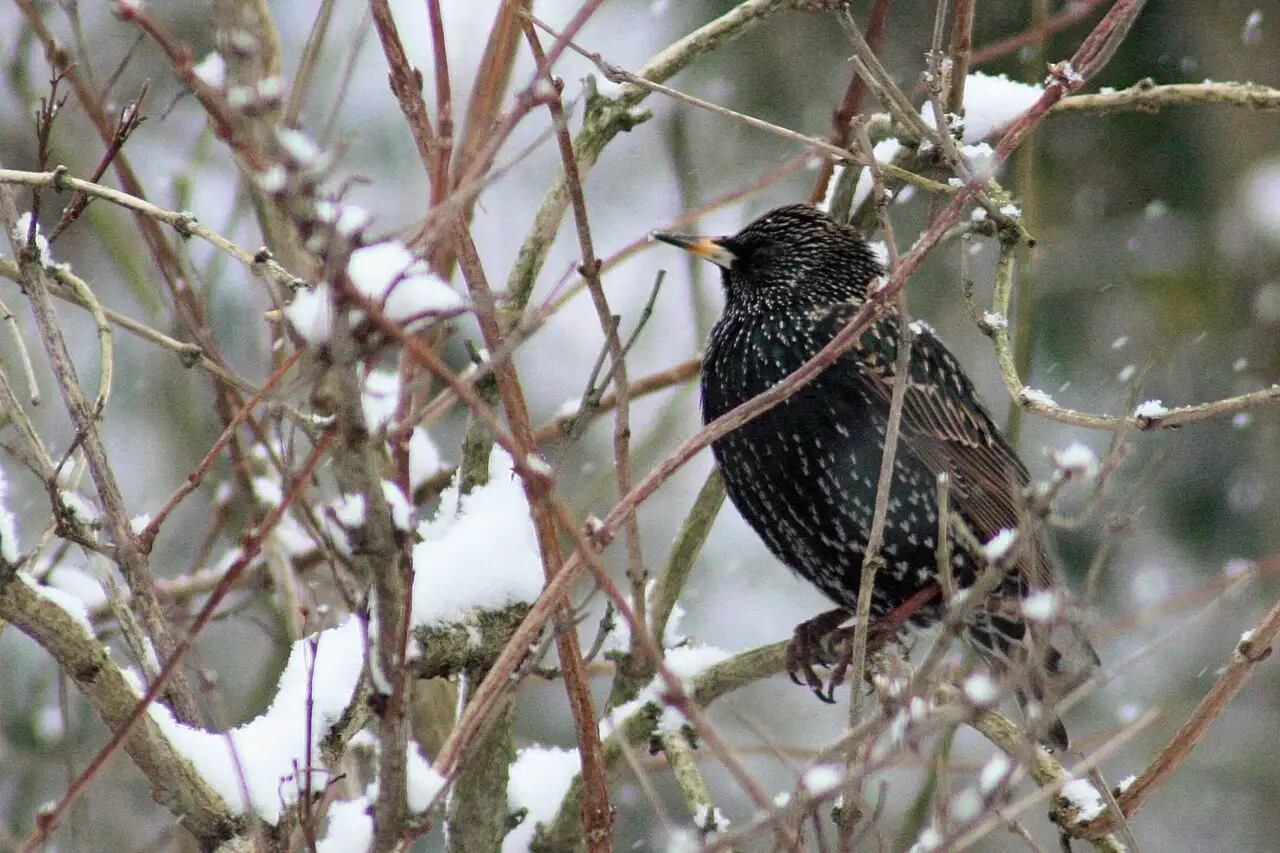
Common Starling in winter plumage among the branches of a snowy shrub, with intense spotting and a dark billPhoto: Si Griffiths, CC BY-SA 3.0Photo 4 of 4
1 / 4
Identification of the Common Starling
The Common Starling is a medium-sized, compact bird, with strong, short, pink legs and a pointed bill. Its plumage is predominantly black, with violet and purple sheen and with variable spotting of yellowish-white flecks. In winter the spotting is especially intense, and in summer it is less noticeable. The bill is yellow in summer and black in winter. Young birds have greyish-brown tones. It is like the Common Blackbird, although it moves more upright, walking and not by hopping.
Adult
Black plumage with violet and purple sheen, spotted with yellowish white.
Spotting more intense in winter and bill black; in summer, bill yellow.
Young bird
Greyish-brown tones.
Habitat and distribution of the Common Starling
It is distributed as a breeder across the whole of Europe, Asia and the Near East, and reaches east to China and Pakistan. It has been introduced to North America, Australia, New Zealand, Tasmania, South Africa and some localities in South America, where it has for the most part gone feral successfully. The wintering areas are in southern Europe, North Africa, the Middle East and the plains of India. Twelve subspecies have been described, and in Spain «vulgaris» is seen.
As a breeder it is distributed across most of Catalonia, Navarre, the Basque Country and the Cantabrian coastal zone as far as Asturias, and more patchily across the Ebro valley, the Valencian Community and the Canary Islands (Tenerife and Gran Canaria). In winter, with the arrival of birds from central Europe, it occupies the whole Peninsula and the Balearics, and the main wintering areas are in Galicia, the Cantabrian fringe, the Ebro valley and the Mediterranean coast. Its expansion is held back by that of the Spotless Starling, with which it competes for the same habitats and resources.
It occupies a wide variety of agricultural and semi-urban landscapes: wooded farmland with grassland and crops, vegetable plots, meadows, cereal crops, thinned woods, vineyards and urban parks. In winter it clearly prefers irrigated and dry-farmed agricultural areas (sown fields, ploughed land, stubble and vineyards), grasslands, Mediterranean scrub and tree crops, above all olive groves.
In Spain it behaves as a partial migrant or resident. The populations of southern Europe, including the Spanish ones, are sedentary, with movements of small scale, but in winter the Peninsula and the Balearics receive an important contingent of starlings from central and northern Europe. The autumn passage occurs between September and November, with a peak in early November, and the pre-breeding one between February and April, with a peak in late February.
Areas where it is regularly recorded since 2010Squares of about 25 km where it is recorded regularly (occasional passage records are left out). Data from GBIF.org (160,303 records, retrieved October 2026); outline from Natural Earth.
Etymology of the Common Starling
According to Wikipedia, Linnaeus described it in 1758 with the name it still bears. «Sturnus» and «vulgaris» come from the Latin for «starling» and «common». The English word «starling» and the Latin «sturnus» derive from an unknown Indo-European root, imitative of this bird’s song. In other languages it is called «estornell vulgar» in Catalan, «estorniño pinto» in Galician, «arabazozo pikarta» in Basque and «common starling» in English1.
Population of the Common Starling
In the 2021 European Red List of Birds the European breeding population is estimated at between 53,300,000 and 94,400,000 mature individuals, with a stable trend. Not enough information has been obtained on the Spanish population, and its trend is stable. No specific threats have been detected, apart from those arising from agricultural intensification, which it can tolerate to a high degree, and hybridisation with its relative, the Spotless Starling.
Nest of the Common Starling
It places it in a hole in a tree, wall or bank, lined with grasses and feathers.
Courtship and breeding of the Common Starling
The breeding season runs from March to June. It usually makes a single clutch a year, of three to eight eggs of plain colour, white or bluish. Incubation lasts 11 to 15 days and is done mainly by the female, and the chicks, fed mainly by the mother, are able to fly at 21 days. Afterwards, the young join flocks with other birds of their age.
Diet of the Common Starling
Its rich, varied diet is made up of invertebrates and plants. In spring and summer the animal component dominates, and in autumn and winter it is a more vegetarian bird, with marked fruit-eating. The chicks are fed only on invertebrates.
Curious facts about the Common Starling
It is a bird of compact appearance and black colouring, in which the white spotting and the yellow bill stand out, which has colonised the Peninsula in recent times and is expanding1. EURING lists a Common Starling ringed in Denmark that lived 22 years and 11 months, almost the same as AnAge gives (22.9 years).
The Common Starling in Cabañeros
The habitat pages of this website do not mention it, and we have not found any other published source on it in the Park. GBIF.org records 15 observations of the Common Starling in Cabañeros and its surroundings.
Where to see the Common Starling in Cabañeros
In Cabañeros and its surroundings, in winter, in grasslands, fields and olive groves, where it forms flocks.
When
In winter, with the arrival of birds from central and northern Europe; the autumn passage is from September to November.
What time
By day, in flocks that move across the fields.
Where
In agricultural areas, grasslands, Mediterranean scrub and olive groves.
What to look for
Look for the white spotting and the yellow summer bill; listen for the repertoire of whistles, clicks and imitations.



 Same family
 Same order
 Same order
 Same order
 Same order
 Same order
 Same order
 Same order






