Wingspan compared with a person with arms outstretched.
Length
96–119 cm
Wingspan
1.8–2.22 m
Weight
3–6.1 kg
Social life
Gregarious: in flocks, and at roosts of thousands in winter
Lifespan
Record of 43 years in the wild
Conservation status
LC
NT
VU
EN
CR
EW
EX
Global (IUCN)
Least Concern
Spain
Special protection regime; as a breeder, extinct in Spain (Red Book)
When to see it
Winter visitor in Cabañeros
Months of the year when it is present
J
F
M
A
M
J
J
A
S
O
N
D
In Iberia
yes
yes
yes
no
no
no
no
no
no
yes
yes
yes
In Cabañeros
yes
yes
no
no
no
no
no
no
no
yes
yes
yes
Song or voice of the Common Crane
A loud, resonant trumpeting, which can be heard for kilometres. Flocks in flight and groups on the ground give it endlessly, and it is the first thing that tells us they are arriving.
TrumpetingCommon Crane
0:00 / 0:19
10 kHz5
The sonogram draws the sound: time runs from left to right, and the higher a trace sits, the higher the note.Recording by Wikimalte, Wikimedia Commons (CC BY-SA 4.0).
Flight of the Common Crane
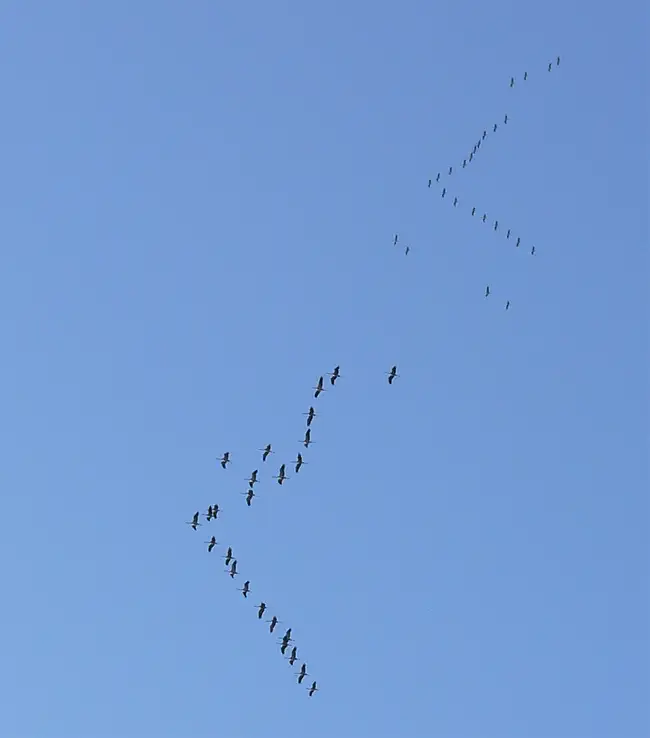
It flies with slow, deep wingbeats, with the neck stretched forward and the legs trailing back. On migration they form a V or long oblique lines, and the leader takes turns so that the others tire less. When they glide, they use thermals to gain height without spending energy.
Flight typeIn a V, with slow wingbeats
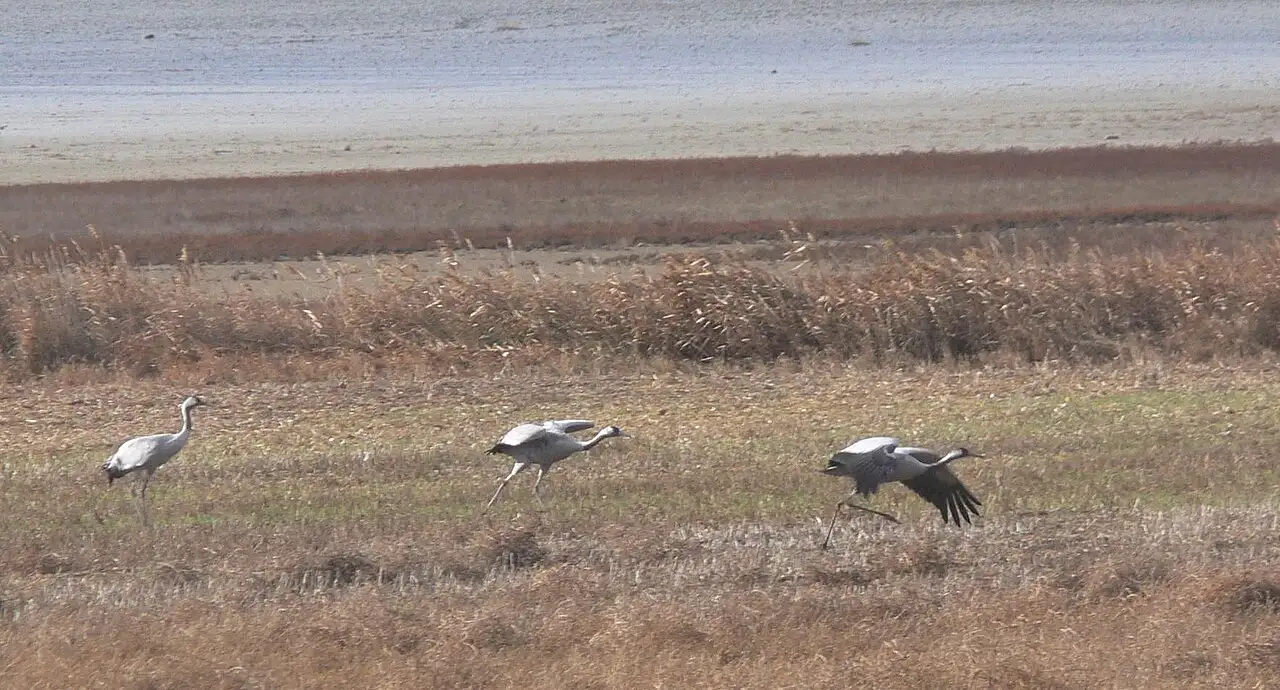
They run a few steps and rise with deep wingbeats, with the wings wide open and the neck stretched out.
They line up in a V, necks forward and legs trailing back, with slow wingbeats. They are heard long before they are seen: their trumpeting sounds for kilometres.
On reaching the dehesa they brake with wings open, tail spread and feet forward, and land to eat acorns.
Photo gallery of the Common Crane
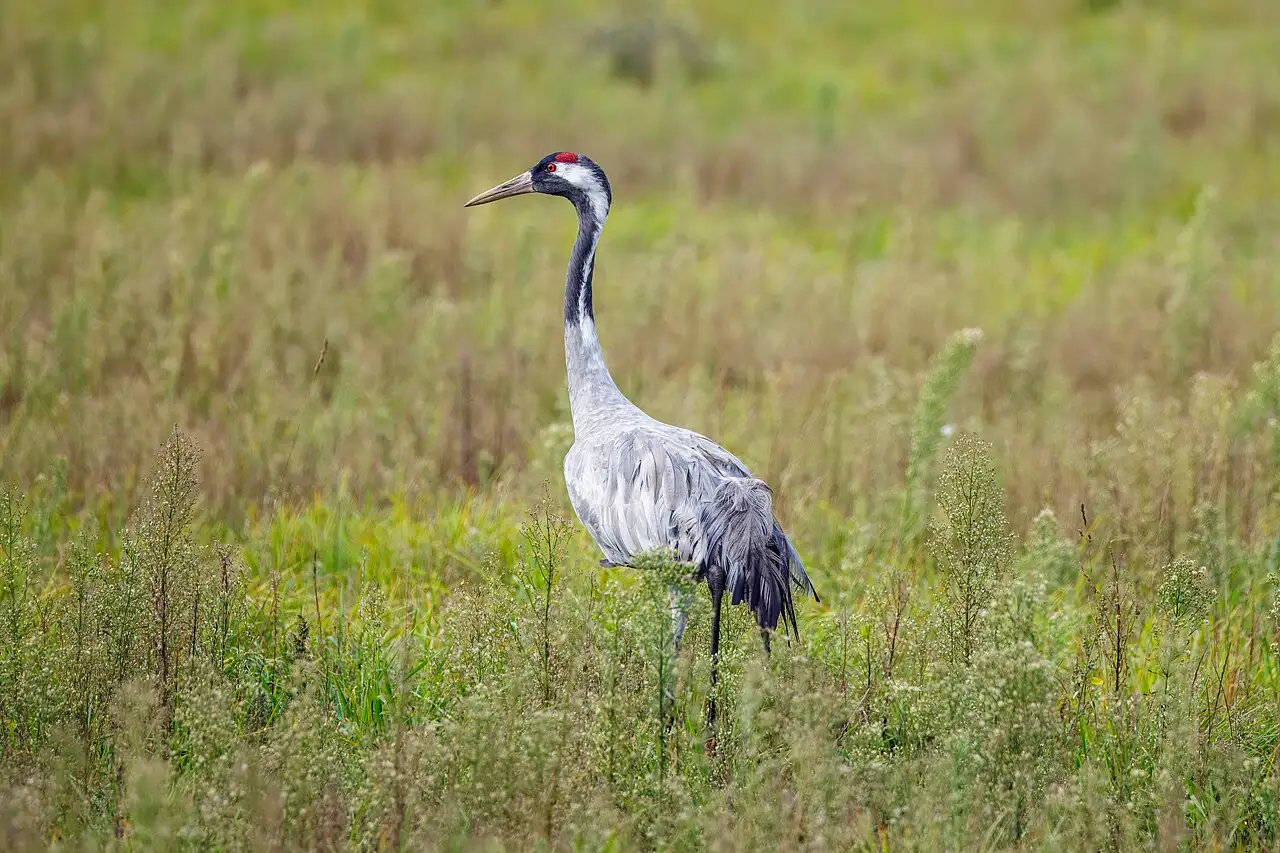
Common Crane in profile among the grass: grey body, black neck with a white band and red crownPhoto: Charles J. Sharp, CC BY-SA 4.0Photo 1 of 4
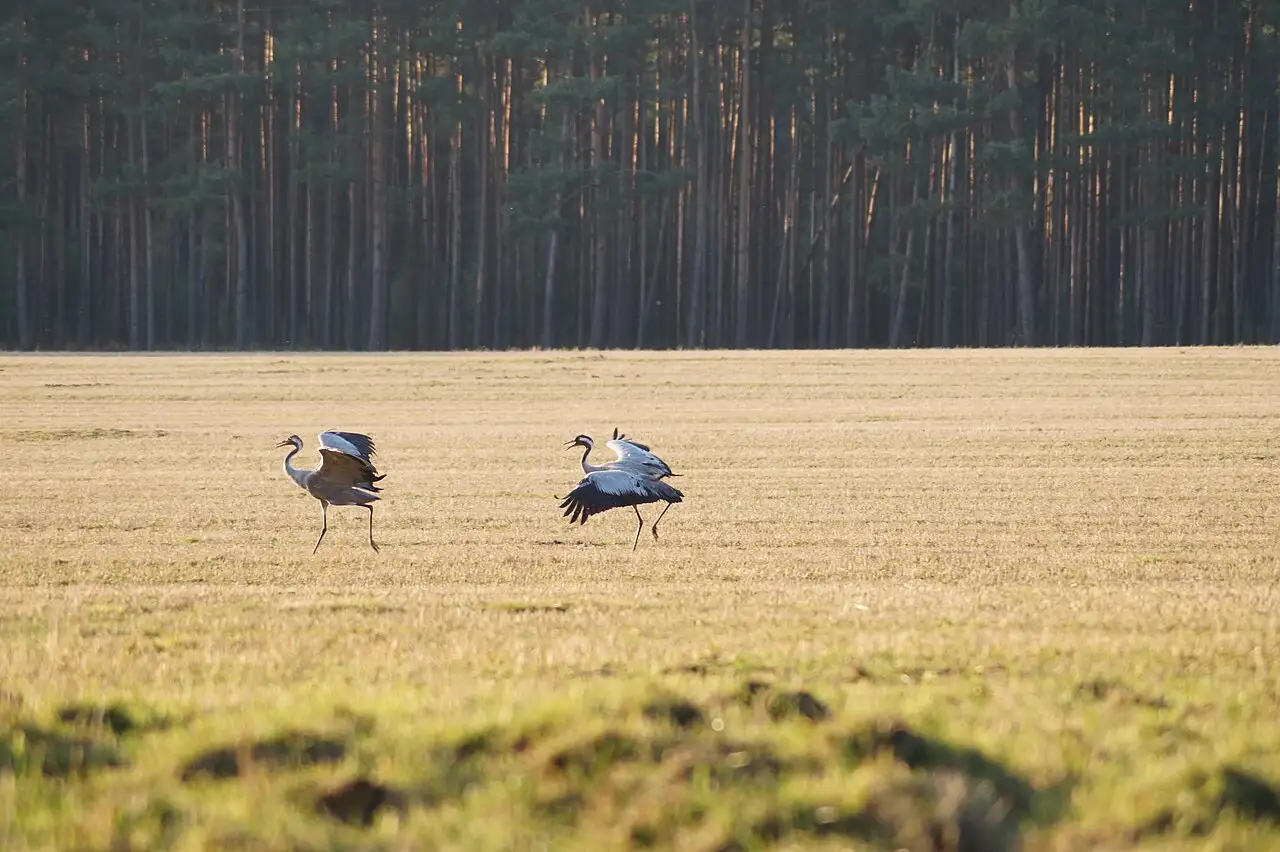
Two cranes dancing in a field: they leap and open their wings, in their courtshipPhoto: Schlaubetal-Liebe, CC BY-SA 4.0Photo 3 of 4
Cranes feeding in a stubble field, with a lagoon in the backgroundPhoto: Alfonso Garmendia, CC BY-SA 4.0Photo 4 of 4
1 / 4
Identification of the Common Crane
It is a bird unmistakable for its size and silhouette. Few birds of the Peninsula resemble it: only herons and storks, though none has its black neck and head with that white band. In flight it is recognised by the way it carries its neck, stretched out, and by the widely spread fingers of the wings.
Its plumage is grey, darker on the back and wings.
The neck and head are black, with a white band running from the eye to the nape. The crown is red.
The bill is long and straight, greenish in colour.
The flight feathers are black, and are very visible from below in flight.
Young birds are browner and do not yet have the head pattern.
Habitat and distribution of the Common Crane
It breeds in northern Europe and Asia, on boggy ground and other wetlands with marsh or herbaceous vegetation. In autumn it migrates south, and a very important part of the European population spends the winter on the Iberian Peninsula and in North Africa. In Spain it no longer breeds: as a breeder it is extinct.
The autumn route follows the Navarrese Pyrenees, the Gallocanta lagoon, and from there the south-west of the Peninsula; the spring one is more easterly and crosses the centre of the Pyrenees. In winter we find it mainly in the holm oak dehesas of Extremadura and Castilla-La Mancha, and also in crops, rice fields and marshes.
Areas where it is regularly recorded since 2010Squares of about 25 km where it is recorded regularly (occasional passage records are left out). Data from GBIF.org (101,743 records, retrieved October 2026); outline from Natural Earth.
Etymology of the Common Crane
Its scientific name is the same word repeated, a tautonym: «Grus» is «crane» in Latin, and our Spanish «grulla» goes back to that root.
Population of the Common Crane
More than 255,000 cranes spend the winter in Spain and the world population is growing, with between 309,000 and 423,000 mature individuals1. It is classified as Least Concern as a winter visitor, while as a breeder it is considered extinct in Spain.
Nest of the Common Crane
It builds the nest on the ground, on waterlogged terrain, piling up vegetation from the shores. It does not breed in Spain, but does so in northern Europe and Asia.
Courtship and breeding of the Common Crane
The crane forms stable pairs and, to strengthen the bond, the two dance: they leap, open their wings and bow with their heads. The clutch is normally two eggs, ranging from beige to bluish green, around May. Incubation lasts about 30 days and the chicks leave the nest a few hours after hatching, following the parents. They fly at some 67 to 70 days of age.
Diet of the Common Crane
It eats anything, although in winter it feeds mainly on acorns, cereal grain, bulbs and legumes. That is why we see it in the holm oak dehesas, under the holm oaks and cork oaks, and on stubble fields.
Curious facts about the Common Crane
Its trumpeting is so powerful thanks to a very long windpipe, coiled inside the keel of the breastbone, which acts as a sounding box. And there is one more fact: cranes pair for life.
The Common Crane in Cabañeros
Several thousand cranes spend the winter in the park and its surroundings, and each year the park counts them at their two roosts: the Torre de Abraham reservoir (Retuerta del Bullaque) and Las Povedas (Alcoba). The numbers change quite a bit from one winter to the next, and so does the roost that leads:
January 2017: some 8,700 cranes, 6,859 at Torre de Abraham and 1,856 at Las Povedas (count by Ángel Arredondo, Ángel Gómez Manzaneque and Carlos Rodríguez Vigal).
December 2023: 5,599, with 2,954 at Torre de Abraham and 2,645 at Las Povedas. That year they arrived late, probably because of the mild autumn in northern Europe and the November storms on the Peninsula.
Winter 2025: 4,432, with 2,506 at Las Povedas and 1,926 at Torre de Abraham.
Winter 2026: some 5,750, almost 30 % more than the year before and with Las Povedas well ahead: some 4,000 against some 1,750 at Torre de Abraham.
The figures from 2023 to 2026 are those of the park’s counts, published in its «Desde el parque» bulletin (all the bulletins). To get an idea of the scale: in the 2025 count more than 232,700 cranes were counted across Spain and 48,192 in Castilla-La Mancha, and a quarter of these were around Cabañeros and the Tablas de Daimiel. They come from Finland, Sweden and the rest of northern Europe. They arrive around 15 October, coinciding with St Teresa’s day, and leave in late February for northern Europe, stopping at Gallocanta and at the Puebla de Beleña lagoon.
They make use of the holm oak dehesas and the cereal fields, above all freshly harvested maize fields.
Where to see the Common Crane in Cabañeros
The best places are the two roosts, the Torre de Abraham reservoir and Las Povedas; in the last two winters more cranes have slept at Las Povedas. During the day they spread over the dehesas and sown fields of the surroundings.
When
From mid-October to late February. The best months are November, December and January, with the peak numbers.
What time
At dawn, when they leave the roost in flocks, and at dusk, when they return. In between, feeding in the dehesas and sown fields.
Where
At the Torre de Abraham and Las Povedas reservoirs and, by day, in the holm oak dehesas and the cereal and maize fields of the surroundings.
What to look for
First you hear it: a distant trumpeting. Then you see V-shaped flocks crossing the sky, and on the ground, very tall grey groups feeding among the holm oaks.
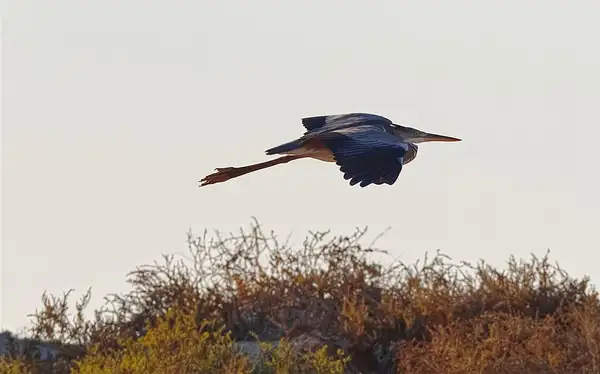
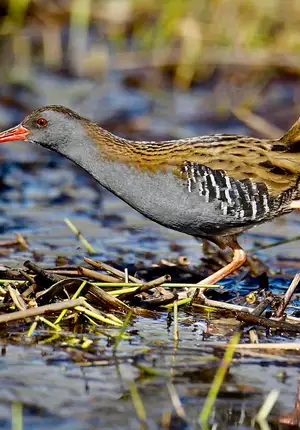
Smaller and slimmer, grey and white, with a black crest and a yellowish bill. In flight it carries its neck tucked into an «S», not stretched out, and its wings give slower beats.
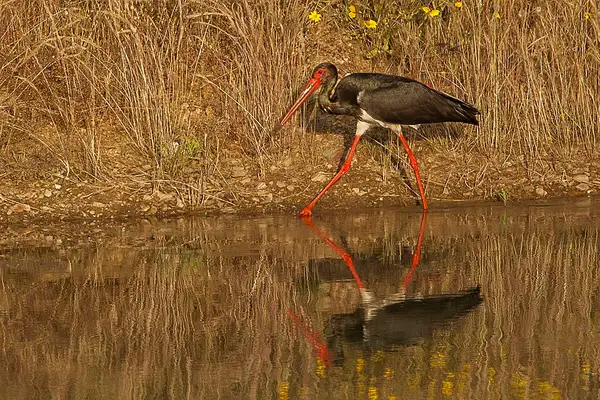
Black and glossy, with white belly and red bill and legs. It stretches out its neck in flight, like the crane, but has longer, broader wings and does not fly in a V.
Photo: Francesco Veronesi from Italy, CC BY-SA 2.0
Other birds
Birds related to the Common Crane or sharing its habitats in Cabañeros.
Bulletin «Desde el parque», Cabañeros NP (OAPN): September–October and November–December 2023, January–February 2025 and January–February 2026 (crane counts). All the bulletins.
Jiménez García-Herrera, José. (2017). Aves de Cabañeros y su entorno. Madrid, Spain: Ecohábitat.
SEO Birdlife - Sociedad Española de Ornitología
Arredondo, Á., Gómez Manzaneque, Á. and Rodríguez Vigal, C. Census of the wintering Common Crane in Cabañeros, January 2017. Lanza Digital.



 Same season in the park
 Same order
 Same season in the park
 Same season in the park
 Same season in the park
 Same season in the park
 Same season in the park
 Same order






