Wingspan compared with a person with arms outstretched.
Length
46–51 cm
Wingspan
85–90 cm
Weight
0.9–1.5 kg
Social life
It gathers in winter concentrations on certain wetlands; in the breeding season the pair zealously defends the eggs and chicks
Lifespan
Record of 14 years and 6 months according to EURING (a bird ringed in the Netherlands that was caught in a fishing net); AnAge gives up to 19.2 years
Conservation status
LC
NT
VU
EN
CR
EW
EX
Global (IUCN)
Least Concern
Spain
Least Concern (LC) in the Red Book of the Birds of Spain, both as a breeder and as a winter visitor or migrant; on the List of Wild Species under Special Protection, but not in the Spanish Catalogue of Threatened Species
When to see it
Resident
Months of the year when it is present
J
F
M
A
M
J
J
A
S
O
N
D
In Iberia
yes
yes
yes
yes
yes
yes
yes
yes
yes
yes
yes
yes
Song or voice of the Great Crested Grebe
It gives harsh, varied, several-syllable sounds, which it alternates in sequence: «grhee-ghagha».
SongGreat Crested Grebe
0:00 / 0:22
10 kHz5
The sonogram draws the sound: time runs from left to right, and the higher a trace sits, the higher the note.Recording by Bicheando Natura, Vídeo de YouTube «Canto del somormujo lavanco» (Vídeo de YouTube, con atribución).
Flight of the Great Crested Grebe
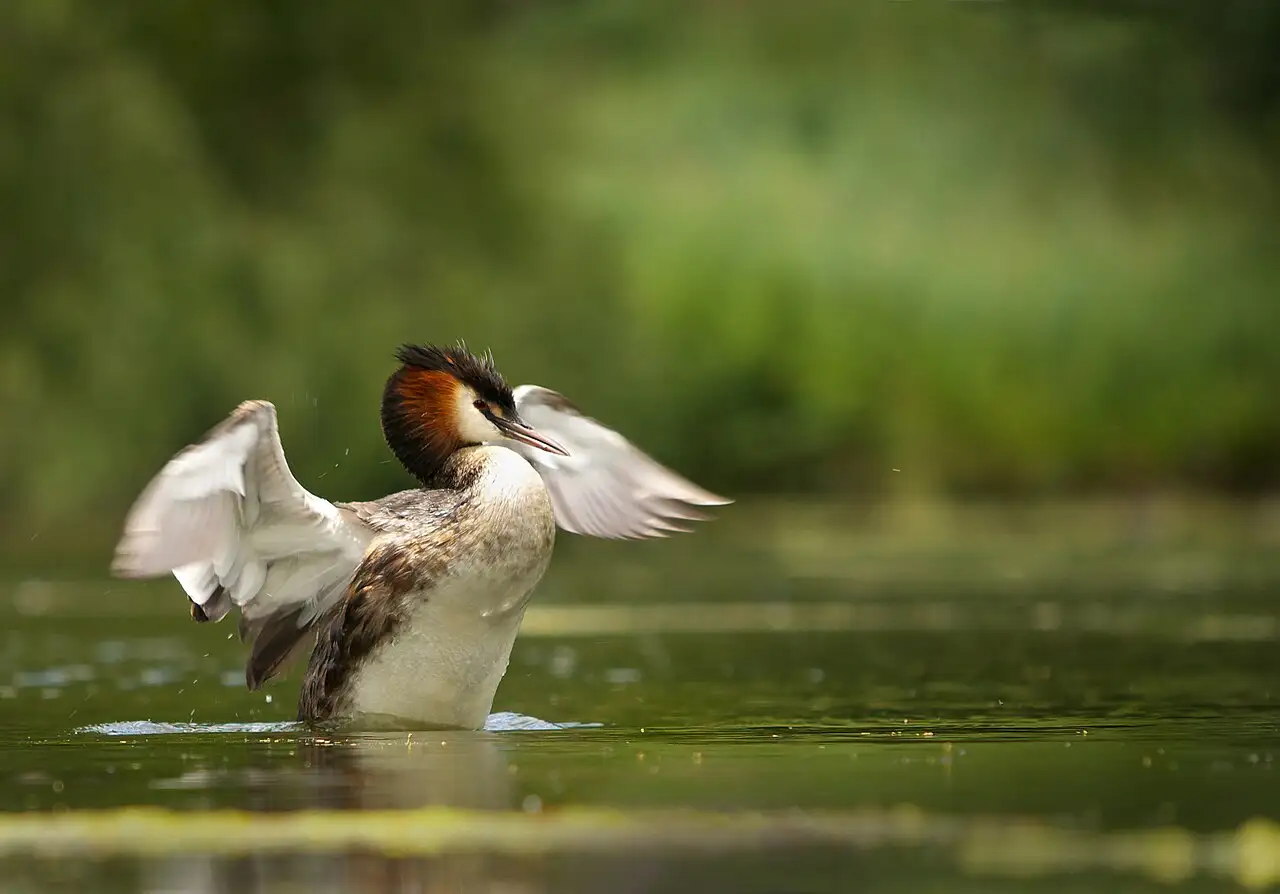
In flight its slender build is apparent, with the long neck stretched out. Its quick wingbeats show the white wing areas like flashes.
Flight typeDirect, with the neck stretched out and a quick beating of the wings
It occupies wetlands of open, moderately deep water with fish, both inland and on the coast.
Its slender build is apparent, with the long neck stretched out, and its quick wingbeats show the white wing areas like flashes.
It is mostly a fish-eater: it catches fish while diving, and only occasionally eats invertebrates.
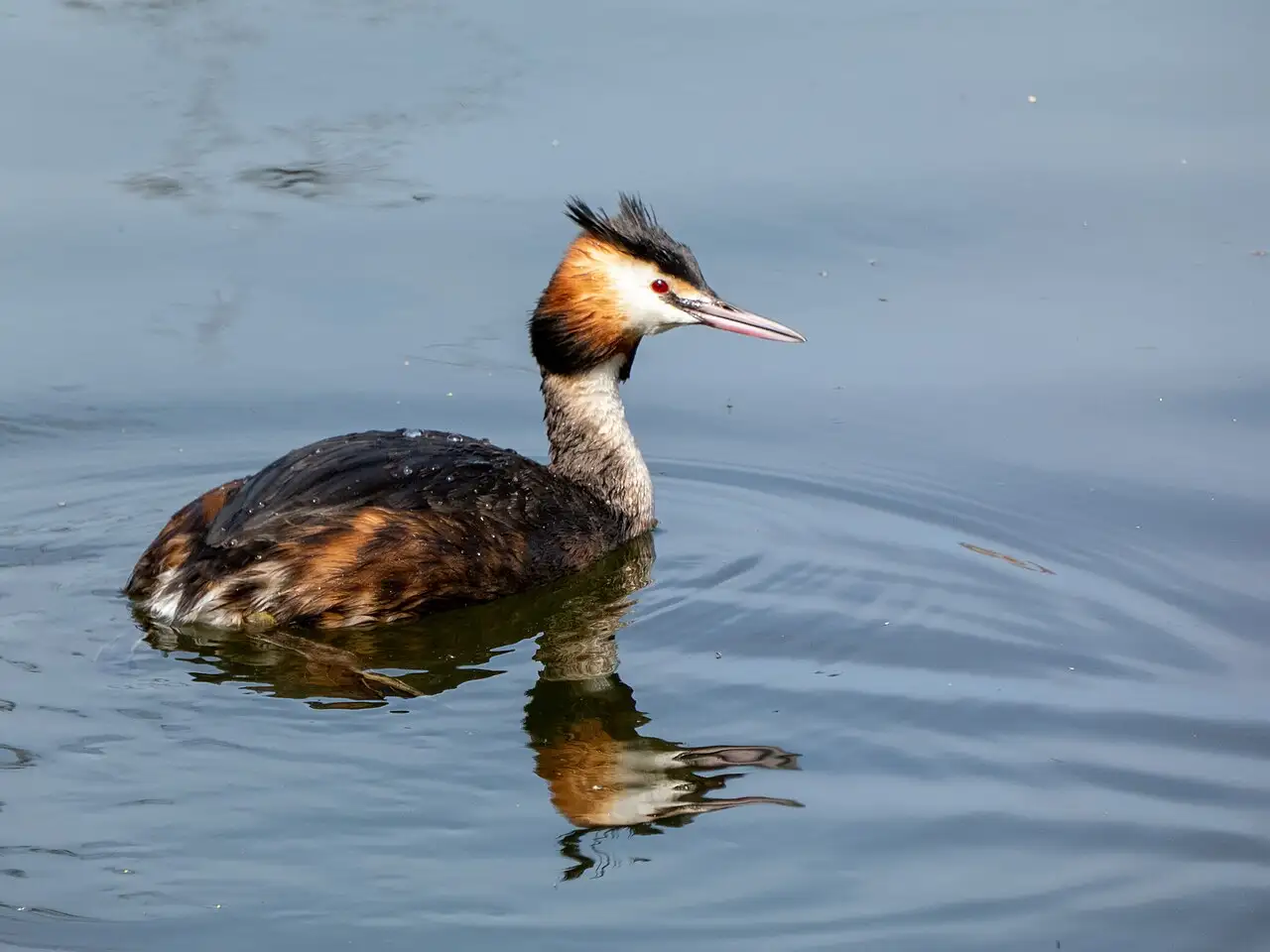
The Great Crested Grebe is the largest of the grebes that can be seen in Spain, the size of a large mallard. It is an elegant bird, with a slender neck, a long, pointed bill and an elongated body. In any plumage the long neck is a good diagnostic feature. There are no differences between the sexes.
Summer plumage
Black top of the head, with two groups of feathers like tufts.
Elongated feathers in reddish and black tones grow from the cheeks.
White area around the eyes, neck, breast and belly, contrasting with the dark back and reddish flanks.
Winter plumage
Much less showy: overall dark tone on the back and sides.
White neck, head (except the dark crown) and underparts.
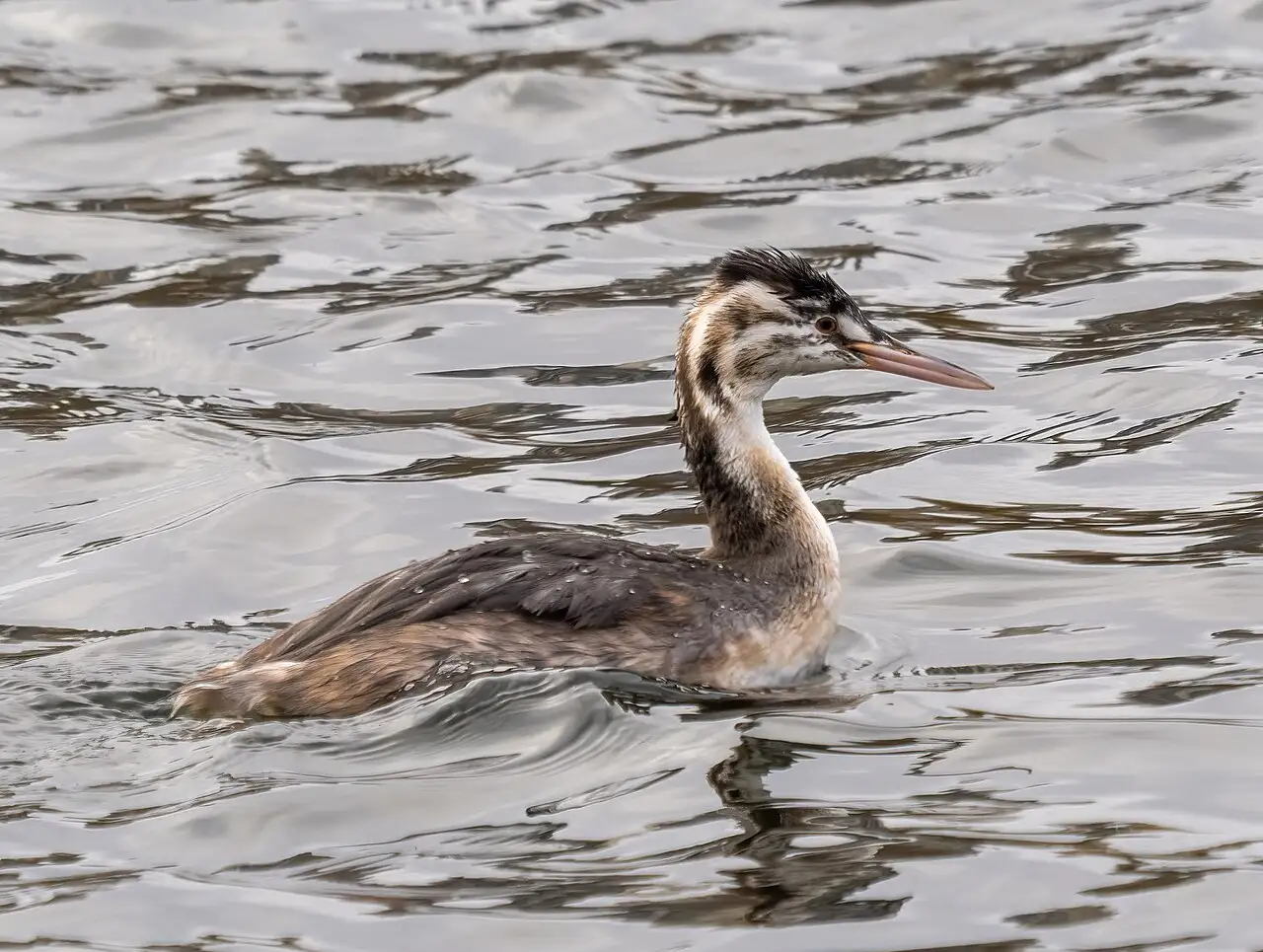
Young bird
Similar to the adults in winter, but with a pattern of black lines on the face that sets them apart.
Habitat and distribution of the Great Crested Grebe
It is distributed across Europe, Africa, Asia and Australia, and three subspecies have been described. In Spain the subspecies «cristatus» lives, present in Europe and Asia, and it is found in practically every region, except the Canary Islands, Ceuta and Melilla. As a water bird, it is better and more widely distributed in the areas with the most wetlands suited to it.
It occupies a wide variety of wetlands, inland and coastal, as long as they are open water, moderately deep and with fish. Unlike other species of its family, it is not so demanding about well-developed emergent marsh vegetation, and it accepts nutrient-rich water.
It can behave as a sedentary bird or as a partial migrant. The northernmost European populations are more migratory and move south, to places that do not freeze in winter, which means that in Spain the wintering population is larger than the breeding one. In Europe winter concentrations on certain wetlands are frequent, such as the Camargue (France), although in Spain this phenomenon seems to occur only in the Bay of Cádiz.
Areas where it is regularly recorded since 2010Squares of about 25 km where it is recorded regularly (occasional passage records are left out). Data from GBIF.org (151,556 records, retrieved October 2026); outline from Natural Earth.
Etymology of the Great Crested Grebe
According to Wikipedia, «Podiceps» comes from the Latin «podicis» («vent») and «pes» («foot»), and alludes to the fact that a grebe’s legs are set towards the rear of the body; «cristatus» means «crested». Linnaeus described it in 1758 as «Colymbus cristatus». In other languages it is called «cabusó emplomallat» in Catalan, «mergullón cristado» in Galician, «murgil handia» in Basque and «great crested grebe» in English1.
Population of the Great Crested Grebe
In the 2021 European Red List of Birds the European breeding population is estimated at between 772,000 and 1,060,000 mature individuals, with a stable trend. There are no recent data on the Spanish population allowing an assessment, not even an approximate one1. It is not possible to infer reliably what trend it is following1.
Nest of the Great Crested Grebe
To breed, the pair builds a floating nest of plant material which also anchors it to the bottom so that currents do not move it. It measures about 45 centimetres across and is often hidden among the marsh vegetation of the bank, if there is any. In Spain it has a strong tendency to choose reservoirs for breeding; these are very unpredictable places and sudden changes in the water level can flood the nests or leave them dry, within reach of predators.
Courtship and breeding of the Great Crested Grebe
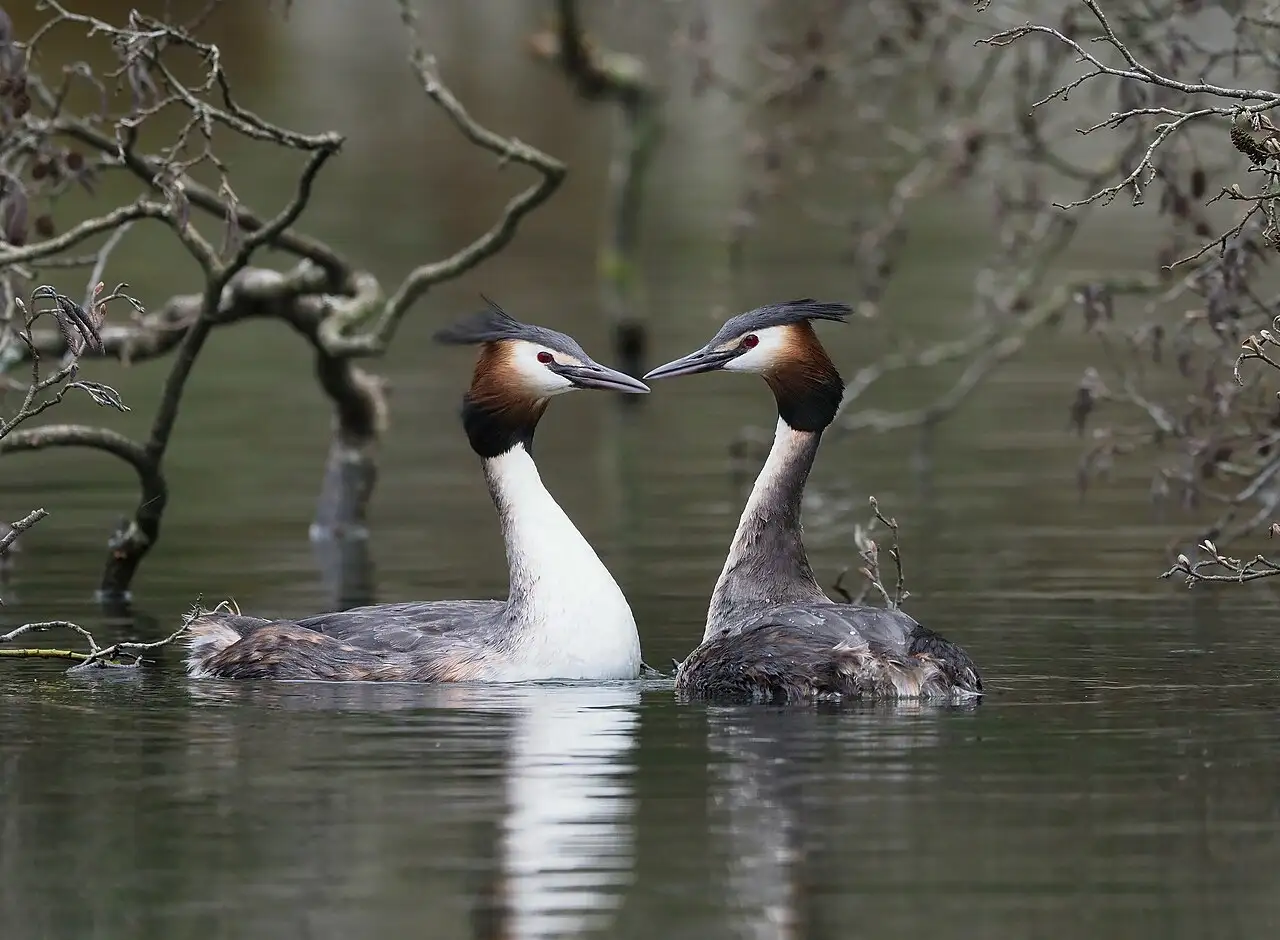
The courtship is striking, with various poses in which it often puffs out the neck feathers. The most peculiar act occurs when both sexes, approaching head-on, meet and stand practically upright on the water for a few seconds. It normally lays only one clutch, of one to six eggs, white at first and turning brown later, stained by the aquatic vegetation of the nest. Incubation, shared by both sexes, lasts 27 to 29 days. As in all species of the family, the chicks leave the nest soon after hatching and climb onto their parents’ backs to shelter and to be carried. At seven weeks they can feed themselves and a couple of weeks later they are ready to become independent. The adults zealously defend the eggs and chicks, which dive quickly when in danger.
Diet of the Great Crested Grebe
Unlike the other members of its family, it is mostly a fish-eater: fish, which it catches while diving, are the main component of its diet. Occasionally it may also eat invertebrates, such as insects and their larvae.
Curious facts about the Great Crested Grebe
According to Wikipedia, it is the largest of the grebes of the Old World, although in America there are bigger species. Its tendency to breed on reservoirs, an artificial environment in which it has found a place, is sometimes an advantage and sometimes not, because of the sudden rises and falls of the water level1. EURING lists a bird ringed in the Netherlands that lived 14 years and 6 months, a figure below the 19.2 years that AnAge gives.
The Great Crested Grebe in Cabañeros
The habitat pages of this website do not mention it. GBIF.org records 110 observations of the Great Crested Grebe in Cabañeros and its surroundings.
Where to see the Great Crested Grebe in Cabañeros
In Cabañeros and its surroundings, all year round, in areas of open water.
When
All year: it is resident, and in winter its numbers grow with the birds arriving from the north.
What time
In good light; in the courtship season the tufts and ruff are best seen.
Where
On wetlands of open, moderately deep water with fish, such as reservoirs and lagoons.
What to look for
Look for the long, thin neck and the pointed bill; in winter, the white neck and head with the dark crown.



 Same family
 Same family
 Same season in the park
 Same season in the park
 Same season in the park
 Same season in the park
 Same season in the park
 Same season in the park






