Strictly resident: only dispersing young birds make some movements, mainly following riverside woods
Lifespan
No data of its own for the species: the EURING record (15 years and 1 month, a bird ringed in Great Britain) corresponds to the Eurasian Green Woodpecker, its sister species
Conservation status
LC
NT
VU
EN
CR
EW
EX
Global (IUCN)
Least Concern
Spain
Least Concern (LC) in the Red Book of the Birds of Spain; on the List of Wild Species under Special Protection, but not in the Spanish Catalogue of Threatened Species
When to see it
Resident
Months of the year when it is present
J
F
M
A
M
J
J
A
S
O
N
D
In Iberia
yes
yes
yes
yes
yes
yes
yes
yes
yes
yes
yes
yes
Song or voice of the Iberian Green Woodpecker
The song of this species is unmistakable and is given by males and females all year round. It could be described as a kind of very loud whinny, which the bird delivers in a rapid sequence of about two or three seconds. Unlike other woodpeckers, it does not usually use drumming to communicate.
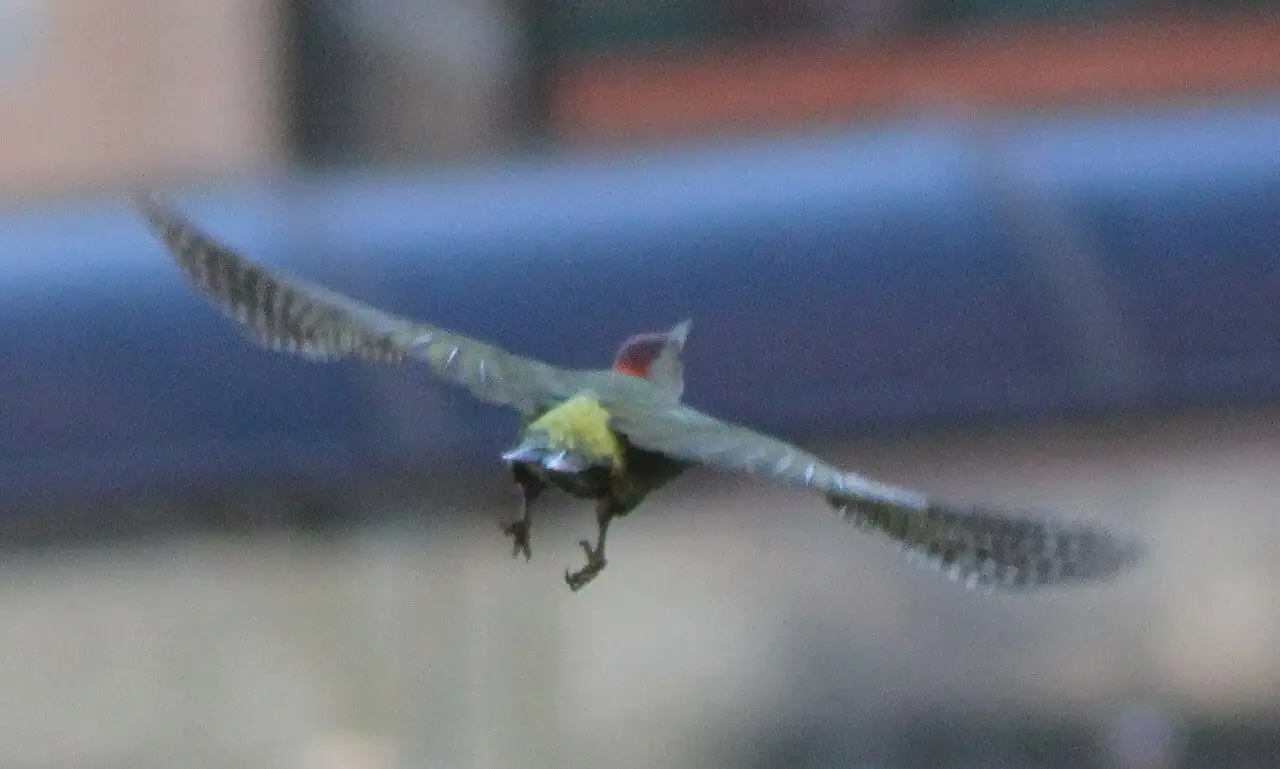
Its flight is very characteristic, with an undulating path in which the bird combines stretches of wingbeats with others with the wings folded.
Flight typeUndulating, alternating flaps and stretches with the wings folded
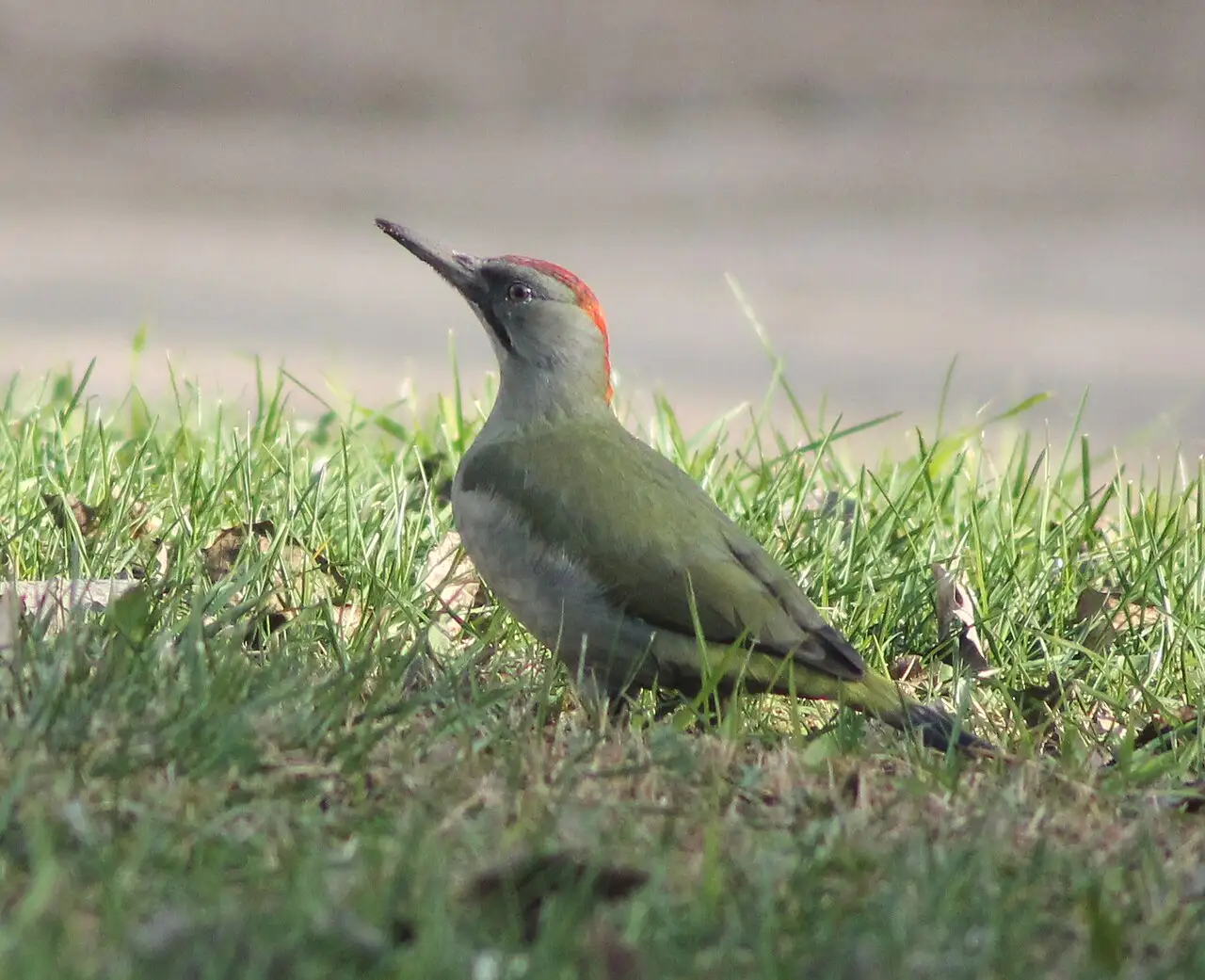
It moves through riverside groves, deciduous woods and landscaped areas, and looks for ants on the bark of trees or on the ground.
Its flight is very characteristic: an undulating path in which it combines stretches where it beats its wings with others where it folds them.
It lands on a trunk and, with its long sticky tongue, extracts larvae hidden up to 10 centimetres deep in the wood's galleries.
Photo gallery of the Iberian Green Woodpecker
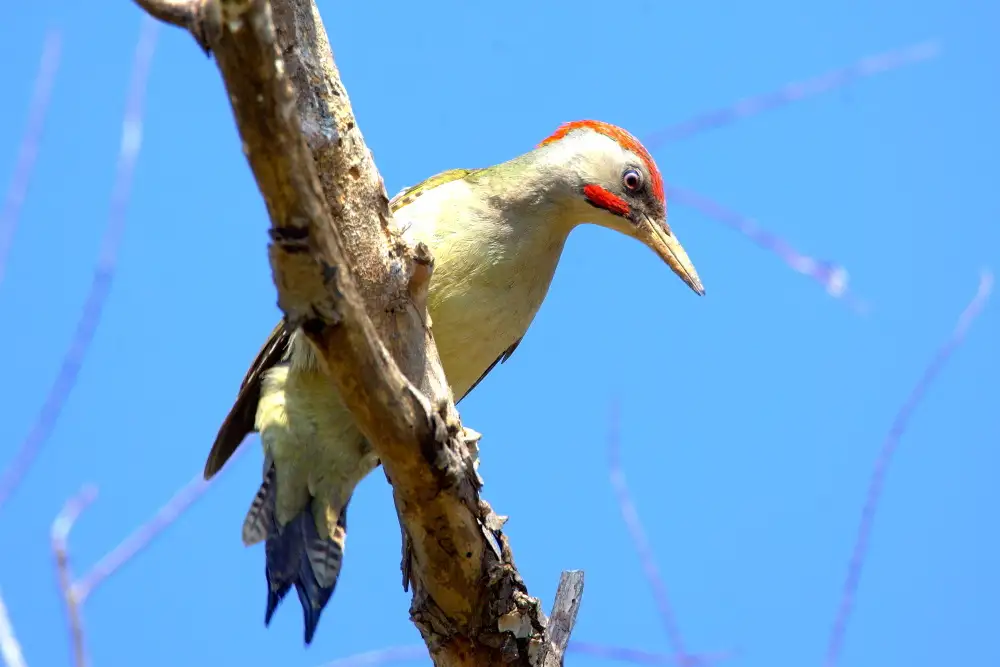
Iberian Green Woodpecker clinging to a branch against a blue sky, with red crown, black mask, yellowish-green back and long billPhoto: Carles Pastor, CC BY-SA 4.0Photo 1 of 4
Iberian Green Woodpecker in flight seen from behind, with barred open wings and yellowish rumpPhoto: Luis García (Zaqarbal), CC BY-SA 3.0 esPhoto 2 of 4
Iberian Green Woodpecker in profile on the grass, with red crown and greenish back, looking for ants on the groundPhoto: Luis García (Zaqarbal), CC BY-SA 3.0 esPhoto 3 of 4
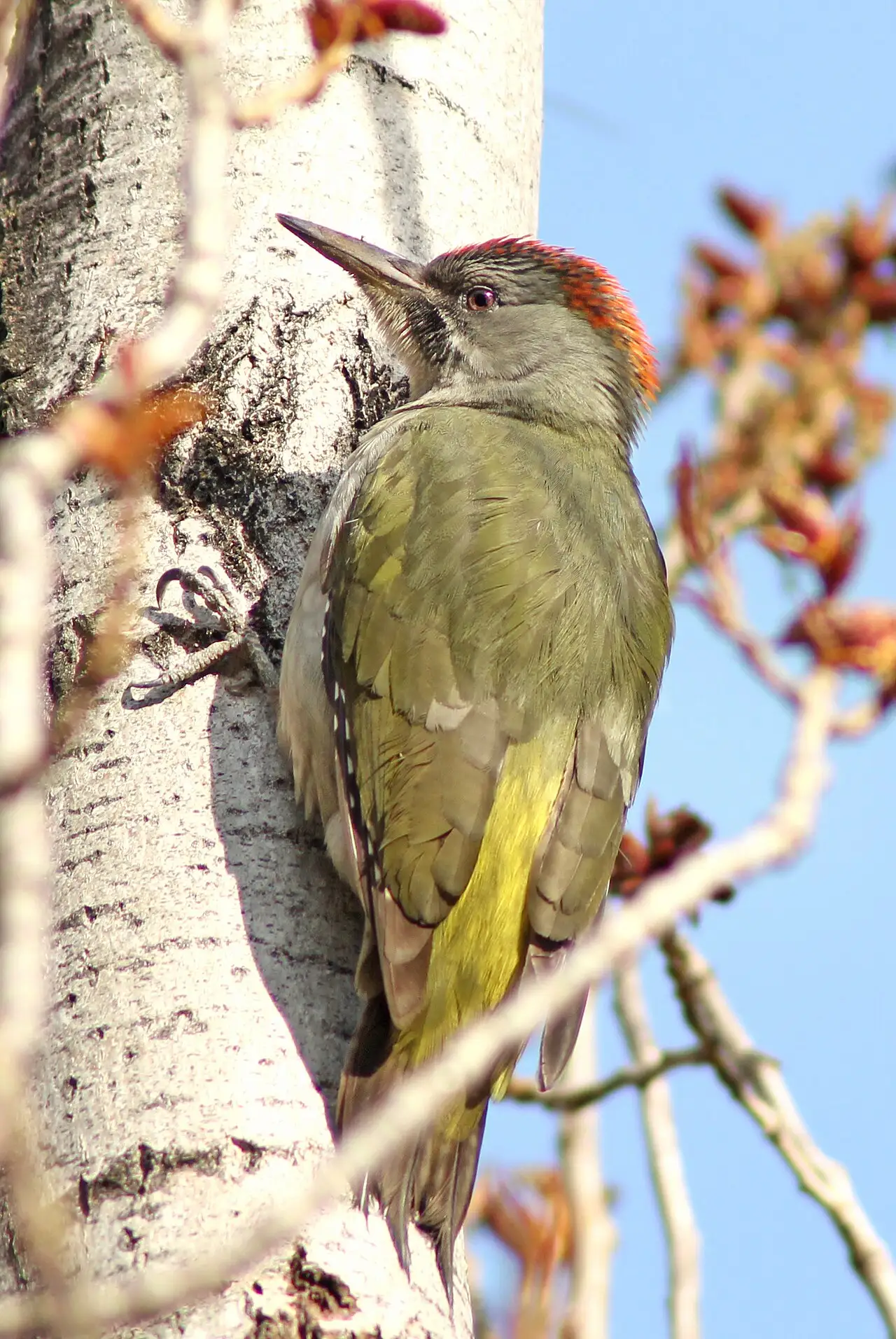
Iberian Green Woodpecker clinging to a pale trunk, in profile, with reddish crown, olive-green back and yellowish rumpPhoto: Luis García (Zaqarbal), CC BY-SA 3.0 esPhoto 4 of 4
1 / 4
Identification of the Iberian Green Woodpecker
The Iberian Green Woodpecker is a big, robust woodpecker of unmistakable look, whose plumage is dominated by greenish tones, stronger on the back, slightly greyish below and with yellowish touches on the rump. It lacks speckles and streaks, except faintly on the vent, but wears a striking colour pattern on the head: the crown is red and the yellowish eyes are framed by a black mask.
Male
Black and red moustache.
Female
Moustache entirely black.
Young bird
Black and red moustache, like the male’s.
Heavily speckled plumage, above all on the underparts, and duller colouring than the adult’s; no mask and a darker iris.
Habitat and distribution of the Iberian Green Woodpecker
It is distributed only across the Iberian Peninsula, with a small population in south-western France. Until a few years ago the Iberian population was considered the subspecies «sharpei» of the Eurasian Green Woodpecker, «Picus viridis», which is widely distributed across temperate and Mediterranean Europe as far as the Urals, not going beyond 60 degrees north.
It is the most widespread woodpecker on the Peninsula. It is spread across much of the territory, although rarer in some regions, such as the more open districts of Extremadura, certain points of the Ebro and Levante valleys and the Guadalquivir valley. It is absent from both archipelagos, Ceuta and Melilla.
It is not very demanding: it occupies a great variety of woodland, semi-woodland or partly wooded habitats, and is not rare in parks and gardens, even in big cities. It prefers not-very-dense deciduous woods, well-wooded farmland, the margins of dense woods and, very especially, riverside woods, from sea level to the tree line, although it is scarce above 1,200 metres.
It is a strictly resident species throughout its range, and only makes movements forced by low temperatures in snowy mountain areas.
Areas where it is regularly recorded since 2010Squares of about 25 km where it is recorded regularly (occasional passage records are left out). Data from GBIF.org (258,265 records, retrieved October 2026); outline from Natural Earth.
Etymology of the Iberian Green Woodpecker
According to Wikipedia, «Picus» is the Latin word for «woodpecker». Howard Saunders described it in 1872 as «Gecinus sharpei» and chose the epithet in honour of his friend, the English zoologist Richard Bowdler Sharpe, who was the first to tell it apart from the Eurasian Green Woodpecker. It was treated as a subspecies of the latter until in 2011 two studies found significant differences in the mitochondrial and nuclear DNA of the two populations. It is also known as «pito ibérico»; in other languages it is «picot verd ibèric» in Catalan, «peto verdeal ibérico» in Galician, «okil berde iberiarra» in Basque and «Iberian green woodpecker» in English1.
Population of the Iberian Green Woodpecker
In the 2021 European Red List of Birds the European breeding population is estimated at between 488,000 and 938,000 mature individuals, with a decreasing trend. In Spain about 397,260 individuals are estimated, with the most important populations in Castilla y León, Castilla-La Mancha, Andalusia, Aragón, Catalonia, Extremadura and Galicia. The SACRE programme shows a decline, probably linked to the intensification of agriculture and forestry, which have reduced ants, its main sustenance. Some studies forecast a 16 % fall in population size over the next ten years. It is affected by agricultural intensification and unsuitable forest management, which reduce old groves and remove river groves and tree-lined boundaries, and in some places by the use of insecticides against ants, which causes poisoning.
Nest of the Iberian Green Woodpecker
It excavates a deep nest in a tree of rotten or soft wood. Both sexes do the building, but mostly the male, over 15–30 days.
Courtship and breeding of the Iberian Green Woodpecker
Its breeding period begins in late March, with the excavation of the nest. In mid-May the female lays five to seven white eggs, which both adults incubate for 17–19 days. The chicks call incessantly for food from both parents for at least 23–27 days, after which they leave the cavity where they were born.
Diet of the Iberian Green Woodpecker
It eats mainly ant larvae and adults, which it catches on tree bark or on the ground. It extracts larvae of wood-boring insects only from rotten and weak wood, because it does not have as strong a bill as other woodpeckers; instead it has a long, sticky, very mobile tongue, able to extract larvae hidden up to 10 centimetres deep in the galleries of the wood, and also to pull ants and larvae from their nest. In woods that have suffered fires it chooses unaffected areas for almost all its activities (grooming, resting, watching), but moves to the burnt ones to feed, because there it finds its prey more easily1.
Curious facts about the Iberian Green Woodpecker
It is the commonest and most widespread of our woodpeckers and often we will know of it by its song, a sort of loud whinny that gives away its presence in the groves1. According to Wikipedia, it was considered a subspecies of the Eurasian Green Woodpecker until 2011. The longevity data from EURING and the BTO correspond to the Eurasian Green Woodpecker, not to this species: with an average weight of about 189 g and a record of 15 years and 1 month.
The Iberian Green Woodpecker in Cabañeros
The habitat pages of this website do not mention it. GBIF.org records 54 observations of the Iberian Green Woodpecker in Cabañeros and its surroundings.
Where to see the Iberian Green Woodpecker in Cabañeros
In Cabañeros and its surroundings, all year, in riverside groves, copses and wooded dehesas.
When
All year: it is resident and sings all year, males and females.
What time
In good light; the easiest thing is to hear it before seeing it.
Where
In not-very-dense deciduous woods, well-wooded farmland, woodland margins and, above all, riverside woods; also in parks and gardens.
What to look for
Look for the red crown, the black mask and the yellowish rump; on the ground, looking for ants; listen for its whinny.
Videos of the Iberian Green Woodpecker
Similar species
Eurasian Green Woodpecker
Picus viridis
How to tell them apart
Until a few years ago the Iberian population was considered a subspecies of the Eurasian Green Woodpecker1.



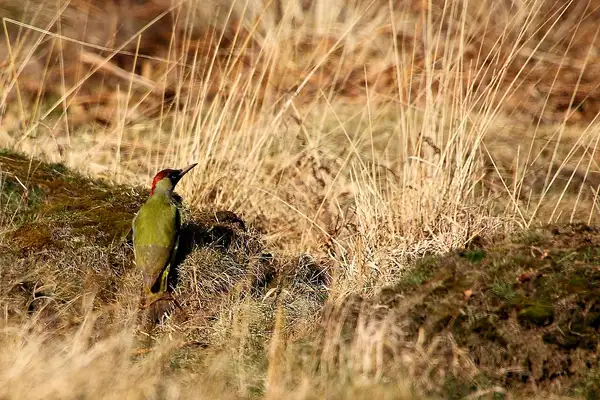
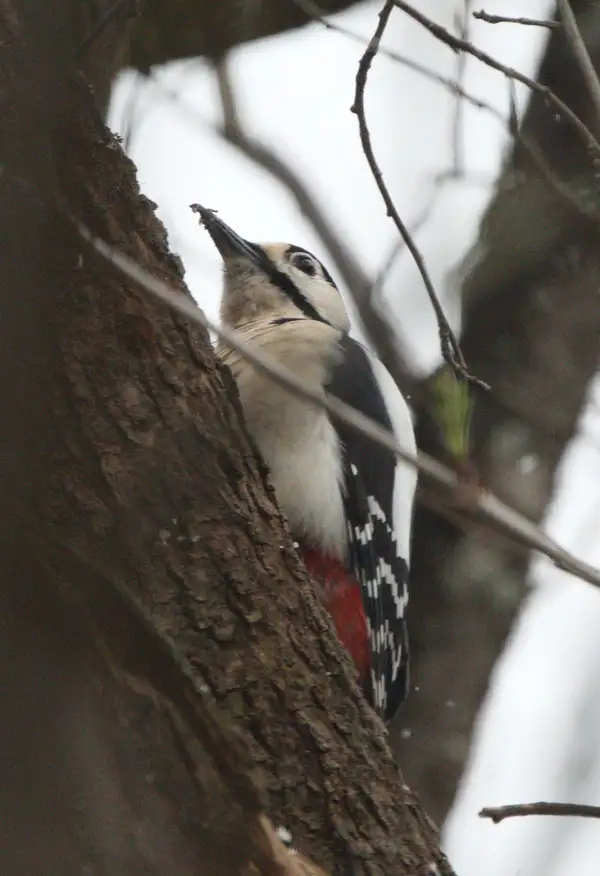
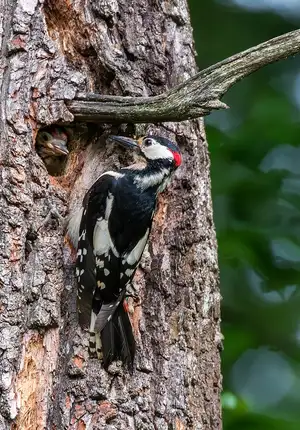 Same family
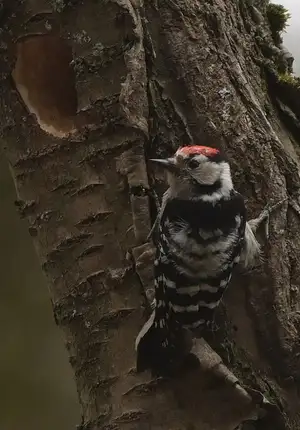 Same family
 Same family
 Same season in the park
 Same season in the park
 Same season in the park
 Same season in the park
 Same season in the park






