Quite territorial in the breeding season: it aggressively defends the nest and chicks, also against other rails
Lifespan
Record of 8 years and 11 months in the wild according to AnAge; EURING lists a bird ringed in France that lived 21 years and 11 months, a figure that looks out of line
Conservation status
LC
NT
VU
EN
CR
EW
EX
Global (IUCN)
Least Concern
Spain
Least Concern (LC) as a breeder in the Red List of Birds of Spain; not on the List of Wild Species under Special Protection or in the Spanish Catalogue of Threatened Species
When to see it
Resident
Months of the year when it is present
J
F
M
A
M
J
J
A
S
O
N
D
In Iberia
yes
yes
yes
yes
yes
yes
yes
yes
yes
yes
yes
yes
Song or voice of the Water Rail
It gives a great variety of calls like groans, grunts and plaintive notes, sometimes an explosion of shrill squeals that are soon smothered and turn into a quick, persistent «guip-guip-guip». The recording is of a rail from Switzerland; we have trimmed and normalised it.
SongWater Rail
0:00 / 0:28
10 kHz5
The sonogram draws the sound: time runs from left to right, and the higher a trace sits, the higher the note.Recording by Pascal Christe, xeno-canto XC731097 (Ile St-Pierre, Suiza) (CC BY-SA 4.0).
Flight of the Water Rail
It is reluctant to fly: when it rises over the water or the marsh vegetation, with quick wingbeats and dangling legs, it only covers short stretches.
Flight typeReluctant to fly: quick wingbeats and dangling legs, over short stretches
With crepuscular habits, it usually spends most of its time hidden in marsh vegetation, although it also perches on bare bushes to sun itself and swims in open water looking for food.
It is reluctant to fly: when it rises over the water or vegetation, with quick wingbeats and dangling legs, it only covers short stretches.
It gives a great variety of calls like groans, grunts and plaintive notes, sometimes a quick, persistent «guip-guip-guip».
Photo gallery of the Water Rail
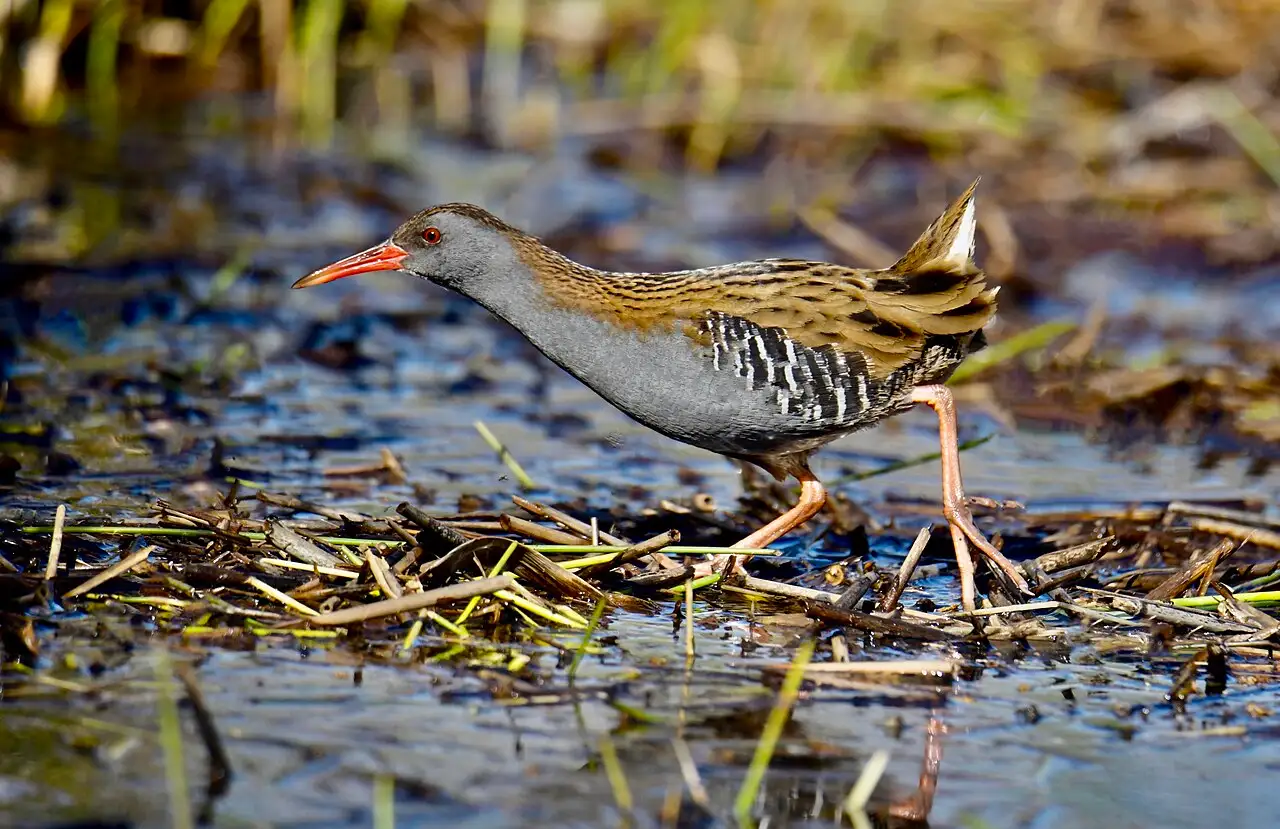
Water Rail walking among the mud and plant debris of a bank, with its long red bill, brown back and barred flanksPhoto: Luiz Lapa from Oeiras, Portugal, CC BY 2.0Photo 1 of 4
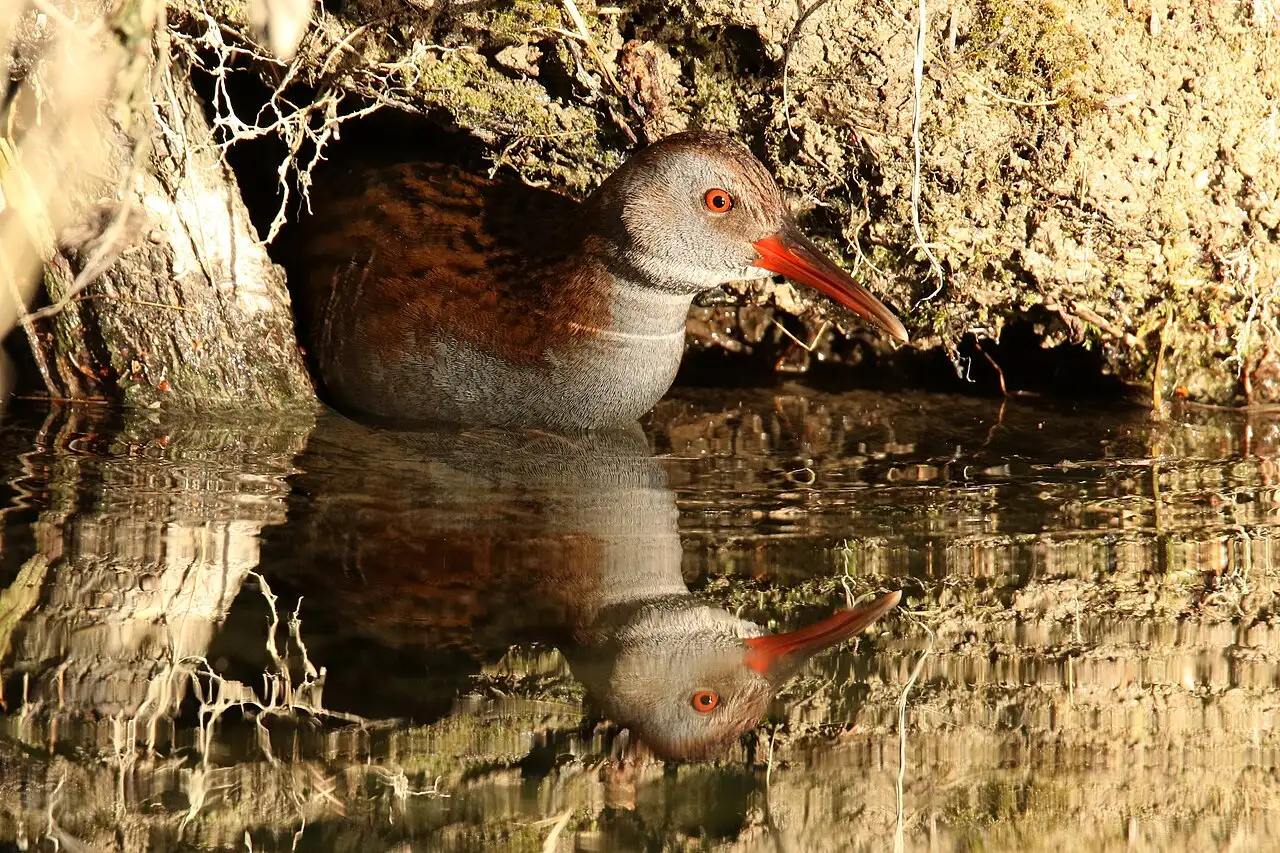
Water Rail peeking out of a gap in the bank, with red bill, reddish eye and its reflection in the waterPhoto: Maurizio Carlini, CC BY-SA 4.0Photo 4 of 4
1 / 4
Identification of the Water Rail
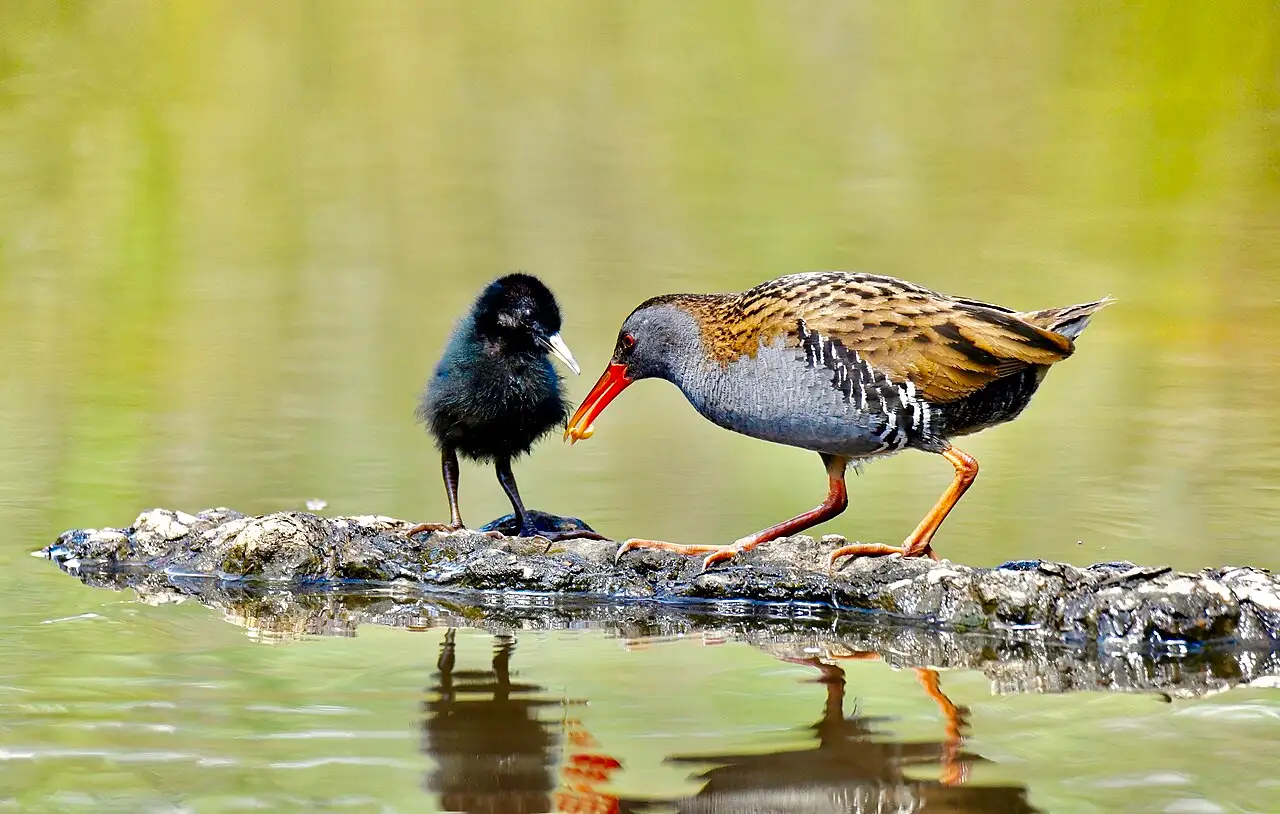
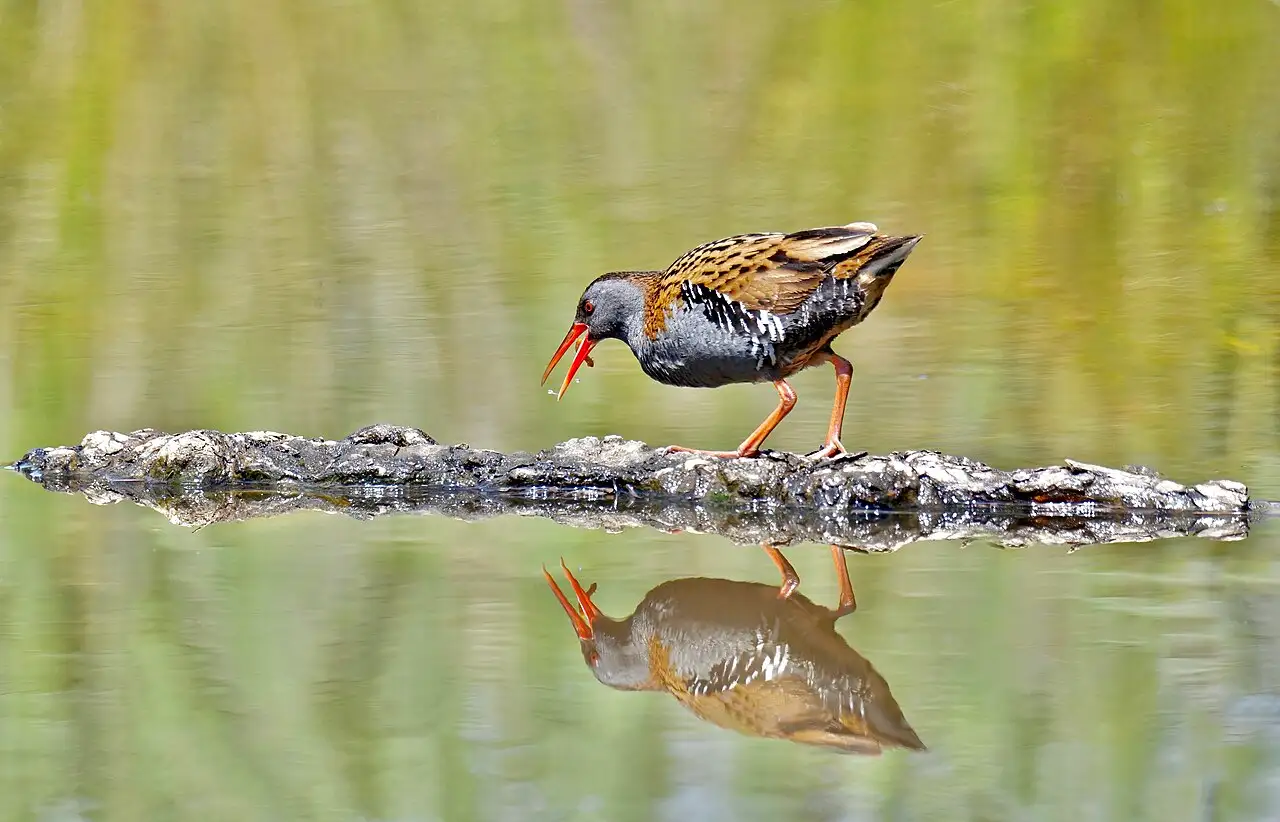
Very similar to the crakes in pattern, the Water Rail differs from them in its bulkier size and its long, deep red bill. Adults are very alike, females slightly smaller and with a shorter bill. The upperparts are olive brown, with blackish feather centres, while the face, forehead, breast and belly are a dark bluish grey. The flanks are barred in black and white, and the undertail coverts stand out vividly in white. Juveniles resemble adults on the upperparts, but have a browner breast, plenty of barring and spotting below and a less reddish bill.
Adult
Olive-brown back with blackish feather centres.
Blue-grey face, breast and belly; flanks barred in black and white.
Long, deep red bill; white undertail coverts.
Young bird
Browner breast and plenty of barring and spotting below.
Less reddish bill and browner colouring.
Habitat and distribution of the Water Rail
It is patchily distributed across a good part of Eurasia and, although it reaches Iceland, it does not live in other very northern regions. Most of its numbers are concentrated in the easternmost countries of Europe, above all Russia, where densities are highest. Four subspecies are recognised.
In Spain it is relatively common and spread over the main wetlands, inland and coastal, and the basins of the large rivers. It occupies above all the montane and supra-Mediterranean zones of the northern half, several pockets in the Levante, Castilla-La Mancha and Extremadura and, at higher densities, the wetlands of western Andalusia, especially those of the lower Guadalquivir; it is scarce in the south-east of the peninsula. It also breeds in the Balearics, but is absent from Ceuta, Melilla and the Canaries.
It occupies a great variety of wetlands, preferring still fresh water, although it can turn up on sandy beaches, and muddy bottoms with dense belts of marsh vegetation: lagoons, streams, pools, marshes or coastal salt marshes. In winter it widens its preferences to artificial habitats, such as drainage canals, rice fields or gravel pits. It usually spends most of its time hidden in the vegetation, although it likes to perch on bare bushes to sun itself and to swim in open water looking for food.
The populations of the south and west of its range are mostly sedentary, while those of northern and eastern Europe move mainly to the British Isles, the Mediterranean countries (the Iberian Peninsula receives a good share) and some regions of North Africa. European birds spread along the Ebro and the middle Duero, and often appear in the inner Catalan basins, the Mediterranean coastal lagoons and the floodplains of the Guadiana and the Guadalquivir.
Areas where it is regularly recorded since 2010Squares of about 25 km where it is recorded regularly (occasional passage records are left out). Data from GBIF.org (90,198 records, retrieved October 2026); outline from Natural Earth.
Etymology of the Water Rail
According to Wikipedia, Linnaeus described it in 1758 under the name it still bears today, «Rallus aquaticus», the Latin equivalent of the English «water rail», «rascón de agua», already used by the English ornithologists Francis Willughby in 1676 and Eleazar Albin in 1731. In other languages it is called «rascló occidental» in Catalan, «furamatos común» in Galician, «uroilanda handia» in Basque and «water rail» in English1.
Population of the Water Rail
In the 2021 European Red List of Birds the European breeding population is estimated at between 315,000 and 653,000 mature individuals, with an unknown trend. In Spain, apart from a few current counts at certain breeding sites, there are no up-to-date figures for the number of breeders. Because of its secretive nature, breeding is hard to confirm, which prevents an accurate assessment of its numbers and trend. In the absence of concrete data, the peninsular population is believed to have declined in recent decades through the loss and transformation of its habitat and the fall in rainfall caused by global warming.
The loss or degradation of wetlands, through pollution, drainage or channelling, are the main problems it faces. It is a rather little-known bird, both in its numbers and in its breeding sites1.
Nest of the Water Rail
The nest is built on the ground, very close to the water or over it, hidden among the tall stems of marsh vegetation. It is a fairly bulky cup, made of dry leaves, reeds and stems, which is usually covered by the surrounding plants.
Courtship and breeding of the Water Rail
The pair bond is consolidated after a courtship in which the male gives his characteristic song and there are continual chases with the neck stretched out, the bill open and the tail raised, showing the conspicuous undertail coverts. The clutch consists of 6 to 11 smooth, light cream eggs with reddish spots, laid on consecutive days and incubated by both adults, the female more, for 19–22 days. The chicks hatch synchronously, stay in the nest for the first days looked after by their parents and become independent quite early, even before they can fly; when this happens, the adults lay a second clutch.
Diet of the Water Rail
It is partly omnivorous and feeds basically on invertebrates, such as aquatic insects and their larvae, snails or worms, to which it occasionally adds small vertebrates, such as little birds or mice, generally as carrion. In autumn and winter its diet includes a good proportion of plant matter, such as fruits, buds or seeds.
Curious facts about the Water Rail
It is just as hard to observe as its close relatives the crakes, and says it is detected mainly by its song, although it is somewhat easier to spot because it swims more often in open water and perches on the bushes of the banks1. AnAge gives a maximum longevity of 8 years and 11 months, and EURING lists a bird ringed in France that lived 21 years and 11 months, a figure that looks out of line.
The Water Rail in Cabañeros
The habitat pages of this website do not mention it, and we have found no other published source about it in the Park, although Castilla-La Mancha is among the regions with sites for the species1. GBIF.org records 13 observations of the Water Rail in Cabañeros and its surroundings.
Where to see the Water Rail in Cabañeros
In Cabañeros and its surroundings, all year round, on banks with reeds and dense marsh vegetation.
When
All year; in Spain it is mostly sedentary and in winter birds arrive from northern and eastern Europe.
What time
At dawn and at dusk; it has crepuscular habits.
Where
In wetlands of still fresh water and muddy bottom, with dense belts of marsh vegetation.
What to look for
It is easier to hear than to see: listen for its groans and its «guip-guip-guip», and look at the bushes on the bank.
Videos of the Water Rail
Similar species to the Water Rail
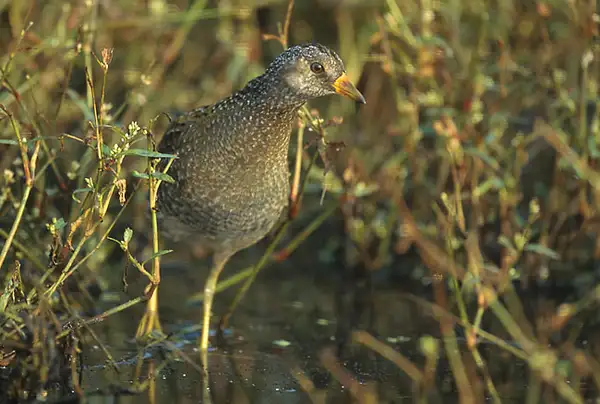
Spotted Crake
Porzana porzana
How to tell them apart
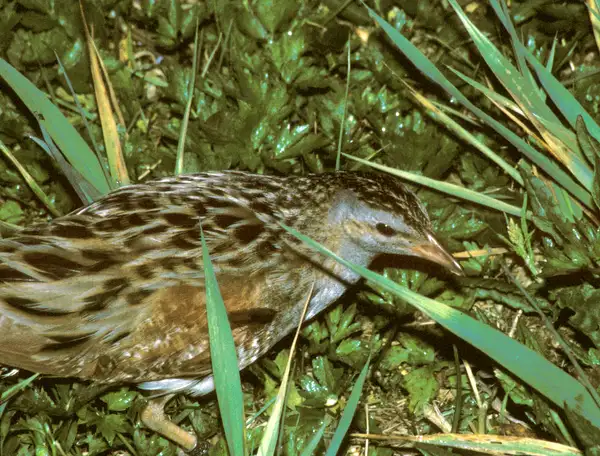
It is similar in physical appearance1. The Water Rail looks very like the crakes but is bulkier and has a long, deep red bill1.



 Same family
 Same family
 Same season in the park
 Same season in the park
 Same season in the park
 Same season in the park
 Same season in the park
 Same season in the park






