Very gregarious all year; pairs may be monogamous or one male with several females
Lifespan
No figure of its own; its relative the Common Starling reaches 17 years in the wild
Conservation status
LC
NT
VU
EN
CR
EW
EX
Global (IUCN)
Least Concern
Spain
Unlisted: not on the List of Wild Species under Special Protection or in the Spanish Catalogue of Threatened Species
When to see it
Resident
Months of the year when it is present
J
F
M
A
M
J
J
A
S
O
N
D
In Iberia
yes
yes
yes
yes
yes
yes
yes
yes
yes
yes
yes
yes
Breeding season
no
no
no
yes
yes
yes
yes
no
no
no
no
no
Song or voice of the Spotless Starling
A long, varied song, made of whistles, clicks and trills, and sprinkled with imitations: it copies other birds and all kinds of sounds it hears around it. It is harsher and louder than the Common Starling’s. This one, recorded at El Condado, in Huelva, mixes its own phrases with borrowed ones.
Song and mimicrySpotless Starling
0:00 / 0:24
10 kHz5
The sonogram draws the sound: time runs from left to right, and the higher a trace sits, the higher the note.Recording by Joost van Bruggen, Wikimedia Commons (CC BY-SA 4.0).
Flight of the Spotless Starling
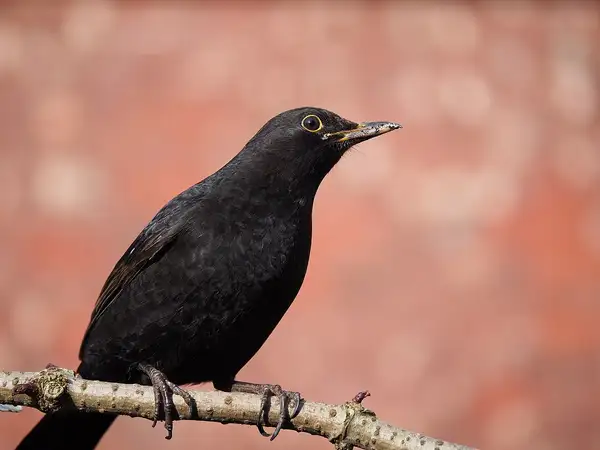
Fast, direct flight, with continuous wingbeats and the wings triangular, and a short tail. Flocks wheel at once, as if they were a single cloud, and on the ground they walk upright, striding, without hops, which is what most separates them from the blackbird.
Flight typeDirect, fast and in a flock
It rises from the ground at the same time as the others, with quick wingbeats and triangular wings. In autumn and winter you never see one alone.
Direct, fast flight, with pointed wings and short tail. Flocks wheel all at once, like a single cloud.
It glides with wings open and drops onto the pasture or onto the branches of the holm oak, all chattering at once.
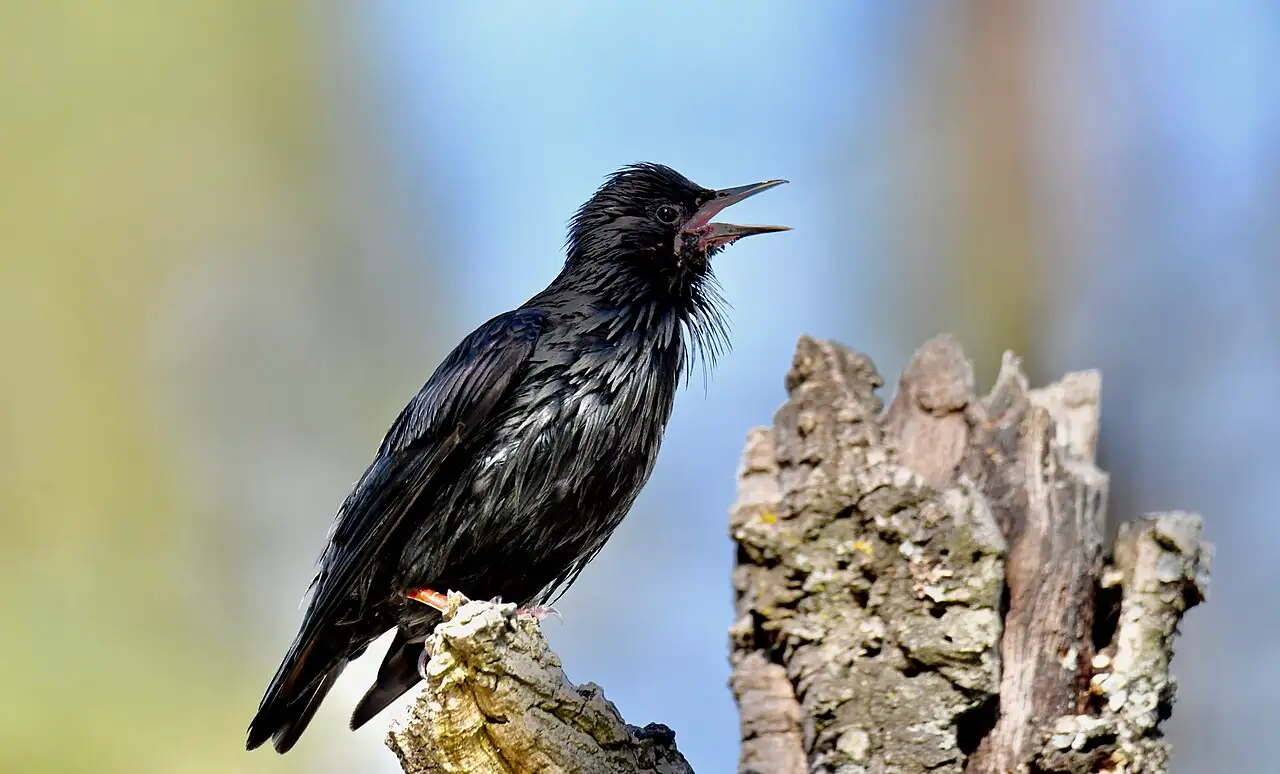
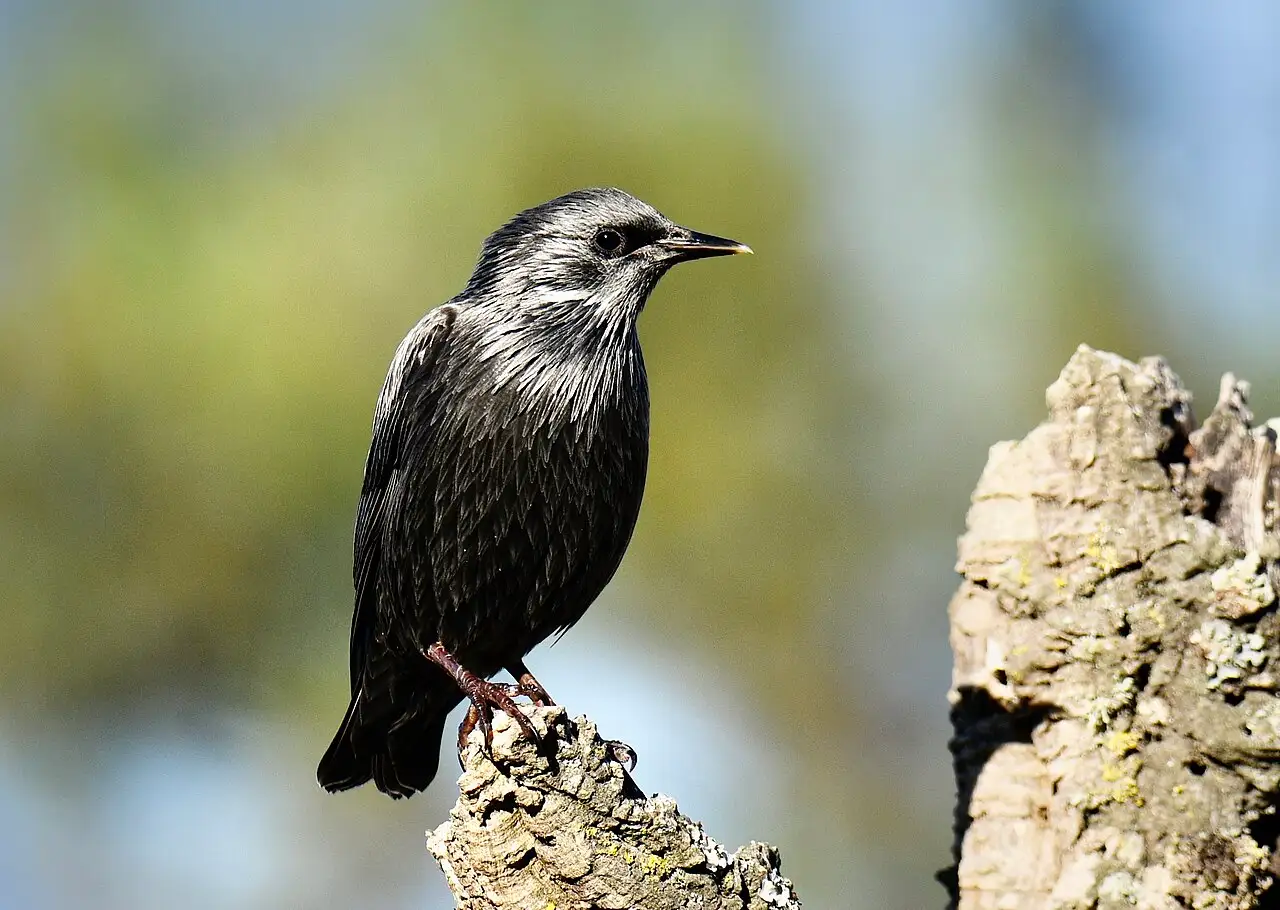
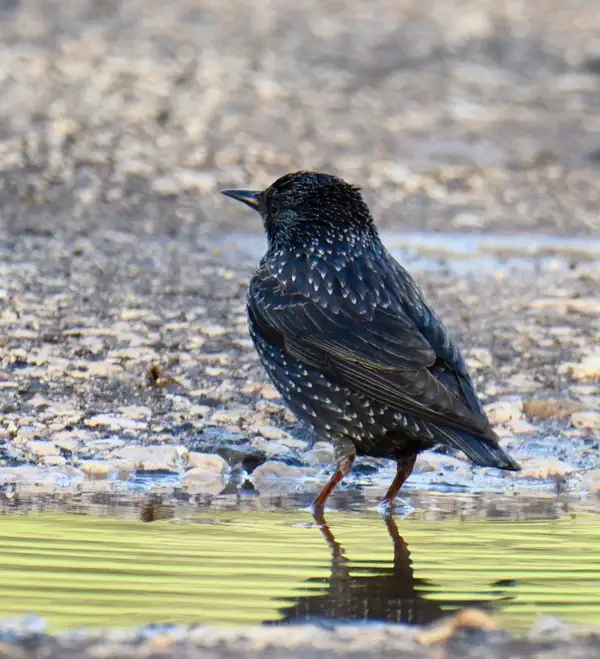
It is medium-sized and compact in appearance, with short, strong legs and a pointed bill. It has uniformly black colouring, with green and purple sheen, but without spots. It resembles the Common Blackbird, but walks more upright and not by hopping, and flies fast and direct.
Adult
Black with metallic sheen, without spots in spring and summer.
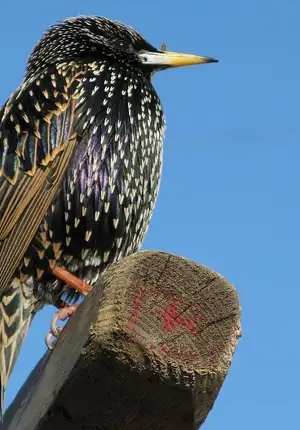
Bill yellow in summer and dark in winter.
In winter it may show some white spots in the plumage.
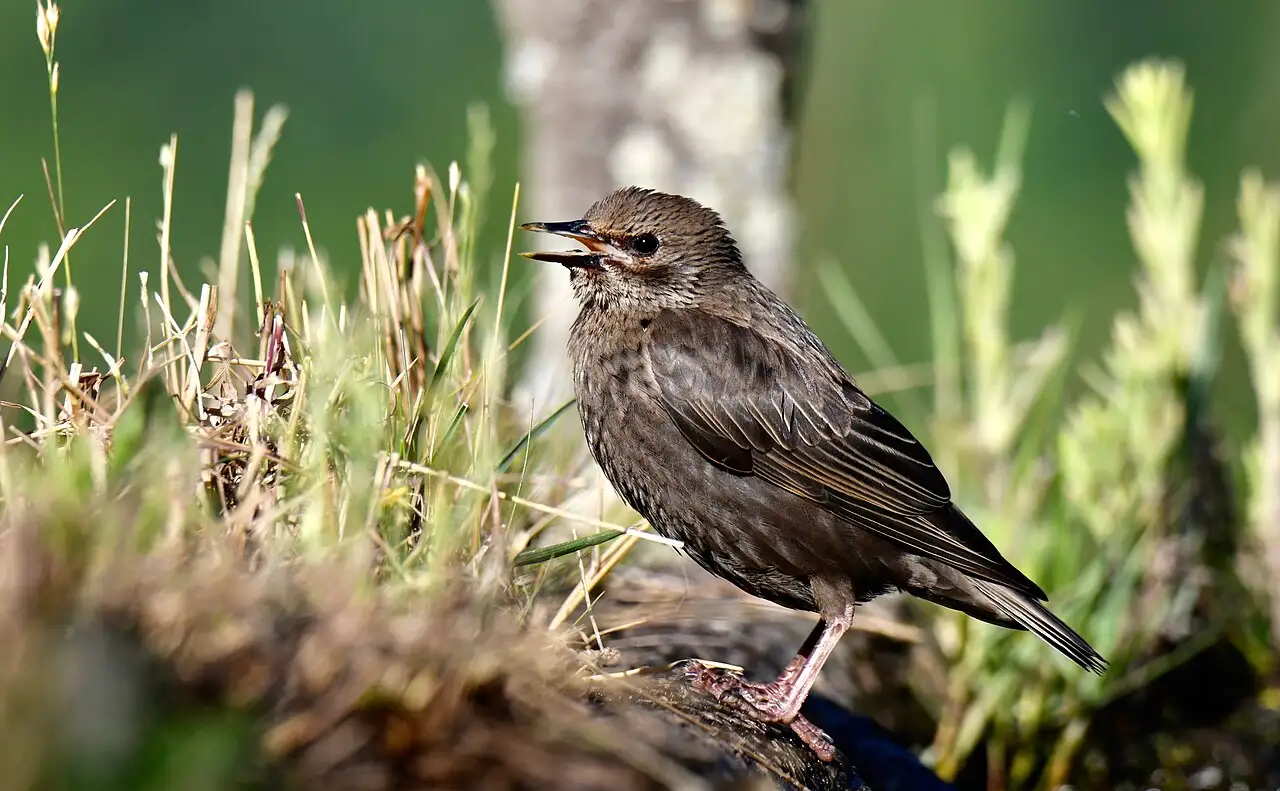
Young bird
Uniform brown, without the adult’s sheen.
Habitat and distribution of the Spotless Starling
Its world distribution is restricted to the western Mediterranean: the Iberian Peninsula, north-west Africa and the islands of Corsica, Sardinia and Sicily. It has no subspecies.
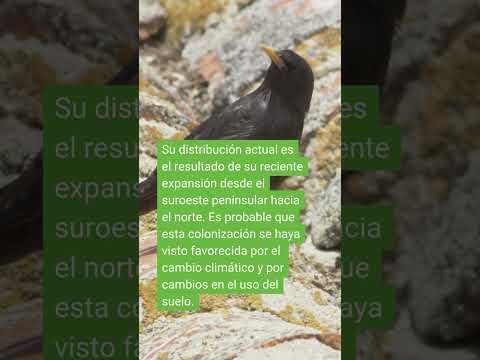
In Spain it is very common over almost the whole territory: it is absent from the Balearics, except at one locality in Menorca, and from the Canaries, and scarce at the highest parts of the Cantabrian Range and the Pyrenees and in the farmland occupied by the Common Starling. Its present range is the result of a recent expansion from the south-west of the Peninsula northwards, probably favoured by climate change and changes in land use. It occupies very varied environments, preferring human-made ones, and reaches its highest densities in the holm oak dehesas of western Iberia, where there are plenty of holes for nesting and grasslands and crops to feed in. It climbs to 1,500 metres in the Central System. It is basically sedentary, with dispersive movements in winter.
Areas where it is regularly recorded since 2010Squares of about 25 km where it is recorded regularly (occasional passage records are left out). Data from GBIF.org (966,868 records, retrieved October 2026); outline from Natural Earth.
Etymology of the Spotless Starling
«Sturnus» is the Latin name for the starling, and «unicolor» means «of a single colour», for its black, spotless plumage, unlike the Common Starling.
Population of the Spotless Starling
In Spain there are more than 10 million individuals. The largest absolute populations are in Castilla y León, Castilla-La Mancha and Andalusia, and the highest densities in the Community of Madrid, Castilla y León, La Rioja and the Valencian Community. The trend is stable. In Europe between 47.7 and 61.4 million mature individuals are estimated. It is classified as Least Concern. In some regions it has traditionally been considered a pest, for the damage to vineyards and olive groves, and has been the target of control campaigns. The only known threat is its possible hybridisation with the Common Starling.
Nest of the Spotless Starling
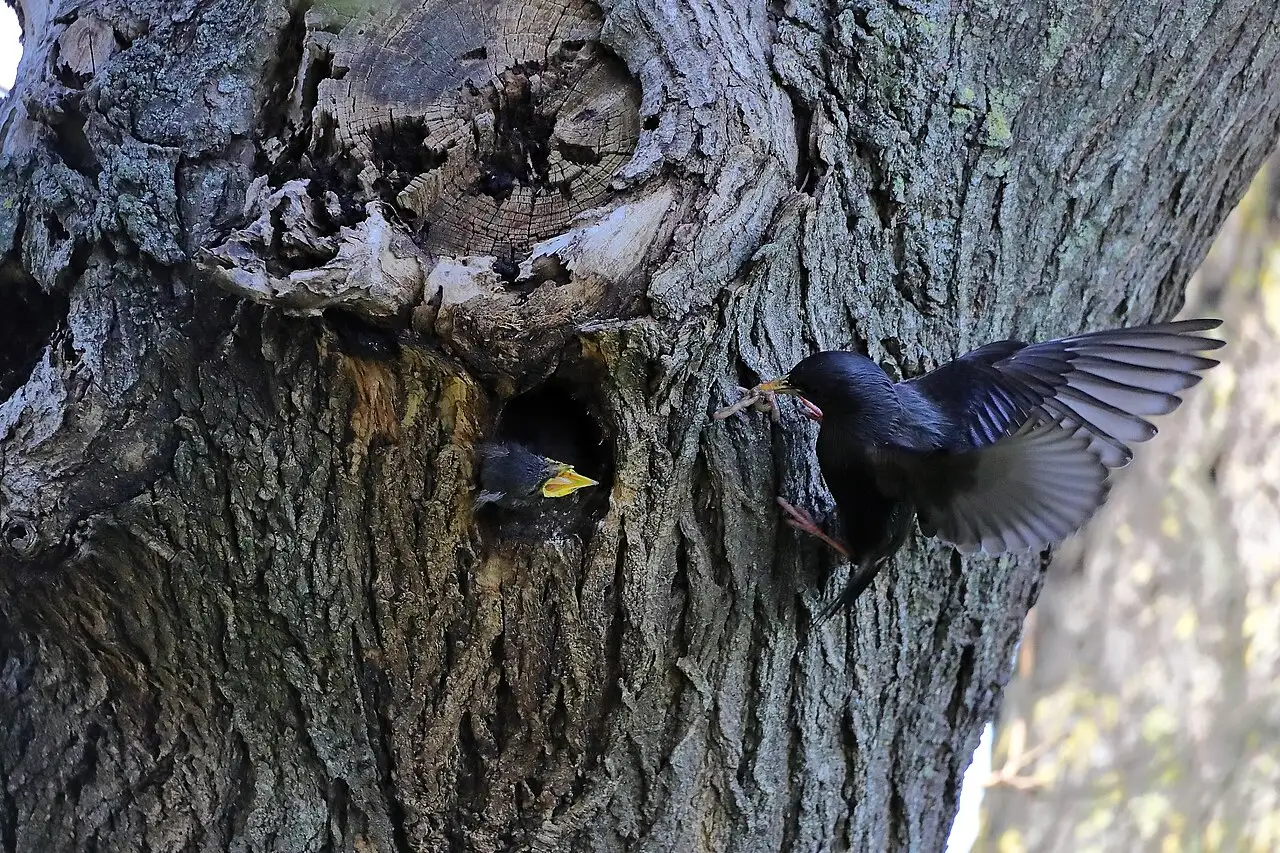
It breeds in tree cavities, in rock or sand banks and in buildings, in walls or under tiles. The nest is a simple structure of leaves and twigs, lined with feathers.
Courtship and breeding of the Spotless Starling
It breeds from April to July and can make two clutches a year. It lays two to nine eggs, most commonly four or five, plain blue. It practises egg-laying parasitism within its own species: around 20 % of clutches are parasitised. Incubation begins around the second-to-last egg and lasts 10 to 15 days, most likely 11, and is usually done by the female, although some males develop a brood patch. Both parents care for the chicks, which take flight at 21 or 22 days, and go on feeding them for another week.
Diet of the Spotless Starling
The diet is varied. In summer it eats mainly invertebrates, such as beetles and grasshoppers, and in autumn and winter fruit and seeds, of grasses and legumes, dominate.
Curious facts about the Spotless Starling
It is one of the few birds able to imitate sounds from its surroundings so faithfully that it is hard to tell them from the original. And its expansion northwards has been so rapid that today we find it in places where it was not a few decades ago.
The Spotless Starling in Cabañeros
The habitat pages of this website cite it among the birds of the sclerophyllous forest. In winter, in the mature scrub, it is one of those that base their diet on insects from the bark and leaf litter and come to depend on the fruits of the bramble, the mock privet, the laurustinus, the wild service tree, the myrtle, the mastic, the wild olive and the strawberry tree. The holm oak dehesas of western Iberia are its habitat of maximum density.
Where to see the Spotless Starling in Cabañeros
In the dehesas and in the rural settlements around, all year round.
When
All year round; in winter, in larger flocks.
What time
At dawn and dusk, when they gather at the roosts and can be heard from afar.
Where
In the dehesas, perched on wires, the high branches of the holm oaks and rooftops, and feeding on the ground.
What to look for
A black bird with a yellow bill, which walks upright, and a racket of whistles and imitations.




 Same family
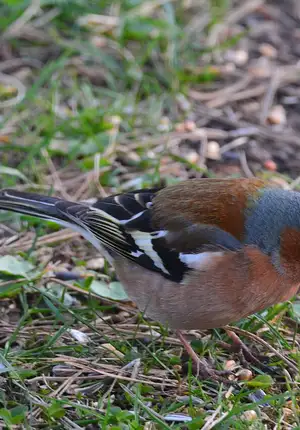 Also in sclerophyllous woodland
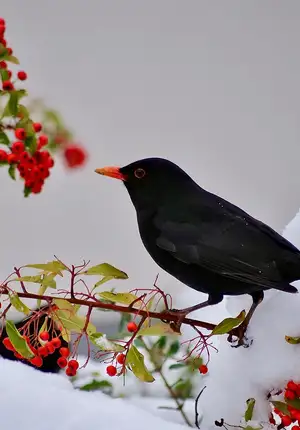 Also in sclerophyllous woodland
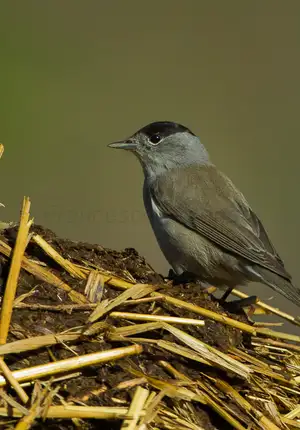 Also in sclerophyllous woodland
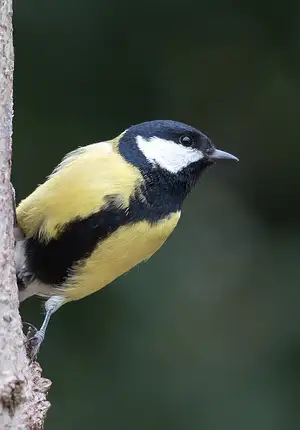 Also in sclerophyllous woodland
 Also in sclerophyllous woodland
 Also in sclerophyllous woodland
 Also in sclerophyllous woodland






