Monogamous and territorial; both parents feed the chicks
Lifespan
Record of 15 years and 1 month in the wild according to EURING (a bird ringed in Spain and later recaptured); AnAge gives 10 years
Conservation status
LC
NT
VU
EN
CR
EW
EX
Global (IUCN)
Least Concern
Spain
Near Threatened (NT) as a breeder in the Red List of Birds of Spain; on the List of Wild Species under Special Protection, but not in the Spanish Catalogue of Threatened Species
When to see it
Summer visitor
Months of the year when it is present
J
F
M
A
M
J
J
A
S
O
N
D
In Iberia
no
no
yes
yes
yes
yes
yes
yes
yes
yes
no
no
Breeding season
no
no
no
no
yes
yes
yes
yes
no
no
no
no
Song or voice of the Great Reed Warbler
Its song is strong, ringing and audible at long distances, more than a kilometre. It is similar in structure to the Common Reed Warbler’s, but with a hoarser, more strident voice, and repeats a series of croaks with abrupt changes of pitch: «karra-karra-karra-kri-kri-kri…». The recording is of a male singing in a reedbed on a river bank, in Poland; we have trimmed and normalised it.
SongGreat Reed Warbler
0:00 / 0:28
10 kHz5
The sonogram draws the sound: time runs from left to right, and the higher a trace sits, the higher the note.Recording by Phoenicurus ochruros, xeno-canto XC416396 (Park Wschodni, Wrocław, Polonia) (CC BY-SA 4.0).
Flight of the Great Reed Warbler
It moves among dense marsh vegetation, and so is easier to detect by its powerful song than to see.
Flight typeAmong dense marsh vegetation, where it is detected mainly by its song
It occupies areas of dense marsh vegetation made up of reedbeds, bulrush beds and cane brakes, in wetlands of low, warm areas.
Its song, loud, ringing and audible from over a kilometre away, repeats a series of rasping notes with abrupt changes of pitch.
Its diet is based on invertebrates, mainly beetles, hymenopterans, flies and true bugs.
Photo gallery of the Great Reed Warbler
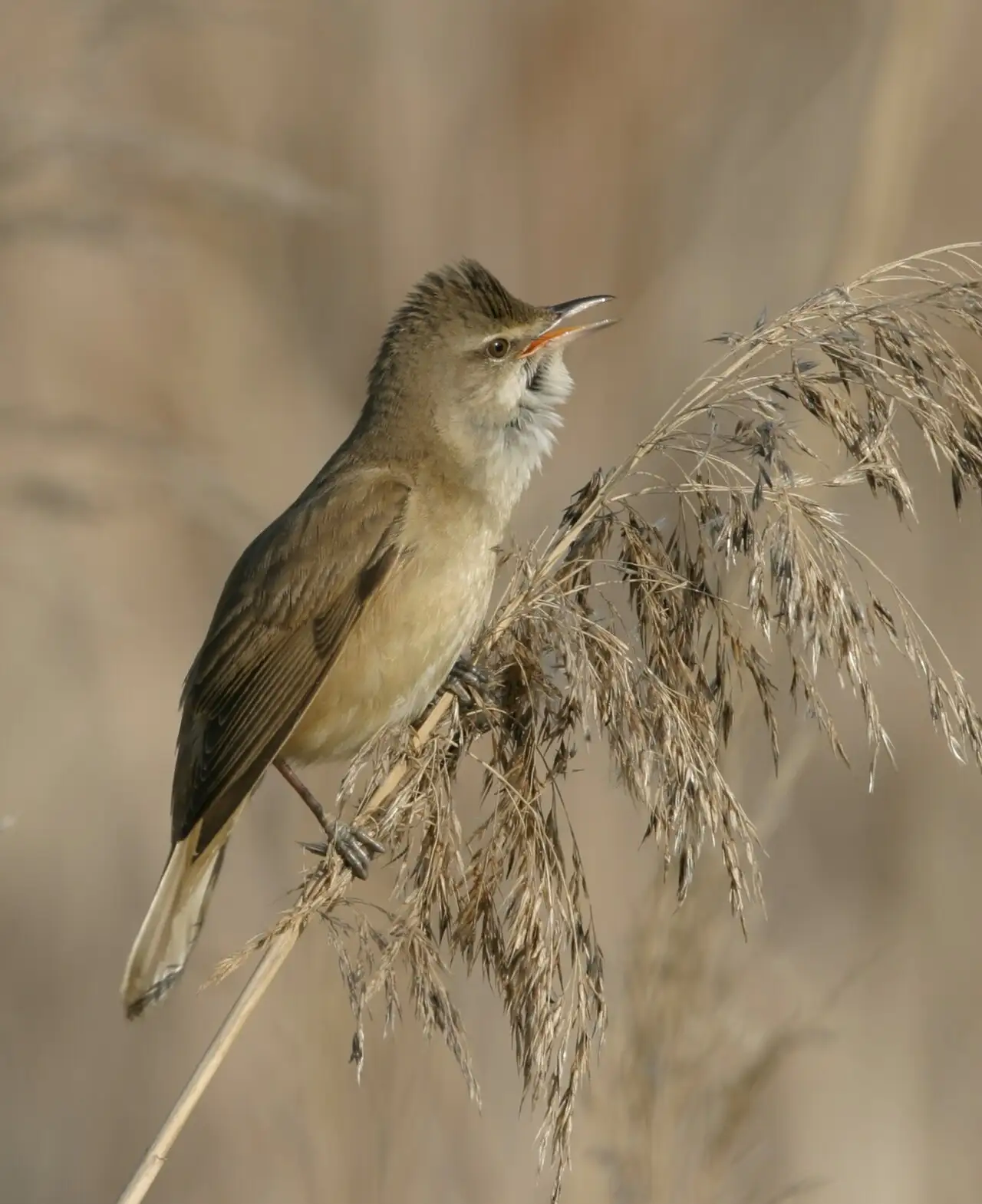
Great Reed Warbler singing with its bill open, perched on a reed spike, with brown back and yellowish underpartsPhoto: Carles Pastor, CC BY-SA 3.0Photo 1 of 4
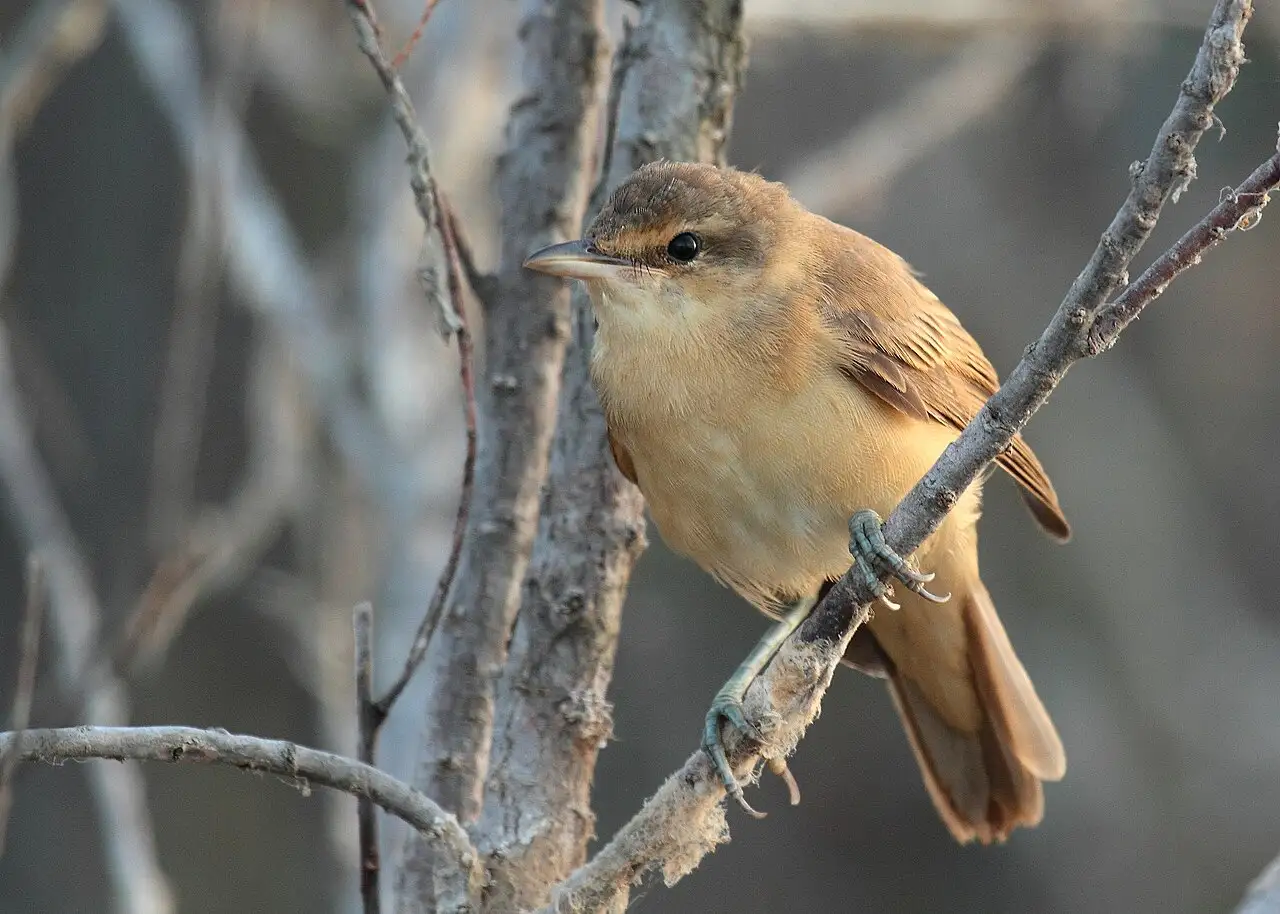
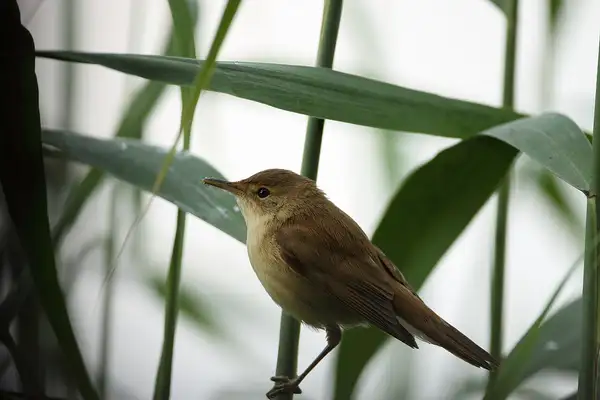
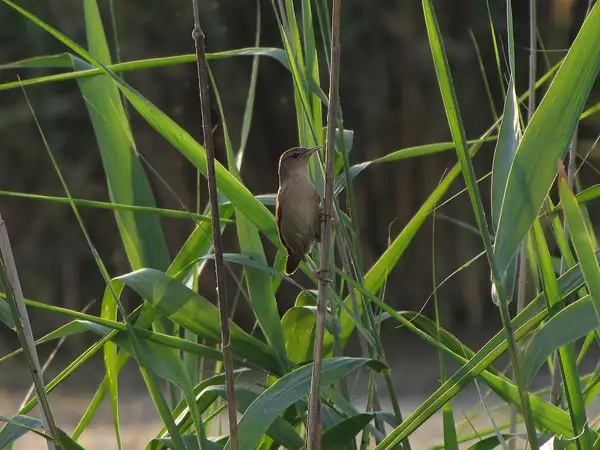
Great Reed Warbler perched on a dry branch, with brown back, yellowish-brown underparts and big billPhoto: Agustín Povedano, CC BY 2.0Photo 2 of 4
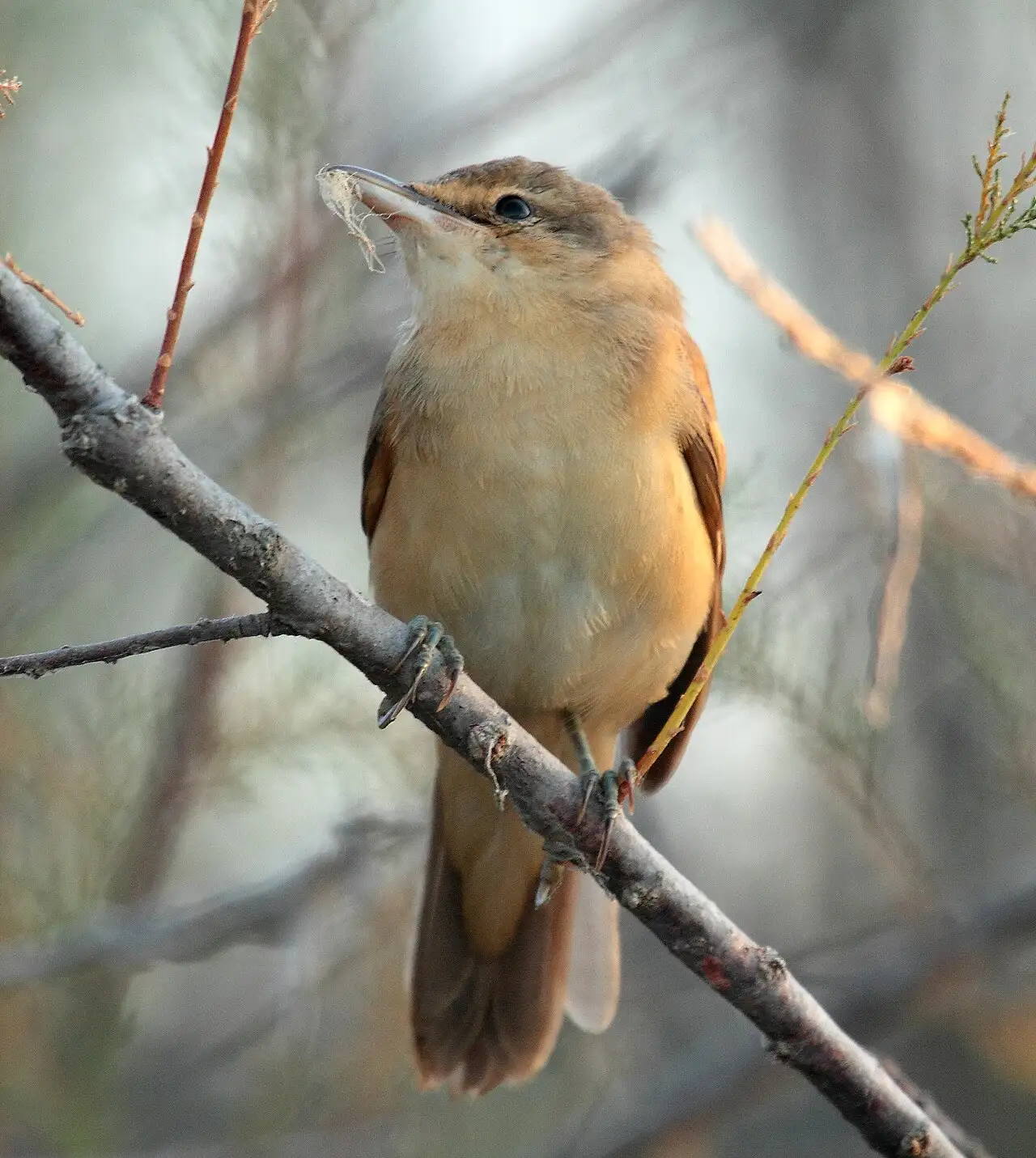
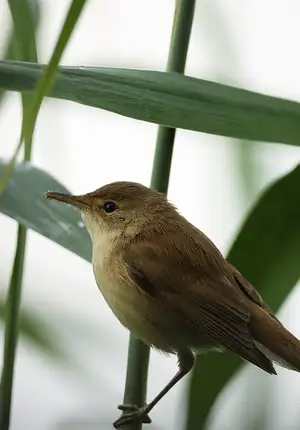
Great Reed Warbler perched from the front on a thin branch, looking up, with its long tail hanging downPhoto: Agustín Povedano, CC BY 2.0Photo 3 of 4
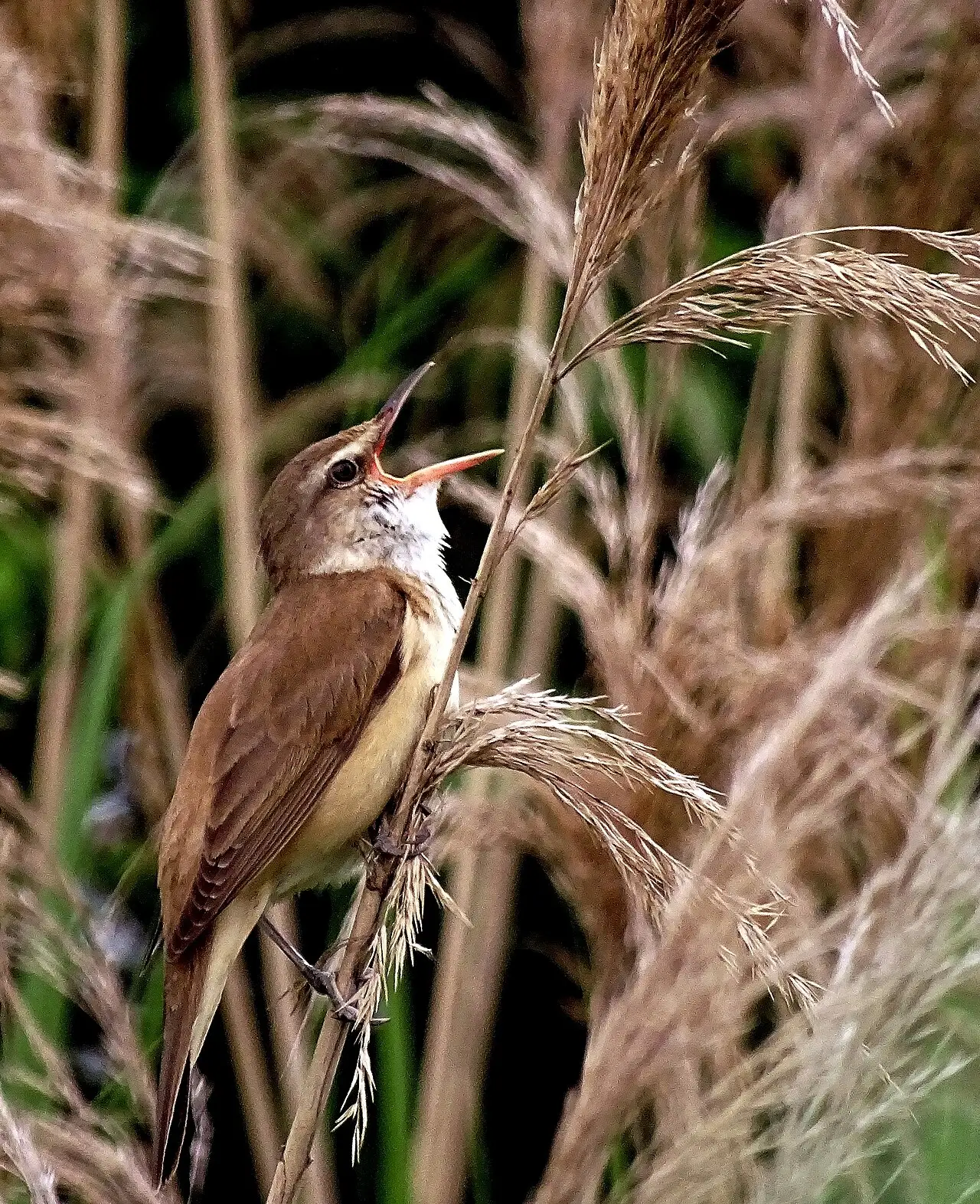
Great Reed Warbler singing with its bill wide open, clinging to a dry reed in a reedbedPhoto: Zoran Gavrilović, CC BY-SA 4.0Photo 4 of 4
1 / 4
Identification of the Great Reed Warbler
The Great Reed Warbler is, among the reed and marsh warblers, the sturdiest species. In uniform brown tones, it is similar to the Common Reed Warbler, although notably bigger and with a bigger bill. It has a reddish-brown or greyish back, depending on age and wear of the feathers, and the underparts are yellowish-brown. Both sexes are alike.
Adult
Back reddish brown or greyish, depending on age and wear of the feathers.
Underparts yellowish brown.
Bigger than the Common Reed Warbler and with a bigger bill.
Habitat and distribution of the Great Reed Warbler
It is widely distributed as a breeder across temperate latitudes of the Palaearctic: it occupies most of Europe and central Asia, and reaches China in the east. It is also present, though more patchily and locally, in the Middle East and north-west Africa. Several subspecies are distinguished, and the one present in Europe and Spain is «arundinaceus».
As a nester it is well spread across the Peninsula, though discontinuously, along the main river basins (Ebro, Duero, Tagus, Guadiana and Guadalquivir), the Levante and the Balearic Islands. It is absent from the Canaries, Ceuta and Melilla. It is scarce on the southern plateau, in the arid south-east of the peninsula and on the Andalusian Mediterranean coast, as well as in much of León, Asturias and Galicia, where it appears almost only on the coast and at a few isolated inland sites.
It is associated with wetlands in low, warm areas with abundant marsh vegetation, such as reeds, cattails and canes. It inhabits lagoons and marshes as well as river banks or canals, natural and artificial wetlands.
It is a long-distance migrant with wintering areas in tropical sub-Saharan Africa. The Peninsula and the Balearics are crossed by both local birds and those from central and western Europe. The pre-breeding passage takes place between March and May, and the post-breeding one between August and October, with peaks in May and August respectively.
Areas where it is regularly recorded since 2010Squares of about 25 km where it is recorded regularly (occasional passage records are left out). Data from GBIF.org (69,910 records, retrieved October 2026); outline from Natural Earth.
Etymology of the Great Reed Warbler
According to Wikipedia, Linnaeus described it in 1758 under the name «Turdus arundinaceus», as he placed it among the thrushes. The epithet «arundinaceus» is Latin and means «like a reed», «of the reeds», from «arundo», «reed». Today it is placed in the genus «Acrocephalus», introduced in 1811 by the German naturalist Johann Andreas Naumann. In other languages it is called «balquer» in Catalan, «folosa grande» in Galician, «lezkari karratxina» in Basque and «great reed warbler» in English1.
Population of the Great Reed Warbler
In the 2021 European Red List of Birds the European breeding population is estimated at between 4,760,000 and 8,880,000 mature individuals, without knowing for certain what the trend is. In Spain, according to 2008 estimates, the average population size is between 436,066 and 945,348 birds, and about 85 % would be concentrated in Castilla y León, Aragón, Castilla-La Mancha, Andalusia and Extremadura.
Although it is not threatened in general, it may be affected by the destruction or alteration of breeding habitats through drainage, pollution, dredging or burning of reedbeds. These pressures have possibly been offset by recent wetland restorations or by the creation of artificial wet sites, such as gravel pits and canals.
Nest of the Great Reed Warbler
The nest is built by the female in a few days among marsh vegetation: a small basket of interwoven leaves, fixed between the stems of reeds and cattails and lined with fine material, such as hairs and feathers.
Courtship and breeding of the Great Reed Warbler
It is usually a monogamous and territorial species. The breeding season runs from late May to early August, with one clutch a year and, occasionally, two. The clutch consists of three to six white, bluish or blue-green eggs, speckled in varying degree with dark. Incubation lasts about 14 days and is done by the female alone. The chicks, fed by both parents, fly at 12–14 days and become independent two weeks later.
Diet of the Great Reed Warbler
Its diet is based on invertebrates, mainly beetles, hymenopterans, dipterans and hemipterans. Outside the breeding period it may eat various plant matter, such as fruit and seeds.
Curious facts about the Great Reed Warbler
It is a fairly sturdy bird and the biggest of the reed warblers, which is easier to detect by its powerful song, audible at a great distance1. EURING lists a bird ringed in Spain that lived 15 years and 1 month, quite a bit more than AnAge gives (10 years).
The Great Reed Warbler in Cabañeros
The habitat pages of this website do not mention it, and we have not found any other published source on it in the Park. GBIF.org records 18 observations of the Great Reed Warbler in Cabañeros and its surroundings.
Where to see the Great Reed Warbler in Cabañeros
In Cabañeros and its surroundings, from March to October, in reedbeds, cattail beds and shores with dense marsh vegetation.
When
From March to October: it is a summer visitor, and breeds from late May to early August.
What time
By day, singing from inside the vegetation.
Where
In wetlands in low, warm areas with reeds, cattails and canes: lagoons, marshes, banks and canals.
What to look for
It is easier to hear than to see: listen for its hoarse, strident song, «karra-karra-karra-kri-kri-kri».



 Same family
 Same family
 Same order
 Same order
 Same order
 Same order
 Same order
 Same order






