The chicks are tended by both parents; incubation is by the female alone
Lifespan
Record of 11 years and 9 months according to EURING (a bird ringed in France and shot), well above the 8.9 years of AnAge
Conservation status
LC
NT
VU
EN
CR
EW
EX
Global (IUCN)
Least Concern
Spain
Least Concern (LC) in the Red Book of the Birds of Spain; on the List of Wild Species under Special Protection, but not in the Spanish Catalogue of Threatened Species
When to see it
Summer visitor
Months of the year when it is present
J
F
M
A
M
J
J
A
S
O
N
D
In Iberia
no
no
yes
yes
yes
yes
yes
yes
yes
yes
no
no
Breeding season
no
no
no
no
yes
yes
yes
no
no
no
no
no
Song or voice of the Melodious Warbler
It has a quick, fluent, relatively monotonous song, made up of long verses given at great speed in which more melodious tones alternate with strident sounds.
SongMelodious Warbler
0:00 / 0:24
10 kHz5
The sonogram draws the sound: time runs from left to right, and the higher a trace sits, the higher the note.Recording by Benoît Van Hecke, xeno-canto XC554162 (Francia) (CC BY-SA 4.0).
Flight of the Melodious Warbler
It is a bird that loves thickets: it moves among plant tangles, in semi-open environments with good scrub cover, and is easier to detect by its ringing, harsh song than to see.
Flight typeShort, among dense vegetation
It moves among plant tangles, in semi-open environments with scattered trees and good scrub cover, where it is easier to hear than to see.
It feeds basically on invertebrates and, at the end of summer, before migration, may eat fruit.
It has a quick, fluent song, of long verses given at great speed, in which melodious tones alternate with strident sounds.
Photo gallery of the Melodious Warbler
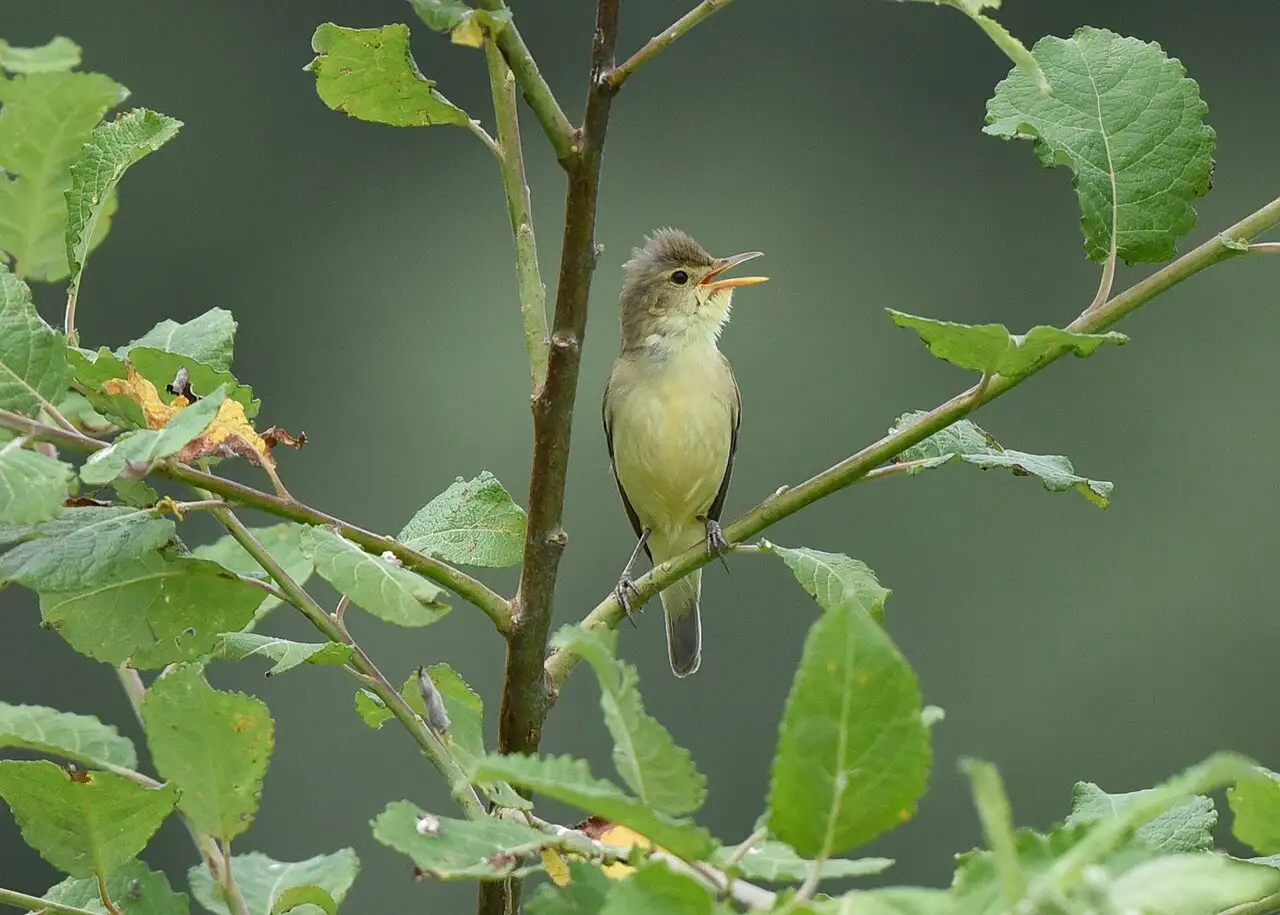
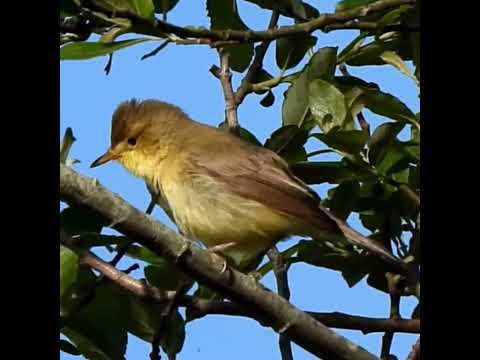
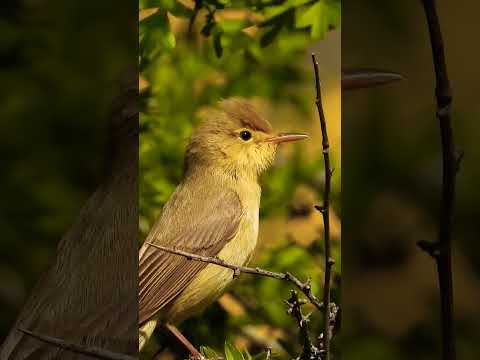
Melodious Warbler singing with open bill among the green leaves of a branch, with greyish-green back and yellowish underpartsPhoto: Pierre-Marie Epiney, CC BY-SA 2.0Photo 1 of 4
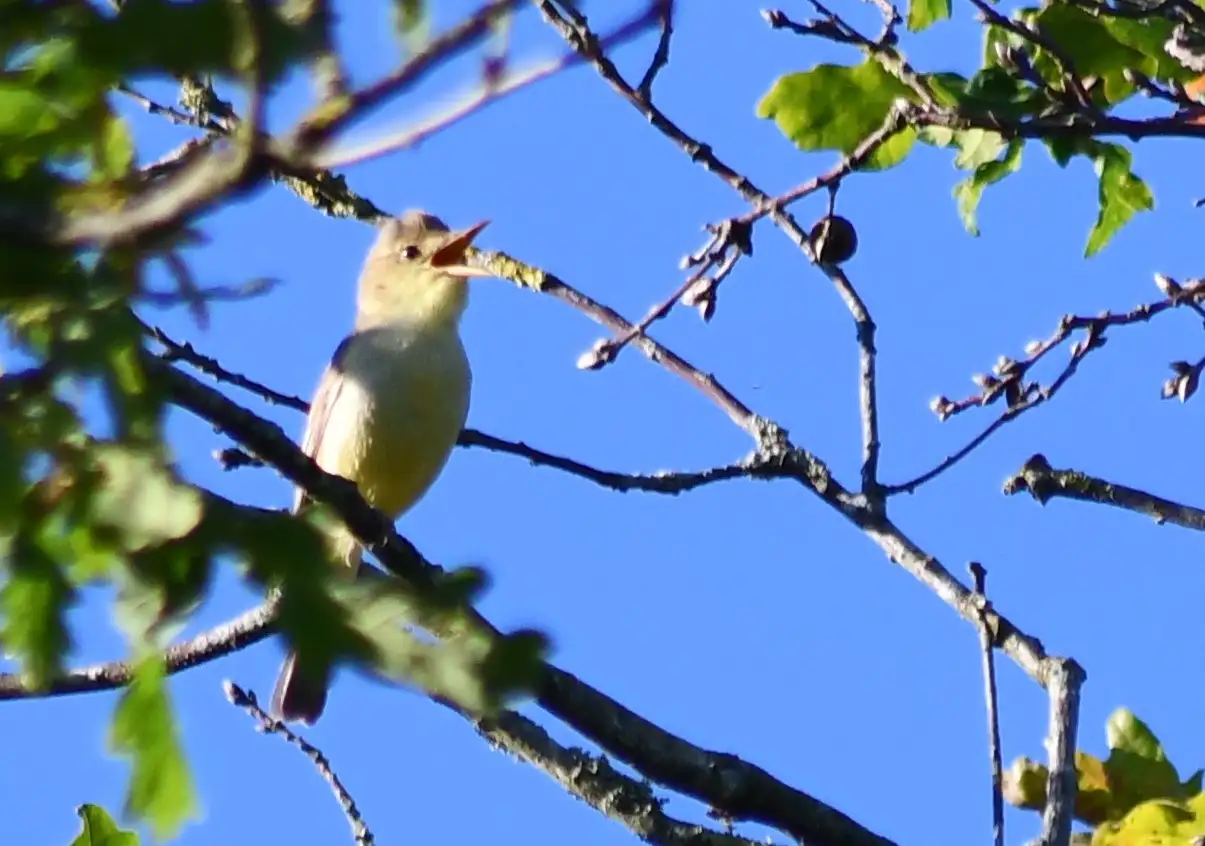
Melodious Warbler singing with open bill in the branches of a tree, with blue sky behindPhoto: BeALLARD, CC BY-SA 4.0Photo 3 of 4
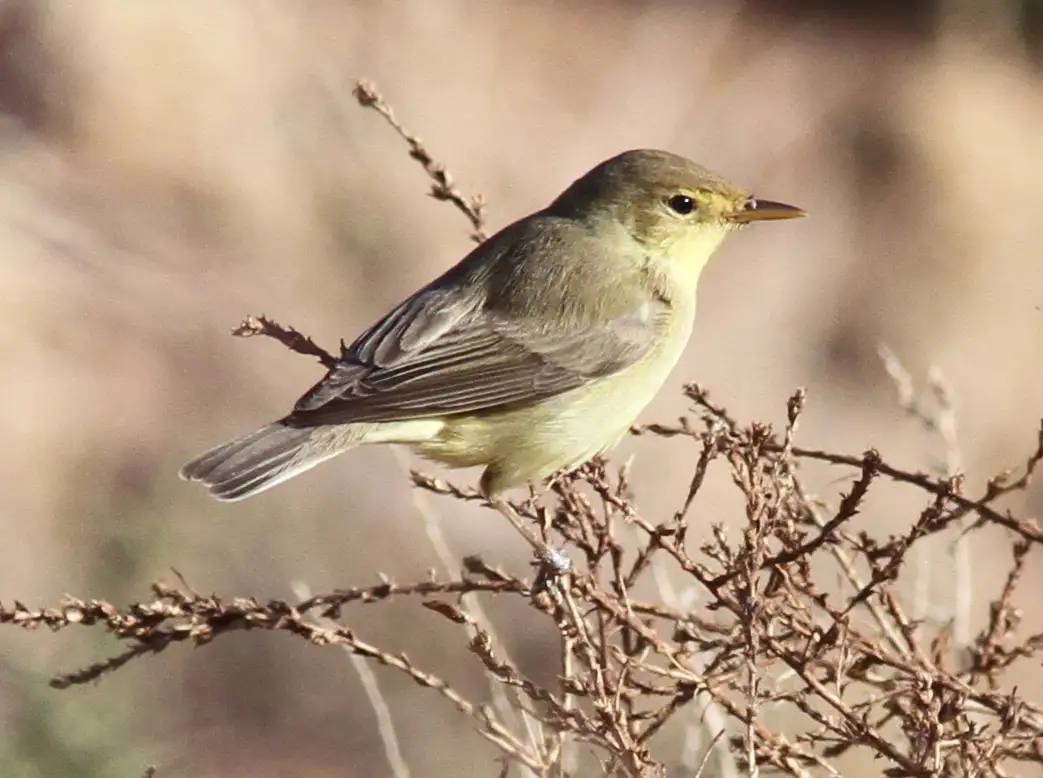
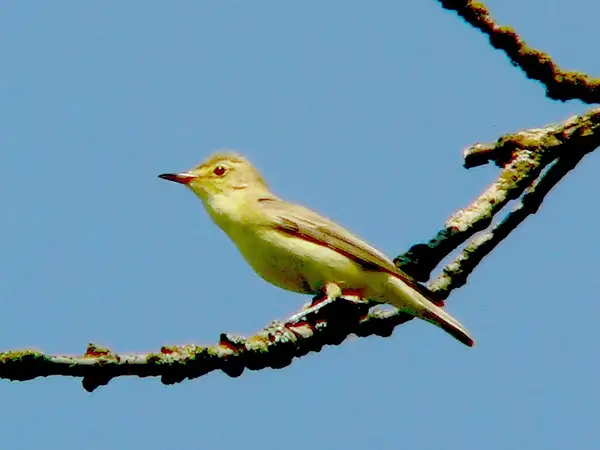
Melodious Warbler in profile on a dry branch, with greyish-green back, orange bill and yellowish throatPhoto: Gary L. Clark, CC BY-SA 4.0Photo 4 of 4
1 / 4
Identification of the Melodious Warbler
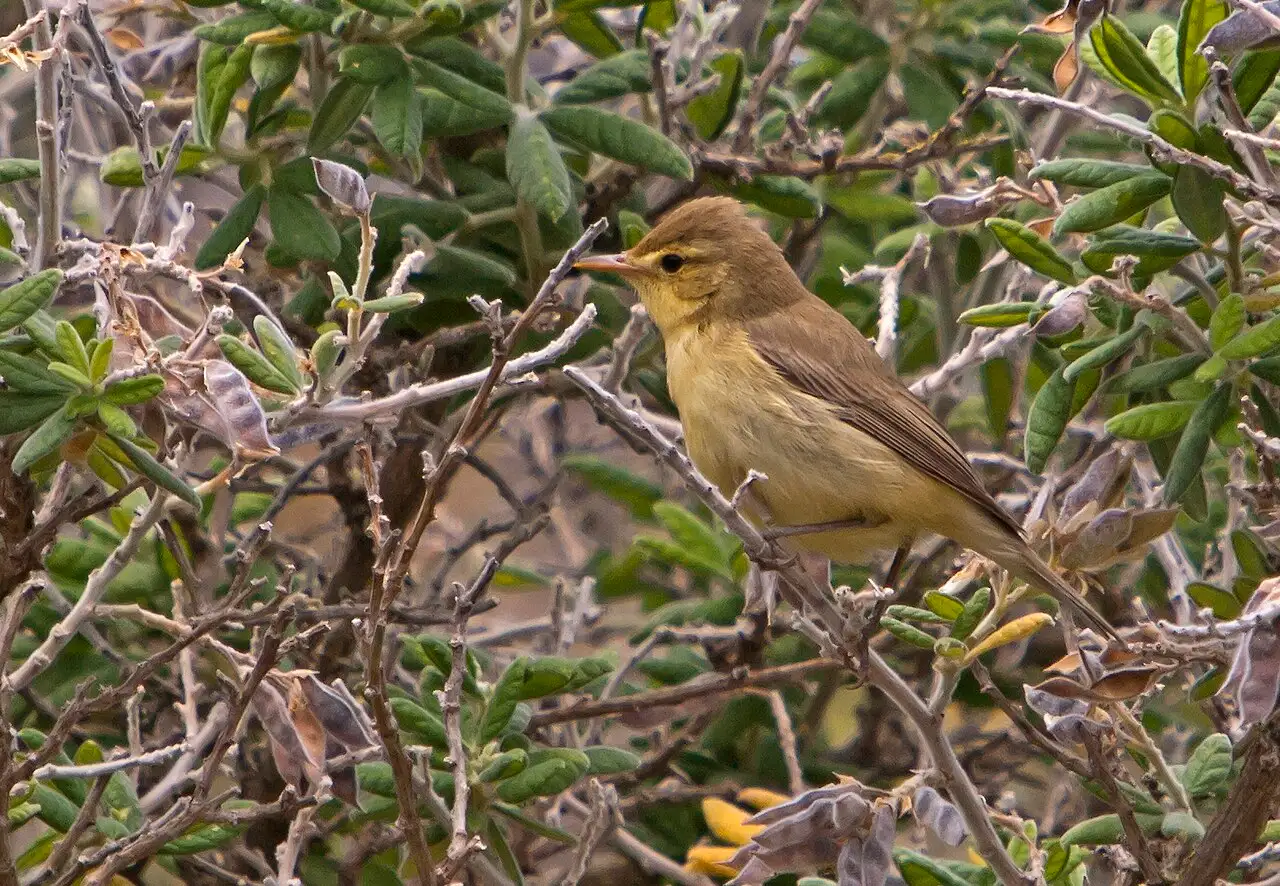
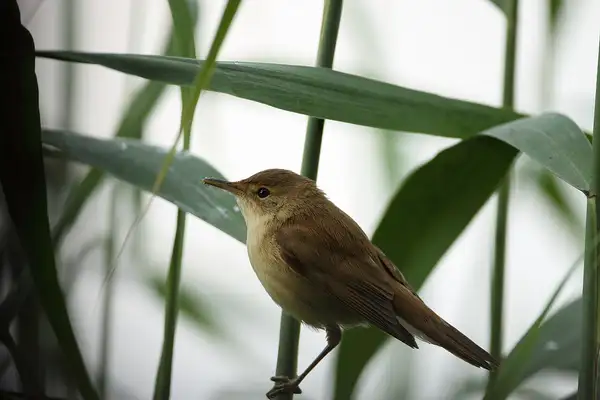
The Melodious Warbler is a small bird in overall yellow-green tones. The back is greyish green and the underparts yellowish, paler in juveniles. It is very similar to the rare Icterine Warbler, from which it is hard to tell in the field, and some very pale birds or those with very worn plumage can be confused with other species, such as the Olivaceous Warbler or the Garden Warbler. Both sexes are alike.
Adult
Greyish-green back.
Yellowish underparts, paler in juveniles.
Habitat and distribution of the Melodious Warbler
As a breeder, its world distribution is restricted to south-western Europe (the Iberian Peninsula, France and Italy) and north-west Africa. No subspecies are recognised. In Spain it is widely and continuously distributed across the whole Peninsula, although it is absent or scarce in the highest mountain systems (Pyrenees, Cantabrian Range, Iberian System, Sierra Nevada) and in the most deforested parts of the southern plateau. It also breeds in Ceuta and Melilla, and is absent from the Balearics and the Canaries, where it appears only on migration.
It is a passerine characteristic of low, warm areas, although it can reach 1,950 metres (in the Sierra Nevada). It occupies semi-open environments with scattered trees, clearings and forest edges, always in areas with good scrub cover. The highest densities are reached in riverside woods with abundant undergrowth.
It is a long-distance migrant, wintering in West Africa, south of the Sahara. Pre-breeding migration is detected between March and June, peaking in May, and post-breeding migration runs from the end of June to October, with the largest number of birds in August.
Areas where it is regularly recorded since 2010Squares of about 25 km where it is recorded regularly (occasional passage records are left out). Data from GBIF.org (127,126 records, retrieved October 2026); outline from Natural Earth.
Etymology of the Melodious Warbler
According to Wikipedia, the genus name, «Hippolais», comes from the Ancient Greek «hypolaís», as Linnaeus wrote it wrongly, and the epithet «polyglotta» comes from the Greek «polýs» («many») and «glôssa» («tongue»), and means «harmonious». It is also known as «zarcero políglota»; in other languages it is «bosqueta vulgar» in Catalan, «folosa común» in Galician, «sasi-txori arrunta» in Basque and «melodious warbler» in English1.
Population of the Melodious Warbler
In the 2021 European Red List of Birds the European breeding population is estimated at between 4,270,000 and 7,070,000 mature individuals, with an increasing trend. The Spanish population is estimated at 3.6 million birds and its trends have been slightly positive, according to the SACRE programme from 1998 to 2005. Given the size of its populations and its wide, almost continuous distribution on the Peninsula it is not considered threatened, although it may be locally affected by the destruction of riverside groves, by changes in land use or by the abuse of biocides.
Nest of the Melodious Warbler
The nest, built by the female, is a small cup of leaves and twigs, lined with hair and feathers, and is placed in the fork of a shrub.
Courtship and breeding of the Melodious Warbler
It normally lays a single clutch during the breeding season, which runs from May to July. The clutch consists of three to five pinkish-white eggs with variable speckling. Incubation is the female’s responsibility and lasts 12–14 days. The chicks, tended by both parents, can fly at 11–13 days.
Diet of the Melodious Warbler
It feeds basically on invertebrates, although it may eat fruit in late summer, during the period before migration.
Curious facts about the Melodious Warbler
It is the most abundant and widespread representative of the tree warblers, a group of small thicket-loving birds that show no very distinctive morphological features1. EURING lists a bird ringed in France and shot that lived 11 years and 9 months, against the 8.9 years of AnAge.
The Melodious Warbler in Cabañeros
The habitat pages of this website do not mention it. GBIF.org records 70 observations of the Melodious Warbler in Cabañeros and its surroundings.
Where to see the Melodious Warbler in Cabañeros
In Cabañeros and its surroundings, from March to October, in riverside woods and scrub with good cover.
When
From March to October: pre-breeding passage between March and June (peaking in May), and post-breeding passage from the end of June to October (with the largest number of birds in August).
What time
In good light, when it sings.
Where
In riverside woods with abundant undergrowth and, in general, in semi-open environments with scattered trees, clearings and forest edges, always with good scrub.
What to look for
Listen for its fast, harsh song; look for the yellowish tone of the underparts and the greyish-green back.
Videos of the Melodious Warbler
Similar species to the Melodious Warbler
Icterine Warbler
Hippolais icterina
How to tell them apart
It is similar in song and appearance1; it is rare and very hard to tell apart in the field.



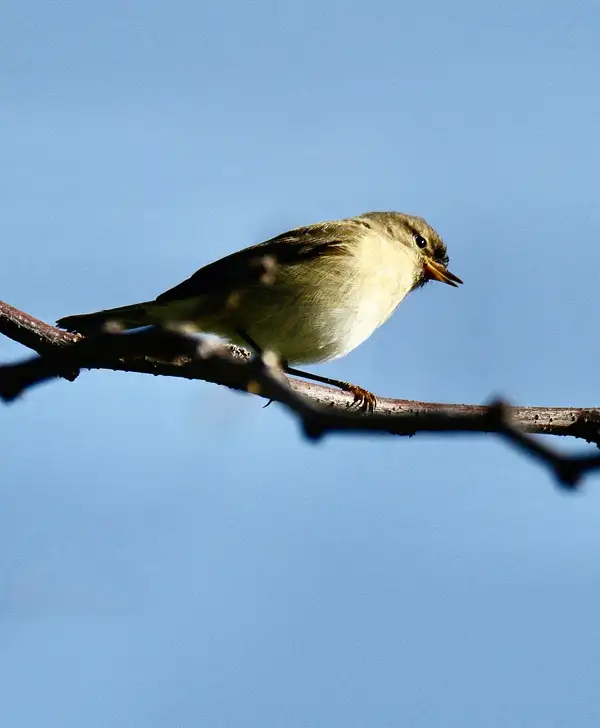
 Same family
 Same family
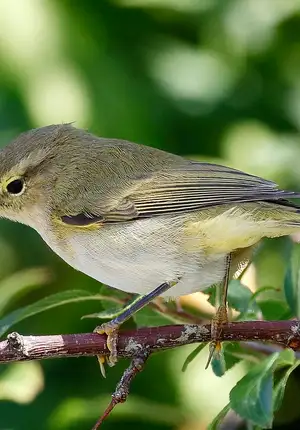 Same order
 Same order
 Same order
 Same order
 Same order
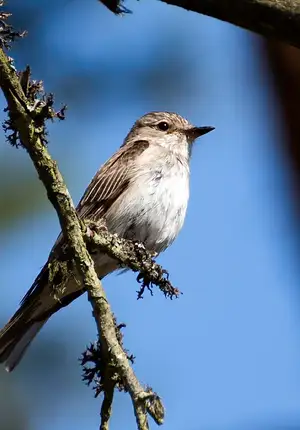 Same order





