It is usually monogamous, although cases of bigamy have been seen: one male with two females
Lifespan
Record of 14 years and 10 months in the wild according to EURING (a bird ringed in Germany); in captivity, AnAge gives up to 24 years
Conservation status
LC
NT
VU
EN
CR
EW
EX
Global (IUCN)
Least Concern
Spain
Least Concern (LC) as a breeder in the Red List of Birds of Spain; on the List of Wild Species under Special Protection, but not in the Spanish Catalogue of Threatened Species
When to see it
Summer visitor
Months of the year when it is present
J
F
M
A
M
J
J
A
S
O
N
D
In Iberia
no
no
no
yes
yes
yes
yes
yes
yes
yes
no
no
Breeding season
no
no
no
no
yes
yes
yes
no
no
no
no
no
Song or voice of the Garden Warbler
Its song, melodious and pleasant, is made of long, fluty phrases, longer, softer and more melodious than those of the Blackcap, which it closely resembles. The call is a repeated «chec-chec», quite like that of other warblers. The recording, from Galicia, was weak and we have filtered it and raised the volume.
SongGarden Warbler
0:00 / 0:20
10 kHz5
The sonogram draws the sound: time runs from left to right, and the higher a trace sits, the higher the note.Recording by Amadeo A. Pombo Eirín, xeno-canto XC955860 (Terra Chá, Lugo) (CC BY-SA 4.0).
Flight of the Garden Warbler
It moves among shrubs, hedges and copses, where it looks for invertebrates and, at the end of summer, fruit such as blackberries or elderberries.
Flight typeShort flights through the vegetation
Tied to cool, damp woodland environments; in the south of its range it occupies riverside woods, damp farmland and shaded slopes.
It eats a wide range of invertebrates and, at the end of summer and in autumn, a lot of fruit: blackberries, elderberries, figs or wild olives.
Its song, melodious and pleasant, is long, fluty phrases, longer and softer than those of the Blackcap.
Photo gallery of the Garden Warbler
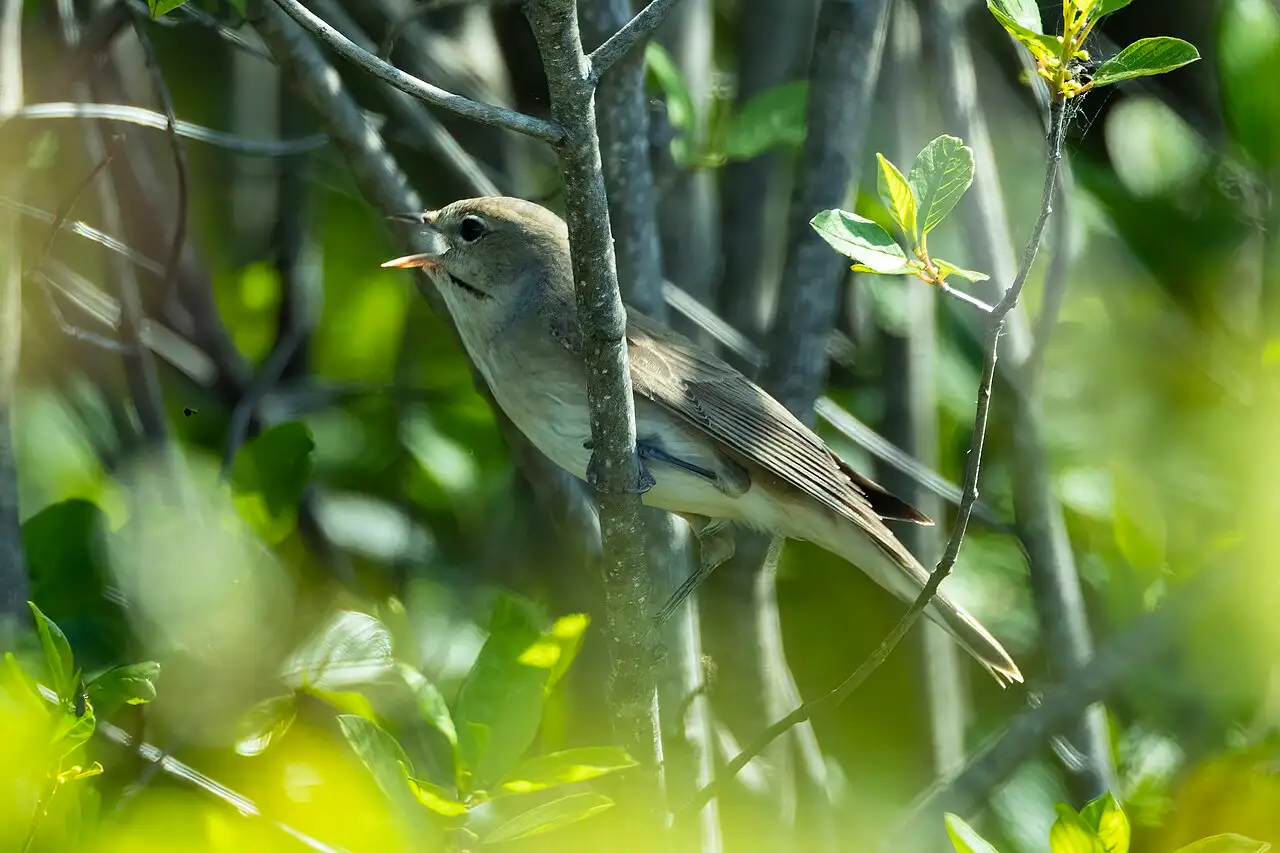
Garden Warbler among the fine branches of a shrub, with greyish-brown back, pale belly and fine ring around the eyePhoto: fveronesi1, CC BY-SA 4.0Photo 1 of 4
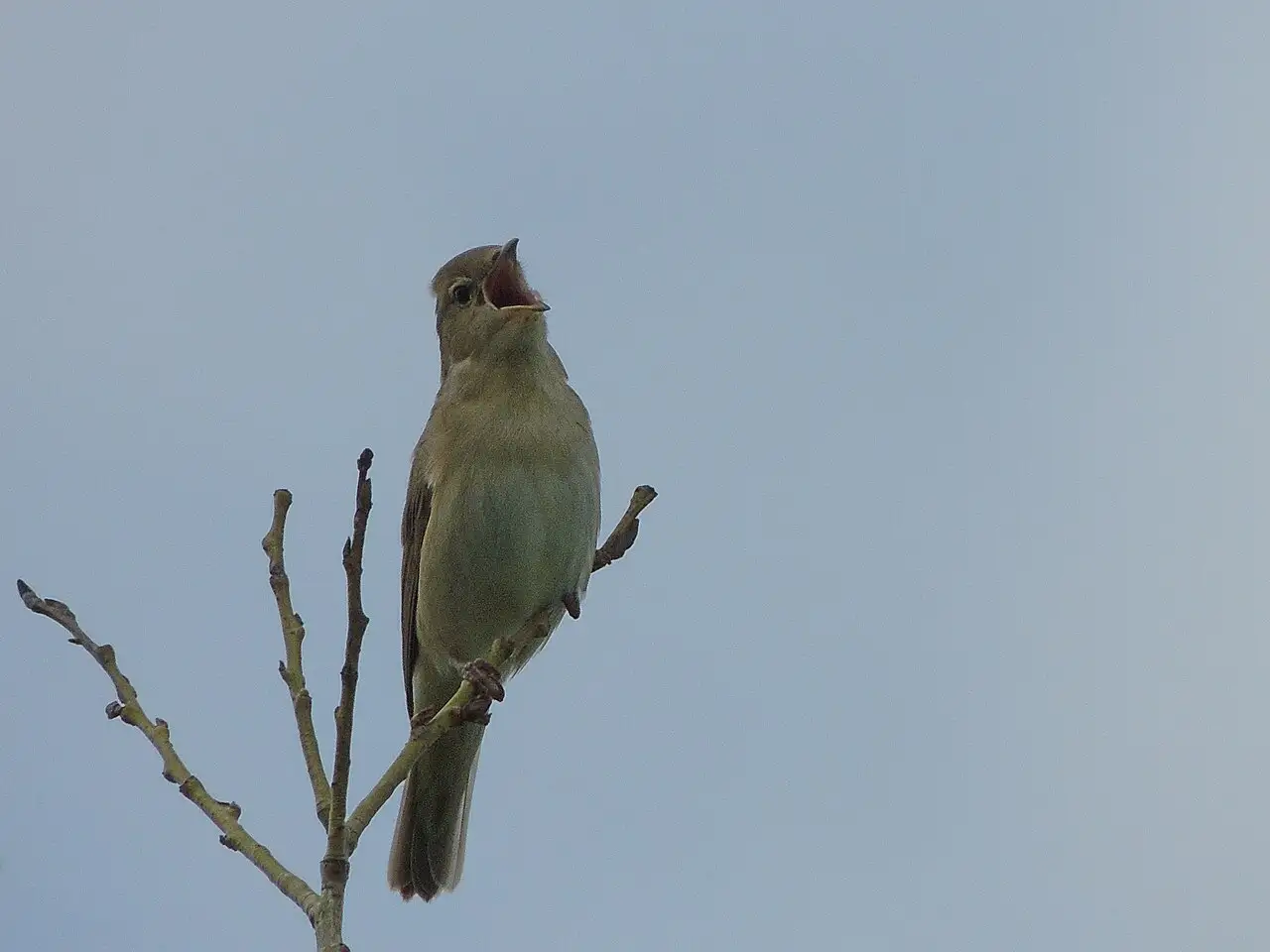
Garden Warbler singing with open bill at the top of some dry branches, against the skyPhoto: xulescu_g, CC BY-SA 2.0Photo 3 of 4
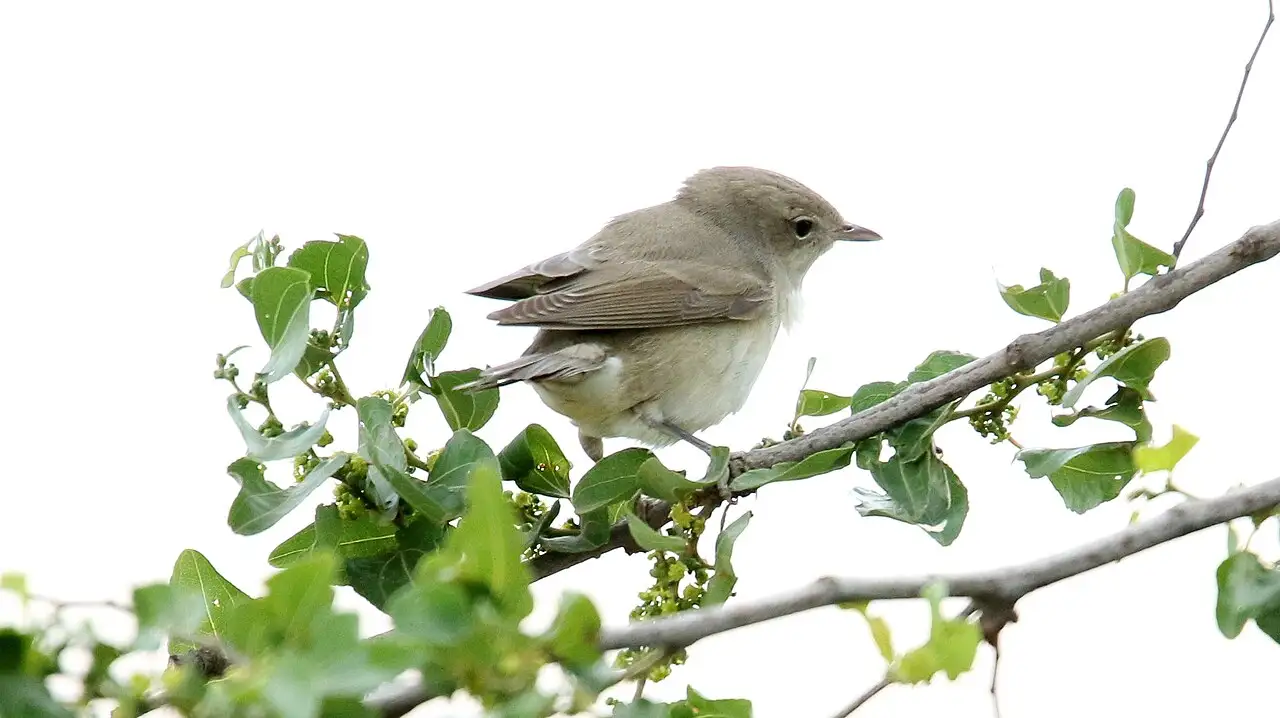
Garden Warbler in profile on a leafy branch, against a white background, with greyish-brown body and short billPhoto: Dominic Sherony, CC BY-SA 2.0Photo 4 of 4
1 / 4
Identification of the Garden Warbler
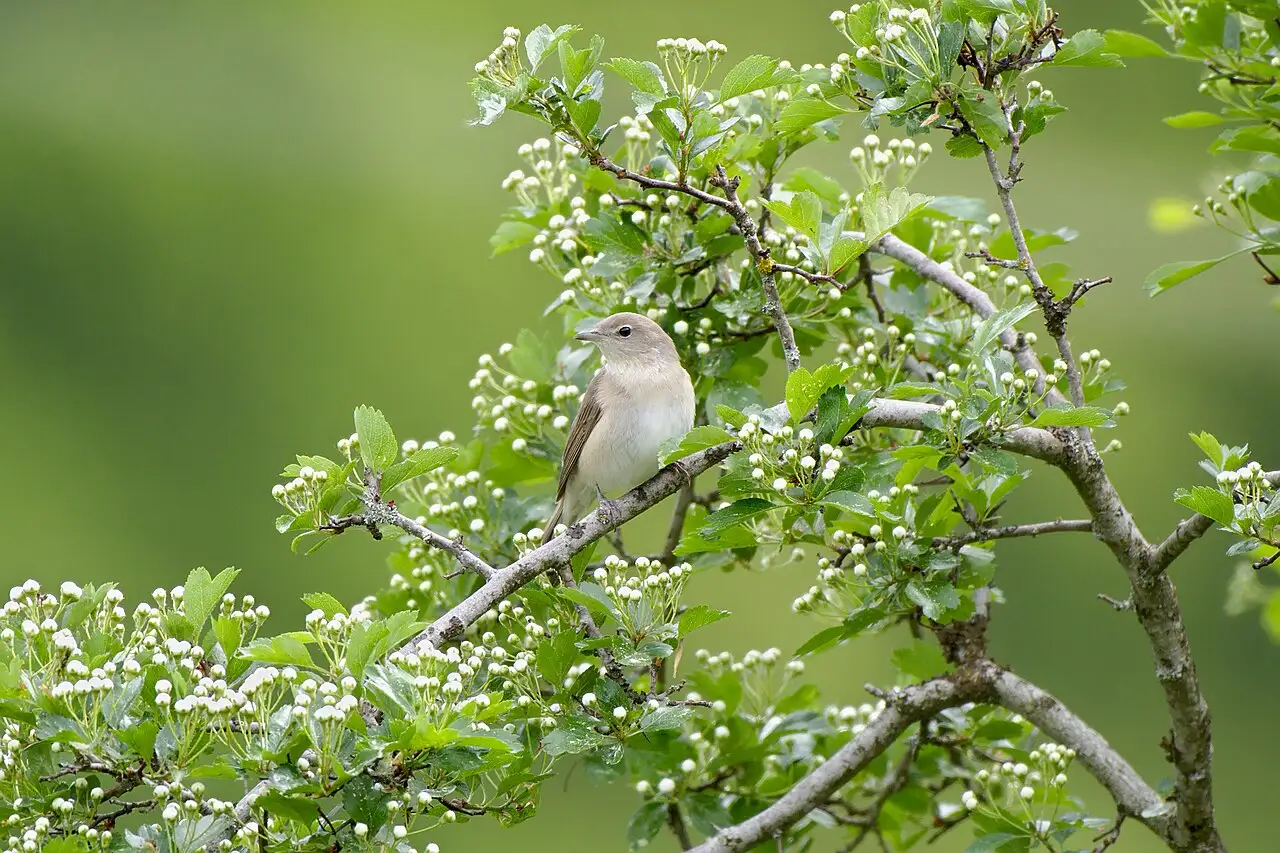
It is a little bird more compact and robust than other warblers, although quite like the Blackcap, with a more rounded head and a shorter, thicker bill. A fine ring surrounds the eye. Otherwise it has no really striking features and its look is quite uniform: the underparts are pale buff and the back greyish brown, and around the neck a discreet, greyer collar shows slightly. Males and females are alike.
Adult
Greyish-brown back and pale buff underparts.
Rounded head, short, thick bill and a fine ring around the eye.
A discreet greyish collar.
Habitat and distribution of the Garden Warbler
It breeds widely and continuously in the temperate and boreal latitudes of Europe and central Asia, and more patchily in the Middle East and southern Europe. It winters in tropical Africa, south of the Sahara. Two subspecies are distinguished, and in Spain «borin» lives.
As a nesting bird it occupies the northern half of the Peninsula continuously, and is especially abundant in the north-west, the sub-Cantabrian zone, the Pyrenees and the Iberian System. It does not breed in the southern half, nor in the Balearics or the Canaries.
It is tied to cool, damp woodland environments: it is frequent in deciduous woods, such as oak and Lusitanian oak woods, in Scots pine woods and in mosaics of pasture with hedges and copses. In the south of its range it occupies riverside woods, damp farmland and shaded slopes.
It is a trans-Saharan migrant that winters from Senegal to Ethiopia and reaches South Africa in the south. On passage it is common throughout the Peninsula and the Balearics: the spring one, from April to May, with the peak in early May, and the autumn one, between August and November, with peaks in late September.
Areas where it is regularly recorded since 2010Squares of about 25 km where it is recorded regularly (occasional passage records are left out). Data from GBIF.org (66,535 records, retrieved October 2026); outline from Natural Earth.
Etymology of the Garden Warbler
According to Wikipedia, «Sylvia» comes from modern Latin «silvia», a wood nymph, related to «silva», «wood». The epithet «borin» comes from a local name for the bird in the Genoa area and derives from Latin «bos», «ox», because it was believed to accompany oxen. Boddaert described it in 1783 as «Motacilla borin». In English it is called «garden warbler»1.
Population of the Garden Warbler
In the 2021 European Red List of Birds the European breeding population is estimated at between 23,200,000 and 38,900,000 mature individuals, with a decreasing trend. The Spanish population would be around 700,000 birds, with the largest number in Castilla y León, and the SACRE programme has observed a moderate increase between 1998 and 2018.
It is not considered threatened and no specific risk factors are known, although adverse conditions, such as droughts, in its African winter quarters could affect it greatly.
Nest of the Garden Warbler
The males start several nests, and the female chooses one and finishes it: a small cup of twigs and leaves, lined with moss and feathers, which is usually low down in a shrub or among tall grasses.
Courtship and breeding of the Garden Warbler
Its breeding season runs from May to July, and now and then it makes two clutches in the year, of two to six eggs, white to greenish with variable speckling. Both parents incubate them for 11 or 12 days. The chicks, which both care for, fly at 10 days and are independent two weeks later.
Diet of the Garden Warbler
It eats a wide range of invertebrates. At the end of summer and in autumn its diet changes and takes a high proportion of fruit: blackberries, elderberries, figs or wild olives.
Curious facts about the Garden Warbler
It is a bird without really identifying features, of very uniform appearance, which is better recognised by its song1. EURING lists a Garden Warbler ringed in Germany that lived 14 years and 10 months; AnAge cites birds that reached 24 in captivity.
The Garden Warbler in Cabañeros
The habitat pages of this website do not mention it, and we have not found any other published source on it in the Park. It does not breed in the southern half of the Peninsula, but on passage it is common throughout it1. GBIF.org records 38 observations of the Garden Warbler in Cabañeros and its surroundings.
Where to see the Garden Warbler in Cabañeros
In Cabañeros and its surroundings, mostly on passage, in riverside groves, hedges and damp woods.
When
On passage: from April to May, with the peak in early May, and from August to November, with peaks in late September.
What time
By day; in spring, easier to hear than to see.
Where
In riverside woods, hedges, copses and cool shaded slopes, and in autumn wherever there are blackberries or elderberries.
What to look for
Listen for its long, fluty song; look for its uniform appearance, with no markings, and the short bill.



 Same family
 Same family
 Same family
 Same family
 Same order
 Same order
 Same order
 Same order





