Territorial and monogamous, although males with two females have been recorded
Lifespan
Record of 19 years and 1 month in the wild according to EURING (a bird ringed in Lithuania); AnAge gives 16.9 years
Conservation status
LC
NT
VU
EN
CR
EW
EX
Global (IUCN)
Least Concern
Spain
Least Concern (LC) as a breeder in the Red List of Birds of Spain; on the List of Wild Species under Special Protection, but not in the Spanish Catalogue of Threatened Species
When to see it
Summer visitor
Months of the year when it is present
J
F
M
A
M
J
J
A
S
O
N
D
In Iberia
no
no
yes
yes
yes
yes
yes
yes
yes
yes
no
no
Breeding season
no
no
no
no
yes
yes
yes
yes
no
no
no
no
Song or voice of the Common Reed Warbler
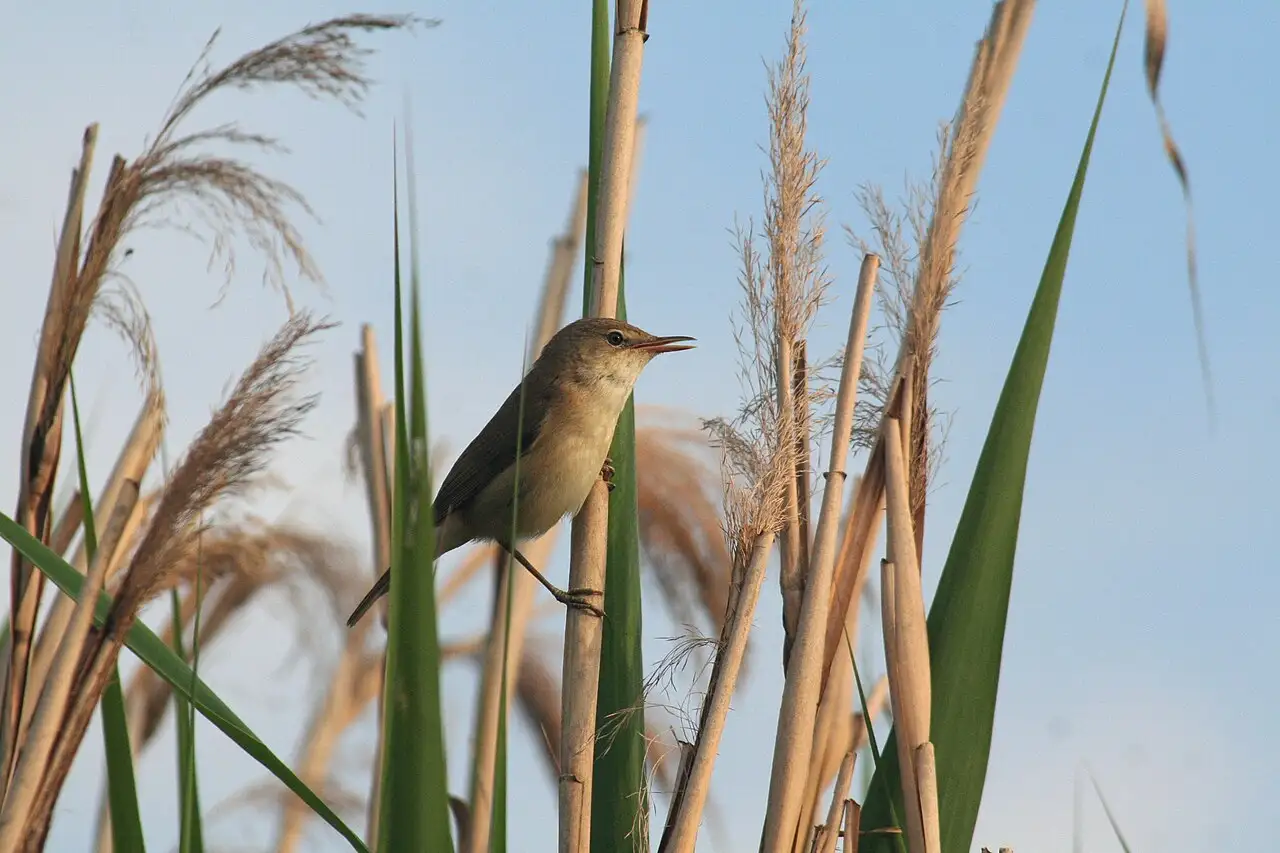
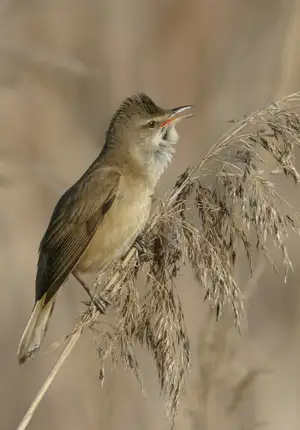
Its song is long and pleasant, made of short, varied phrases, repeated two or three times, alternating high and rasping phrases, although the final result is rhythmic and melodic. The recording is of a male from a reedbed in Switzerland; we have trimmed it and filtered the bass slightly.
SongCommon Reed Warbler
0:00 / 0:26
10 kHz5
The sonogram draws the sound: time runs from left to right, and the higher a trace sits, the higher the note.Recording by Pascal Christe, xeno-canto XC1141738 (Hagneck, Suiza) (CC BY-SA 4.0).
Flight of the Common Reed Warbler
It lives among the marsh vegetation of marshes and the edges of rivers, streams and canals.
Flight typeAmong marsh vegetation
It lives in areas of marsh vegetation of marshes and the edges of rivers, streams and channels, in stands of reeds, rushes, bulrushes and saw-sedge.
Its song is long and pleasant, with brief, varied phrases repeated two or three times, which alternate high, scratchy phrases.
Its diet is based on insects, spiders and small snails, and occasionally includes fruit and seeds.
Photo gallery of the Common Reed Warbler
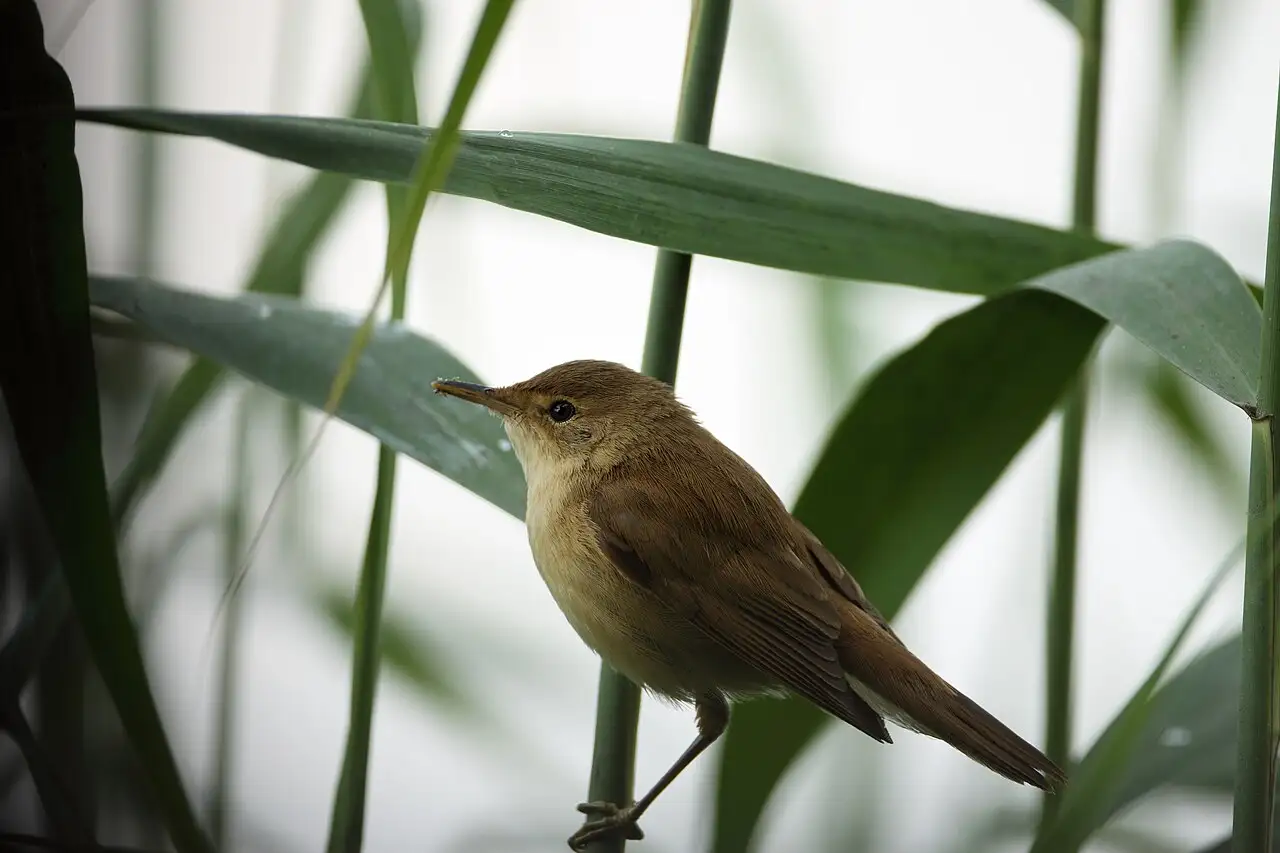
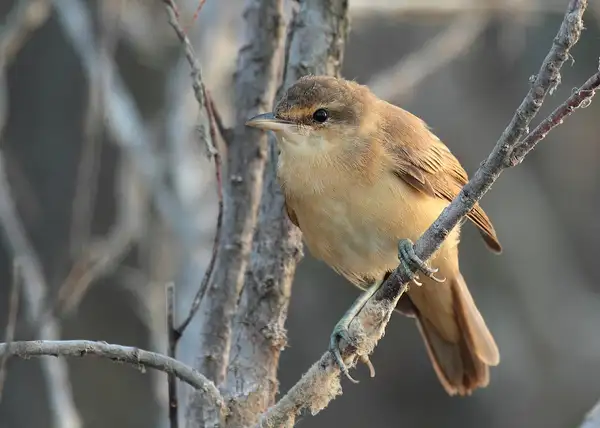
Common Reed Warbler in profile among reed leaves, with brown back, ochre underparts and thin billPhoto: Matthias Barby, CC BY-SA 3.0Photo 1 of 4
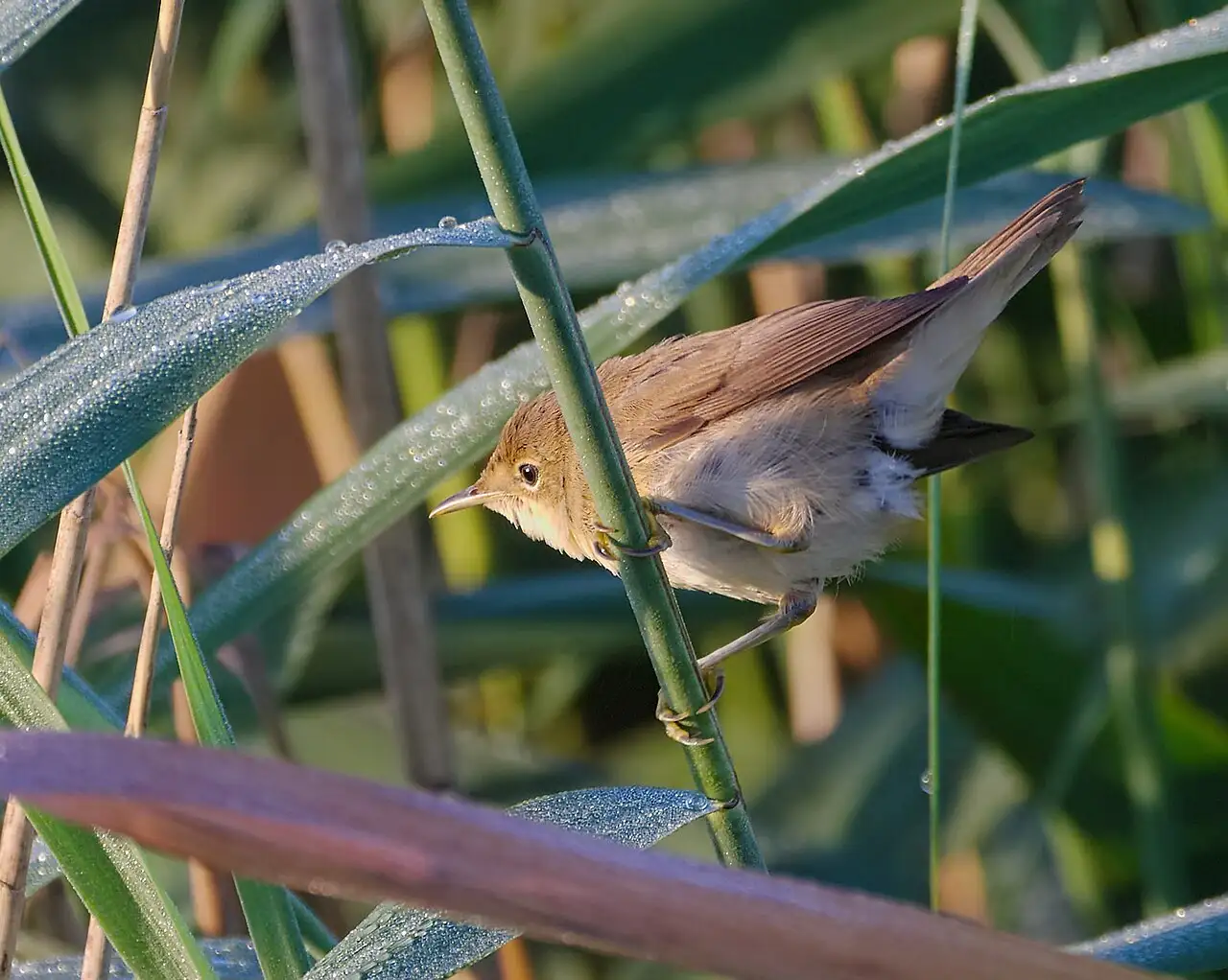
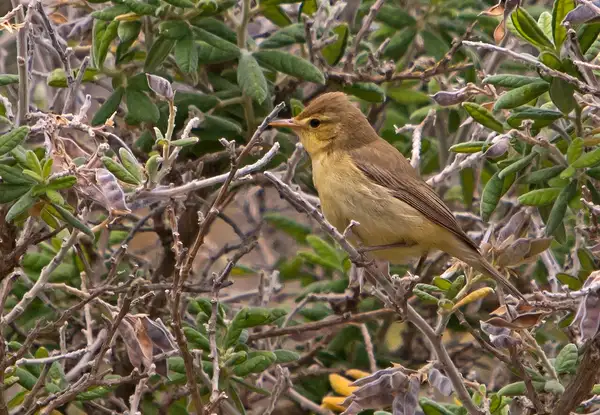
Common Reed Warbler clinging to a dewy reed stem, with brown back and tail tilted, among green reed leavesPhoto: Andreas Eichler, CC BY-SA 4.0Photo 2 of 4
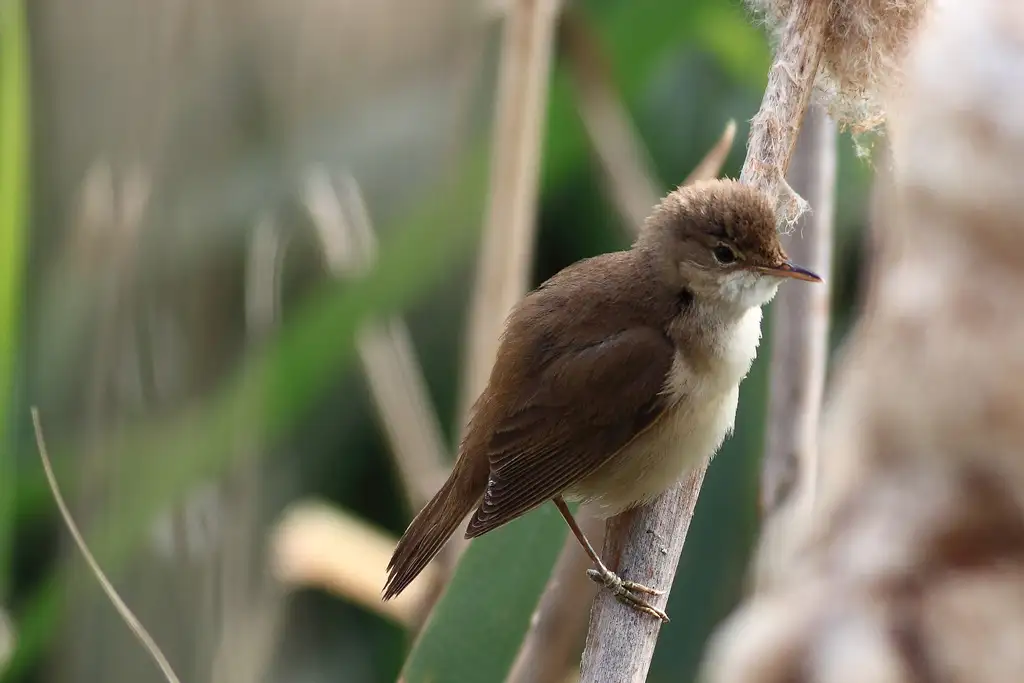
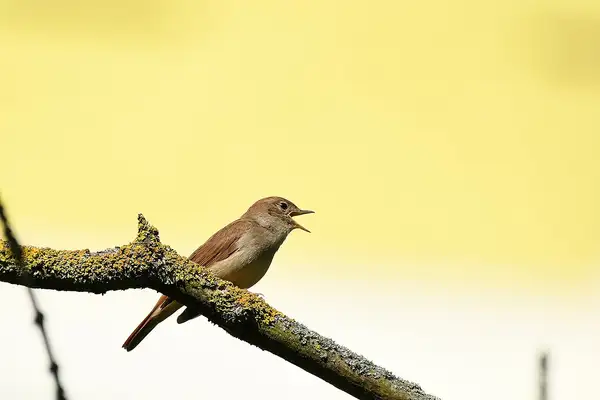
Common Reed Warbler perched on a dry bulrush spike, in profile, with pale throat and thin billPhoto: Andy Vernon, CC BY 2.0Photo 3 of 4
Common Reed Warbler singing with its bill open, clinging to a dry reed stem in a reedbed, with the sky behindPhoto: Pmau, CC BY-SA 3.0Photo 4 of 4
1 / 4
Identification of the Common Reed Warbler
The Common Reed Warbler is a small insectivorous bird in uniform ochre tones. Like other reed warblers and marsh warblers, it has a pointed head, with a flattened forehead and a relatively long, thin bill. The back is brown, with olive or grey tints depending on age and wear of the plumage, and the underparts show pale ochre tones. It lacks the distinctive head stripes and eyebrows of other species of the genus «Acrocephalus» and, unlike other reed warblers, has a reddish-brown rump. Both sexes are similar.
Adult
Brown back, with olive or grey tints.
Pale ochre underparts and reddish-brown rump.
No stripes or eyebrows on the head.
Habitat and distribution of the Common Reed Warbler
Its worldwide distribution as a breeder is eminently European, and on this continent it is well spread across temperate and warm latitudes. It is also found, more locally and patchily, in the Middle East and north-west Africa. Two subspecies are recognised, and the one of western Europe and Spain is «scirpaceus».
It is distributed as a breeder across much of the Peninsula and the Balearics, but is absent from the Canaries. It is seen in the main valleys and coasts of Iberia, with the largest numbers in the Duero, Guadalquivir and Ebro basins and in the Levante.
It lives in areas of marsh vegetation in marshes and on the edges of rivers, streams and canals. It settles in stands of reeds, rushes, bulrushes, saw-sedge and, to a lesser extent, in riverside shrub formations. It occupies low ground, although it reaches 1,000 metres in altitude.
It is a summer visitor in our country and a long-distance migrant, with wintering areas in tropical Africa, south of the Sahara; in recent years it has been shown to winter in low numbers in the south of the Peninsula. Migration passages are detected in March–May and between August and mid-November, with peaks in May and September, and reed warblers from western and central Europe pass through the Peninsula.
Areas where it is regularly recorded since 2010Squares of about 25 km where it is recorded regularly (occasional passage records are left out). Data from GBIF.org (358,542 records, retrieved October 2026); outline from Natural Earth.
Etymology of the Common Reed Warbler
According to Wikipedia, the French naturalist Johann Hermann described it in 1804 under the name «Turdus scirpaceus». The genus «Acrocephalus», introduced by Johann Andreas Naumann and his son in 1811, comes from the ancient Greek «ákros», «highest», and «kephalḗ», «head». The epithet «scirpaceus» is Latin and means «of the rushes» (from «scirpus»). In other languages it is called «boscarla de canyar» in Catalan, «folosa das canaveiras» in Galician, «lezkari arrunta» in Basque and «common reed warbler» in English1.
Population of the Common Reed Warbler
In the 2021 European Red List of Birds the European breeding population is estimated at between 3,890,000 and 6,630,000 mature individuals, with a stable trend. The Spanish population is about 977,000 Common Reed Warblers, with a wide margin of error, because the number of breeders can vary greatly from year to year. By community, Aragón holds the largest share (24 %, about 237,000), followed by Castilla y León, Catalonia, Andalusia and Castilla-La Mancha, with similar sizes (14–17 %, between 140,000 and 170,000).
It is not considered threatened, given its wide Iberian distribution, the size of its populations and recent trends. Its main threats are related to the destruction or alteration of the wetlands it depends on, through burning of reedbeds, channelling and dredging of river courses or drainage, although the creation of new artificial wetlands, such as irrigation pools, canals and gravel pits, may have offset the loss of the original natural habitats.
Nest of the Common Reed Warbler
The nest is set low, among marsh vegetation, and is built by the female: a small cup of interwoven leaves, normally reed, finely stitched with hairs or spider-web threads.
Courtship and breeding of the Common Reed Warbler
It is a territorial and monogamous bird, although cases of males with two mates have been recorded. The breeding period runs from late May to early August, with the possibility of making two clutches a year. The clutch consists of between two and seven eggs, white to greenish and more or less speckled with dark. Incubation lasts 9 to 12 days and is done by both parents. The chicks, cared for by both parents, can fly at 9–13 days.
Diet of the Common Reed Warbler
Its diet is based on eating insects, spiders and small snails. Occasionally it includes various plant matter, such as fruit and seeds.
Curious facts about the Common Reed Warbler
It is the archetypal reed warbler, in uniform brown tones and with a pleasant song1. EURING lists a Common Reed Warbler ringed in Lithuania that lived 19 years and 1 month, quite a bit more than AnAge (16.9 years) and the rest of the data on the list (the next, from the Netherlands, 14 years and 3 months).
The Common Reed Warbler in Cabañeros
The habitat pages of this website do not mention it, but Castilla-La Mancha is one of the five communities with the largest shares of the Spanish population1. We have not found any other published source on it in the Park. GBIF.org records 16 observations of the Common Reed Warbler in Cabañeros and its surroundings.
Where to see the Common Reed Warbler in Cabañeros
In Cabañeros and its surroundings, from March to October, in reedbeds and marsh vegetation on shores and streams.
When
From March to October: it is a summer visitor, with migration passages in March–May and from August to mid-November, and breeds from late May to early August.
What time
By day, singing from inside the reedbed.
Where
In reeds, rushes, bulrushes and saw-sedge of marshes and the edges of rivers, streams and canals.
What to look for
Look for its reddish-brown rump and listen for its short phrases, repeated two or three times.



 Same family
 Same family
 Same order
 Same order
 Same order
 Same order
 Same order
 Same order






