Territorial in the breeding season, when it is usually seen on prominent perches; on passage it sometimes forms small groups
Lifespan
Record of 8.8 years in the wild according to AnAge; EURING lists a bird ringed in the Czech Republic that lived 8 years and 9 months and was found dead
Conservation status
LC
NT
VU
EN
CR
EW
EX
Global (IUCN)
Least Concern
Spain
Least Concern (LC) as a breeder in the Red List of Birds of Spain; on the List of Wild Species under Special Protection, but not in the Spanish Catalogue of Threatened Species
When to see it
Summer visitor
Months of the year when it is present
J
F
M
A
M
J
J
A
S
O
N
D
In Iberia
no
no
yes
yes
yes
yes
yes
yes
yes
yes
no
no
Breeding season
no
no
no
yes
yes
yes
yes
yes
no
no
no
no
Song or voice of the Tree Pipit
The call is a loud, high, buzzing note («tsiip», «tiisz»)1. The song, powerful and melodious, consists of a trill of notes repeated for 5–8 seconds, which it gives in flight or from the top of a perch, usually a tree or bush, and its slow ending, «chiuchiu-chiuuuu», is characteristic. The recording (song from a perch) is by Jacobo Ramil Millarengo and was made at Embalse da Fervenza, Brandomil, Zas, Galicia (xeno-canto XC991722, quality A). It lasts 9 seconds and is a trimmed section of the original, without repeating or lengthening, from which we have removed the bass below 300 Hz, reduced the background noise and adjusted the volume; neither pitch nor speed has been changed.
It sings in flight or from the top of a perch, usually a tree or bush. On migration it crosses the Peninsula, the Balearics and the Canaries: the spring passage runs between March and May, with a peak in April, and the autumn one, much more noticeable and shifted to the west, between late August and early October, with a peak in September.
Flight typeSings in flight or from the top of a perch; migratory, wintering in Africa
The song, powerful and melodious, is a trill of notes repeated for 5–8 seconds, which it gives in flight or from the top of a perch, normally a tree or shrub.
Its slow ending, «chiuchiu-chiuuuu», is characteristic.
It searches for and pecks at insects, above all small beetles, on the ground, among the grass and leaf litter, and less often on branches and leaves.
Photo gallery of the Tree Pipit
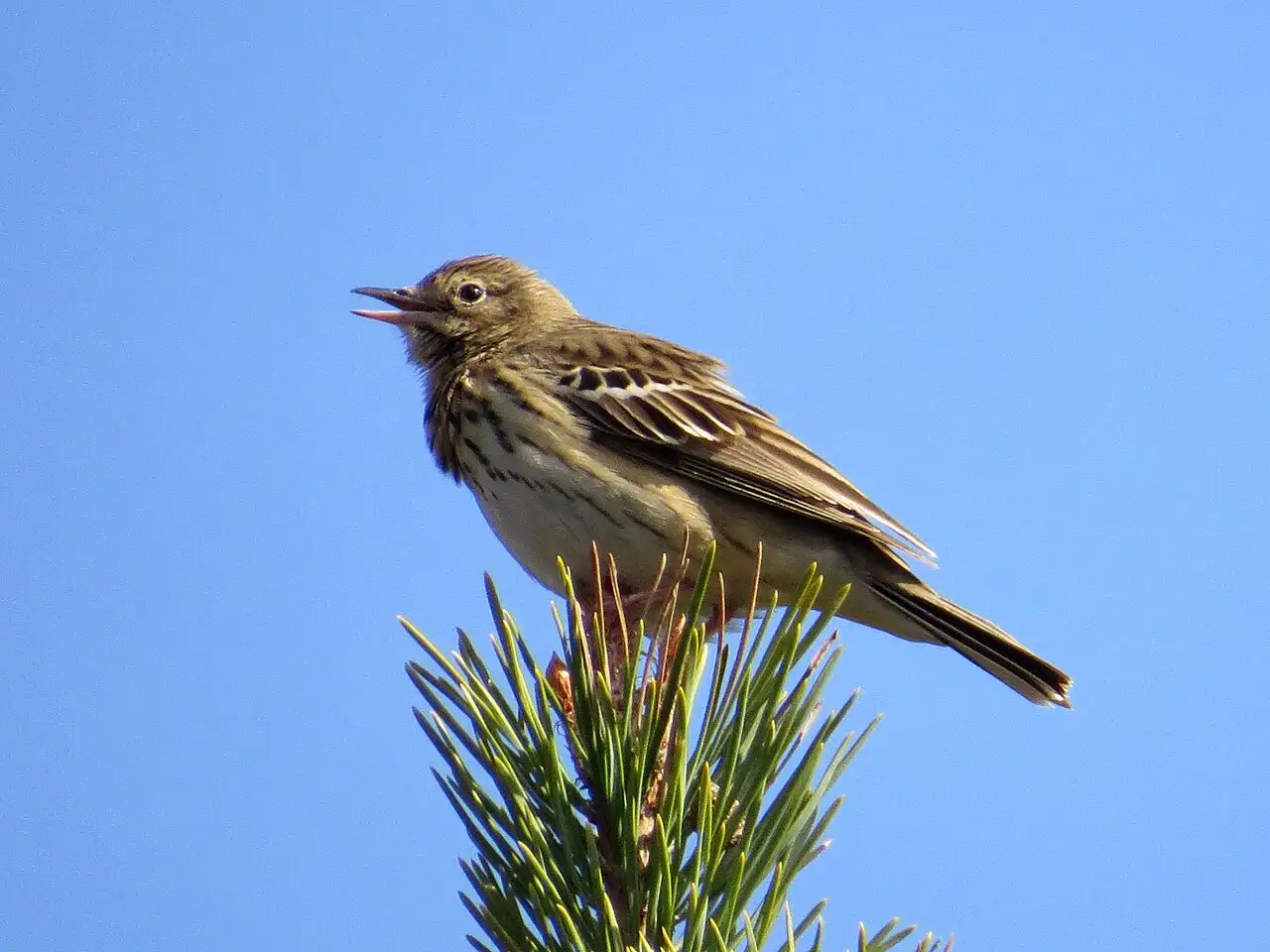
Tree Pipit singing with its bill open on top of a pine, with streaked brown back and pale streaked breast, against a blue skyPhoto: MPF, CC BY-SA 3.0Photo 1 of 5
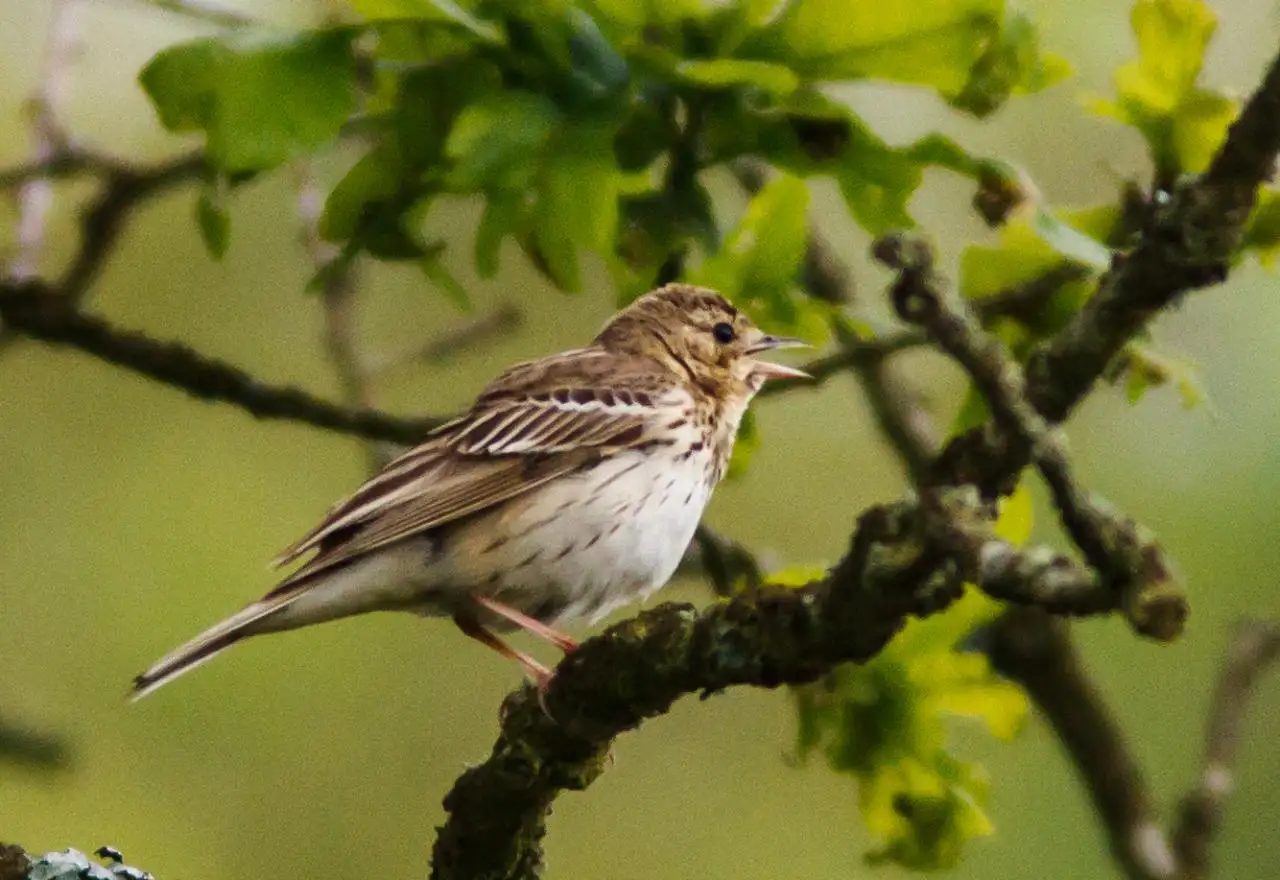
Tree Pipit perched in profile on an oak branch with new leaves, with pale, heavily streaked breast and brown backPhoto: Ómar Runólfsson, CC BY 2.0Photo 2 of 5
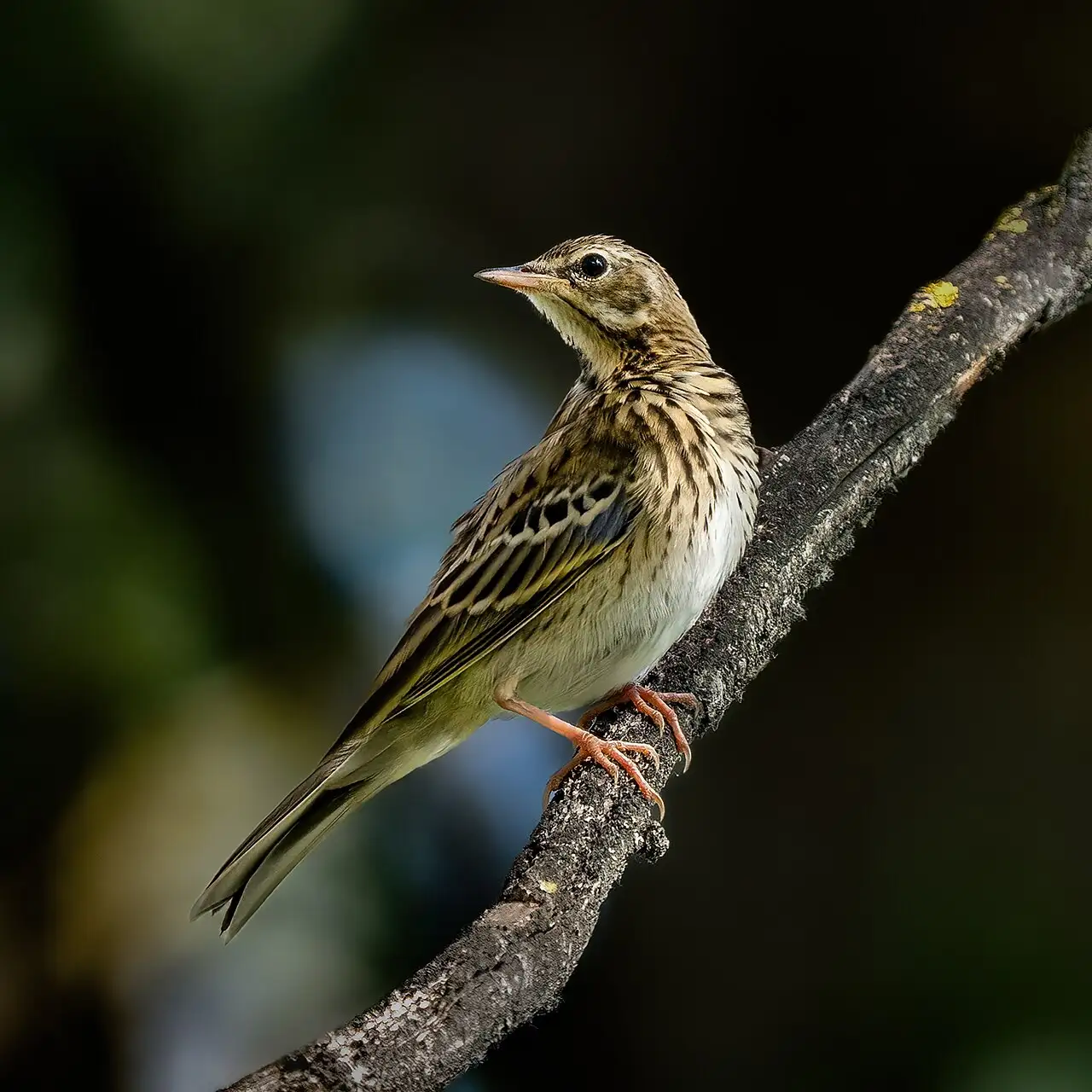
Tree Pipit perched on a sloping branch, in profile and upright, with orange streaked breast and streaked wingsPhoto: Mike Duchstein, CC BY-SA 4.0Photo 3 of 5
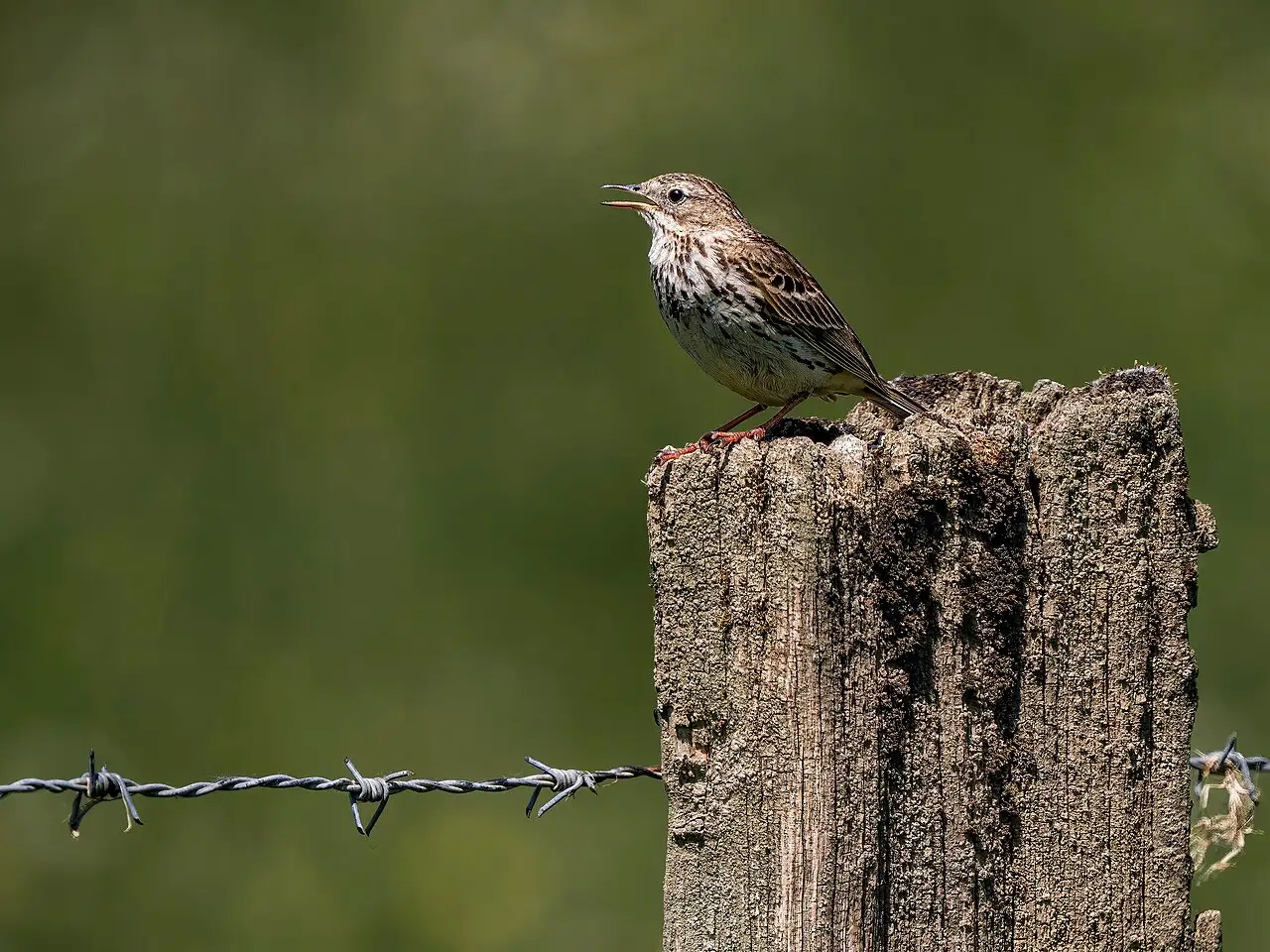
Tree Pipit with bill open on a wooden post beside a wire fence, in a meadowPhoto: Ralf Hüsges, CC BY 4.0Photo 4 of 5
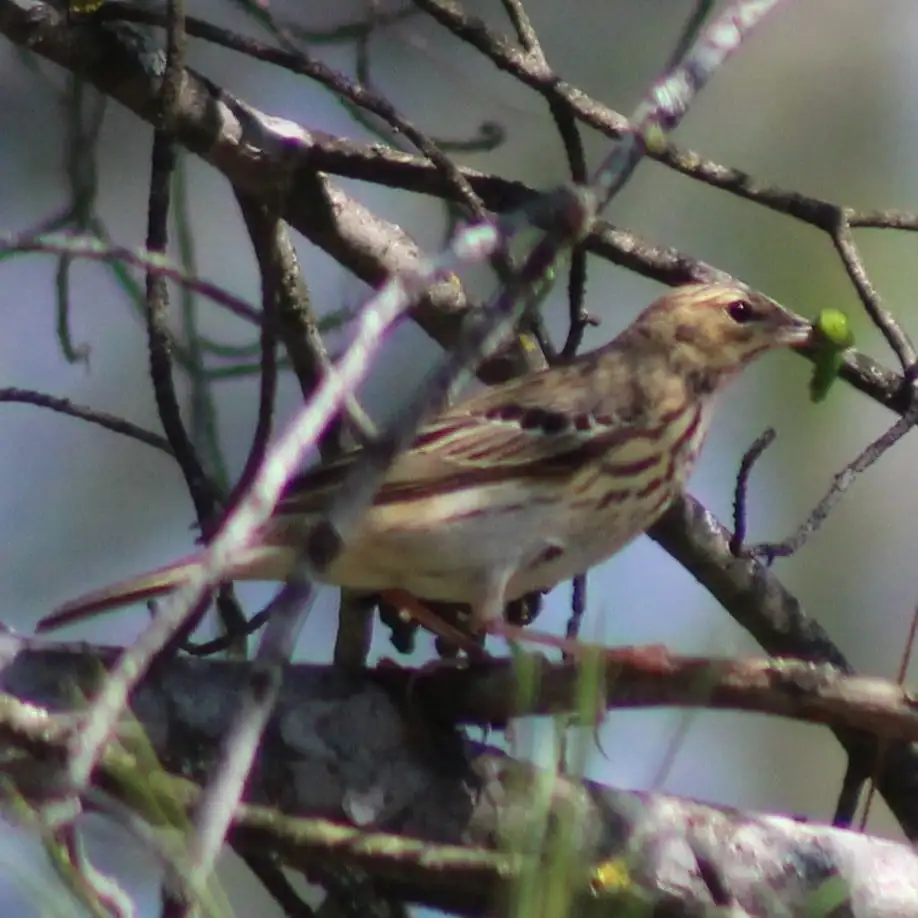
Tree Pipit among branches, with streaked breast and something green in its bill (Community of Madrid)Photo: Gonzalo Ganda Álvarez, CC BY 4.0Photo 5 of 5
1 / 5
Identification of the Tree Pipit
The Tree Pipit shows a heavily streaked brown back and a pale, heavily streaked belly, with an orange wash on the breast and flanks. It has rounded wings and a long tail, with white outer feathers. The bill and legs are thin, with a medium-length hind claw. On the face it shows a pale eyebrow and a thin black moustache. Its look is very similar to that of the other pipits, especially the Meadow Pipit, from which it is subtly distinguished by being a little sturdier and more olive in tone, and by having a thicker bill and shorter hind claw, a more contrasting face and finer streaks on the flanks. Both sexes are alike. Young birds, somewhat paler, show white edges on the back feathers, which gives them a scaly look.
Adult
Heavily streaked brown back and pale, heavily streaked belly, with an orange wash on breast and flanks.
Pale eyebrow and thin black moustache; long tail with white outer feathers.
Young bird
Somewhat paler, with white edges on the back feathers, which give it a scaly look.
Habitat and distribution of the Tree Pipit
As a breeder it occupies temperate and boreal latitudes of Eurasia, and in winter it moves to sub-Saharan Africa and India. Three subspecies are recognised.
The subspecies «trivialis», the only one seen in Spain, breeds in the northern third of the peninsula, specifically in the Pyrenees and north of the Duero, as well as in the Iberian System1. It also penetrates the Central System, colonised from 1976, where it has populations in the Ayllón and Guadarrama sierras, although it thins out to the west, in the Gredos and Gata sierras. On migration it crosses the Peninsula, the Balearics and the Canaries.
It occupies northern farmland with pasture, scrub and scattered trees, as well as thinned woods in the breeding season; it also lives in Pyrenean oak woods, river groves and plantation pine woods, avoiding these formations when they are closed. It nests between sea level and 1,700 metres and shows a preference for areas with little sun, rainy and with plenty of scrub and shrubs. On passage it uses similar environments, as well as wetland shores, where it is seen more easily.
It is a summer visitor in Spain, wintering in Africa. The spring passage runs between March and May, with a peak in April; the autumn one, much more noticeable and shifted to the west, between late August and early October, with a peak in September. The birds on passage come from western Europe.
Areas where it is regularly recorded since 2010Squares of about 25 km where it is recorded regularly (occasional passage records are left out). Data from GBIF.org (39,126 records, retrieved October 2026); outline from Natural Earth.
Etymology of the Tree Pipit
In other languages it is called «piula dels arbres» in Catalan, «pica das árbores» in Galician, «uda-txirta» in Basque and «tree pipit» in English1. We have not found a source explaining the origin of the name «bisbita arbóreo» or of the scientific name, so we do not venture one.
Population of the Tree Pipit
The 2021 European Red List of Birds estimates between 38,900,000 and 70,100,000 adult individuals in Europe, with a decreasing trend. The Spanish breeding population, relatively small, is estimated at about 585,369 individuals, spread across Castilla y León, where the main cores are, Navarre, Aragón and Catalonia1. According to the SACRE programme monitoring, the trend in Spain is stable, despite its disappearance from some localised areas through loss of trees.
It is not a threatened species and no specific problems are known: the possible threats, of a general kind, are related to habitat loss through changes in land use, urbanisation, abusive use of pesticides and illegal captures.
Nest of the Tree Pipit
The nest is built only by the female: a large cup of dry grass, sheltered on the ground.
Courtship and breeding of the Tree Pipit
The breeding period runs from late April to August, and it normally makes two clutches, sometimes three. Although it is a monogamous and territorial bird, occasionally a male breeds with more than one female at the same time. It lays between four and six eggs, of very variable colour (brown, grey, pink, blue or green, with spots or streaks), which the female incubates for about 13 days. The chicks leave the nest after two weeks, during which both sexes feed them.
Diet of the Tree Pipit
The diet, based on invertebrates, is made up essentially of insects, above all small beetles. The technique most used to catch them is searching and pecking on the ground, among grass and leaf litter, and, less often, on branches and leaves. It feeds alone or in pairs.
Curious facts about the Tree Pipit
In the 1970s it began a slow expansion along the Central System1. It is one of the many hosts of the Common Cuckoo1. AnAge gives 8.8 years of maximum longevity and EURING 8 years and 9 months in a bird found dead in the Czech Republic.
The Tree Pipit in Cabañeros
The habitat pages of this website do not mention it, but it does appear in the bird list of the «Visitor guide to Cabañeros National Park» (OAPN, page 105). That list vouches for its presence in the Park, not for breeding there. GBIF.org records 4 observations of the Tree Pipit in Cabañeros and its surroundings, which fits a species that crosses the Peninsula on migration, with a more noticeable autumn passage to the west. It breeds mainly in the northern third1. In the Central System it thins out to the west1. Only one of those observations falls within the Park boundary (according to OpenStreetMap); the rest are from the surroundings.
Where to see the Tree Pipit in Cabañeros
In Cabañeros and its surroundings, during migration passage, on the edges of crops, groves and shores.
When
In Spain from March to October; on the spring passage peaking in April and on the autumn one, from late August, peaking in September.
What time
By day, singing in flight or from the top of a tree or bush, or looking for insects on the ground.
Where
In farmland with pasture, scrub and scattered trees, Pyrenean oak woods, river groves and plantation pine woods; on passage, also on wetland shores.
What to look for
Look for the streaked back and breast, and listen for the trill with a slow ending, «chiuchiu-chiuuuu».
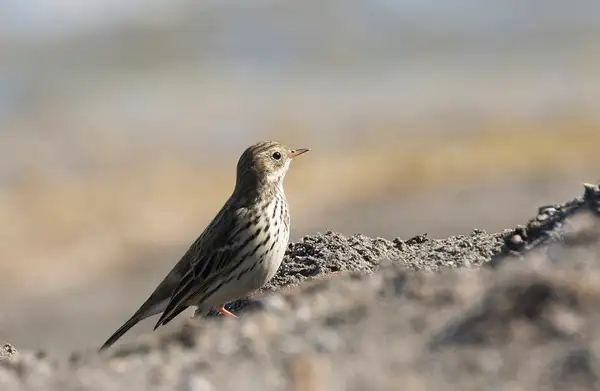
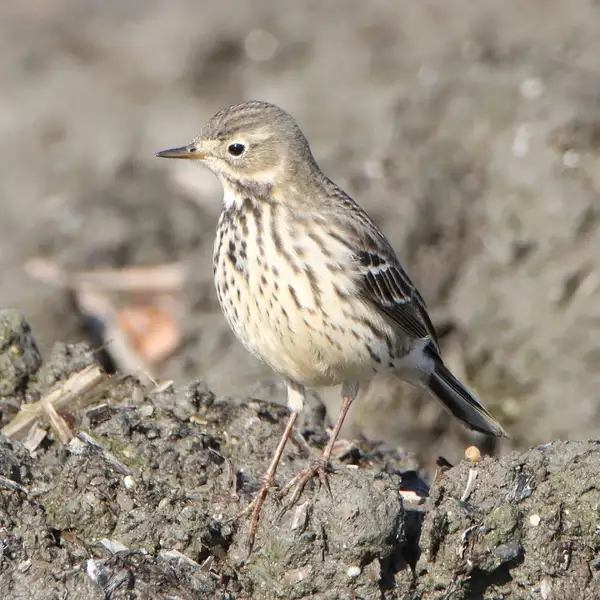
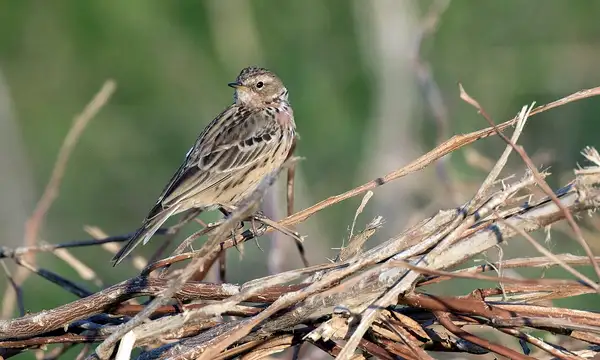
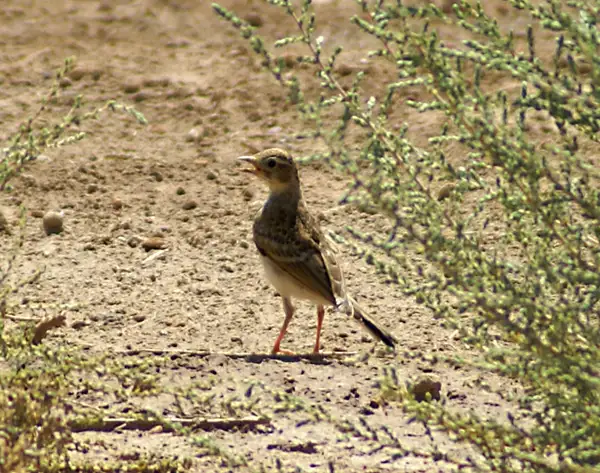
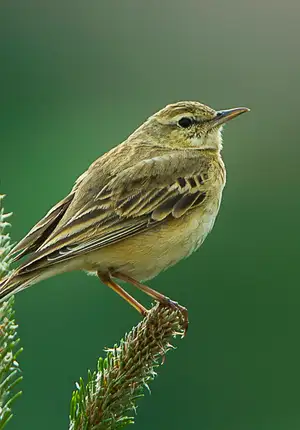
It is similar in song and physical appearance1: the Tree Pipit is a little sturdier and more olive in tone, with a thicker bill, a shorter hind claw, a more contrasting face and finer streaks on the flanks.



 Same family
 Same family
 Same family
 Same family
 Same order
 Same order
 Same order
 Same order






