In the breeding season, the male calls and drums throughout his territory; the pair excavate the nest together and both parents incubate and feed
Lifespan
Record of 10 years and 3 months in the wild according to EURING (a bird ringed in Hungary); AnAge gives 9.8 years
Conservation status
LC
NT
VU
EN
CR
EW
EX
Global (IUCN)
Least Concern
Spain
Data Deficient (DD) as a breeder in the Red List of the Birds of Spain; on the List of Wild Species under Special Protection, but not in the Spanish Catalogue of Threatened Species
When to see it
Resident
Months of the year when it is present
J
F
M
A
M
J
J
A
S
O
N
D
In Iberia
yes
yes
yes
yes
yes
yes
yes
yes
yes
yes
yes
yes
Breeding season
no
no
no
no
yes
yes
yes
no
no
no
no
no
Song or voice of the Lesser Spotted Woodpecker
Its characteristic sound is an explosive succession of «kick-kick-kick», like that of other woodpeckers but higher and faster. The drumming with which it calls is very quick and fairly weak; it is what is heard in this recording.
DrummingLesser Spotted Woodpecker
0:00 / 0:28
10 kHz5
The sonogram draws the sound: time runs from left to right, and the higher a trace sits, the higher the note.Recording by Hannu Varkki, xeno-canto XC470657 (Helsinki, Finlandia) (CC BY-SA 4.0).
Flight of the Lesser Spotted Woodpecker
It moves from tree to tree through deciduous woods and riverside groves, and clings to trunks with its four toes, two forward and two back, propping itself on its tail.
Flight typeFrom tree to tree
It lives in deciduous woods: oak woods, chestnut woods, Lusitanian oak woods, mixed holm oak woods and riverside groves of ash, alder and poplar.
It is the smallest of the European woodpeckers, no larger than a chaffinch or a sparrow.
It eats almost only larvae and adult insects, above all wood-boring beetles, which it takes from the cracks in the bark with its long, thin tongue.
Photo gallery of the Lesser Spotted Woodpecker
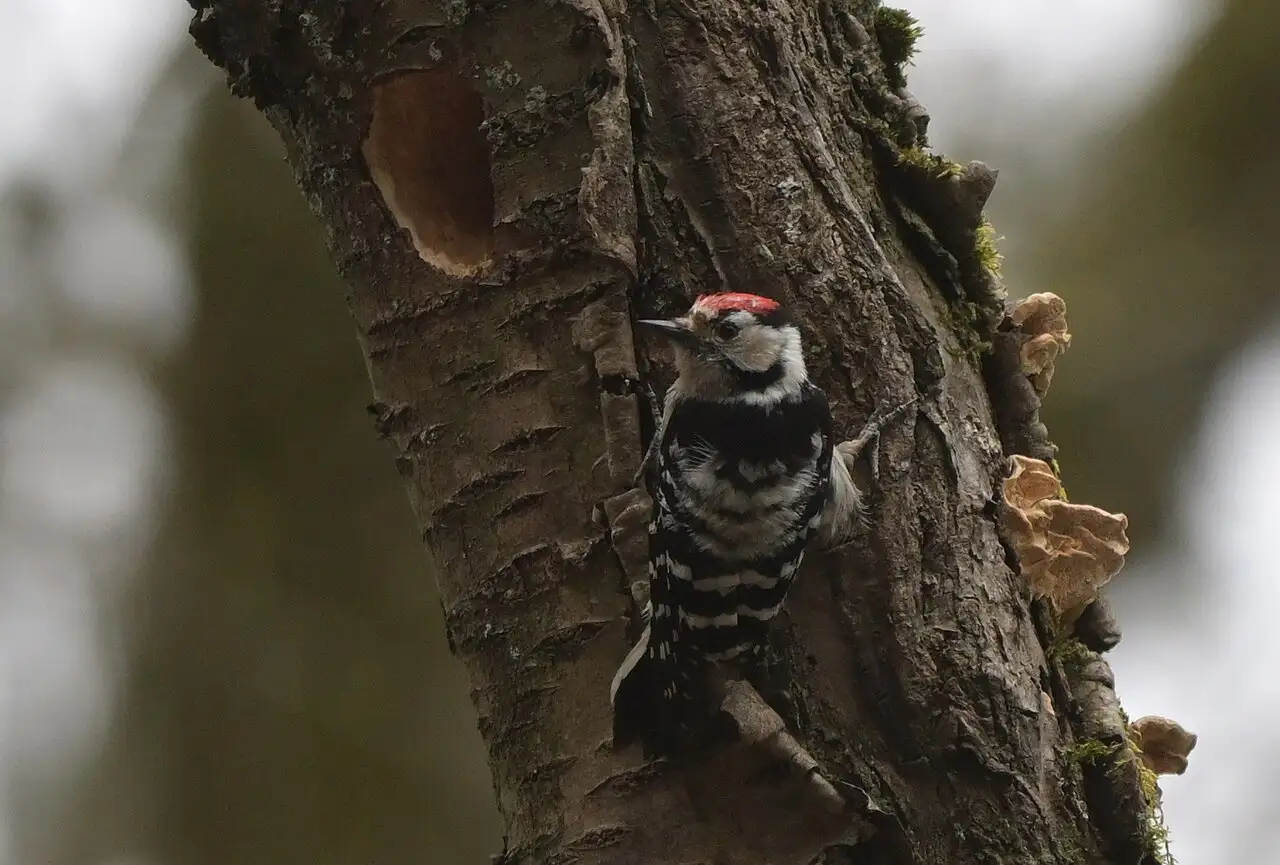
Male Lesser Spotted Woodpecker clinging to a trunk beside a hole, with red crown and back barred in white and blackPhoto: Simon Mannweiler, CC BY-SA 4.0Photo 1 of 4
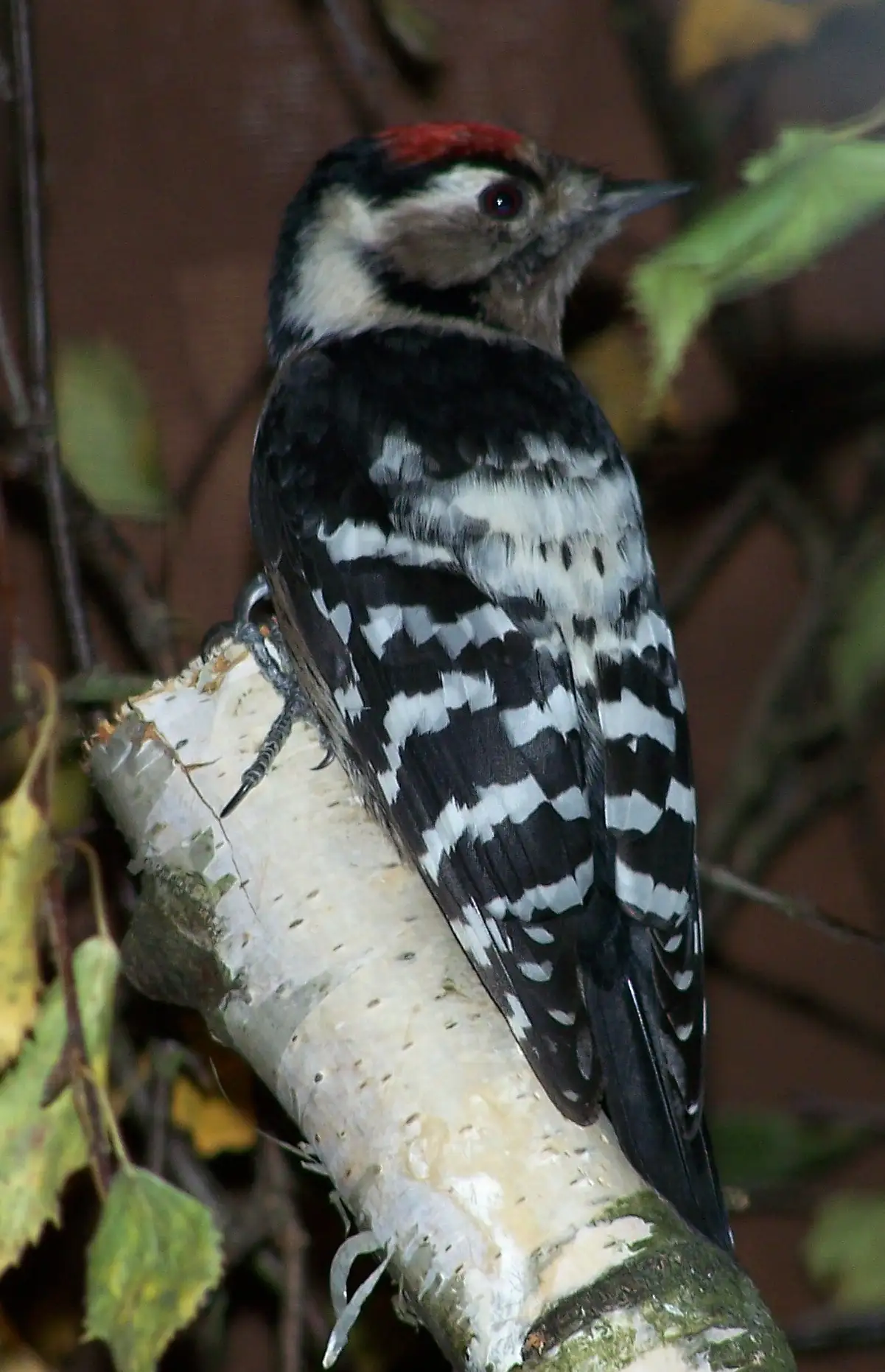
Male Lesser Spotted Woodpecker perched on a birch branch, with red crown and barred backPhoto: T.Voekler, CC BY-SA 3.0Photo 2 of 4
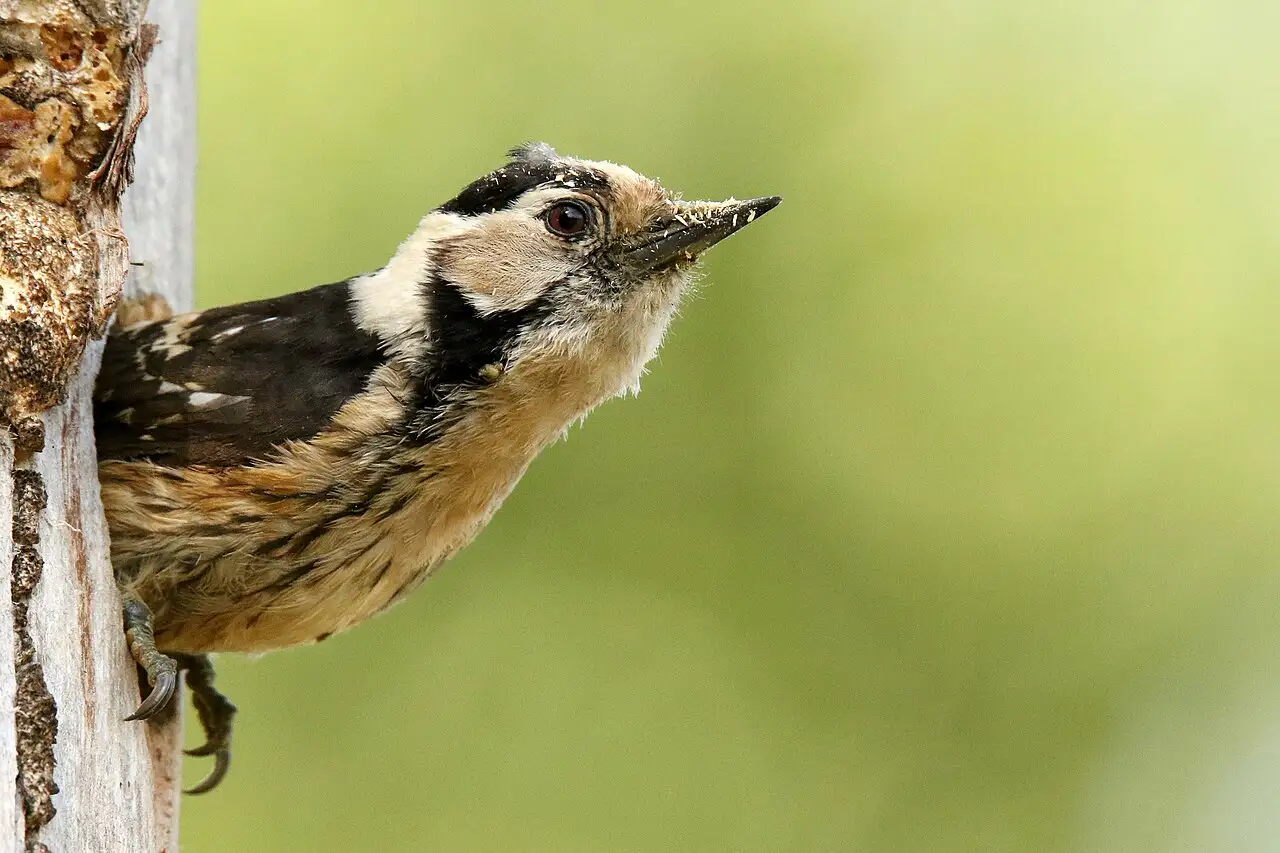
Female Lesser Spotted Woodpecker peering out of the nest hole in a trunk, with no red on the headPhoto: Maurizio Carlini, CC BY-SA 4.0Photo 3 of 4
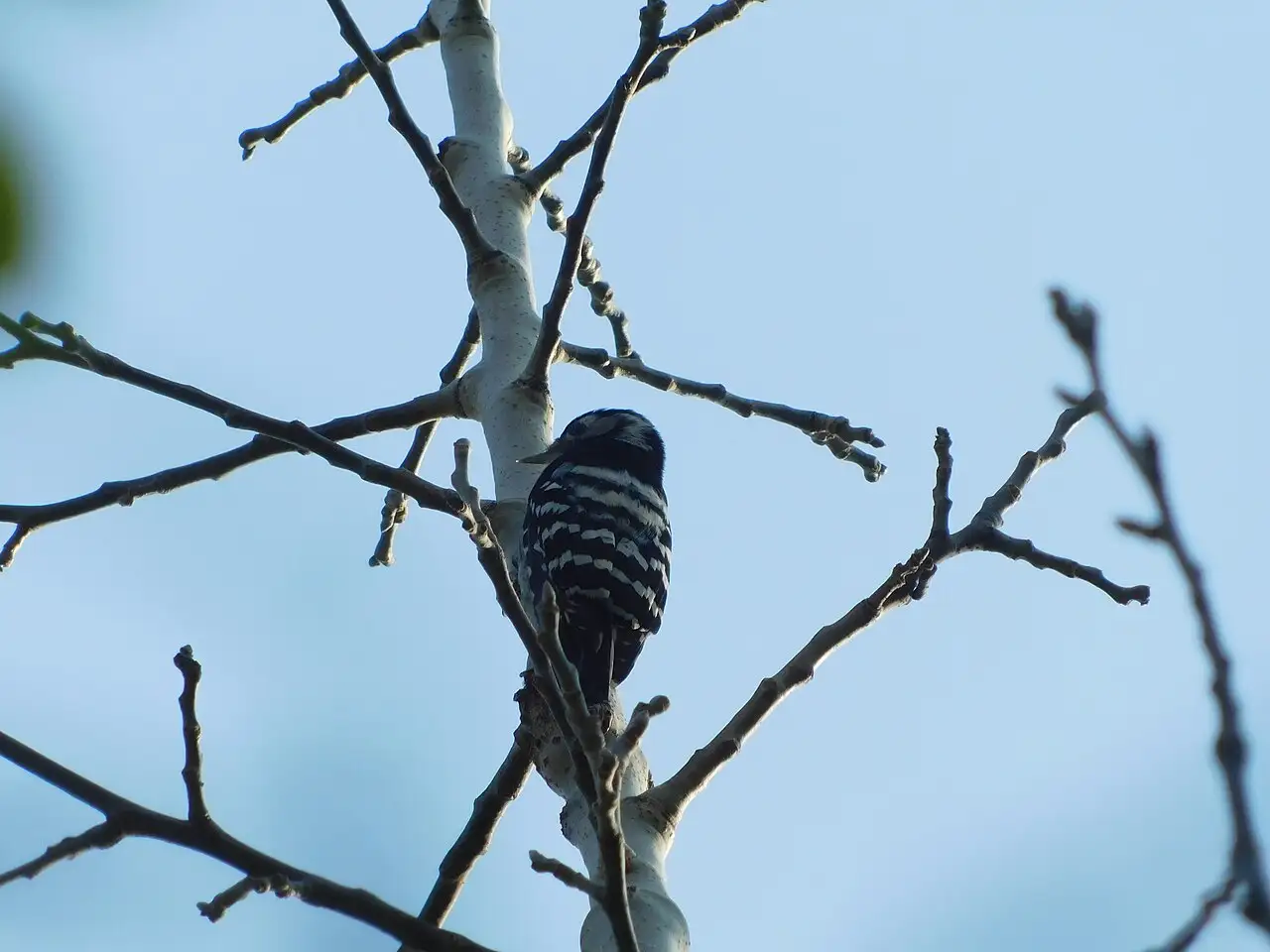
Lesser Spotted Woodpecker from behind on a leafless tree against the sky, with back barred in white and blackPhoto: Nikola Veljković, CC BY-SA 4.0Photo 4 of 4
1 / 4
Identification of the Lesser Spotted Woodpecker
The Lesser Spotted Woodpecker is the smallest European woodpecker, no larger than a chaffinch or a sparrow, with a stocky, short body, rounded head and relatively small bill pointing slightly upwards. Above a combination of white and black dominates, and below a soft creamy tone with a slight mottling towards the flanks. It has a black band on the nape and a poorly developed moustache, and the crown, framed in black, is red in males and dirty white in females. Although its plumage resembles that of other woodpeckers, its tiny size prevents any confusion.
Adult
Back barred in white and black and belly creamy.
Male with red crown; female with dirty-white crown.
Young bird
Like the male, but with the white very dirty and the crown less defined.
Habitat and distribution of the Lesser Spotted Woodpecker
It is well spread across the whole boreal and temperate Palearctic, although in the Mediterranean basin its distribution is fragmentary. It has many races, and that of southern Europe, including the Iberian Peninsula, is «buturlini».
In Spain it lives only on the Peninsula and without a uniform pattern. There are three main cores: one in the north (the Basque Country, La Rioja, Navarre and the upper Ebro), another in Catalonia and a third on the western slope of the Central System (Cáceres, Salamanca and Ávila). The rest is spread in small cores in the riverside groves of the Duero, Asturias, the Sierra de Guadarrama, the Villuercas, the Sierra de San Pedro, the cork oak woods of south-west Badajoz and the Sierra de Aracena.
It is limited to deciduous woods, single-species or mixed: in Spain, from oak woods in the north to chestnut woods, Lusitanian oak woods and mixed holm oak woods in the centre and south, as well as riverside woods, such as ash groves, alder groves and poplar groves. It does not usually go above some 1,400 metres. It is resident throughout its range.
Areas where it is regularly recorded since 2010Squares of about 25 km where it is recorded regularly (occasional passage records are left out). Data from GBIF.org (38,383 records, retrieved October 2026); outline from Natural Earth.
Etymology of the Lesser Spotted Woodpecker
According to Wikipedia, «Dryobates» comes from ancient Greek «druos», «forest», and «batēs», «walker»: the one that walks in the forest. The epithet «minor» is Latin and means «smaller». In other languages it is called «picot garser petit» in Catalan, «picapau pequeno» in Galician, «okil txikia» in Basque and «lesser spotted woodpecker» in English1.
Population of the Lesser Spotted Woodpecker
In the 2021 European Red List of Birds the European breeding population is estimated at between 1,510,000 and 3,020,000 mature individuals, with an increasing trend. In Spain it has not been possible to obtain precise data on its population, nor has the SACRE programme given trend results between 1998 and 2018; that is why the Red Book considers it «Data Deficient».
Its main problem is habitat loss through felling and the replacement of native woodland by plantations of conifers and eucalyptus; the expansion of fruit trees at the expense of riverside groves has taken away many territories in the Levante and Extremadura. It is also harmed by the habit of removing old or fallen trunks from woods, which takes away nests and food. It is proposed to conserve deciduous woods, riverside groves and mature Mediterranean woodland, and not to take out dead trees during breeding1.
Nest of the Lesser Spotted Woodpecker
Once the pair is formed, male and female drill a hole together in a suitable trunk, a task that takes them 12 to 16 days of intense work.
Courtship and breeding of the Lesser Spotted Woodpecker
Its short breeding period runs from May to early July. Males begin courtship with constant calls and drumming throughout the territory, and then display with wings spread and head raised. Laying begins in early May and consists of three to eight white eggs, which both sexes incubate for 11 or 12 days; later pairs may be incubating until late June. Both parents feed the chicks, which leave the nest in the first weeks of July. It does not make second clutches, although it does make replacement ones if the first is lost.
Diet of the Lesser Spotted Woodpecker
Like almost all woodpeckers, it eats almost exclusively larvae and adult insects, above all wood-boring beetles, which it finds in the bark of trees. From time to time it takes fruit and visits feeders. Its tongue, long, thin, pointed and with small bristles, serves it to extract food from cracks, and it clings to trunks with its four toes, two forward and two back, using its tail as a lever.
Curious facts about the Lesser Spotted Woodpecker
Its skull is made of spongy bones, full of small air chambers that cushion the blows1. Its bill is longer below so that most of the impact is absorbed by the lower part of the head1. It is also considered an excellent indicator of the health of our best woodlands1. EURING lists a Lesser Spotted Woodpecker ringed in Hungary that lived 10 years and 3 months.
The Lesser Spotted Woodpecker in Cabañeros
The habitat pages of this website do not mention it, and we have not found any other published source on it in the Park. GBIF.org records 26 observations of the Lesser Spotted Woodpecker in Cabañeros and its surroundings.
Where to see the Lesser Spotted Woodpecker in Cabañeros
In Cabañeros and its surroundings, throughout the year, in riverside groves, oak woods, Lusitanian oak woods and cork oak woods.
When
All year round: it is resident; in spring, when it calls and drums, it is easier to locate.
What time
By day, climbing trunks and branches.
Where
In well-preserved deciduous woods and riverside groves, with old trees.
What to look for
Look for its sparrow size and barred back; listen for its high «kick-kick-kick» and its quick, weak drumming.



 Same family
 Same family
 Same family
 Same season in the park
 Same season in the park
 Same season in the park
 Same season in the park
 Same season in the park






