Very aggressive in the breeding season towards other wrynecks and towards other small woodland birds, which it drives out of their nests
Lifespan
Record of 10 years in the wild according to AnAge; EURING lists a bird ringed in Germany that lived 9 years and 10 months
Conservation status
LC
NT
VU
EN
CR
EW
EX
Global (IUCN)
Least Concern
Spain
Vulnerable (VU) in the 2021 Red Book of the Birds of Spain; on the List of Wild Species under Special Protection, but not in the Spanish Catalogue of Threatened Species
When to see it
Summer visitor
Months of the year when it is present
J
F
M
A
M
J
J
A
S
O
N
D
In Iberia
yes
yes
yes
yes
yes
yes
yes
yes
yes
yes
yes
yes
Song or voice of the Eurasian Wryneck
It produces a nasal, plaintive sound, «ki, ki, ki, ki», which may resemble that of other woodpeckers and even of certain birds of prey. The recording is of a male from Sweden, barely sixteen seconds long; we have normalised it.
SongEurasian Wryneck
0:00 / 0:17
10 kHz5
The sonogram draws the sound: time runs from left to right, and the higher a trace sits, the higher the note.Recording by Robert Petersen, xeno-canto XC1103098 (Norrköping, Suecia) (CC BY-SA 4.0).
Flight of the Eurasian Wryneck
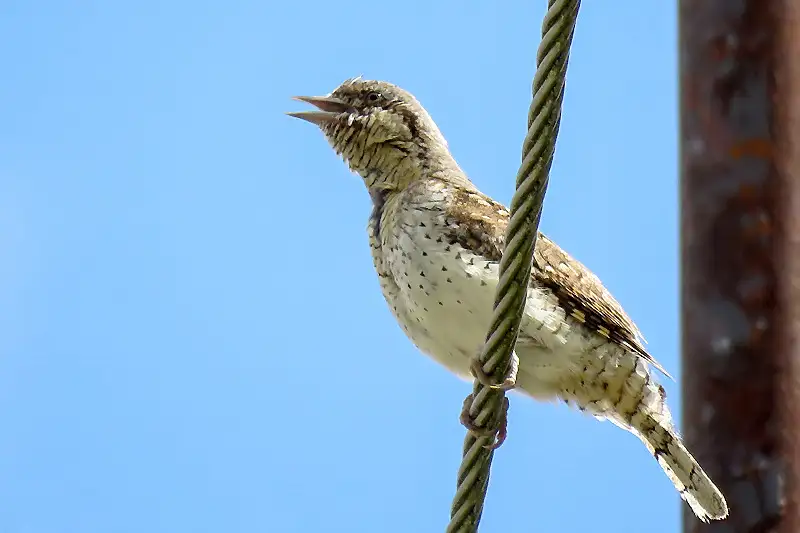
It behaves more like a passerine than a woodpecker: it tends to hop about on the ground and prefers to perch on horizontal branches rather than on trunks.
Flight typeHops about on the ground and prefers horizontal branches
It prefers partly wooded areas, with riverside groves, woodlots or dehesas, and readily settles in orchards, fruit trees, gardens and even urban parks.
It tends to hop about on the ground and prefers to perch on horizontal branches rather than on trunks.
Its diet is based largely on ants in all their life stages, which it catches with its long tongue, probing the galleries under logs or between stones.
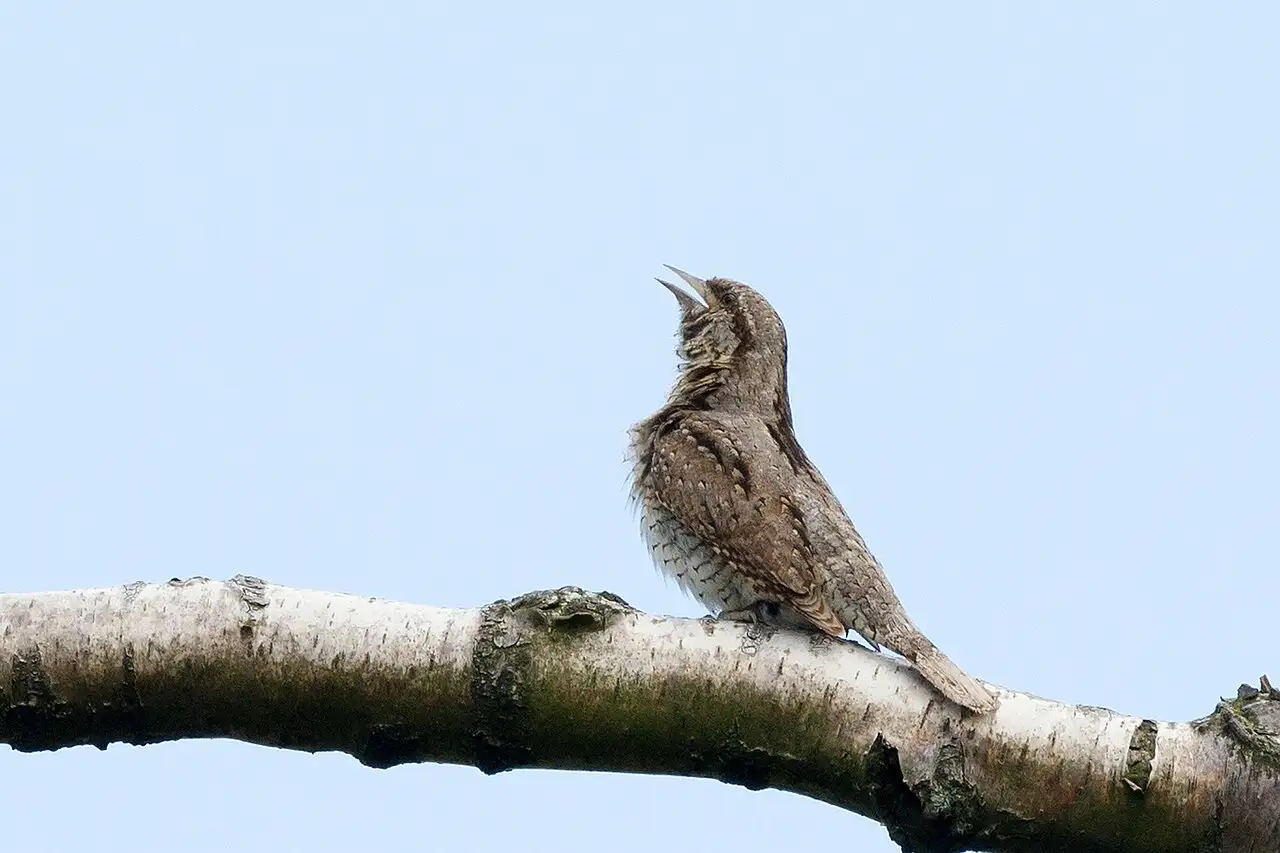
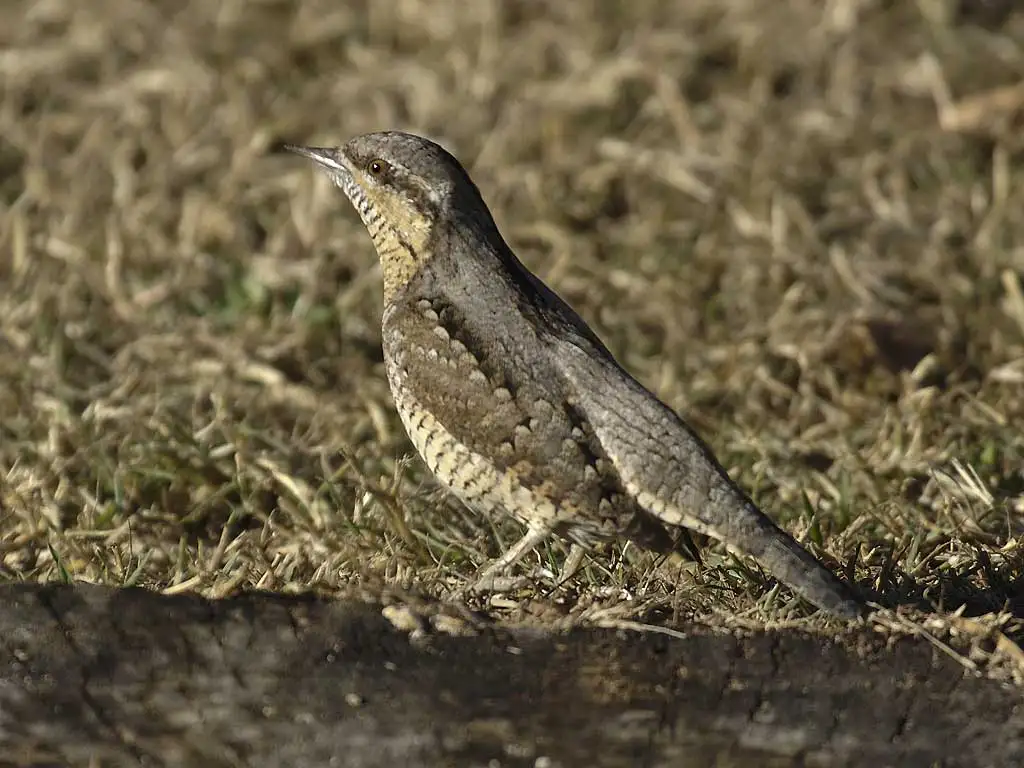
The Eurasian Wryneck is a small woodpecker, of characteristic appearance and with notable morphological peculiarities that set it apart from the other woodpeckers, within whose family it forms a separate subfamily. In contrast to the sharply contrasting colours of other woodpeckers, it wears a very cryptic livery, greyish brown and profusely marked with spots and bars, which at once recalls that of nightjars or nocturnal birds of prey. There is hardly any sexual dimorphism, and its general appearance is quite different from that of other woodpeckers: it resembles a passerine, because it tends to hop about on the ground, prefers to perch on horizontal branches rather than on trunks, and lacks features typical of the group, such as the stiff tail feathers, replaced by long soft feathers, and the stout bill for drilling wood, something it never attempts.
Adult
Greyish brown, with spots and bars.
Long soft tail feathers and a bill too weak to drill.
Habitat and distribution of the Eurasian Wryneck
It is distributed across the Palearctic, from the temperate regions of Europe to the boreal areas and across most of Asia as far as Japan, with isolated breeding areas in North Africa and eastern Asia. Several subspecies have been described.
In Spain it is fairly widely spread over the peninsula and the Balearic Islands, although it is more frequent in the northern half of the Peninsula, a good part of the Levante and Mallorca. It is rare in the Cantabrian strip and Galicia, as well as in the central area, with very scattered populations, while in the south it occurs at some density in a few centres of different Andalusian ranges. It is absent from the Canaries, Ceuta and Melilla.
Like all woodpeckers, it needs some forest cover, but unlike many of them it does not require large expanses of mature forest. It prefers partly wooded areas, with riverside groves, woodlots or dehesas, and readily settles in orchards, fruit trees, gardens and even urban parks.
Unlike other woodpeckers, it is migratory or partly migratory. Birds from northern and central Europe leave the breeding areas to spend the winter in central Africa and southern Asia. In Spain it has partly migratory habits and makes movements of moderate range in winter, although in some areas it is entirely sedentary. The Peninsula and the Balearics are regular passage areas: post-breeding migration takes place between the end of August and early October, sometimes later, and pre-breeding passage is already detected in March.
Areas where it is regularly recorded since 2010Squares of about 25 km where it is recorded regularly (occasional passage records are left out). Data from GBIF.org (41,407 records, retrieved October 2026); outline from Natural Earth.
Etymology of the Eurasian Wryneck
According to Wikipedia, Linnaeus described it in 1758, and the type specimen came from Sweden. The genus «Jynx» comes from the Ancient Greek name of this bird, «iunx», and the epithet «torquilla» is Medieval Latin, derived from «torquere», «to twist», and alludes to the odd head movements that recall those of a snake. In other languages it is called «colltort comú» in Catalan, «peto formigueiro» in Galician, «lepitzulia» in Basque and «Eurasian wryneck» in English1.
Population of the Eurasian Wryneck
In Europe a population of between 1.6 and 3 million individuals has been estimated (European Red List of Birds 2021), of which some 180,000 would be in Spain (Third Atlas of Breeding Birds in Spain 2021). The trend seems to be one of decline: although its range in Spain seems to have grown, the SACRE programme data show falls of around 40% between 1998 and 2018, above all in the Eurosiberian region and the northern Mediterranean one. In Great Britain it was considered almost extinct in the 1990s, and in Sweden and Finland its populations fell by 50% at the end of the 20th century.
Its main problem is the decline in ant populations due to insecticides, which can also poison it, and to agricultural intensification. It is sensitive to the loss of the trees it breeds in and to adverse weather, and the Spanish population has suffered a decline of 41.1% over three generations according to SACRE. As conservation measures it is proposed to include it in the Spanish Catalogue of Threatened Species as Vulnerable, to conserve fallows and farming mosaics with large scattered trees, to protect riverside woods and to restrict pesticides.
Nest of the Eurasian Wryneck
Unlike other woodpeckers it cannot drill wood, so it thoroughly inspects the nooks of its territory until it chooses a suitable hole, usually an old nest of a Great Spotted Woodpecker or a Green Woodpecker, where it lays its eggs without adding any material. Sometimes it also occupies nest boxes, burrows in sandy banks or cavities in walls.
Courtship and breeding of the Eurasian Wryneck
From the start of the breeding season, normally in April or early May, it marks out its territory with calls and looks for a suitable cavity. It lays between 7 and 10 white eggs, which are incubated mostly by the female. The chicks hatch after 12–14 days of incubation and stay in the cavity for about 20–22 days, the time they need to develop fully. It is not unusual for the pair then to lay a second clutch, sometimes even before the first chicks of the season have flown.
Diet of the Eurasian Wryneck
Its diet is based largely on ants in all their life stages, which it catches with its long tongue, probing the galleries under logs or between stones. Besides ants, it eats a good number of other invertebrates, which it catches on the ground, on tree branches and even in flight.
Curious facts about the Eurasian Wryneck
It is considered the most atypical representative of the woodpecker family in Europe: it cannot drill wood and behaves more like a passerine, although it keeps the cave-dwelling habits and the long tongue with which it raids ant nests1. According to Wikipedia, its English name, «wryneck», alludes to its ability to turn the head almost 180 degrees, and when disturbed at the nest it threatens by twisting its neck like a snake and hissing.
The Eurasian Wryneck in Cabañeros
The habitat pages of this website do not mention it, and we have found no other published source about it in the Park. GBIF.org records 11 observations of the Eurasian Wryneck in Cabañeros and its surroundings.
Where to see the Eurasian Wryneck in Cabañeros
In Cabañeros and its surroundings, in spring and summer, in dehesas, riverside groves and orchards with scattered trees.
When
Present in Spain almost all year, with migration passage in March and from the end of August to early October.
What time
By day, on the ground, where it looks for ants.
Where
In partly wooded areas: riverside groves, woodlots, dehesas, orchards and gardens.
What to look for
Look for its cryptic plumage and how it perches on horizontal branches; listen for its nasal «ki, ki, ki, ki».
It is not clearly similar, although it is another woodpecker: the Wryneck is the most atypical of the European woodpeckers, and its song can resemble that of other woodpeckers1.
Photo: T.Voekler, CC BY-SA 3.0
Other birds
Birds related to the Eurasian Wryneck or sharing its habitats in Cabañeros.




 Same family
 Same family
 Same family
 Same season in the park
 Same season in the park
 Same season in the park
 Same season in the park
 Same season in the park





