Monogamous and territorial in the breeding season; it usually accompanies livestock, above all cattle
Lifespan
Record of 9 years and 10 months in the wild according to EURING (a bird ringed in Spain); AnAge gives 8.8 years
Conservation status
LC
NT
VU
EN
CR
EW
EX
Global (IUCN)
Least Concern
Spain
Least Concern (LC) as a breeder in the Red List of Birds of Spain; on the List of Wild Species under Special Protection, but not in the Spanish Catalogue of Threatened Species
When to see it
Summer visitor
Months of the year when it is present
J
F
M
A
M
J
J
A
S
O
N
D
In Iberia
no
no
yes
yes
yes
yes
yes
yes
yes
yes
no
no
Breeding season
no
no
yes
yes
yes
yes
yes
yes
no
no
no
no
Song or voice of the Western Yellow Wagtail
Its very characteristic call is made up of two high, plaintive notes, «tsi-i, pi-ip», and from it derives a modest song of two syllables and a somewhat grating timbre, «sriiii-srrriii». The recording is of an Iberian Yellow Wagtail in the Guadalquivir marshes.
It looks for its food by pecking on the ground, dry or waterlogged, and now and then chases insects on foot or in flight.
Flight typeOccasional chases of insects in flight
Tied to open, damp areas, such as waterlogged meadows, marshes and rice fields, it is usually associated with livestock, above all cattle, hence its name.
It searches for and pecks at larvae and adults of mosquitoes, flies and bugs on the ground, dry or waterlogged, with occasional chases on foot and in flight.
Its call is two high, plaintive notes, «tsi-i, pi-ip».
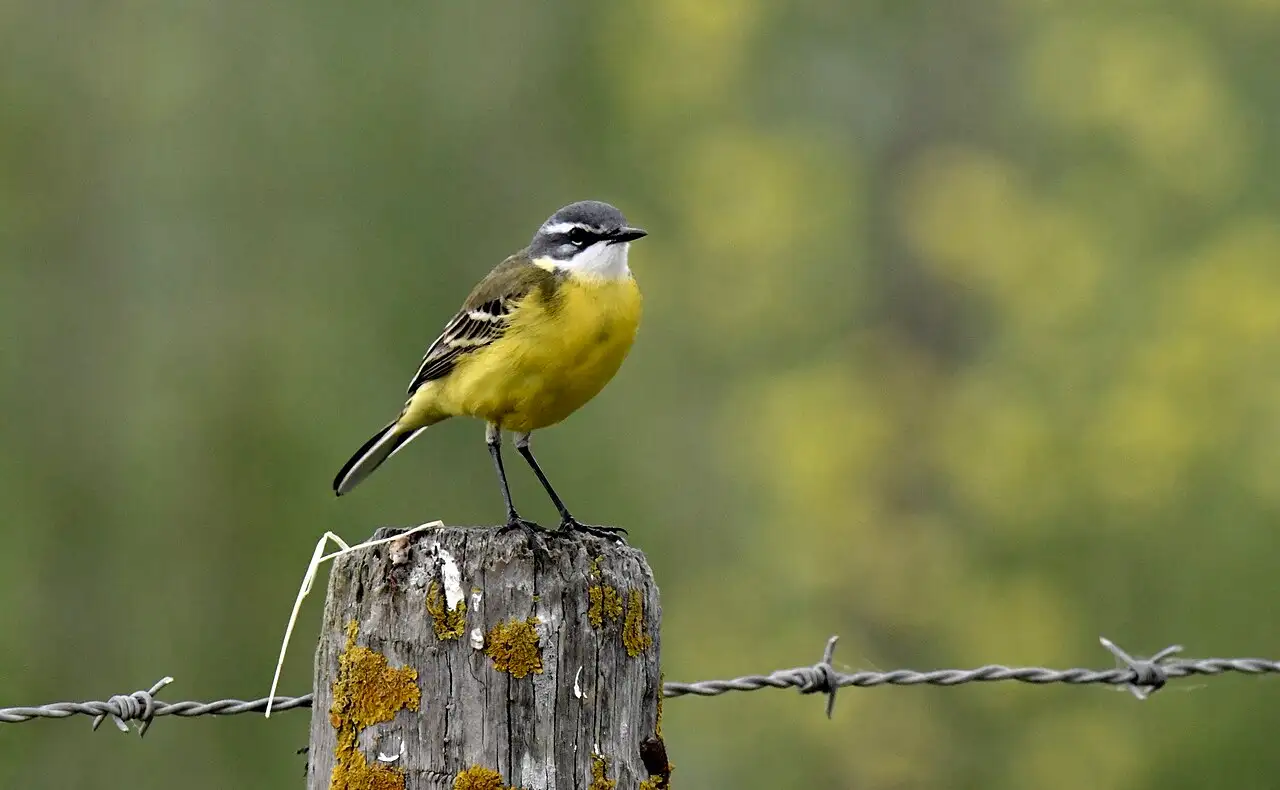
Male Western Yellow Wagtail perched on a wooden post with barbed wire, with yellow belly and long tailPhoto: Luiz Lapa from Oeiras, Portugal, CC BY 2.0Photo 3 of 4
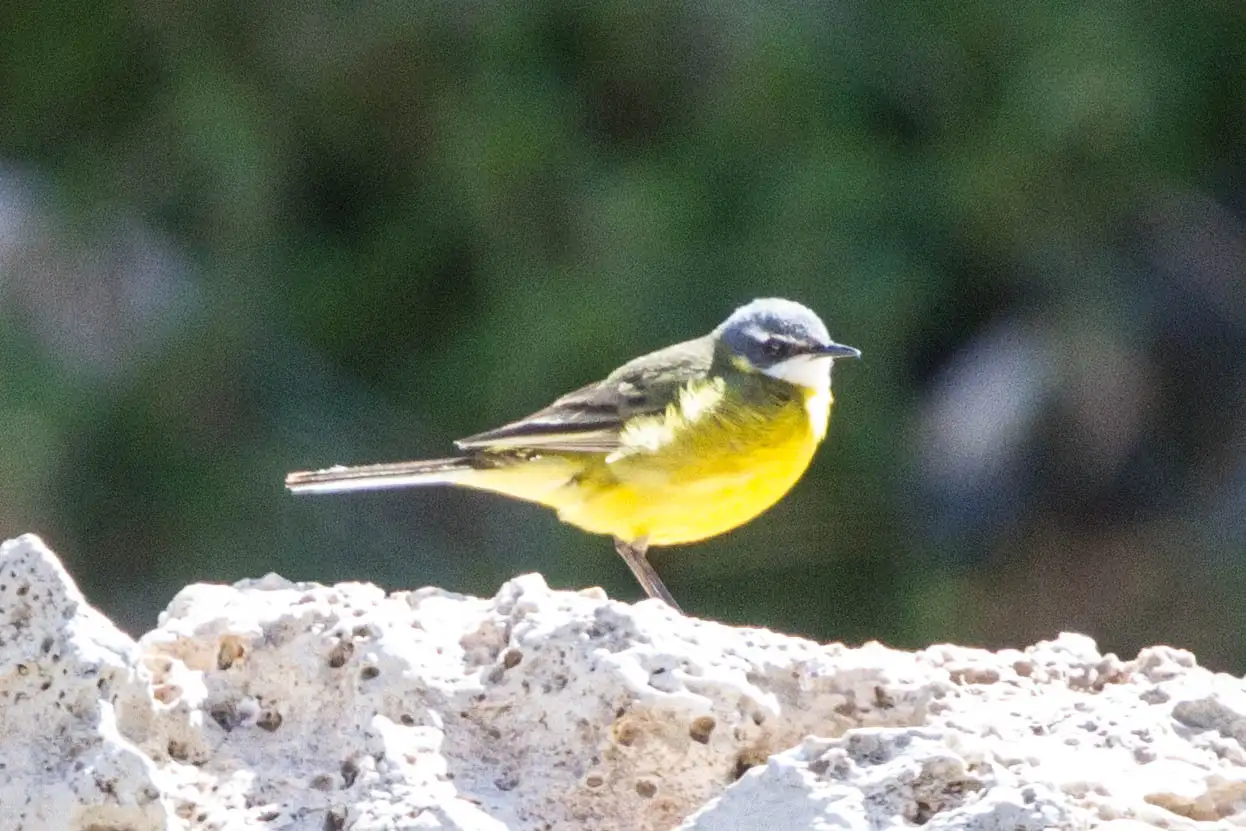
Male Iberian Yellow Wagtail on a white rock, with grey head, white throat and olive-green backPhoto: Ron Knight, CC BY 2.0Photo 4 of 4
1 / 4
Identification of the Western Yellow Wagtail
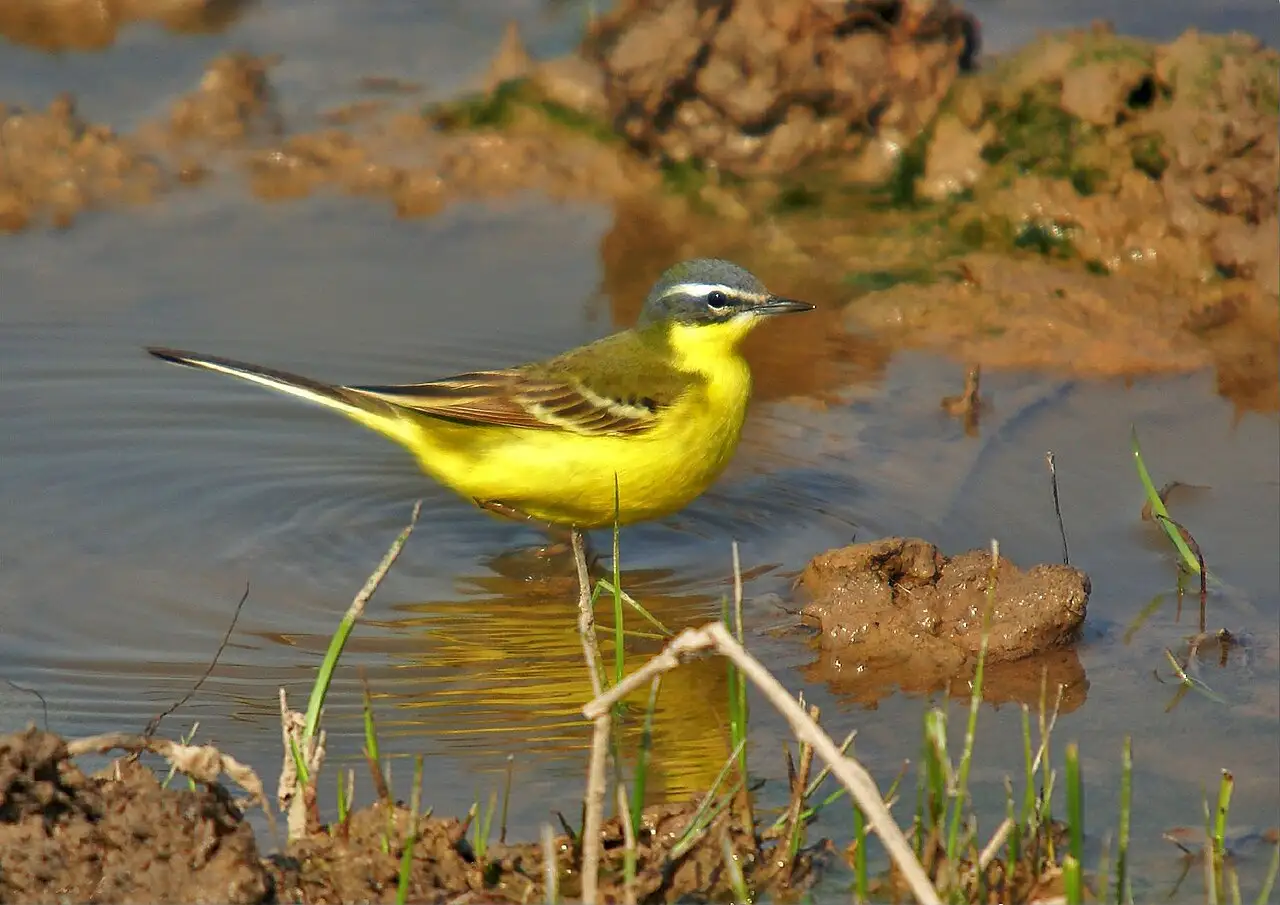
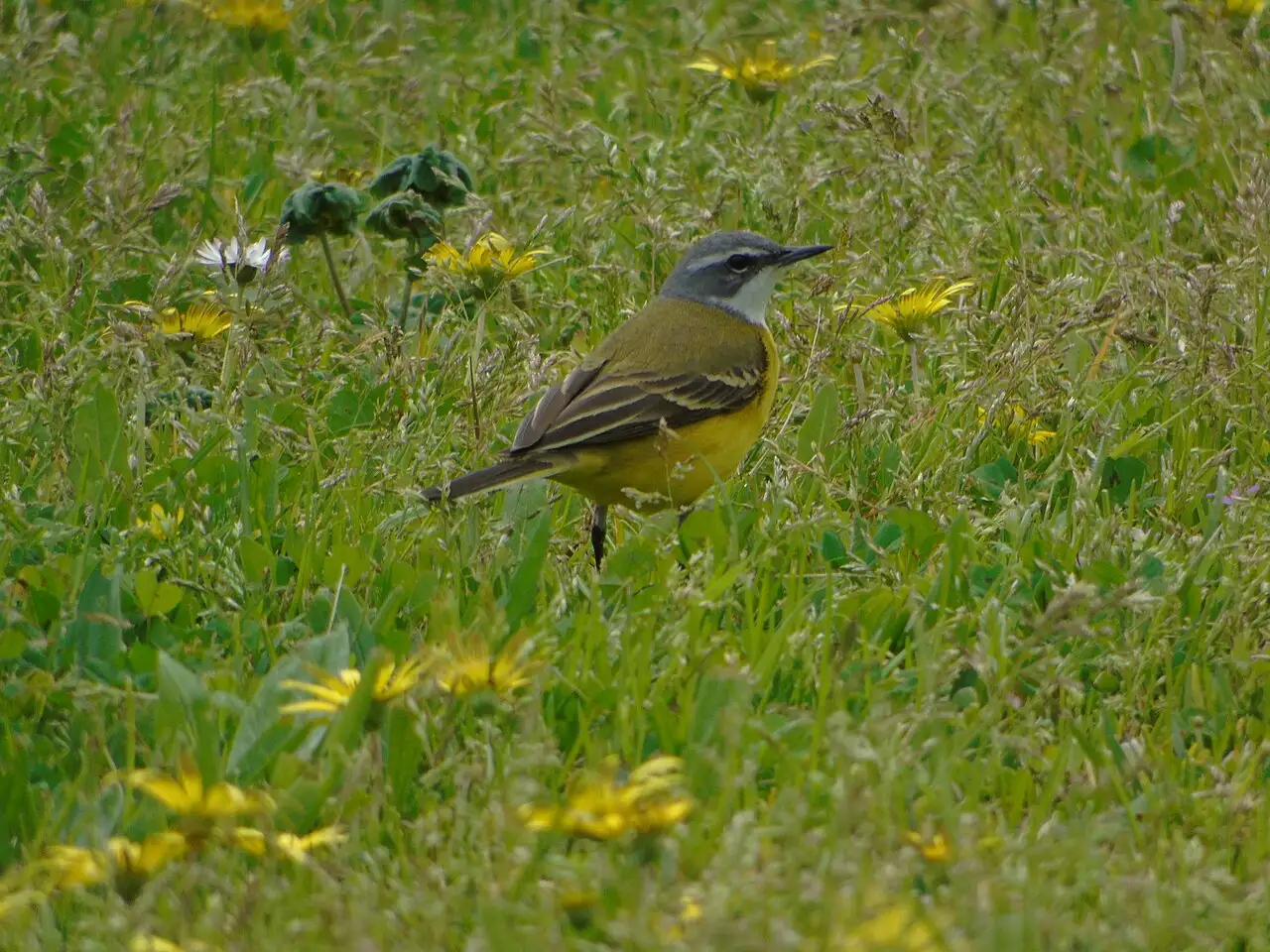
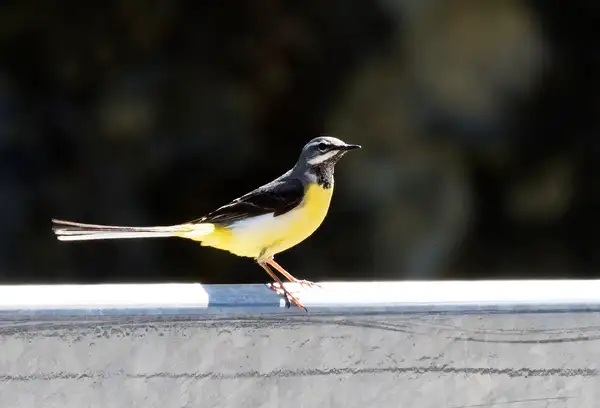
It is the most compact, greenish and shortest-tailed of the Spanish wagtails. The male in breeding plumage of the Iberian subspecies, «iberiae», has the back and rump olive green, the folded wings with black feathers edged in white and the underparts very yellow. The tail is long and black, with white outer feathers, and the legs and bill are black. The head is blue-grey, with white throat and eyebrow and the eye and ear regions dark. It is one of the Spanish birds with the greatest variety of plumages: five other subspecies pass through Spain, told apart mainly by the males’ heads, and there are also hybrids. Females are less colourful, with a greenish-grey head and faintly yellow underparts.
Adult
Male: blue-grey head with white eyebrow and throat, olive-green back and intense yellow belly.
Female: greenish-grey head and faintly yellow underparts.
In autumn males look like females, and females turn brownish, with an incomplete collar on the breast.
Young bird
Like females, but greener.
Habitat and distribution of the Western Yellow Wagtail
It breeds in the temperate and cold latitudes of Eurasia and in part of Alaska, and almost the whole population winters in sub-Saharan Africa and southern Asia. It has enormous geographical variation, with 17 recognised subspecies, and some recent studies propose splitting it into three species, although its classification is not yet settled.
In Spain the subspecies «iberiae» breeds, on the Peninsula and in the Balearics; in Catalonia there is a core of hybrids between «iberiae» and «cinereocapilla». In the breeding season it is spread across four main cores: the largest, in the Duero basin, and the other three, on the Cantabrian-Galician coast, the lower Guadalquivir and the Gulf of Cádiz, and the Mediterranean and Balearic coast. In the rest of the Peninsula it appears scattered, with notable absences across much of Extremadura, Andalusia, the Ebro valley and Catalonia. On passage, above all in autumn, it is seen throughout the territory, the Canaries included.
It lives tied to open, damp areas: waterlogged meadows and pastures, marshes, marshy zones, estuaries, saltmarshes, irrigated land, streams between dry-farmed land and rice fields. It prefers plains and avoids mountains: it breeds from sea level to a little over 1,000 metres, but is rare above 800.
It is the only summer-visiting wagtail in Spain. The first arrive in March, sometimes in February, and stay until October, sometimes November. The spring passage is centred in April, and the autumn one, more noticeable, in September. Spanish birds winter in the Sahel and perhaps in Morocco.
Areas where it is regularly recorded since 2010Squares of about 25 km where it is recorded regularly (occasional passage records are left out). Data from GBIF.org (207,241 records, retrieved October 2026); outline from Natural Earth.
Etymology of the Western Yellow Wagtail
According to Wikipedia, «Motacilla» is the Latin name for the White Wagtail; it is really a diminutive of «motare», «to move from side to side», but since the Middle Ages «cilla» was understood as «tail». Its Spanish name is due to its habit of accompanying cattle, and lists its names in other languages: «cuereta groga» in Catalan, «lavandeira amarela» in Galician, «larre-buztanikara» in Basque and «western yellow wagtail» in English1.
Population of the Western Yellow Wagtail
In the 2021 European Red List of Birds the European breeding population is estimated at between 26,700,000 and 36,000,000 mature individuals, with a decreasing trend. The Spanish breeding population, relatively small, is estimated at 1,982,487 individuals, a good part in Castilla y León and Andalusia. The SACRE programme shows a moderate increase between 1998 and 2018, with contrasts: it grows in the southern Mediterranean region and falls in the Alpine one.
No specific threats are known, but habitat loss affects it, above all the alteration of wetlands and livestock pastures, and pollution of the farming and aquatic environment. The expansion of irrigation, on the other hand, may benefit it.
Nest of the Western Yellow Wagtail
It is built almost exclusively by the female: a small cup of dry grass on the ground, sheltered by some bush or shrub.
Courtship and breeding of the Western Yellow Wagtail
The breeding period runs from March to August, with one or two clutches, and in that period it is monogamous and territorial. It lays four to six dirty-white eggs with abundant dark spots, which both sexes incubate for some 12 days. After 10–14 days of parental care, the chicks leave the nest, although they stay for several weeks in the family territory. It is one of the birds in whose nest the Common Cuckoo lays.
Diet of the Western Yellow Wagtail
It is strictly insect-eating and eats a great variety of terrestrial and aquatic species, above all larvae and adults of mosquitoes, flies and bugs. Most often it looks for them by pecking on the ground, dry or waterlogged, and now and then chases them on foot or in flight. Its habit of going with livestock, above all cattle, is what gave it its name.
Curious facts about the Western Yellow Wagtail
It is a living example of evolution and the formation of new species: besides the Iberian race, five other subspecies and some hybrids pass through Spain1. EURING lists a Western Yellow Wagtail ringed in Spain that lived 9 years and 10 months, somewhat more than AnAge gives (8.8 years).
The Western Yellow Wagtail in Cabañeros
The habitat pages of this website do not mention it, and we have not found any other published source on it in the Park. GBIF.org records 41 observations of the Western Yellow Wagtail in Cabañeros and its surroundings.
Where to see the Western Yellow Wagtail in Cabañeros
In Cabañeros and its surroundings, from March to October, in damp meadows and pastures with livestock.
When
From March to October: it is a summer visitor, and in September many pass on migration.
What time
By day, looking for insects on the ground.
Where
In waterlogged meadows and pastures, banks of streams and irrigated land, often among the cows.
What to look for
Look for the intense yellow belly and the blue-grey head with the white eyebrow; listen for its «tsi-i».



 Same family
 Same family
 Same family
 Same family
 Same order
 Same order
 Same order
 Same order






