Wingspan compared with a person with arms outstretched.
Length
34–38 cm
Wingspan
53–59 cm
Weight
260–395 g
Social life
Pairs form mainly in spring, sometimes in winter; the chicks leave the nest within hours and feed themselves with their mother
Lifespan
Record of 24 years in the wild according to EURING (a bird ringed in the Netherlands); AnAge gives 27.1 years
Conservation status
LC
NT
VU
EN
CR
EW
EX
Global (IUCN)
Least Concern
Spain
Least Concern (LC) as a winter visitor and Data Deficient (DD) as a breeder in the 2021 Red Book of the Birds of Spain; not on the List of Wild Species under Special Protection or in the Spanish Catalogue of Threatened Species
When to see it
Winter visitor
Months of the year when it is present
J
F
M
A
M
J
J
A
S
O
N
D
In Iberia
yes
yes
yes
yes
no
no
no
yes
yes
yes
yes
yes
Song or voice of the Eurasian Teal
The male gives a short, very musical, metallic whistle. The female quacks a faint, nasal «piiht pat pat», with the first note higher and the others descending. In the recording the calls of males and females of a group are heard; we have filtered it to reduce the background noise.
It rises easily from the water and its flight is extraordinarily agile, with frequent turns and sudden changes of direction.
Flight typeExtraordinarily agile, with frequent turns and sudden changes of direction
It rises easily from the water; in winter it occupies small wetlands, natural or artificial, of fresh or brackish water.
Its flight is extraordinarily agile, with frequent turns and sudden changes of direction.
It feeds in shallow water on aquatic plants, seeds and rhizomes, probing the bottom with its bill as it tips up or walks with its head half sunk in the mud.
Photo gallery of the Eurasian Teal
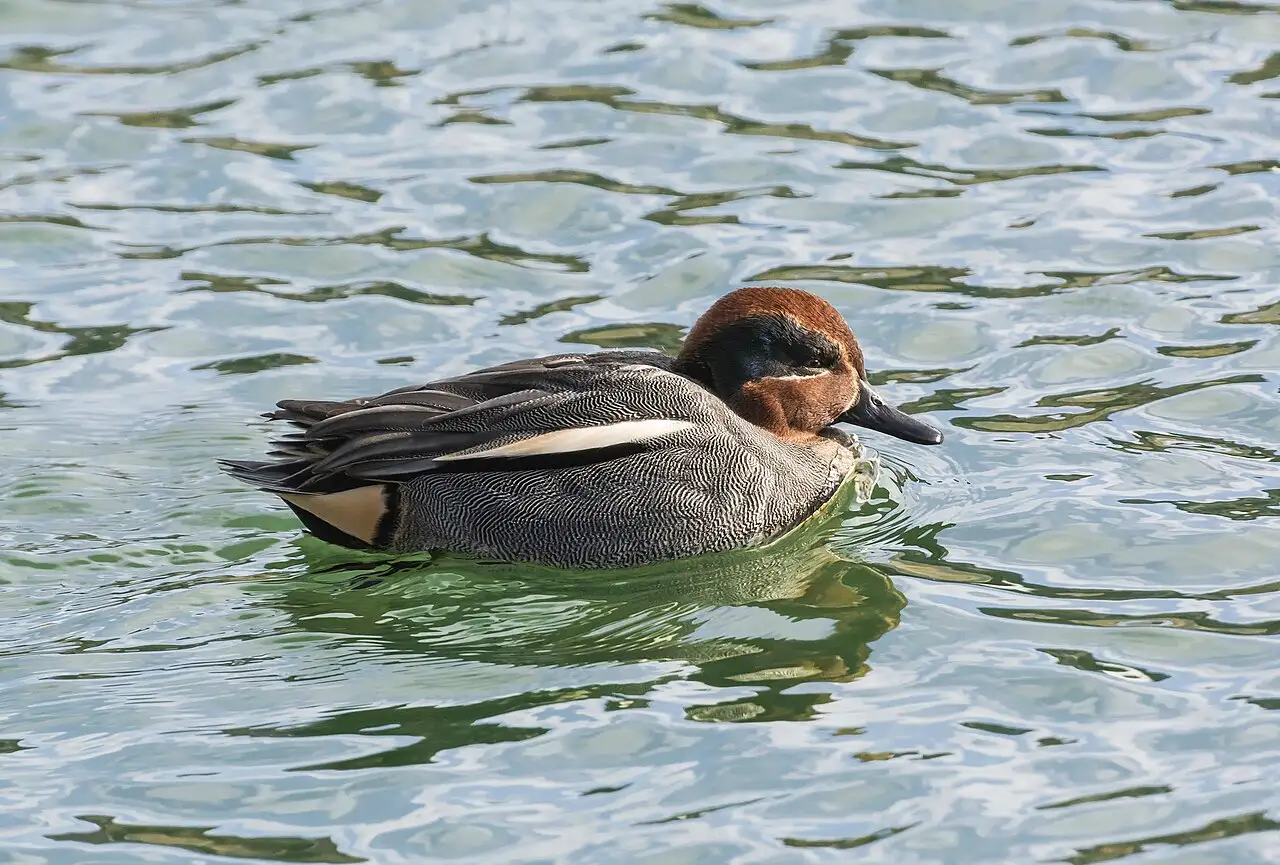
Male Eurasian Teal swimming, with chestnut head, green mask, grey flanks and the white stripe on the sidePhoto: Jacek Halicki, CC BY-SA 4.0Photo 1 of 4
Male Eurasian Teal standing in the water flapping its wings, with green mask and yellow-spotted rumpPhoto: Hobbyfotowiki, CC0Photo 2 of 4
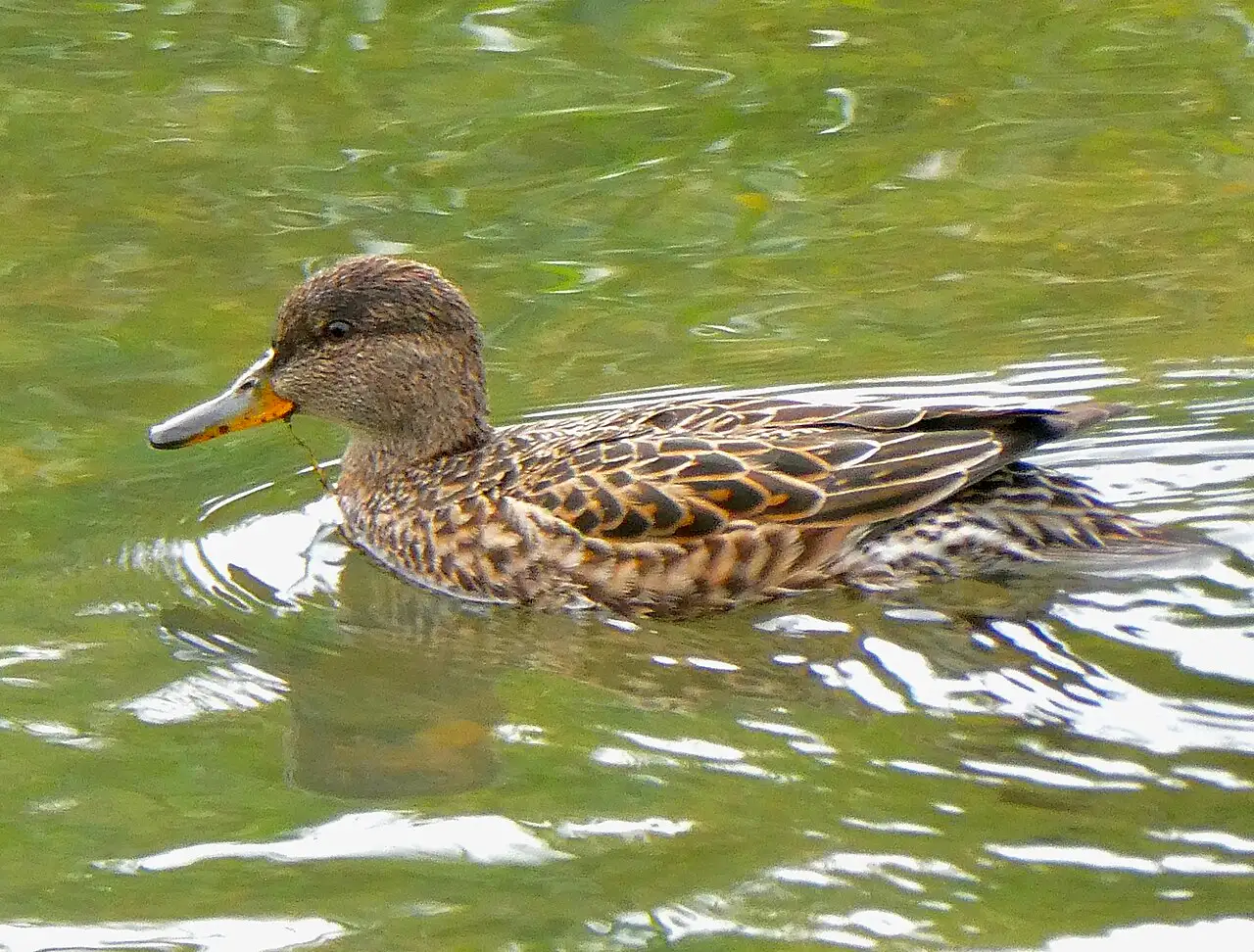
Female Eurasian Teal swimming, with mottled brownish plumagePhoto: KKPCW, CC BY-SA 4.0Photo 3 of 4
Two Eurasian Teal flying low over the sea, with the green speculum in viewPhoto: Marton Berntsen, CC BY-SA 4.0Photo 4 of 4
1 / 4
Identification of the Eurasian Teal
Its most characteristic feature is its small size: it is the smallest of the ducks that frequent our wetlands. Males in breeding plumage have a lovely pattern, with the chestnut head crossed by a striking green mask edged with a yellowish line. The breast is creamy spotted with dark and the flanks grey and finely vermiculated, with a white stripe that corresponds to the scapulars; the speculum is bright green, and on the black rump yellow side bands stand out. Females are told from those of other ducks by their size, but are brownish, like them, and their only note of colour is the green speculum.
Adult
Male: chestnut head with green mask, grey flanks with a white stripe and black rump with yellow bands.
Female: brownish, with the green speculum.
Young bird
Brownish, like the female.
Habitat and distribution of the Eurasian Teal
It is a Palaearctic species of wide distribution, occupying much of Eurasia, from Iceland to Kamchatka, although it is quite rare towards the south, where it has only small breeding cores in Mediterranean countries such as France, Spain or Italy.
In Spain it is very scarce in the breeding season. It has bred sporadically at some sites, and the only places it uses regularly are the banks of the River Louro (Pontevedra), Lake La Ercina (Asturias), the glacial lagoons of the Cebollera (La Rioja) and Urbión (Soria) sierras, the Tablas de Daimiel and their surroundings and the lagoons of south-eastern Albacete. In winter, on the other hand, it is quite habitual: it is spread across the whole Peninsula and both archipelagos, and is most abundant in the Guadalquivir marshes and the Ebro delta.
In winter it occupies small wetlands, natural or artificial, of fresh or brackish water, preferably rich in nutrients. To breed it usually chooses small glacial lagoons with abundant marsh vegetation, although any small stretch of water with good plant cover will do.
Its migratory behaviour is complex: there are resident populations, but most are migratory and change route from one year to the next according to the weather. Birds from northern Europe, Russia and even Siberia arrive in Spain, generally in December, and in very cold winters also from western Europe.
Areas where it is regularly recorded since 2010Squares of about 25 km where it is recorded regularly (occasional passage records are left out). Data from GBIF.org (147,729 records, retrieved October 2026); outline from Natural Earth.
Etymology of the Eurasian Teal
According to Wikipedia, «Anas» is the Latin word for «duck», and «crecca» comes from «kricka», the Swedish name of this species: it is an onomatopoeia, the duck that says «cryc», like its names in Norwegian, Danish or German. Linnaeus described it in 1758. In other languages it is called «xarxet comú» in Catalan, «cerceta común» in Galician, «zertzeta arrunta» in Basque and «Eurasian teal» in English1.
Population of the Eurasian Teal
The 2021 European Red List of Birds estimates a population of 1.04 to 1.64 million Eurasian Teal, with an increasing trend. In Spain it is a regular, abundant winter visitor. As a breeder it is very scarce: in 2007 14 active pairs were found, but breeding was not confirmed, and some studies based on that census give a minimum population of 100 birds and an average of 2,000. That is why the 2021 Red Book of the Birds of Spain considers it Least Concern as a winter visitor and Data Deficient as a breeder.
The wintering population seems to have recovered from the decline of the 1990s and 2000s. In the mountains it is harmed by disturbance from leisure activities and excess cattle, which put nests at risk; in other areas, the silting up of lagoons, eutrophication and changes in vegetation.
Nest of the Eurasian Teal
It is built by the female: a small hollow with leaves, grass and other plant remains, on the ground or, exceptionally, on some bush, but always near water and well sheltered.
Courtship and breeding of the Eurasian Teal
Pairs generally form in spring, although sometimes they do so in winter. The female lays 8 to 11 eggs, sometimes up to 15, smooth and pale yellow, and incubates them for 21–23 days. The chicks leave the nest within hours to feed themselves in their mother’s company, and fly after 25–30 days of development.
Diet of the Eurasian Teal
It eats mainly in shallow water all kinds of plant matter, such as aquatic plants, seeds or rhizomes, which it looks for by sweeping the bottom with its bill while tipping up, or walking with its head half sunk in the mud and moving it from side to side. In summer it adds small invertebrates to its diet, such as molluscs, crustaceans, worms or larvae of aquatic insects.
Curious facts about the Eurasian Teal
It is a species quite sensitive to human disturbance and habitat alteration1. One of the few places in Spain where it breeds regularly is the Tablas de Daimiel, also in Ciudad Real. EURING lists a teal ringed in the Netherlands that lived 24 years; AnAge gives a higher figure, 27.1 years.
The Eurasian Teal in Cabañeros
The habitat pages of this website do not mention it, and we have not found any other published source on it in the Park. GBIF.org records 30 observations of the Eurasian Teal in Cabañeros and its surroundings.
Where to see the Eurasian Teal in Cabañeros
In Cabañeros and its surroundings, in winter, in ponds, reservoirs and small vegetated wetlands.
When
In winter: winter visitors usually arrive in December and stay until spring.
What time
By day, on the water or on muddy shores.
Where
In small wetlands, ponds and reservoir shores with shallow water.
What to look for
Look for its small size and the male's green mask; in flight, the sudden turns.






 Same family
 Same family
 Same family
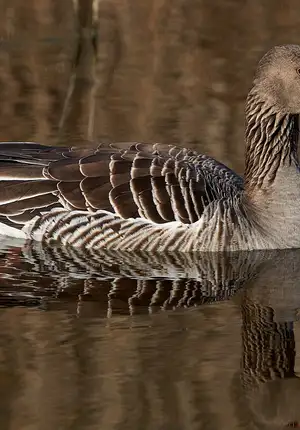 Same family
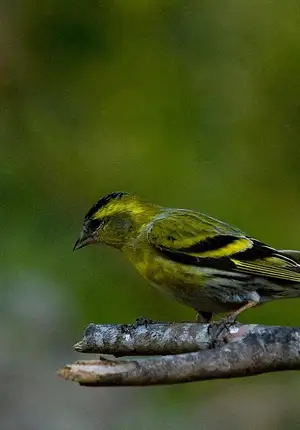 Same season in the park
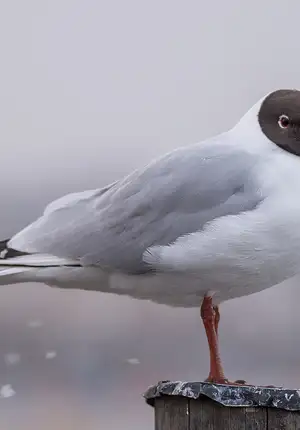 Same season in the park
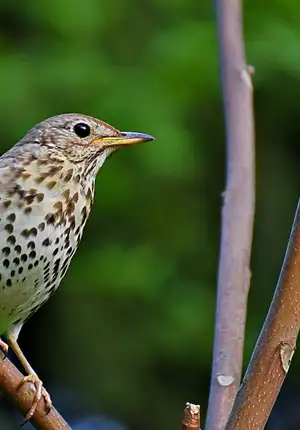 Same season in the park
 Same season in the park






