Wingspan compared with a person with arms outstretched.
Length
42–50 cm
Wingspan
71–85 cm
Weight
610–890 g
Social life
In Spain it is exclusively a winter visitor and forms a notable contingent spread along the coast and over inland lagoons and reservoirs
Lifespan
Record of 25 years and 3 months in the wild according to EURING (a bird ringed in Great Britain and Ireland and shot)
Conservation status
LC
NT
VU
EN
CR
EW
EX
Global (IUCN)
Least Concern
Spain
Near Threatened (NT) in the 2021 Red Book of the Birds of Spain; not on the List of Wild Species under Special Protection
When to see it
Winter visitor
Months of the year when it is present
J
F
M
A
M
J
J
A
S
O
N
D
In Iberia
yes
yes
yes
no
no
no
no
no
no
yes
yes
yes
Song or voice of the Eurasian Wigeon
Males give a very characteristic whistle, «tuiiuuu», from which the species gets its common name in Spanish: a high initial pitch that suddenly turns muffled. Females utter a very low quack. The recording is from the YouTube channel Aves Córdoba and has background noise; we have filtered it and raised the volume.
Male's whistleEurasian Wigeon
0:00 / 0:29
10 kHz5
The sonogram draws the sound: time runs from left to right, and the higher a trace sits, the higher the note.Recording by Aves Córdoba, Canal de YouTube «Aves Córdoba», vídeo «Silbón europeo» (Vídeo de YouTube, con atribución).
Flight of the Eurasian Wigeon
Both males and females show a striking white wing patch, very visible in flight.
Flight typeWith a striking white wing patch, very visible in flight
It is exclusively a winter visitor in our country: it arrives from the end of summer, peaking in October, and heads back to the breeding areas in mid-March.
Both males and females show a striking white wing patch, very visible in flight.
Basically vegetarian, it grazes on the water's edge or in flooded meadows, and sometimes puts its head and neck into the water to reach submerged plants.
Photo gallery of the Eurasian Wigeon
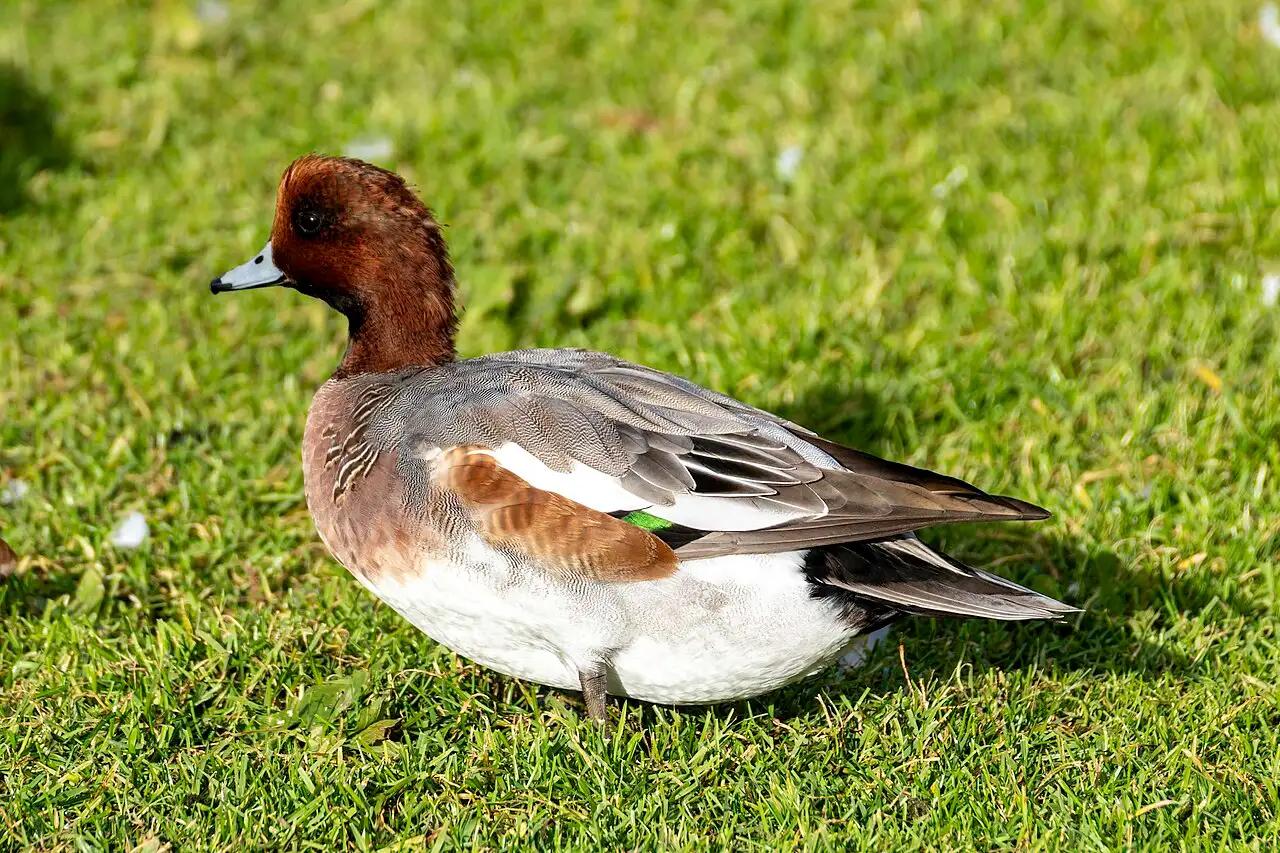
Male Eurasian Wigeon perched on the grass, with chestnut head, small greyish bill, pink breast and black rearPhoto: Bene Riobó, CC BY-SA 4.0Photo 1 of 4
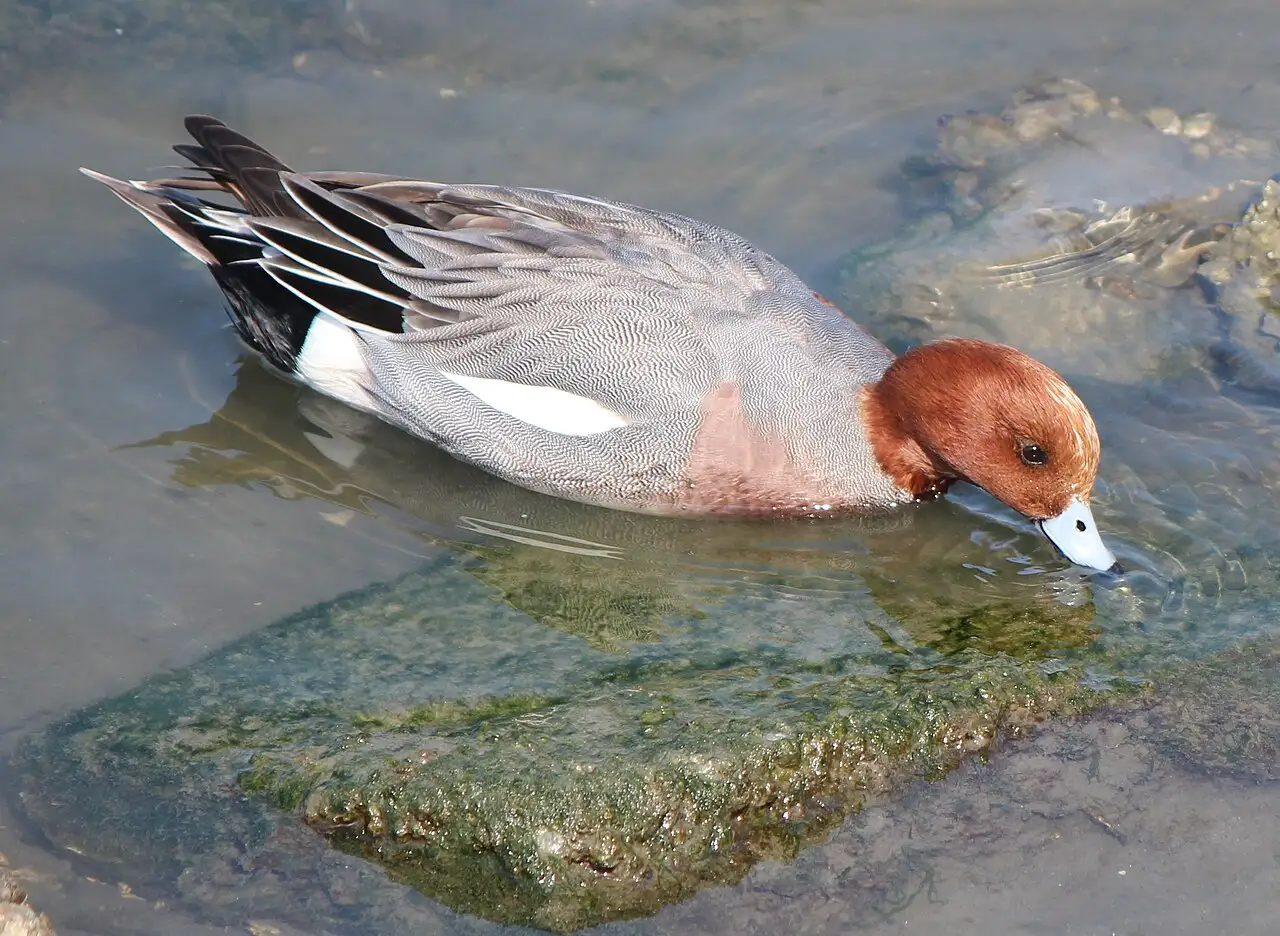
Male Eurasian Wigeon feeding in shallow water over some stones, with chestnut head and the white and green speculum in viewPhoto: Alpsdake, CC BY-SA 3.0Photo 3 of 4
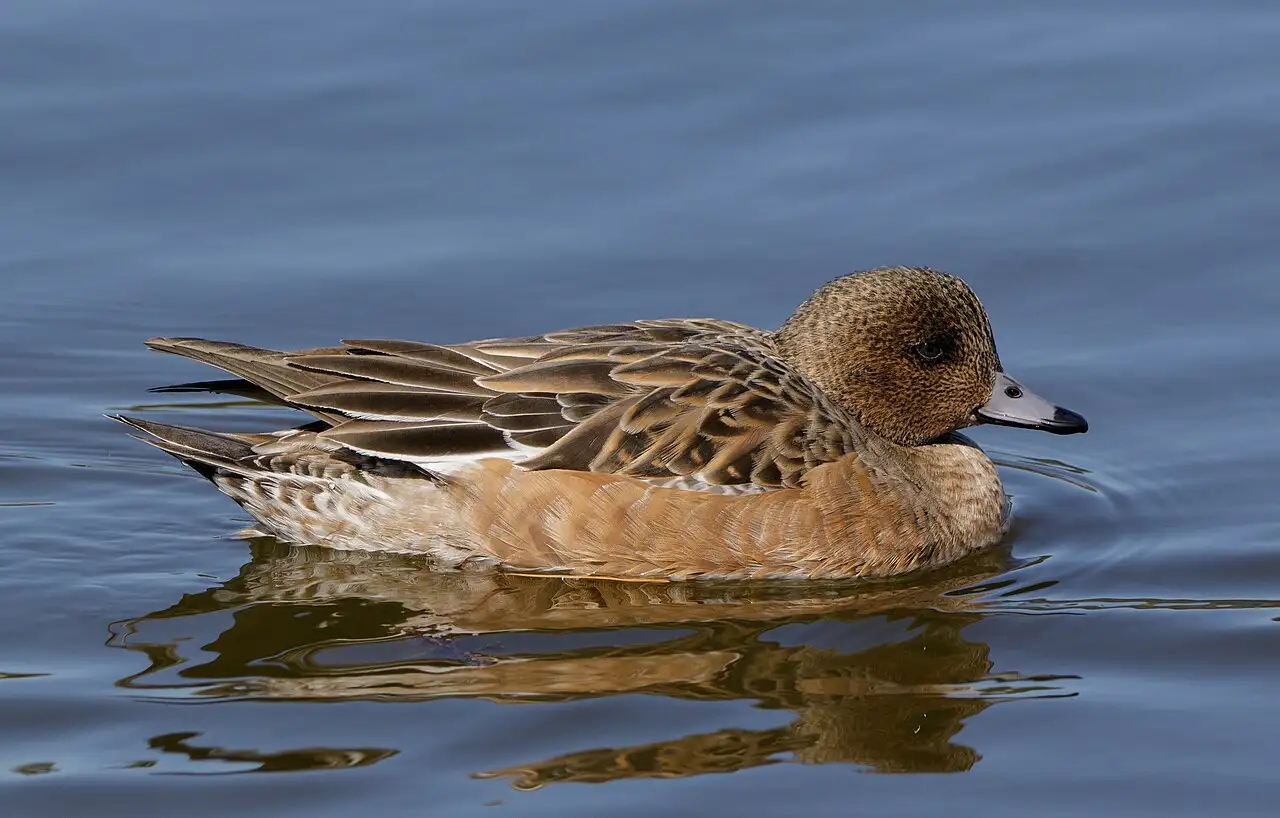
Female Eurasian Wigeon swimming, with slightly reddish brownish plumage and a small greyish billPhoto: Laitche, CC BY-SA 4.0Photo 4 of 4
1 / 4
Identification of the Eurasian Wigeon
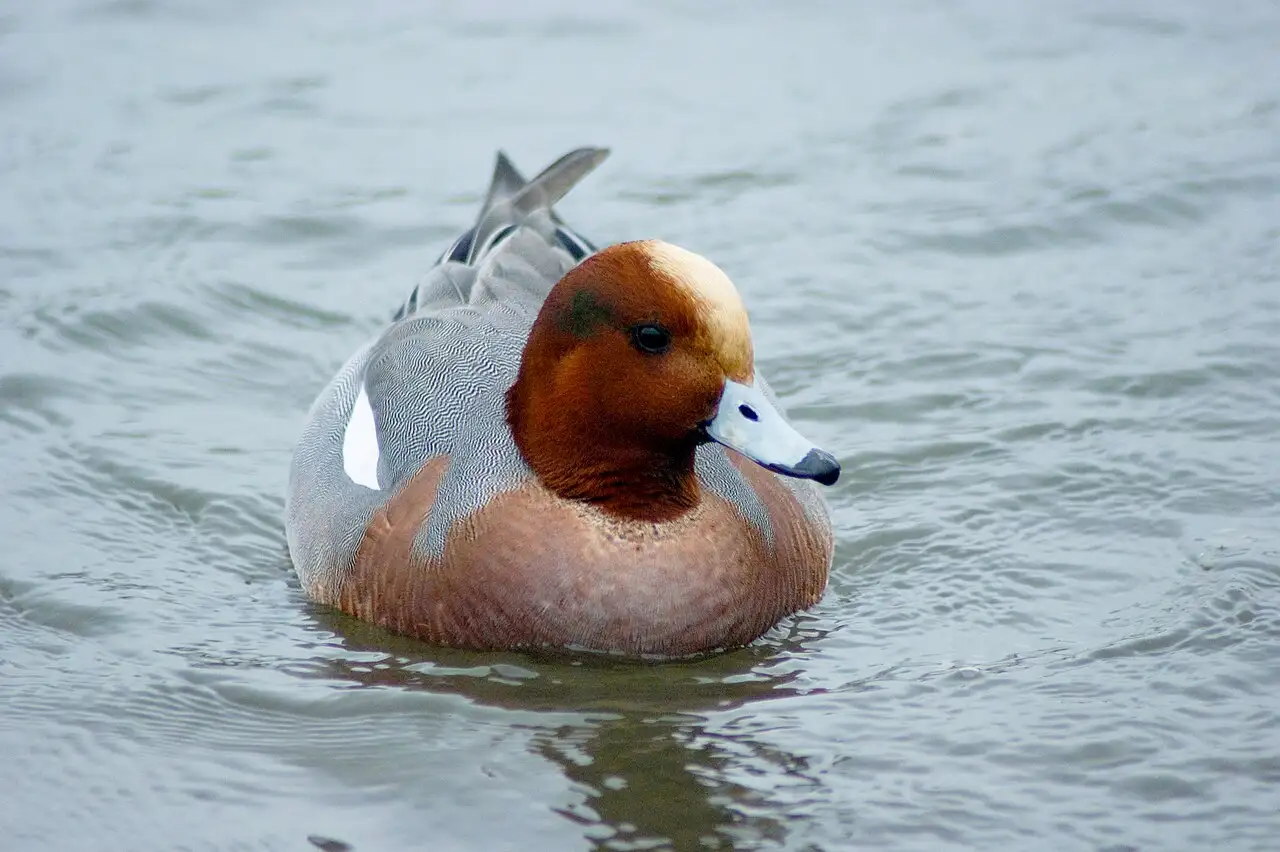
The Eurasian Wigeon is a medium-sized, compact-looking duck, with a short neck, a slightly pointed tail and a rather small bill, greyish in both sexes and somewhat darker in females. The male in breeding plumage wears a showy livery in which the chestnut head and neck stand out, with the forehead and crown creamy yellow, the breast pink and the pale grey back finely vermiculated. The underparts are whitish, the rear black and the speculum green. The female is brownish, slightly reddish, and looks very like the females of other dabbling ducks, although she can be told by the green speculum, a little duller than in the male, and above all by the small greyish bill. The juvenile resembles the female, but with more reddish plumage.
Male in breeding plumage
Chestnut head and neck, with creamy-yellow forehead and crown.
Pink breast, pale grey vermiculated back, black rear and green speculum.
Female and young bird
Brownish, slightly reddish colouring, with a somewhat duller green speculum.
Small greyish bill; the juvenile has more reddish plumage.
Habitat and distribution of the Eurasian Wigeon
It is distributed across all of northern Eurasia, with other breeding centres in Iceland, the British Isles and the Baltic coasts. In winter it settles on the coasts of western Europe, the Mediterranean basin, southern Asia and, to a lesser extent, sub-Saharan Africa.
In Spain it is present as a winter visitor throughout the country: peninsula, archipelagos, Ceuta and Melilla. A notable contingent arrives in winter and spreads preferably along the whole coast, with the largest concentrations in the Guadalquivir marshes, the Ebro delta, the Albufera of Valencia, the Cantabrian coasts and the Balearic Islands. To these coastal areas are added many inland lagoons and reservoirs, above all in Aragón, Extremadura and Castilla-La Mancha, where a good number of birds settle.
In the breeding season it prefers shallow fresh water with not too much emergent vegetation. In winter it occupies a great number of environments, preferring intertidal zones, estuaries and coastal lagoons, although it is also frequent on inland lagoons, reservoirs and flooded meadows.
European populations are mostly migratory and spend the winter mainly in the British Isles, France and Spain. Our country receives birds from the Scandinavian countries, Iceland and Siberia that begin to arrive at the end of summer and peak in October, and the return to the breeding areas takes place in mid-March.
Areas where it is regularly recorded since 2010Squares of about 25 km where it is recorded regularly (occasional passage records are left out). Data from GBIF.org (47,255 records, retrieved October 2026); outline from Natural Earth.
Etymology of the Eurasian Wigeon
According to Wikipedia, Linnaeus described it in 1758 under the name «Anas penelope». «Anas» is the Latin word for «duck», and «penelope» alludes to a duck that, according to legend, saved Penelope when she was thrown into the sea; its name comes from the Ancient Greek «pḗnē», «braid», and «óps», «appearance». After a 2009 study five species of wigeon were moved to the genus «Mareca», which had been revived. In other languages it is called «ànec xiulador eurasiàtic» in Catalan, «pato asubiador común» in Galician, «ahate txistularia» in Basque and «Eurasian wigeon» in English1.
Population of the Eurasian Wigeon
The 2021 European Red List of Birds estimates some 451,000–733,000 Eurasian Wigeons, with a decreasing trend. In Spain it is a winter visitor, and according to the Third Atlas of Breeding Birds in Spain the average of its population between 1997 and 2016 was 38,841 birds.
The 2021 Red Book of the Birds of Spain considers it Near Threatened, because its population trend is negative but not strong enough to classify it as Vulnerable. Like most ducks, its main threat is habitat loss, caused above all by the acidification of waters and the decline of wetland vegetation.
Nest of the Eurasian Wigeon
It does not breed in Spain. In its breeding areas, the nest is usually placed on a lake shore, sheltered by a bush, and consists of a shallow hollow, surrounded by grasses, leaves and twigs and lined with down.
Courtship and breeding of the Eurasian Wigeon
It does not breed in Spain, but courtship begins at the end of winter, still in the wintering areas. Once the pair has formed, they head back to the breeding territories, where they arrive around the beginning of May. The clutch consists of eight to nine creamy eggs, sometimes up to 12, incubated for 24 or 25 days and hatching simultaneously. The chicks can feed themselves a few hours after hatching and, after 40–45 days, towards the end of August, their development is complete.
Diet of the Eurasian Wigeon
Basically vegetarian, it feeds on leaves, roots, bulbs or rhizomes, which it gets by grazing on the water’s edge or in flooded meadows, for which it has a short, pointed bill, perfectly adapted to cutting vegetation. Sometimes it also upends in the water, that is, it puts its head and neck down to reach submerged plants.
Curious facts about the Eurasian Wigeon
It is a duck widely distributed across northern Eurasia and exclusively a winter visitor in our country, and recalls that it owes its Spanish common name to the males’ «tuiiuuu» whistle1. EURING lists a wigeon ringed in Great Britain and Ireland that lived 25 years and 3 months.
The Eurasian Wigeon in Cabañeros
The habitat pages of this website do not mention it, and we have found no other published source about it in the Park, although Castilla-La Mancha is among the regions with inland lagoons and reservoirs where a good number winter1. GBIF.org records 15 observations of the Eurasian Wigeon in Cabañeros and its surroundings.
Where to see the Eurasian Wigeon in Cabañeros
In Cabañeros and its surroundings, from October to March, on reservoirs and lagoons of open water and in flooded meadows.
When
From October to March: it is exclusively a winter visitor; it arrives from the end of summer, peaks in October, and leaves in mid-March.
What time
By day, grazing on the banks or swimming.
Where
On inland lagoons, reservoirs and flooded meadows, and on estuaries and coastal lagoons along the coast.
What to look for
Look for the chestnut head with the male's yellow crown and the white wing patch; listen for its «tuiiuuu» whistle.



 Same family
 Same family
 Same family
 Same family
 Same season in the park
 Same season in the park
 Same season in the park
 Same season in the park






