Wingspan compared with a person with arms outstretched.
Length
44–52 cm
Wingspan
73–82 cm
Weight
500–800 g
Social life
In courtship display males swim in a group around the females; it is not colonial, but often nests near other pairs, and to feed in fields forms large flocks
Lifespan
Record of 30 years and 11 months in the wild according to EURING (a bird ringed in the Netherlands and shot); AnAge gives 22.6 years
Conservation status
LC
NT
VU
EN
CR
EW
EX
Global (IUCN)
Least Concern
Spain
Least Concern (LC) in the 2021 Red Book of the Birds of Spain; not on the List of Wild Species under Special Protection and in some autonomous communities it is hunted
When to see it
Winter visitor
Months of the year when it is present
J
F
M
A
M
J
J
A
S
O
N
D
In Iberia
yes
yes
yes
yes
yes
yes
yes
yes
yes
yes
yes
yes
Breeding season
no
no
no
yes
no
no
no
no
no
no
no
no
Song or voice of the Northern Shoveler
The male gives a nasal whistle, like a «tuuc-tucc, tuuc-tucc», very high at first and gradually softening. The female’s call is similar, but lower and muted, and sometimes turns into a short, hoarse quack.
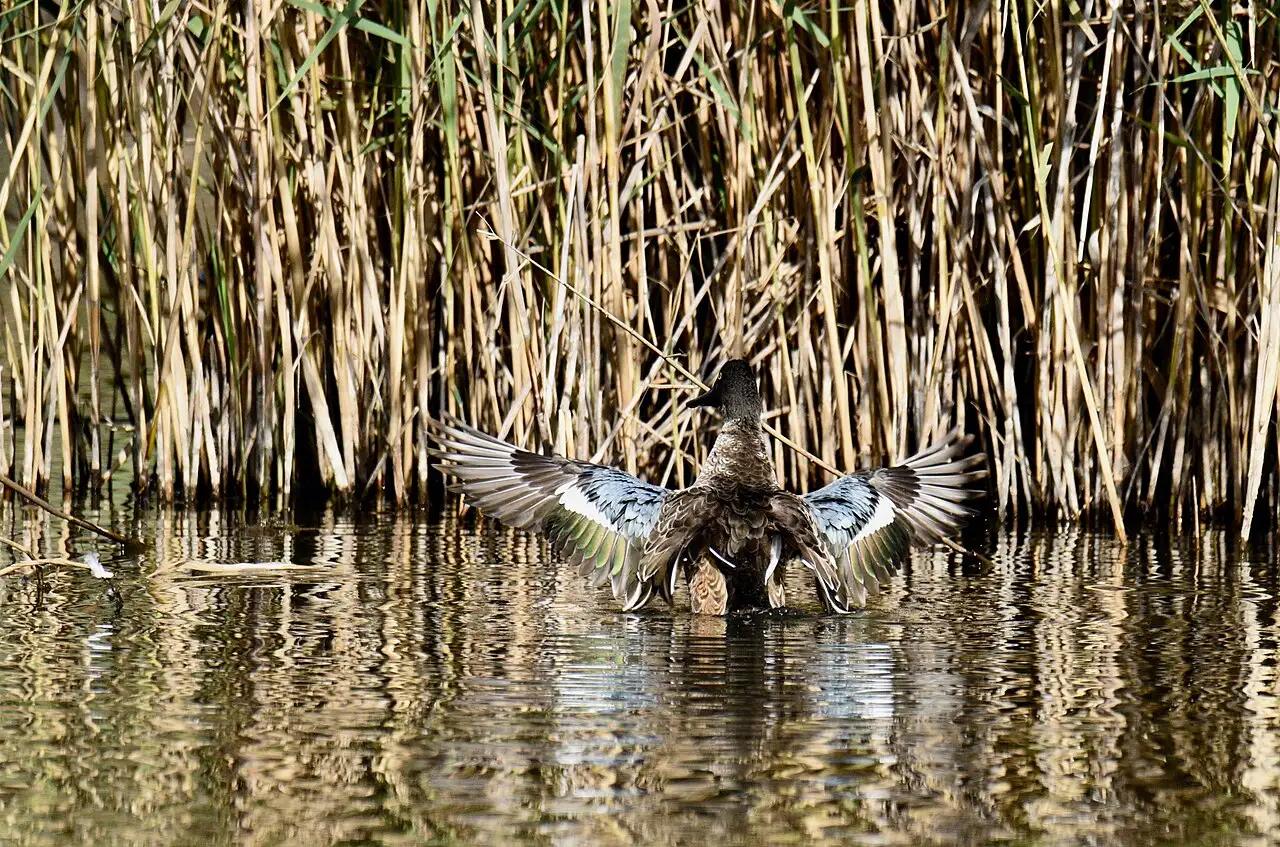
In flight the male’s bright green speculum is very visible; the female’s is a paler green.
Flight typeWith the bright green speculum clearly visible
To breed it chooses pools, lagoons or marshes with meadows, crops or copses nearby; in winter, any wetland with shallow water and plenty of aquatic vegetation.
In flight the male's bright green speculum stands out, paler in the female.
With its bill horizontal on the water it sucks in the silt and keeps on the lamellae along its edges the small organisms it feeds on.
Photo gallery of the Northern Shoveler
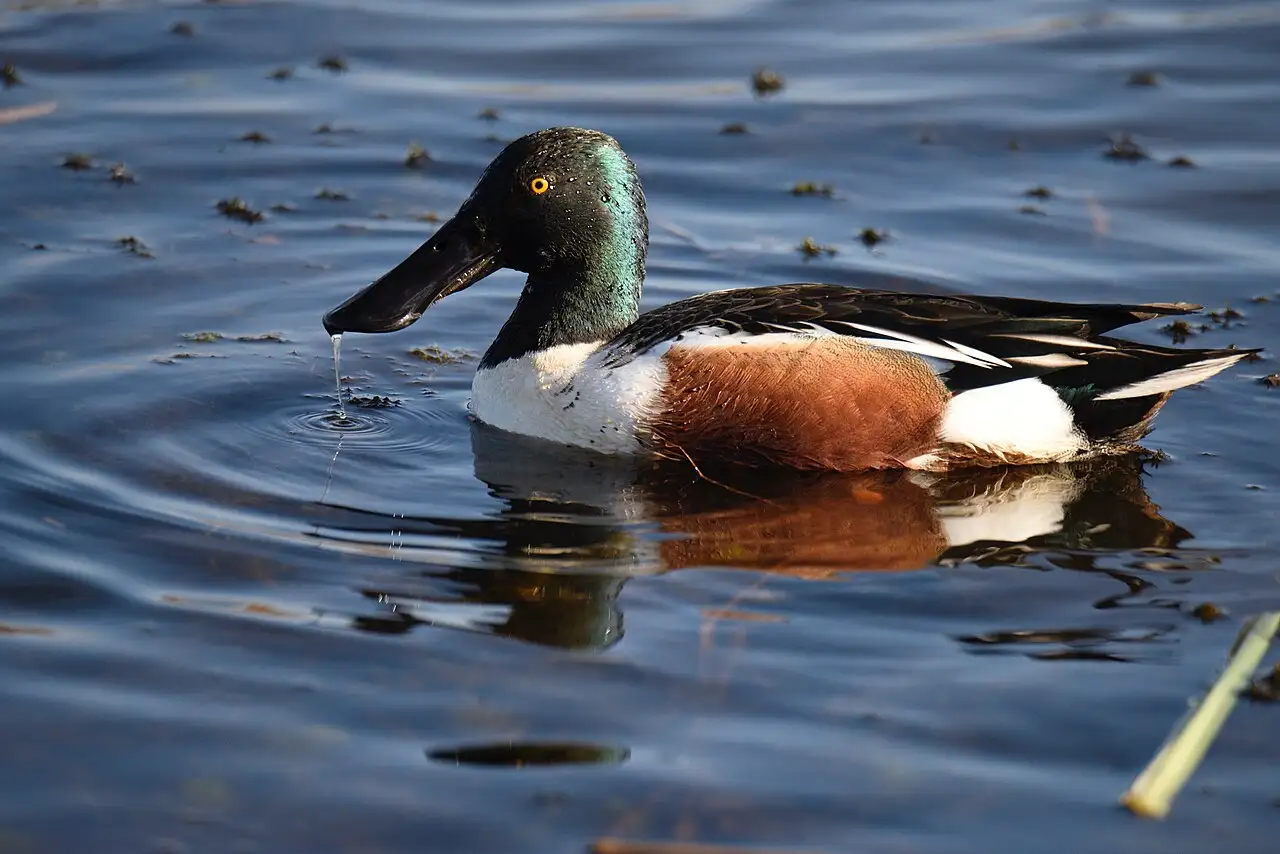
Male Northern Shoveler swimming, with bright green head, broad flattened bill, white breast and chestnut flanksPhoto: Luiz Lapa from Oeiras, Portugal, CC BY 2.0Photo 1 of 4
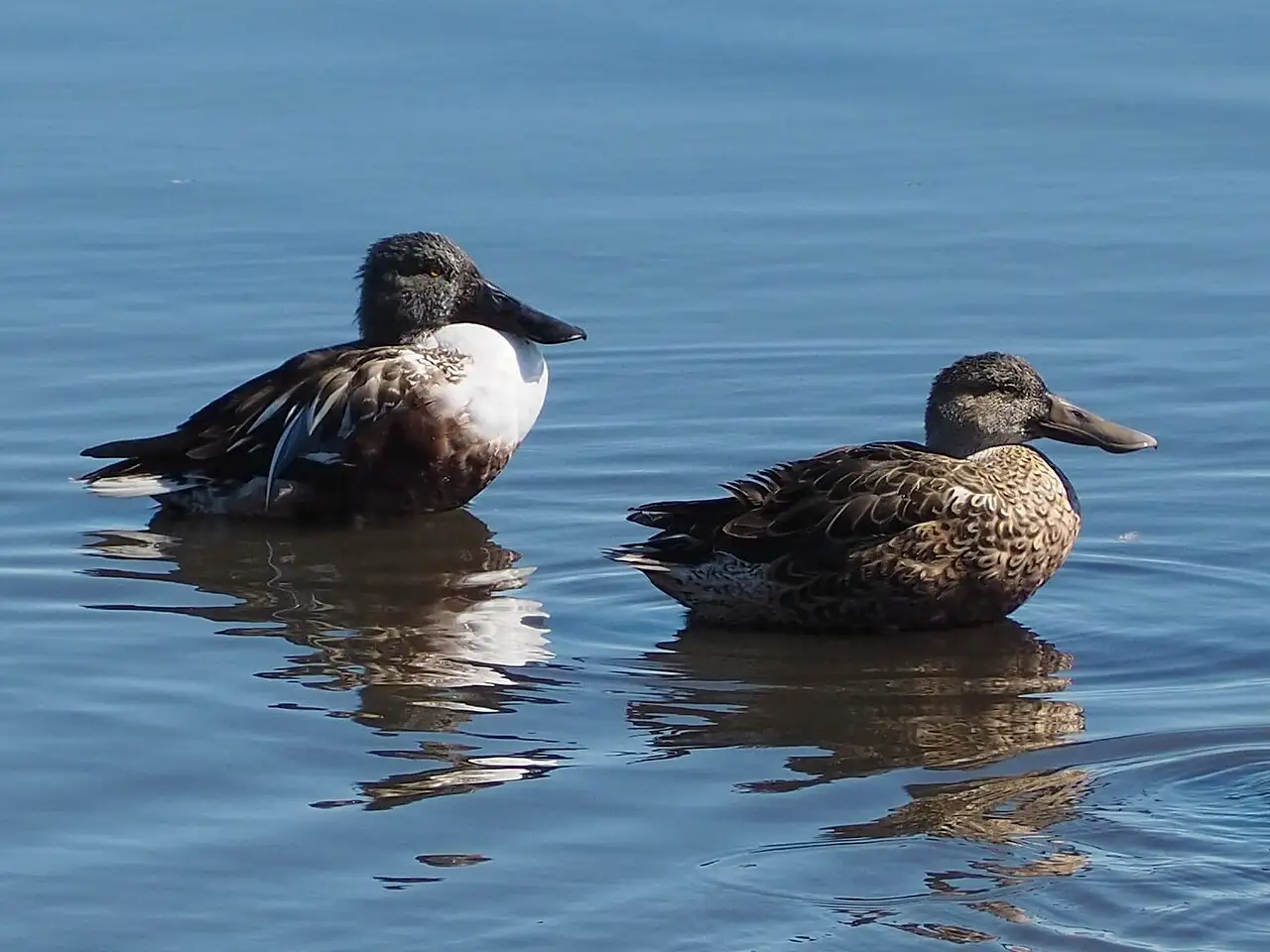
Pair of Northern Shovelers on calm water, with the broad spoon-shaped bill clearly visiblePhoto: Nosferattus, CC0Photo 3 of 4
Northern Shoveler flapping its wings on the water in front of a reedbed, with the bluish wing coverts showingPhoto: Luiz Lapa from Oeiras, Portugal, CC BY 2.0Photo 4 of 4
1 / 4
Identification of the Northern Shoveler
The Northern Shoveler is unmistakable for the flattened shape of its bill, long and specialised, which looks like a spoon and gives the bird its name. The male in breeding plumage is very showy, with the head and short neck bright green, standing out against the white breast. The flanks and belly are chestnut, and on the brownish back there are long black-and-white scapulars. The bright green speculum is seen mainly in flight. Females are brownish, but are easily told from those of other ducks by the bill, and their speculum is a paler green.
Adult
Male: green head, white breast, chestnut flanks and black-and-white scapulars.
Female: brownish, with the same broad bill and a pale green speculum.
Young bird
Very like the females, with more reddish tones on the flanks and a darker back.
Habitat and distribution of the Northern Shoveler
It is a Holarctic species with a very wide breeding range, which in Europe covers mainly the north, centre and east and becomes rarer towards the south. It has no subspecies.
In Spain it breeds in small numbers and locally at a few sites on the Peninsula and in the Albufera of Mallorca: very little in the north and more in large reservoirs of Extremadura and in wetlands of Andalusia, of both plateaus and of the Pre-Pyrenees. In winter, by contrast, it is quite common in many places, above all in the Mediterranean regions, wet La Mancha and the Guadalquivir marshes; it is the second most frequent duck in Spain in winter, after the Mallard.
To breed it chooses marshes, lagoons or wetlands with meadows, crops or open copses nearby, and in winter it occupies a wider variety of environments, as long as they have abundant aquatic vegetation and shallow water.
The more northerly populations are migratory, and from September birds from the Baltic, the North Sea and Central Europe reach the Peninsula.
Areas where it is regularly recorded since 2010Squares of about 25 km where it is recorded regularly (occasional passage records are left out). Data from GBIF.org (190,176 records, retrieved October 2026); outline from Natural Earth.
Etymology of the Northern Shoveler
According to Wikipedia, «Spatula» is the Latin word for «spoon» or «spatula», and the epithet «clypeata» comes from Latin and means «bearing a shield», from «clypeus», «shield». In other languages it is called «ànec cullerot comú» in Catalan, «pato cullereiro europeo» in Galician, «ahate mokozabala» in Basque and «northern shoveler» in English1.
Population of the Northern Shoveler
The 2021 European Red List of Birds estimates that there are some 295,000–391,000 Northern Shovelers in Europe, with a decreasing trend. According to the 2021 Red Book of the Birds of Spain, in Spain it is an abundant and increasing winter visitor: between 1990 and 2009 the average was 109,485 birds, and between 1996 and 2009 it almost doubled. The latest estimate of breeders, from 2003, gave a minimum of 730 birds and a probable figure of some 3,200, far more than the 215 pairs of the previous estimate.
Like most ducks, it is threatened by the overexploitation of aquifers, pollution from pesticides and fertilisers, urban development and irrigation plans that have altered important wetlands, the eutrophication of some wetlands and hunting pressure in some autonomous communities.
Nest of the Northern Shoveler
The female lays on a heap of vegetation lined with abundant down. It is not a colonial species, but nests are often a short distance from one another.
Courtship and breeding of the Northern Shoveler
During the courtship display the males gather and swim in a group around the females, waiting for them to choose. Around April, the female lays 9 to 11 cream or olive-brown eggs. After 22–24 days of incubation all the chicks hatch at once, and soon afterwards they are already following their mother over the water. They fly at 40–45 days.
Diet of the Northern Shoveler
Its bill is perfectly designed to filter, in shallow water, all kinds of plant matter and small animals, such as insects and their larvae, crustaceans or molluscs: it holds it horizontal on the water, sucks in the silt and keeps on the lamellae along its edges whatever serves as food. In deeper water it tips its body up, like any dabbling duck, to pull up the vegetation on the bottom. It also grazes in crops, rice fields or pastures, where it usually gathers in large flocks.
Curious facts about the Northern Shoveler
The lamellae along the edges of the bill act as a sieve: with them it keeps the small organisms in the silt it sucks in. EURING lists a shoveler ringed in the Netherlands that lived 30 years and 11 months, far above what AnAge gives (22.6 years).
The Northern Shoveler in Cabañeros
The habitat pages of this website do not mention it, and we have not found any other published source on it in the Park. GBIF.org records 30 observations of the Northern Shoveler in Cabañeros and its surroundings.
Where to see the Northern Shoveler in Cabañeros
In Cabañeros and its surroundings, mostly in winter, in reservoirs, ponds and shallow wetlands.
When
Mainly from September to spring, when the winter visitors arrive from northern Europe.
What time
By day, filtering the shallow water with the bill pressed to the surface.
Where
In wetlands, lagoons and reservoirs with shallow water and plenty of aquatic vegetation.
What to look for
Look for the enormous flattened bill; the male, with green head, white breast and chestnut flanks.
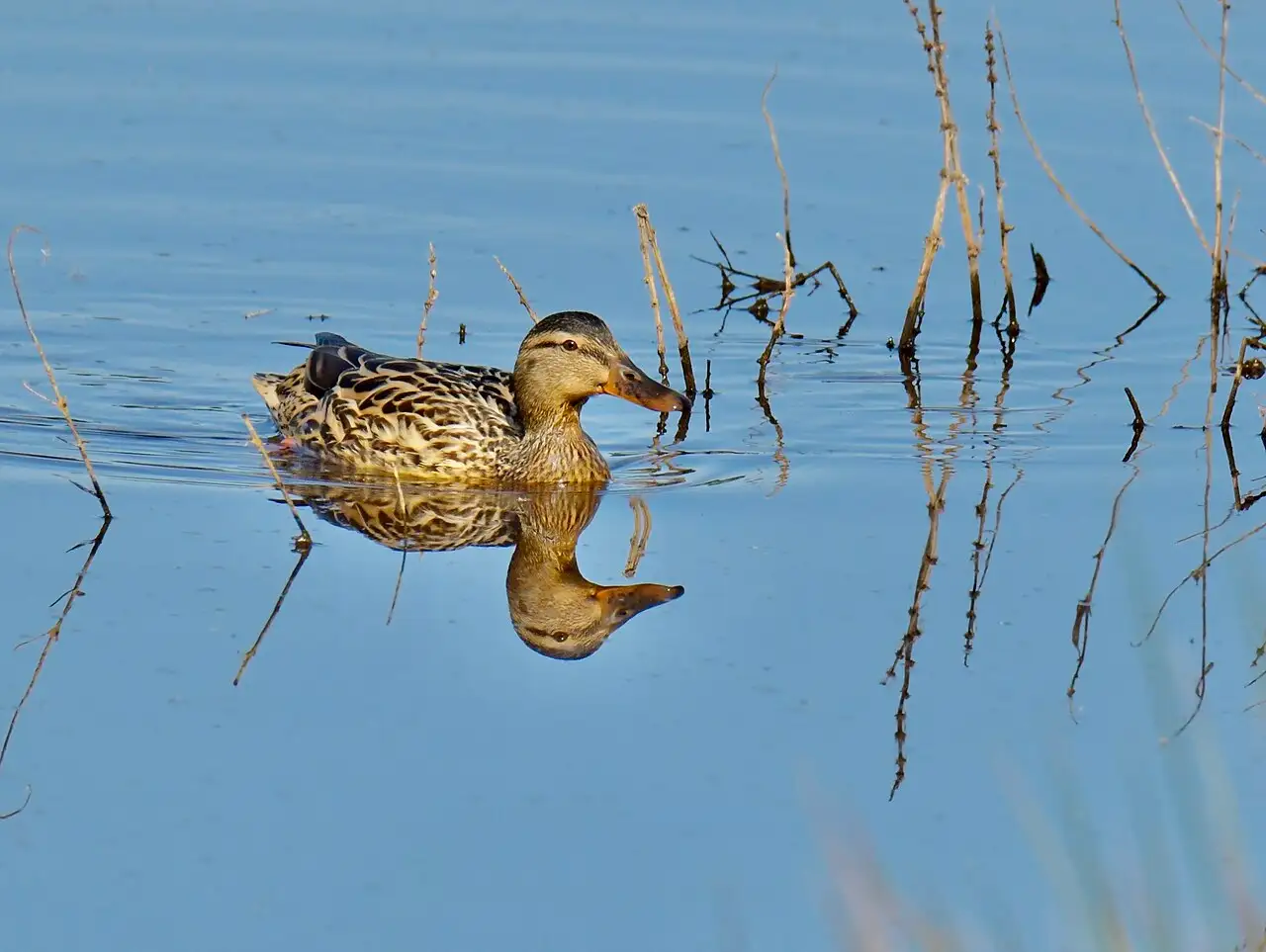
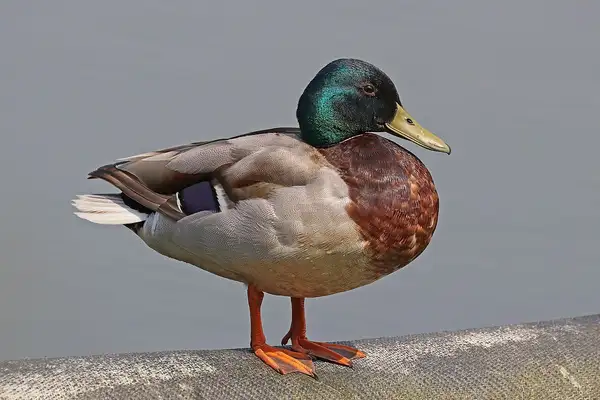
It is not clearly similar1. Like the shoveler, the Mallard is a duck (family Anatidae), and it is the only duck more frequent than the shoveler in winter in Spain.



 Same family
 Same family
 Same family
 Same family
 Same season in the park
 Same season in the park
 Same season in the park
 Same season in the park






