In pairs or small flocks; sometimes it breeds in groupings of several pairs
Lifespan
Record of 12 years and 7 months in the wild (a bird ringed in Germany)
Conservation status
LC
NT
VU
EN
CR
EW
EX
Global (IUCN)
Least Concern
Spain
Least Concern (LC) in the Red Book of the Birds of Spain; included in the List of Wild Species under Special Protection and not in the Spanish Catalogue of Threatened Species
When to see it
Resident
Months of the year when it is present
J
F
M
A
M
J
J
A
S
O
N
D
In Iberia
yes
yes
yes
yes
yes
yes
yes
yes
yes
yes
yes
yes
Breeding season
no
no
no
yes
yes
yes
yes
no
no
no
no
no
Song or voice of the Hawfinch
The song and calls of this bird are very simple. Perched and in flight it gives short notes, «chiiit», perceptible only at close range. The recording picks up its flight calls in Terra de Lemos (Lugo).
Flight callHawfinch
0:00 / 0:22
10 kHz5
The sonogram draws the sound: time runs from left to right, and the higher a trace sits, the higher the note.Recording by Amadeo A. Pombo Eirín, Wikimedia Commons (CC BY-SA 4.0).
Flight of the Hawfinch
Its flight is fast and powerful. The spread wings make the Hawfinch easy to identify, since they clearly show two large white patches, and in flight a characteristic white terminal band on the tail can also be seen.
Flight typeFast and powerful, with two large white patches on the wings
Shy and elusive, it leaves the top of the crowns with a fast, powerful flight, and gives a short note, «chiiit», which is only heard at close range.
Fast, powerful flight. With the wings spread two large white patches can be seen and, on the tail, a white terminal band.
It lands at the top of another tree, where it goes unnoticed, whether in a pair or in a small flock.
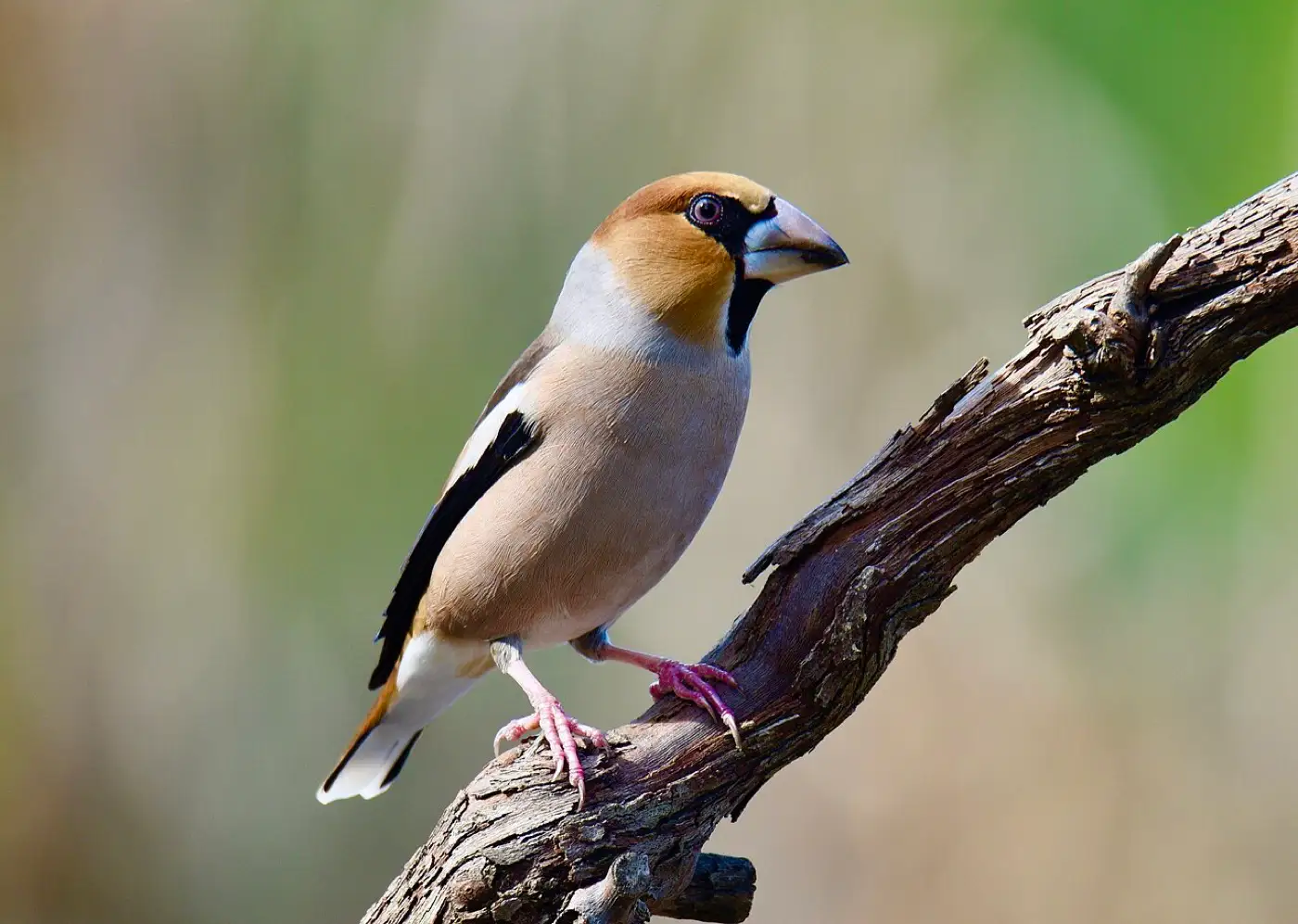
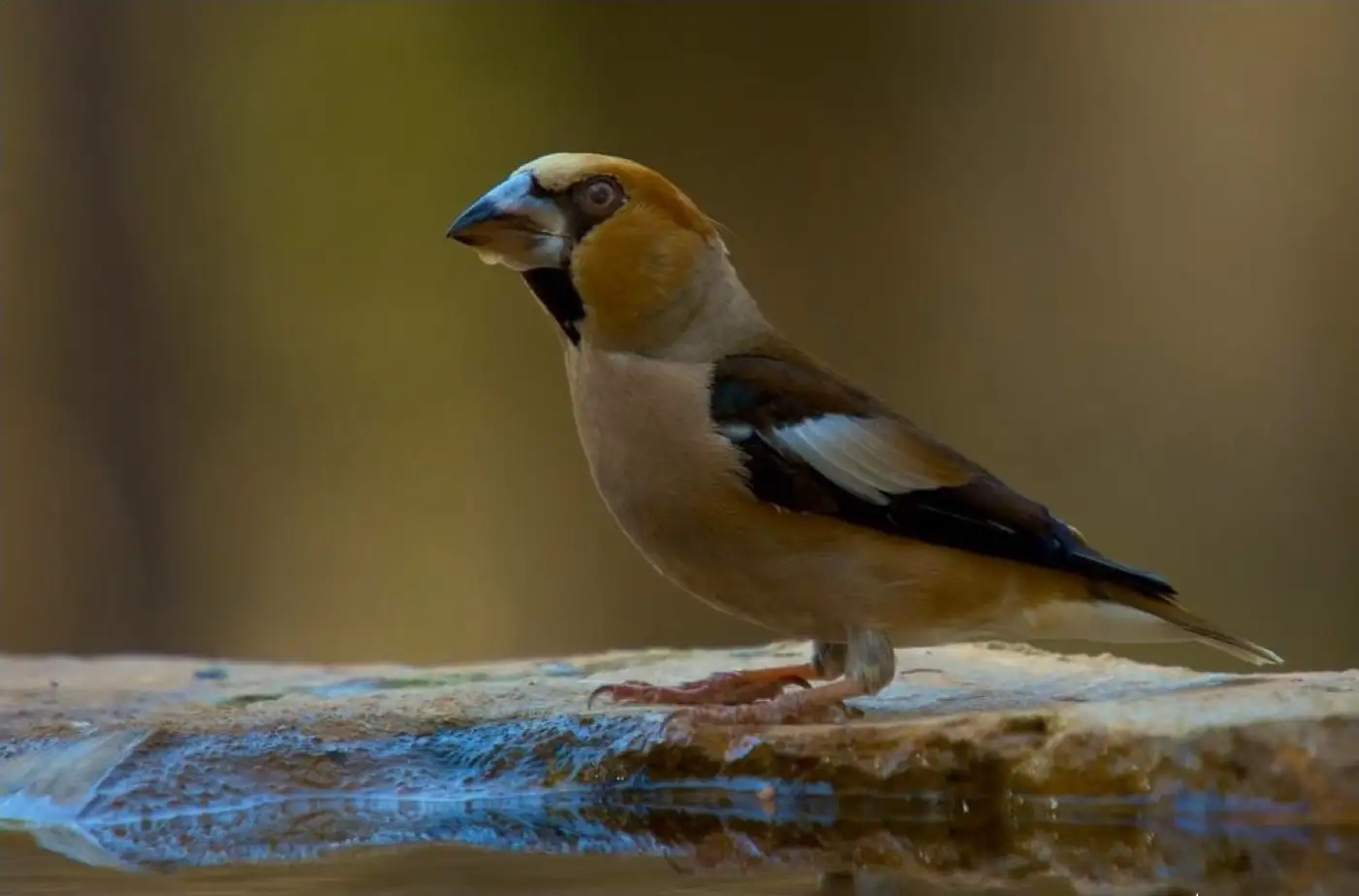
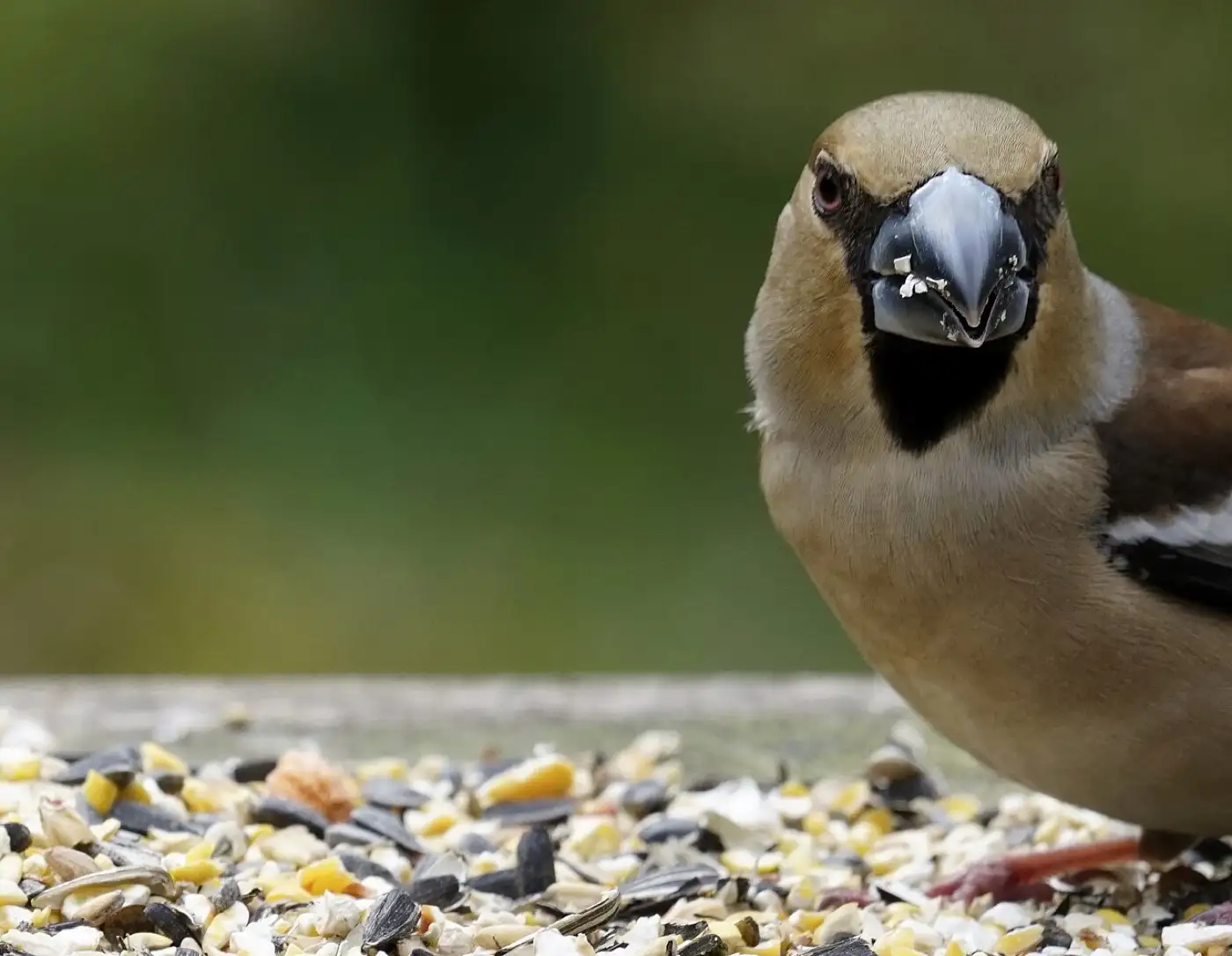
The Hawfinch is characterised by its bulky head and a very thick bill with a notably broad base. Its short tail emphasises the volume of the head and bill, and gives the bird a compact, robust look.
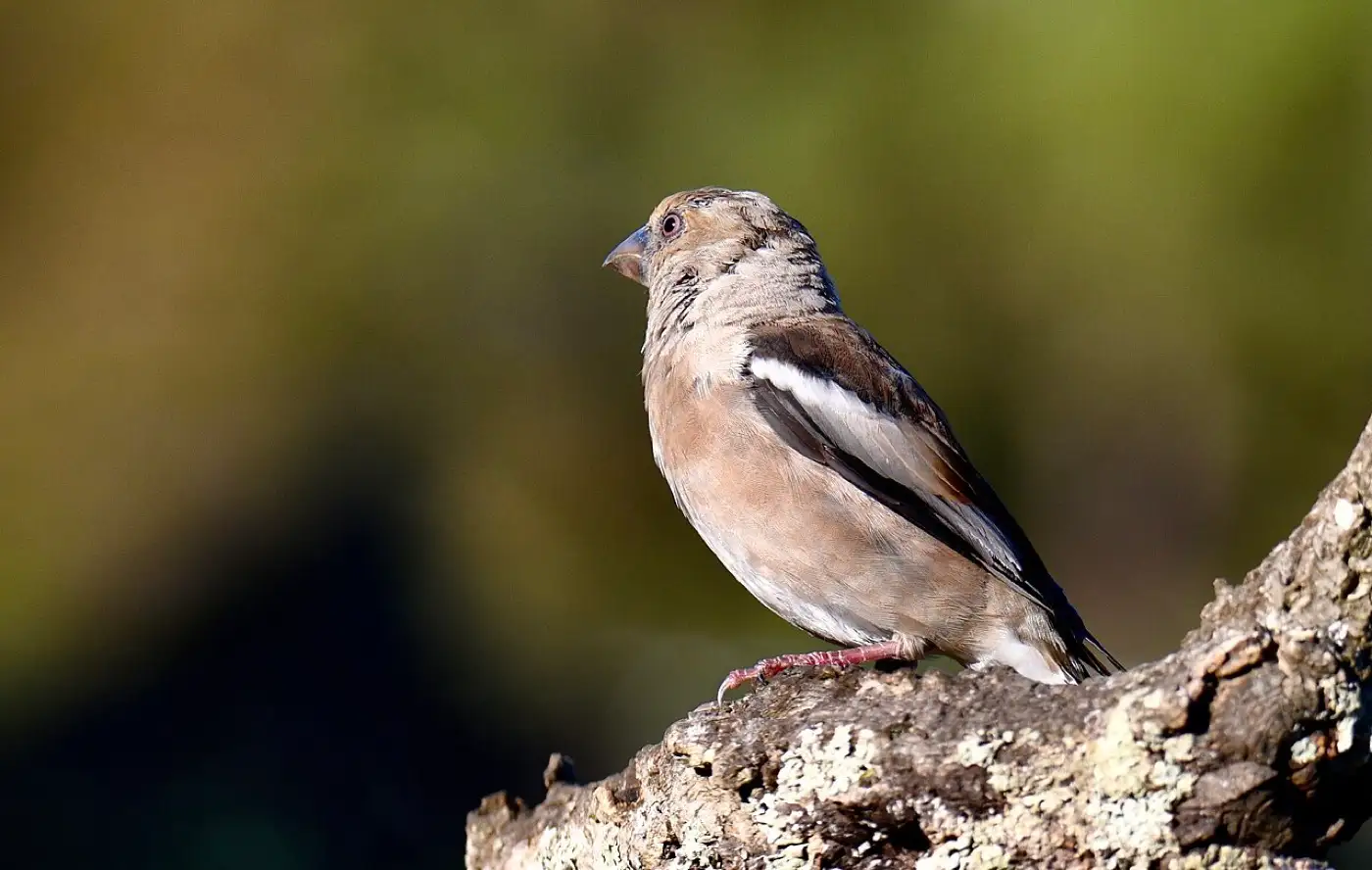
On close observation the sexes can be told apart. Males have the orange and grey patches on the head and face much more vivid than females. In addition, the inner wing feathers are tinged in males with a metallic blue sheen, whereas in females it is silver grey. Young fledglings are in brown tones, without showy colours on the head and without the lovely orange tone of the adults.
Despite its features, it is not easy to detect. Whether in pairs or in small flocks, it easily goes unnoticed, since it is a shy, elusive and very silent bird that bustles about the upper part of the treetops.
Male
Orange and grey patches on the head and face, very vivid.
Inner wing feathers with a metallic blue sheen.
Female and young bird
Female with the head patches duller and the wings with a silver-grey sheen.
Young bird in brown tones, without the adults’ orange colour.
Habitat and distribution of the Hawfinch
Several subspecies have been described, which together range across Europe, North Africa and the temperate strip of Asia. In Asia it appears in a fragmented way from the Caspian Sea to Japan and much of the Pacific coast of Russia and the northern half of China. In Europe it is recorded in every country, although in Scandinavia it is only found in the southern third, and it is absent from Ireland.
In Spain most populations are located in Castilla y León, Extremadura, Madrid, Andalusia and the western half of Castilla-La Mancha, the north of the Iberian System and a strip south of the Pyrenees, in the Basque Country and Catalonia, in mountain areas, but also in low, flat areas. It is a typical bird of inland Mediterranean environments. It is very scarce on both sides of the Cantabrian range and in the Pyrenees, and does not breed in Galicia, Ceuta, Melilla, the Canaries or the Balearics, although in the latter archipelago and in other coastal areas of the eastern half of the Peninsula Hawfinches are detected in the winter months. In Spain the subspecies «coccothraustes» lives.
It occupies wooded stands with abundant undergrowth and near water points, with a preference for dehesas of holm oak, Lusitanian oak or cork oak and for oak woods. It also occupies riverside woods and, secondarily, pine woods and mixed woods.
It is a partial migrant in Spain: native birds are basically resident, and in winter winter visitors arrive from western Europe, irruptively and in very variable numbers. Scientific ringing reveals that in winter some populations stay in their breeding territories, while others arrive in Spain from Europe. In autumn and early spring movements are seen through the Strait of Gibraltar.
Areas where it is regularly recorded since 2010Squares of about 25 km where it is recorded regularly (occasional passage records are left out). Data from GBIF.org (55,668 records, retrieved October 2026); outline from Natural Earth.
Etymology of the Hawfinch
«Coccothraustes» comes from Greek «kókkos», «seed» or «stone», and «thraúō», «to break» or «to crack»: the one that breaks seeds. The Spanish name says the same: a fat bill.
Population of the Hawfinch
In the 2021 European Red List of Birds the European breeding population is estimated at between 7,280,000 and 12,100,000 mature individuals, with an increasing trend. In Spain some 403,000 individuals are calculated. The most numerous populations, of between 60,000 and 90,000 birds, are located in Castilla y León, Extremadura, Castilla-La Mancha and Andalusia, although the highest densities are in Extremadura and Madrid. The population trend has been increasing in recent years. It seems very sensitive to disturbance of woodland habitats and suffers indiscriminate hunting with nets, shotguns and parany during winter on the Spanish Mediterranean coast (Valencian Community and Andalusia).
Nest of the Hawfinch
On the horizontal branches of trees it builds a cup of twigs and fine roots, which it covers outside with lichens and lines inside with rootlets, plant fibres and hair.
Courtship and breeding of the Hawfinch
It breeds once or twice a year, between April and July, sometimes in groupings of several pairs. The female lays four or five bluish-white or greenish-grey eggs, with thick blotches, speckles and black or brown streaks. Incubation lasts 11–13 days, and the male helps with it. The chicks are fed by both parents and fly in under two weeks.
Diet of the Hawfinch
It is an avid consumer of large fruits and seeds. It feeds on the pulp and seeds of cherries, beechnuts, rose hips, olives, nettle-tree drupes and other fruits. It also eats buds and tender stems of trees and shrubs, and in spring completes its diet with insects, especially moths. Its bill is so robust, for the size of the bird, that it lets it feed on a great variety of fruits.
Curious facts about the Hawfinch
It is a bird widely spread in Europe, but not abundant, and very hard to detect: shy, elusive and silent, it lives at the top of the crowns. Its bill is a tool for cracking hard seeds. The most recent data indicate that its population is growing.
The Hawfinch in Cabañeros
This website’s page on deciduous woodland cites it among the species that live at lower density in those woods of Cabañeros, together with the Great Spotted Woodpecker, the Common Blackbird, the Eurasian Nuthatch, the Short-toed Treecreeper, the Eurasian Jay and the Rock Bunting.
Where to see the Hawfinch in Cabañeros
In the deciduous woods of Cabañeros, at the top of the crowns.
When
All year round; in winter birds also arrive from Europe, in very variable numbers.
What time
Throughout the day, looking at the crowns.
Where
In woods with undergrowth and near water, in dehesas of holm oak, Lusitanian oak or cork oak, and in oak woods and riverside woods.
What to look for
A large head with a huge bill, or two white patches on the wings in flight. It is heard little and only at close range.
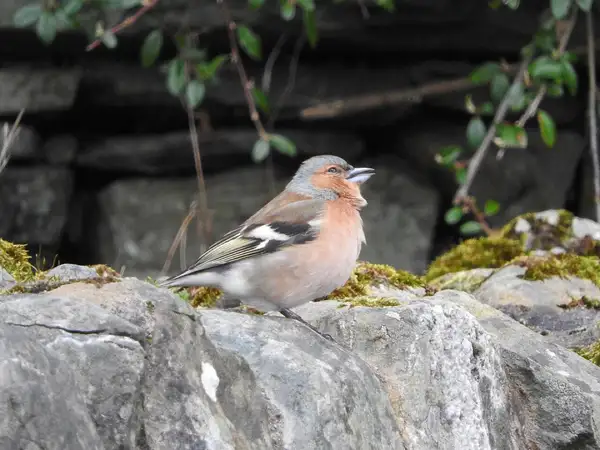
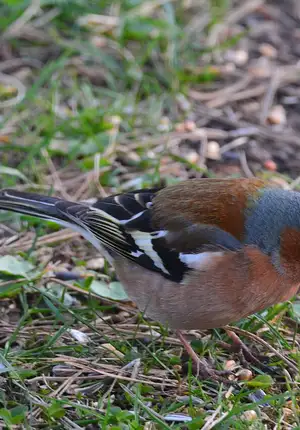
They are similar in appearance1. It is another woodland finch, but has a much thinner bill, blue-grey head and pink breast, with white bars on the wing.
Photo: Rob Mitchell, CC0
Other birds
Birds related to the Hawfinch or sharing its habitats in Cabañeros.



 Same family
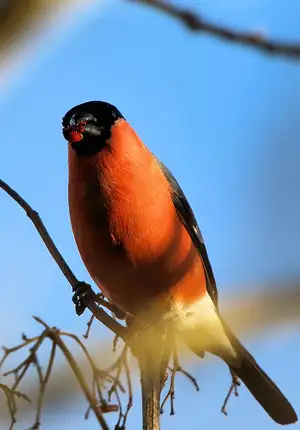 Same family
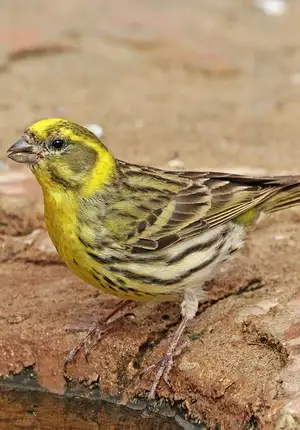 Same family
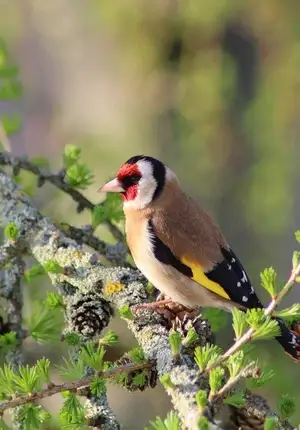 Same family
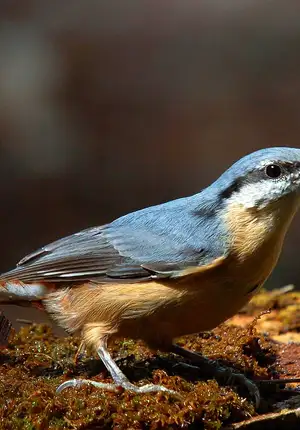 Also in deciduous woodland
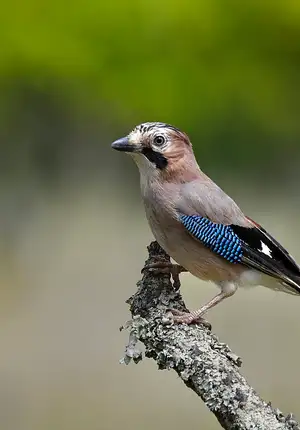 Also in deciduous woodland
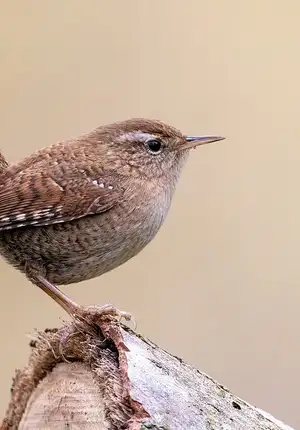 Also in deciduous woodland
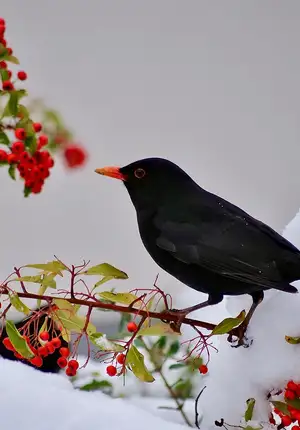 Also in deciduous woodland






