The female builds the nest, incubates the eggs and rears the chicks with the help of the male, who takes a smaller part
Lifespan
Record of 6.8 years in the wild according to AnAge; EURING lists a bird ringed in Italy that lived 8 years and 1 month, and another in Spain that reached 7 years and 10 months
Conservation status
LC
NT
VU
EN
CR
EW
EX
Global (IUCN)
Least Concern
Spain
Near Threatened (NT) as a breeder in the Red List of the Birds of Spain; on the List of Wild Species under Special Protection, but not in the Spanish Catalogue of Threatened Species
When to see it
Summer visitor
Months of the year when it is present
J
F
M
A
M
J
J
A
S
O
N
D
In Iberia
no
no
no
yes
yes
yes
yes
yes
yes
no
no
no
Breeding season
no
no
no
no
yes
yes
yes
no
no
no
no
no
Song or voice of the Ortolan Bunting
The song is made up of variants of a repetitive two-syllable opening sequence, with a longer, slowing ending: «chuí-chuí-chuí-chuiii» or «tsi-tsi-tsi-tsi-ruiii»1. The call is short, simple sounds, like a metallic «sli-í» and a more muted «chu», which alternate at two-second intervals. The recording (song) is by Marcel Gil Velasco and was made at Laguna Grande de Babia, León, Castilla y León (xeno-canto XC660112, quality A). It lasts 9 seconds and is a trimmed section of the original, without repeating or lengthening, from which we have removed the bass below 300 Hz, reduced the background noise and adjusted the volume; neither pitch nor speed has been changed.
All European and Asian populations are long-distance migrants and travel to the tropical regions of Africa to spend the winter; on the Peninsula it is only seen between April and September.
Flight typeLong-distance migrant; it spends the winter in the tropical regions of Africa
It prefers mid-mountain zones with open spaces and sunny slopes, with small trees or shrubs —Spanish broom, genista, heather, wild roses— that it uses as perches to sing from.
It feeds on the ground, above all on invertebrates —grasshoppers, crickets, spiders, ants, beetles—, and outside the breeding season often eats seeds.
All European and Asian populations are long-distance migrants, which travel to the tropical regions of Africa to spend the winter.
Photo gallery of the Ortolan Bunting
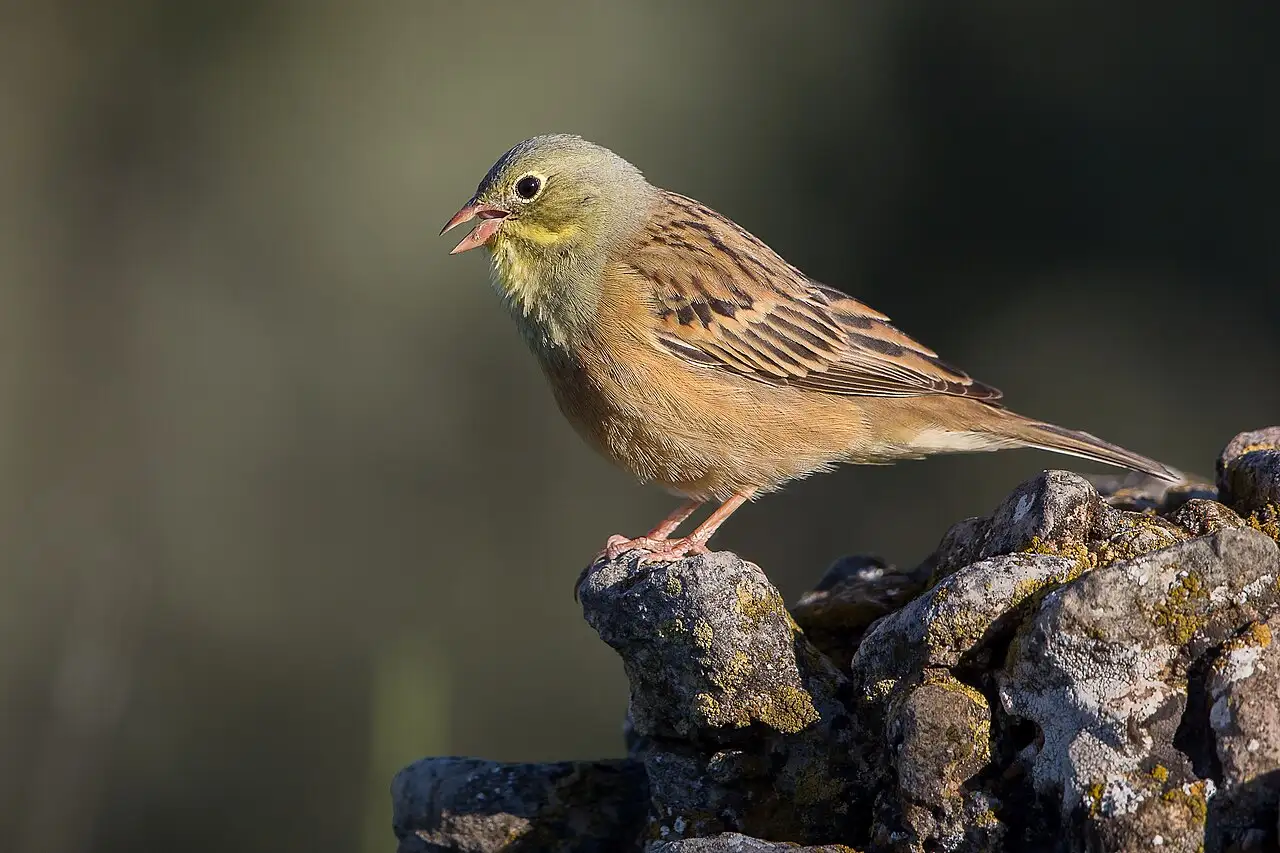
Male Ortolan Bunting singing on a lichen-covered stone, with greenish-grey head, yellow throat and moustache and orange-brown breastPhoto: Pierre Dalous, CC BY-SA 3.0Photo 1 of 5
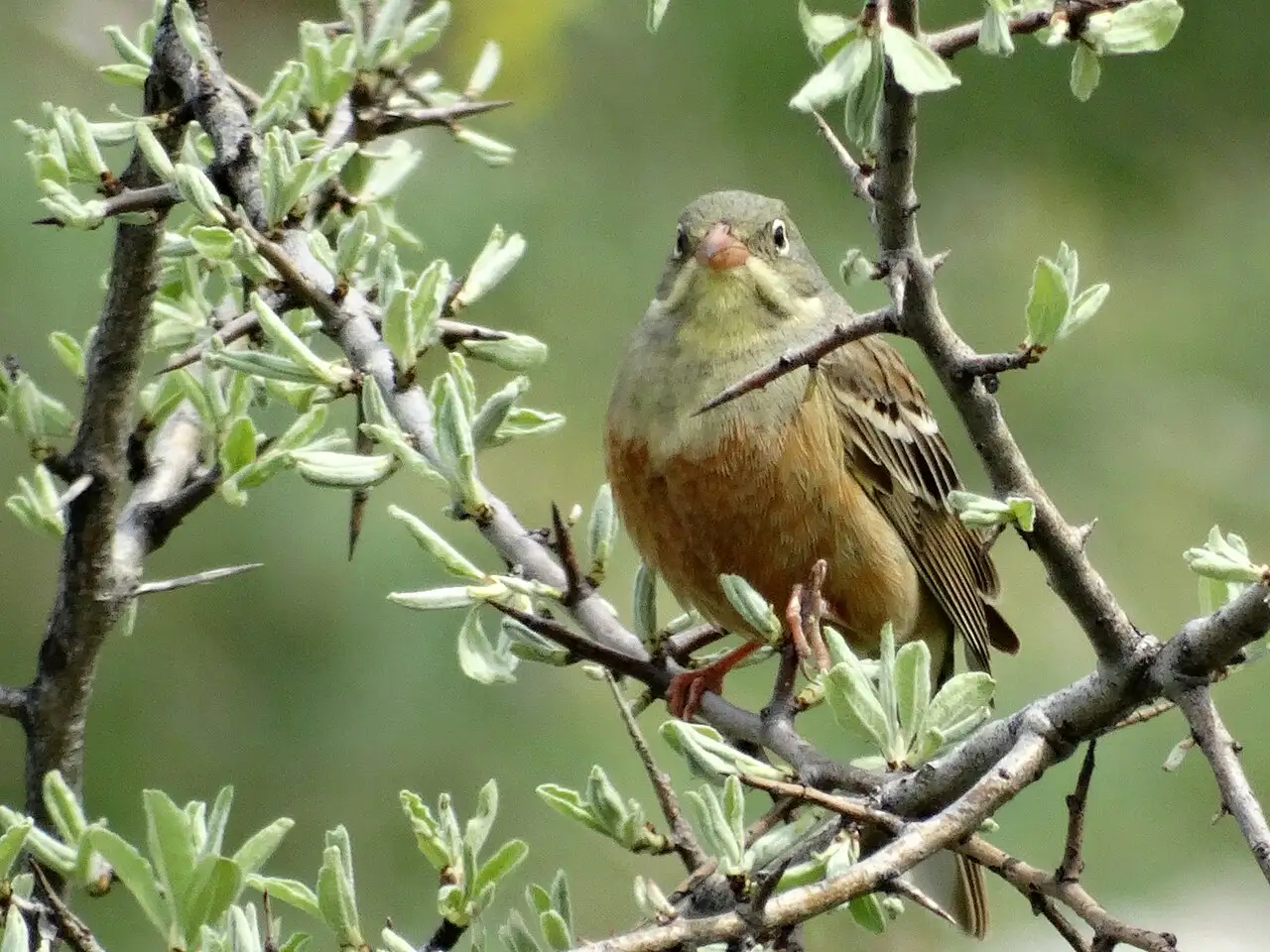
Male Ortolan Bunting perched on a thorny shrub with silvery leaves, from the front, with greenish-grey head and pale eye-ringPhoto: K.B. Simoglou, CC BY-SA 4.0Photo 2 of 5
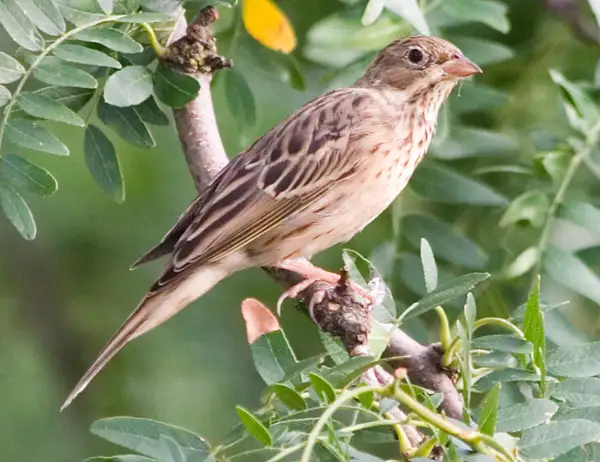
Female Ortolan Bunting perched on a branch among green leaves, with streaked brown plumage and pink billPhoto: phenolog (away for a while), CC BY 2.0Photo 3 of 5
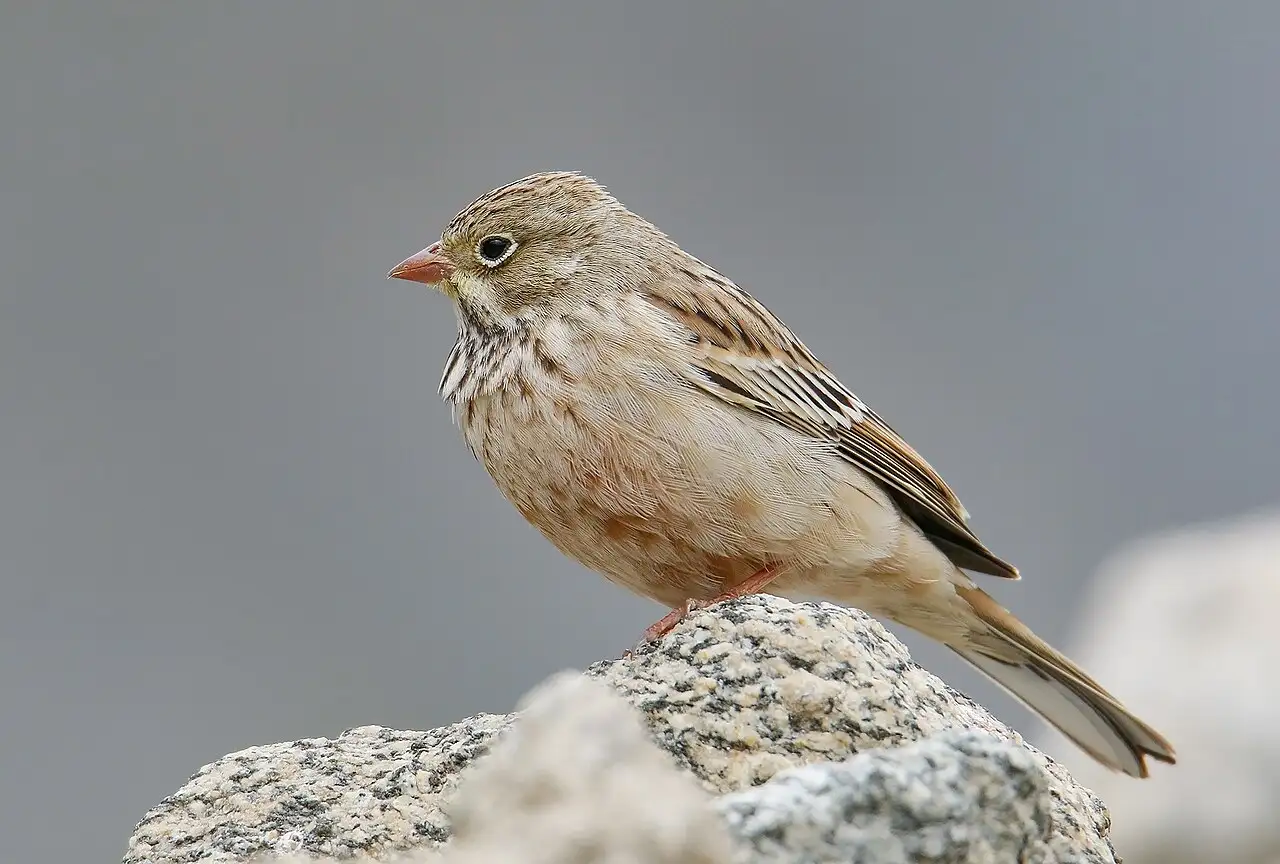
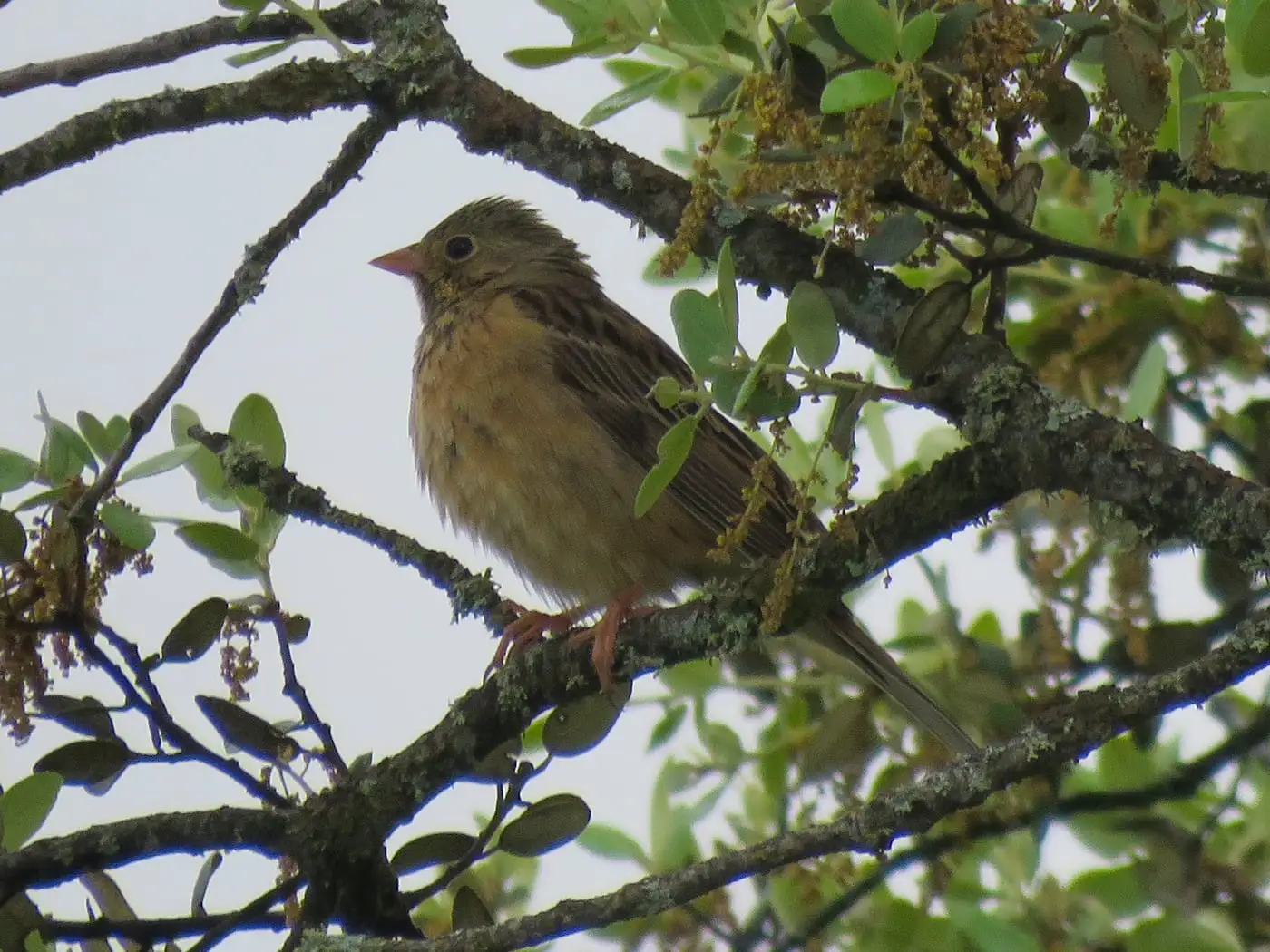
Ortolan Bunting perched on a branch, with olive plumage and pink bill (Zamora)Photo: Óscar Sampedro, CC BY 4.0Photo 5 of 5
1 / 5
Identification of the Ortolan Bunting
The Ortolan Bunting is a medium-sized bunting, with yellow throat and eye-ring, which in all plumages has a characteristic yellow moustache too, while the greyish-brown mantle and wings are always heavily streaked with dark brown. This pattern extends to young birds, females and males in non-breeding plumage. Males in spring have the head, neck and breast a plain greenish-grey tone, although they keep the yellowish moustache and throat; the underparts are orange-brown. In winter plumage, the male is more like the female and the immature, with browner, duller tones predominating on the back and less chestnut on the belly.
Male in spring
Head, neck and breast plain greenish grey; throat and moustache yellowish.
Underparts orange-brown; mantle and wings greyish brown with dark brown streaks.
Female, young bird and male in winter
Yellow throat, eye-ring and moustache, with the streaked mantle pattern across the whole upper part.
Browner, duller tones on the back and less chestnut on the belly.
Habitat and distribution of the Ortolan Bunting
It is distributed across the temperate regions of Europe and western Asia, as far as southern Scandinavia at its northern limit and the Mediterranean peninsulas at its southern; to the east it extends to central Asia, though in a fragmented way. It is absent from large flat expanses of Central Europe, the British Isles and Iceland. No subspecies are known.
In Spain it is restricted to the northern half of the Peninsula, apart from an isolated core in Sierra Nevada1. It selects the foothills of the main massifs: the Cantabrian Range, the Montes de León, the Central System, the Pyrenees and the Iberian System1. It is absent from both archipelagos, Ceuta and Melilla.
Although it can appear from sea level up to 2,400 metres altitude in the Pyrenees (in Sierra Nevada it is restricted to the highest areas), it prefers mid-mountain zones with open spaces and sunny slopes where there are small trees or shrubs, such as Spanish broom, genista, heather and wild roses, which it uses as perches to sing from. It often settles on the edges of crops and mountain vegetable plots.
It is the only Iberian bunting that leaves our territory completely in winter: all its European and Asian populations are long-distance migrants and spend the winter in the tropical regions of Africa.
Areas where it is regularly recorded since 2010Squares of about 25 km where it is recorded regularly (occasional passage records are left out). Data from GBIF.org (6,673 records, retrieved October 2026); outline from Natural Earth.
Etymology of the Ortolan Bunting
In other languages it is called «hortolà» in Catalan, «escribidor sombrío» in Galician, «berdantza miarritza» in Basque and «ortolan bunting» in English1. We have not found a source explaining the origin of the Spanish name «escribano hortelano» or of the scientific one, so we do not venture one.
Population of the Ortolan Bunting
The 2021 European Red List of Birds estimates the European breeding population at between 7,220,000 and 11,300,000 mature individuals, with a decreasing trend. In Spain, according to the 2008–2014 censuses, a population of 200,000 birds was calculated, and the most important are in Castilla y León, Aragon, Catalonia and Castilla-La Mancha, which together hold more than 80 % of the Spanish population. The trend shows a moderate decline.
Its great adaptability to different habitats has let it avoid numerous threats, but that the abandonment of small mountain vegetable plots and agricultural intensification elsewhere have reduced the diversity of environments that traditionally served it for nesting and feeding1. Illegal hunting during its migration passage is one of its main conservation problems.
Nest of the Ortolan Bunting
The nest is cup-shaped and made of rootlets and dry grasses. It is set on the ground, normally in some hollow protected by low vegetation or among rocks, often in vegetable plots and assorted crops.
Courtship and breeding of the Ortolan Bunting
The breeding period, which begins in late May and ends in mid-July, is short and fairly synchronised. Laying takes place between mid-May and mid-June and consists of three to six eggs of variable colour, with abundant spots and irregular streaks, which the female incubates for 11–13 days. The male also takes part in feeding the chicks, although the female puts in more effort. The chicks leave the nest at 10–14 days and depend on their parents for at least another week, until they become independent.
Diet of the Ortolan Bunting
It feeds on the ground, mainly on invertebrates, such as grasshoppers, crickets, spiders, ants and beetles, although it often eats assorted seeds, above all outside the breeding season.
Curious facts about the Ortolan Bunting
It is the only Iberian bunting that leaves our territory completely during the winter period1. AnAge gives a maximum of 6.8 years in the wild; EURING lists longer-lived birds, of 7 years and 10 months in Spain and 8 years and 1 month in Italy, both checked by ringers.
The Ortolan Bunting in Cabañeros
The habitat pages of this website do not mention it, and we have not found any other published source on it in the Park; nor does it appear in the bird list of the «Visitor guide to Cabañeros National Park» (OAPN). GBIF.org records 3 observations of the Ortolan Bunting in Cabañeros and its surroundings. Castilla-La Mancha is among the four communities that hold more than 80 % of the Spanish population1. Of those observations, 2 fall within the Park boundary (according to OpenStreetMap); the rest are from the surroundings.
Where to see the Ortolan Bunting in Cabañeros
In Cabañeros and its surroundings, occasionally, during migration passage, on the edges of crops and on slopes with shrubs.
When
In Spain from April to September; it leaves the Peninsula completely in winter.
What time
By day, singing from a shrub or feeding on the ground.
Where
On sunny mid-mountain slopes with Spanish broom, genista, heather and wild roses, and on the edges of crops and mountain vegetable plots.
What to look for
Look for the yellow throat, eye-ring and moustache; listen for its slowing «chuí-chuí-chuí-chuiii».



 Same family
 Same family
 Same family
 Same order
 Same order
 Same order
 Same order
 Same order






.jpg)
