Wingspan compared with a person with arms outstretched.
Length
55–65 cm
Wingspan
80–95 cm
Weight
633.8 g
Social life
Colonial, with little fidelity to its breeding colonies; in winter its gregarious nature becomes more marked and it forms roosts
Lifespan
Record of 26.8 years in captivity according to AnAge; EURING lists a bird ringed in Spain that lived 15 years and 7 months
Conservation status
LC
NT
VU
EN
CR
EW
EX
Global (IUCN)
Least Concern
Spain
Near Threatened (NT) as a breeder and Least Concern (LC) as a winter visitor in the 2021 Red Book of the Birds of Spain; on the List of Wild Species under Special Protection
When to see it
Resident
Months of the year when it is present
J
F
M
A
M
J
J
A
S
O
N
D
In Iberia
yes
yes
yes
yes
yes
yes
yes
yes
yes
yes
yes
yes
Breeding season
no
no
no
yes
yes
yes
yes
yes
no
no
no
no
Song or voice of the Glossy Ibis
It is practically mute: sometimes it gives hoarse croaks and grunts1. The recording (call) is by Michael John O Mahony and was made in Marina Alta (near Monte Pego), Alicante, Valencian Community (xeno-canto XC1092345, quality A). It lasts 9 seconds and is a trimmed section of the original, without repeating or lengthening, from which we have removed the bass below 200 Hz, reduced the background noise and adjusted the volume; neither pitch nor speed has been changed.
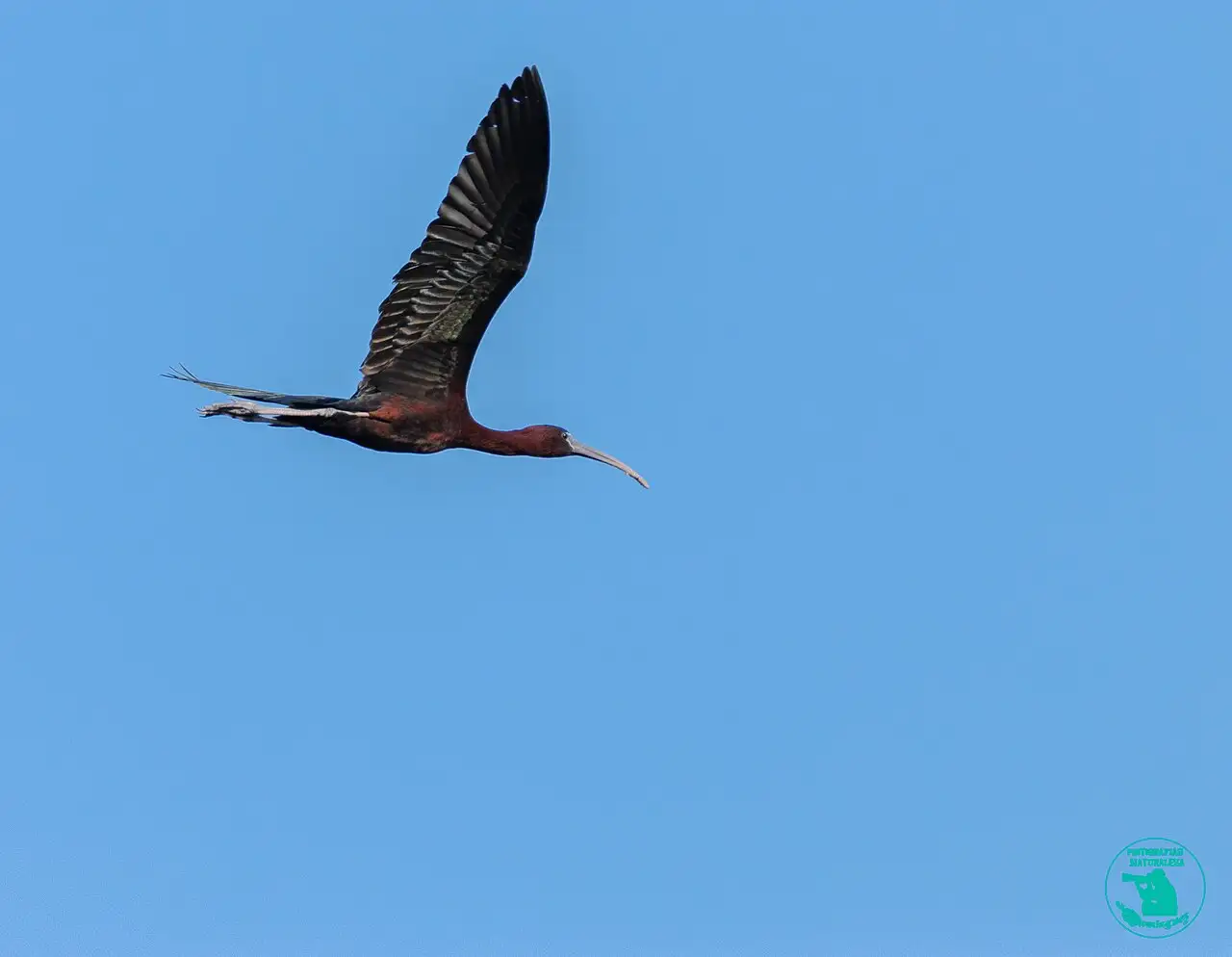
In flight it looks very elongated and slender, with the head slightly drooped. It is a migratory and dispersive bird which, in addition, makes nomadic movements; the Iberian populations are resident, and the Doñana birds are seen throughout the winter, although many cross to North Africa1.
Flight typeElongated and slender, with the head slightly drooped
During winter it feeds in rice fields, pools and shallow freshwater marshes, and forms roosts on islands of marsh vegetation.
In flight it looks very elongated and slender, with the head slightly drooped.
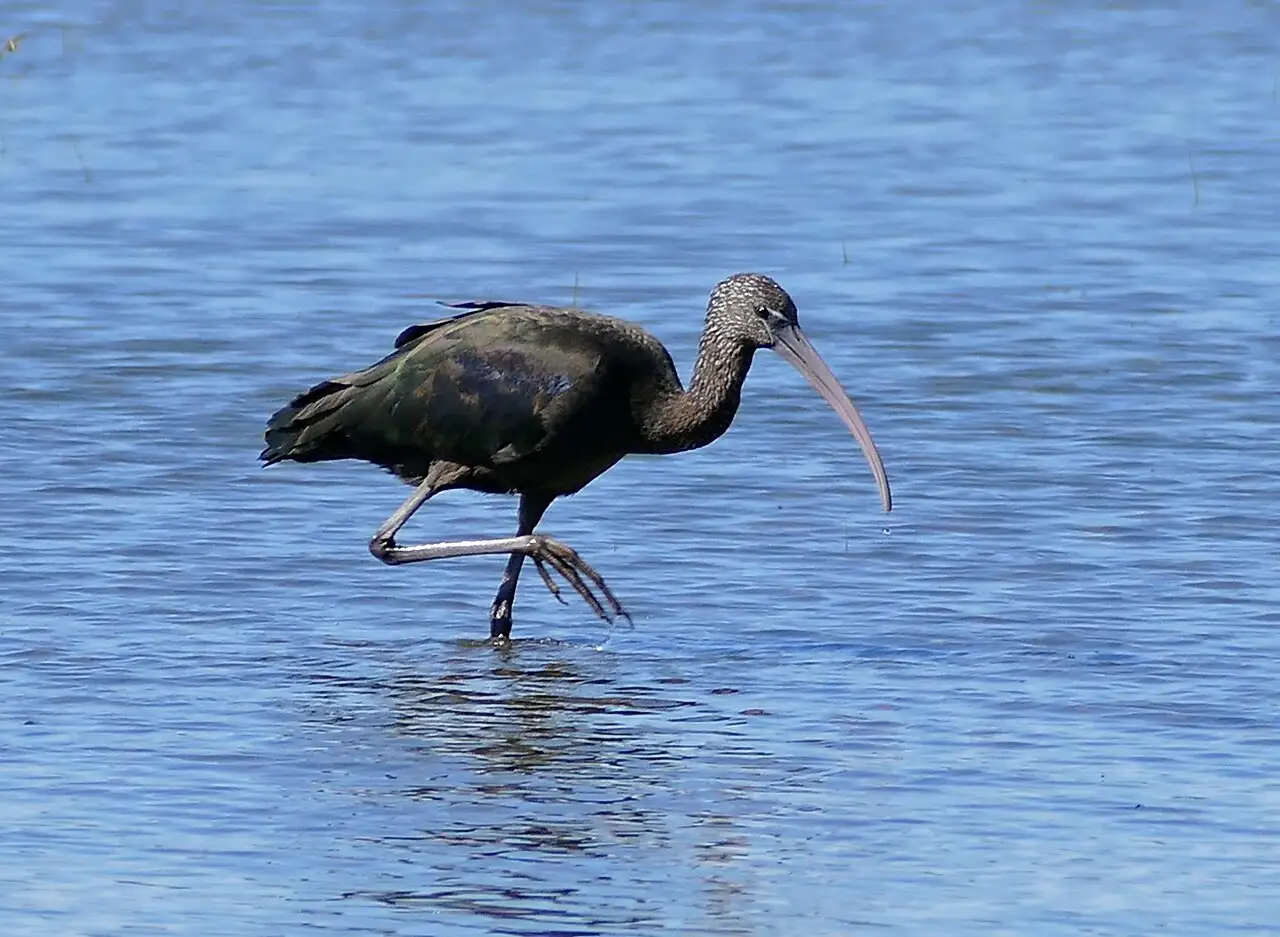
When it feeds, it is typically found in shallow water, moving its bill and head from side to side in search of prey.
Photo gallery of the Glossy Ibis
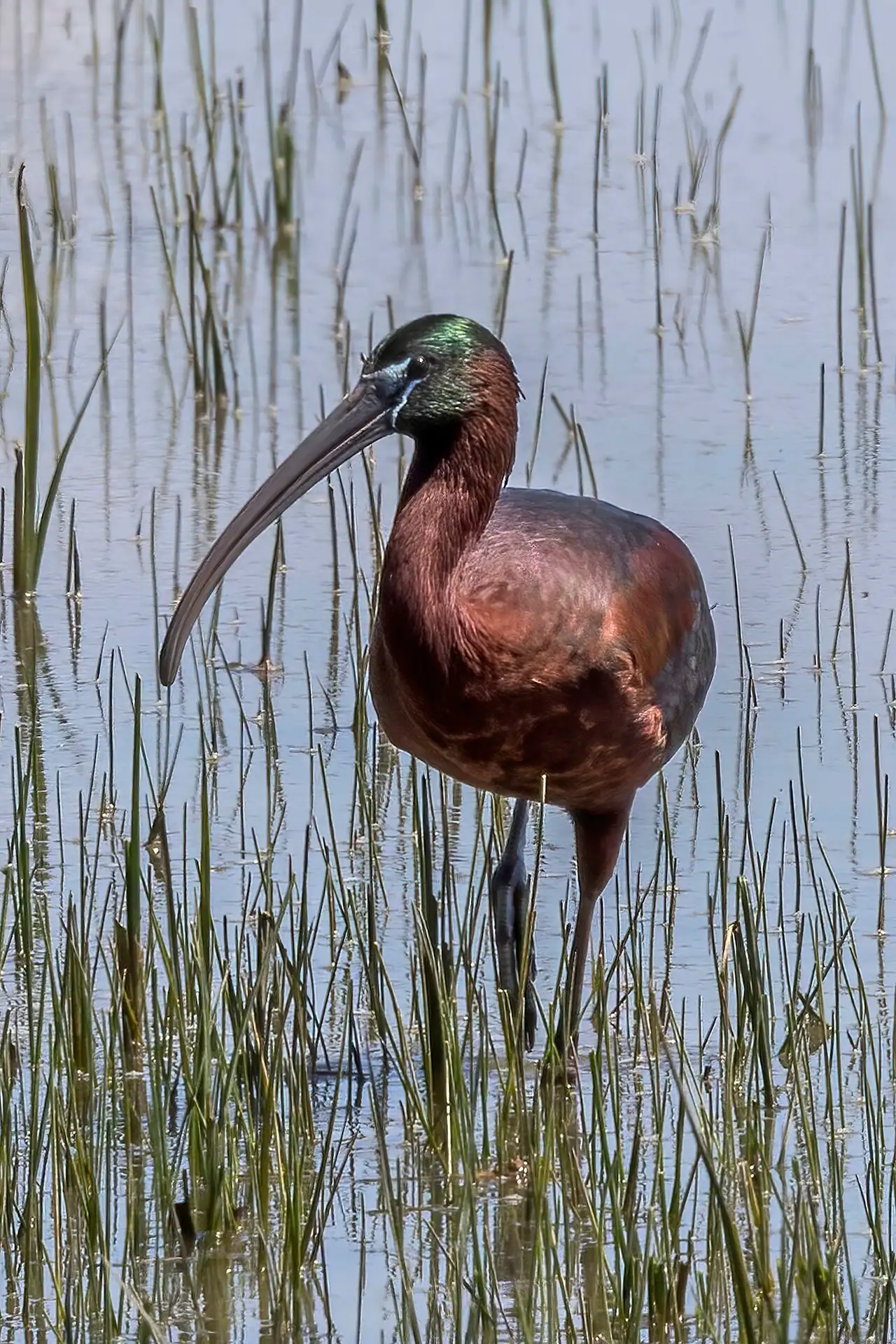
Adult Glossy Ibis among rushes, in profile, with long, curved bill, very reddish-brown plumage and head with greenish sheenPhoto: Charles J. Sharp, CC BY-SA 4.0Photo 1 of 4
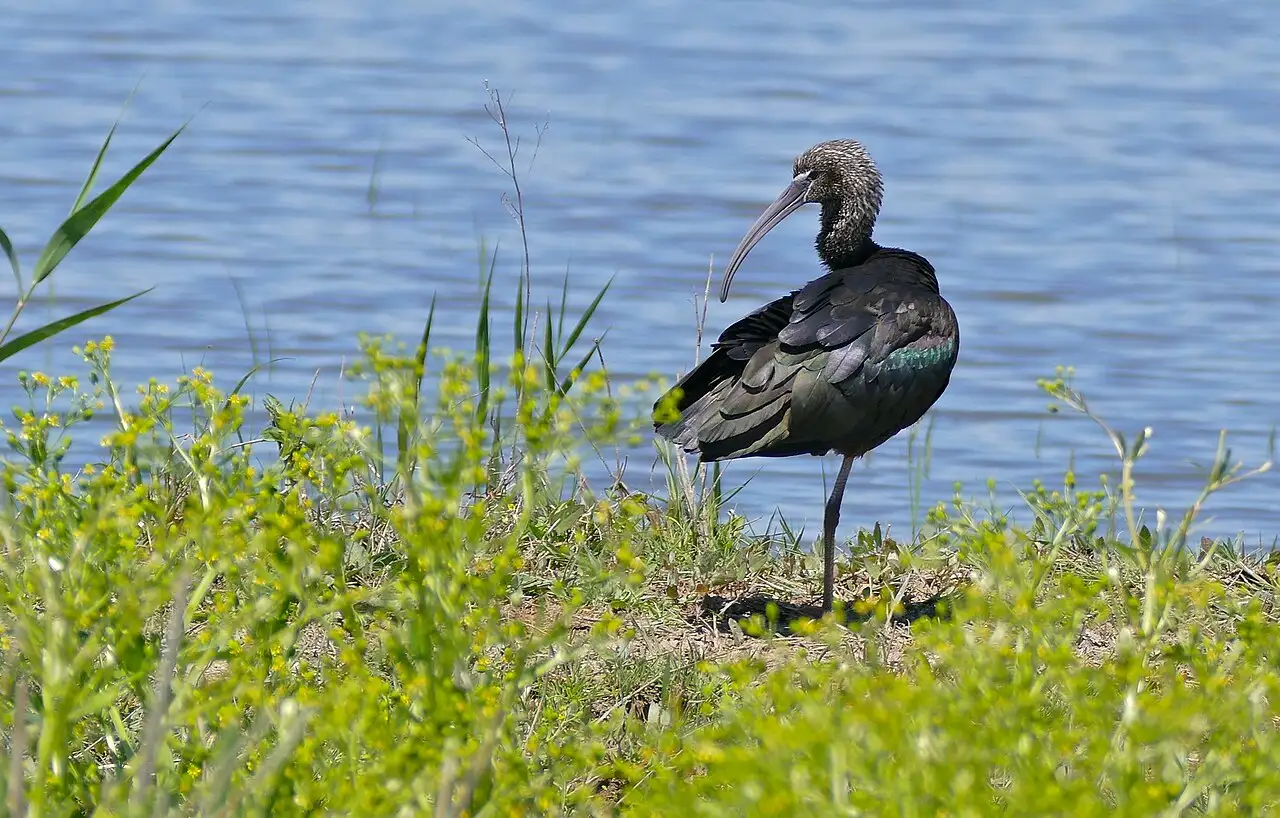
Glossy Ibis of dark, dull plumage beside the water, with speckled head and long, curved bill, on the grassPhoto: Bernard DUPONT from FRANCE, CC BY-SA 2.0Photo 2 of 4
Glossy Ibis in flight against a blue sky, with wings up, head somewhat drooped and long, curved billPhoto: Fran naturaleza, CC BY-SA 4.0Photo 4 of 4
1 / 4
Identification of the Glossy Ibis
The Glossy Ibis is a wader with a long, curved bill and brown and reddish tones. The breeding adult is brown, very reddish, with iridescent, greenish and pinkish tones on the wings and back. On the face it has some very striking white lines that edge the gape of the bill, which is greyish orange, and its legs are dark. The non-breeding adult is much duller, with a darker bill, without the white lines along its edge and with numerous elongated white flecks on the neck and head. Young birds are even duller than non-breeding adults. In flight it looks very elongated and slender, with the head slightly drooped.
Breeding adult
Very reddish brown, with greenish and pinkish iridescence on the wings and back.
White lines on the face, beside the gape of the bill.
Non-breeding adult and young bird
Duller, with a darker bill and elongated white flecks on the neck and head.
Young birds, even duller.
Habitat and distribution of the Glossy Ibis
It is a cosmopolitan species of wide but very fragmented distribution. It habitually breeds in southern and eastern Europe, Africa and Madagascar, central and southern Asia, the Philippines, Indonesia, New Guinea and Australia, and also in North America and the Caribbean islands. In Spain the subspecies «falcinellus» is cited, which appears in the Palearctic, North America and the Caribbean.
In Spain it breeds in Doñana, which holds the largest colony, the Ebro delta and wetlands of the Valencian Community, Castilla-La Mancha (Guadiana vega) and Extremadura (Tagus vegas)1. On migration passage it is seen in many wetlands, above all on the coast and in the south. In winter its gregarious nature becomes more marked, and it sets up roosts on islands of marsh vegetation in wetlands, generally freshwater, and in the rice fields where it feeds.
In Spain colonies are set on tamarisks, cattail beds, reedbeds or saltbush thickets, and there are breeding records on sea rush; at other cores it nests in trees and on other substrates. In winter it feeds in rice fields, pools and shallow freshwater marshes.
It is a migratory and dispersive bird that also makes nomadic movements. The Iberian populations are resident. The return to the colonies occurs en masse in early April, although birds are seen from December, and ringing suggests contact between the populations of eastern Europe and Spain.
Areas where it is regularly recorded since 2010Squares of about 25 km where it is recorded regularly (occasional passage records are left out). Data from GBIF.org (169,150 records, retrieved October 2026); outline from Natural Earth.
Etymology of the Glossy Ibis
According to Wikipedia, the scientific name comes from ancient Greek «plegados» and Latin «falcis», which mean «sickle», and alludes to the characteristic shape of the bill. In other languages it is «capó reial» in Catalan, «ibis mouro» in Galician, «beltzarana» in Basque and «glossy ibis» in English1. It is the only ibis that occurs naturally in Europe1.
Population of the Glossy Ibis
The 2021 European Red List of Birds estimates some 60,200–120,000 Glossy Ibises in Europe. In Spain, in 2014–2016 the wintering population was concentrated mainly in Doñana (85 % of the total) and the Ebro delta (5 %). The breeding one is even more concentrated: in 2007 3,777 pairs were estimated, 96.45 % of them in Doñana. Since then it has been growing rapidly as a breeder and as a winter visitor, with figures that have not yet been quantified, and its geographical expansion has also been notable, perhaps associated with the severe droughts at the main breeding sites1.
It is a bird increasing strongly in Spain, but the high concentration of pairs makes it sensitive to any local incident, natural or human. The possible reduction of the rice area through changes in the Common Agricultural Policy is also cited, along with water pollution (in 1998, in the Doñana colony, near the Aznalcóllar toxic spill, very high levels of cadmium were detected in all the chicks), rice-field plant-protection products and the reduction, during the 20th century, of nesting and feeding habitat in wetlands1.
Nest of the Glossy Ibis
It is a pile of interwoven material, lined with still-green plant matter, some 30 centimetres across and 5–8 deep. Both sexes build it, although the male is in charge of bringing the material.
Courtship and breeding of the Glossy Ibis
It is a colonial species, but with little fidelity to its breeding colonies, where herons and White Storks also breed. Laying is very extended, from early April to mid-July, of three to six bright blue eggs, which both sexes incubate, mainly the female, for 21 days. The chicks are cared for by both parents, and one is always present during the first five days. They spend around a couple of weeks in the nest, then explore the branches around, but return to be fed. The plumage develops in some 28 days and they are in or near the nest for some 50, when they leave it with their parents to go to the feeding areas. The great majority fly in mid-June, although nesting can run on until mid-August.
Diet of the Glossy Ibis
It feeds mainly on insects, adults and larvae, and to a lesser extent on small fish and amphibians. In the Guadalquivir marshes beetles and dragonfly larvae are cited, as well as small carp and Iberian ribbed newts. It looks for food in shallow, fresh water, mainly rice fields, moving its bill and head from side to side.
Curious facts about the Glossy Ibis
Although cadmium was detected in the Doñana chicks in 1998, today the species is growing strongly1. BTO gives 633.8 g as the reference weight of adults. AnAge gives 26.8 years of longevity, but in captivity, against EURING’s 15 years and 7 months in a bird ringed in Spain: they are records from different conditions and are not averaged.
The Glossy Ibis in Cabañeros
The habitat pages of this website do not mention it, and we have not found any other published source on it in the Park; nor does it appear in the bird list of the «Visitor guide to Cabañeros National Park» (OAPN). GBIF.org records 8 observations of the Glossy Ibis in Cabañeros and its surroundings. The Guadiana vega, in Castilla-La Mancha, is among the places where it breeds, without specifying localities1. None of those observations falls within the Park boundary (according to OpenStreetMap): all are from the surroundings.
Where to see the Glossy Ibis in Cabañeros
In Cabañeros and its surroundings, on passage and in winter, in ponds, reservoirs and waterlogged freshwater areas.
When
Present in Spain all year; it returns to the colonies in early April.
What time
By day, wading in shallow water and moving its bill from side to side.
Where
In rice fields, pools, marshes and shallow freshwater lagoons.
What to look for
Look for the curved bill and the reddish-brown colour with iridescent sheen; in flight, its elongated silhouette with the head somewhat drooped.



 Same family
 Same order
 Same order
 Same order
 Same season in the park
 Same season in the park
 Same season in the park
 Same season in the park






