Wingspan compared with a person with arms outstretched.
Length
39–46 cm
Wingspan
1.02–1.16 m
Weight
265–345 g
Social life
Colonial when breeding, although sometimes it breeds alone; the male feeds the female during incubation
Lifespan
Record of 16 years and 1 month in the wild (a bird ringed in Germany)
Conservation status
LC
NT
VU
EN
CR
EW
EX
Global (IUCN)
Least Concern
Spain
Vulnerable (VU) in the 2021 Red Book of the Birds of Spain and in the Spanish Catalogue of Threatened Species
When to see it
Summer visitor
Months of the year when it is present
J
F
M
A
M
J
J
A
S
O
N
D
In Iberia
no
no
yes
yes
yes
yes
yes
yes
yes
no
no
no
Song or voice of Montagu’s Harrier
It is not very vocal. The female and the young give a thin whistle, «pii-ii», when they receive food. The alarm call is a rapid «chit-er-it-it-it».
SongMontagu's Harrier
0:00 / 0:22
10 kHz5
The sonogram draws the sound: time runs from left to right, and the higher a trace sits, the higher the note.Recording by AviCanto, Wikimedia Commons (Vídeo de YouTube, con atribución).
Flight of Montagu’s Harrier
It is common to see it gliding low, slowly scanning the ground over farmland, meadows and wasteland. It flies very gracefully and skilfully thanks to its low wing loading, with the wings held in a «V».
Flight typeGraceful low glide, with wings in a «V»
It takes off from the wheat or barley crop where it sets its nest, or from a low perch.
It glides with its wings in a «V», very graceful and skilful thanks to its low wing loading, slowly surveying ploughed fields, meadows and wasteland.
When it spots a vole, a mouse, a lizard or a locust, it drops onto it.
Photo gallery of Montagu’s Harrier
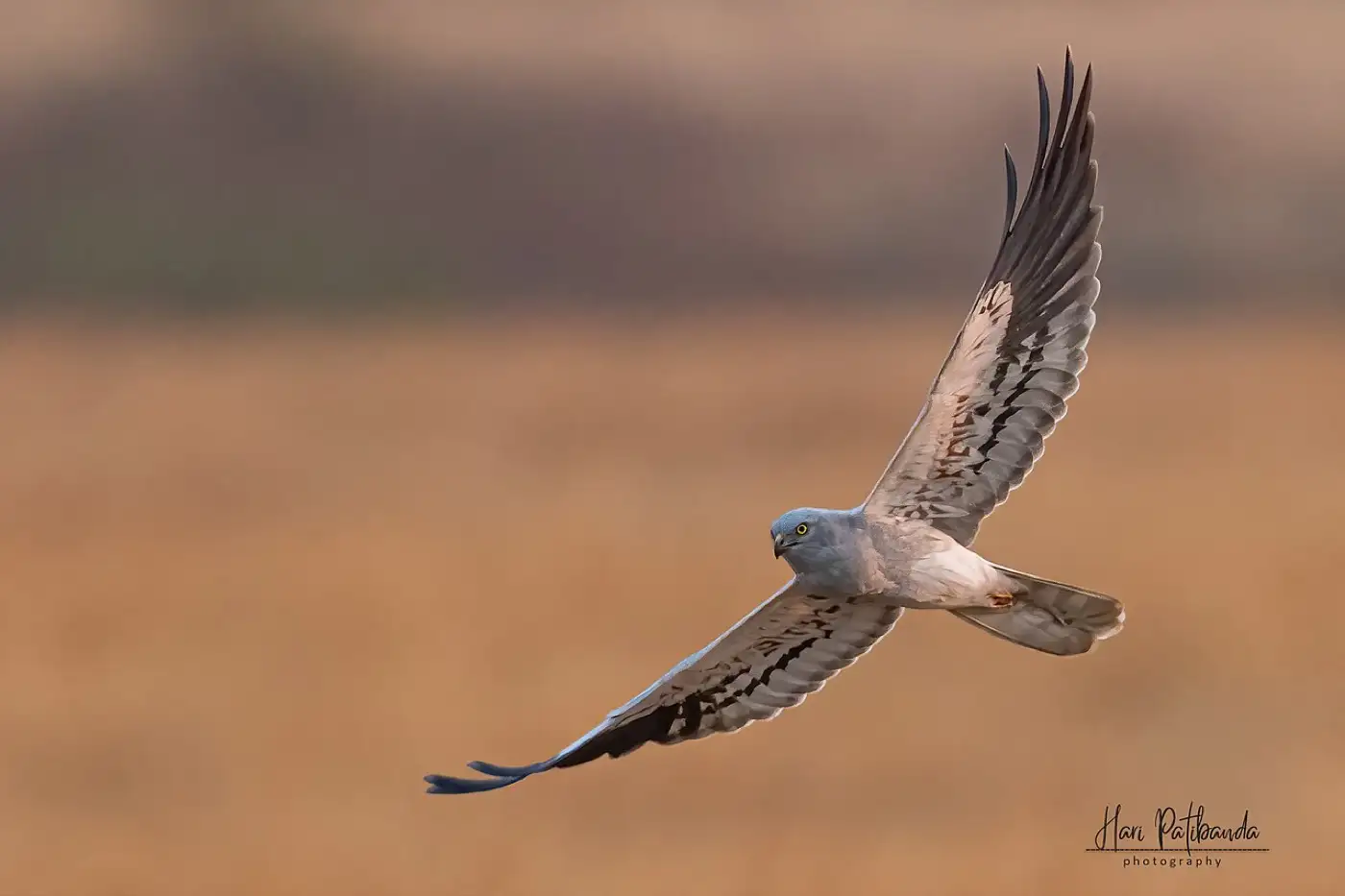
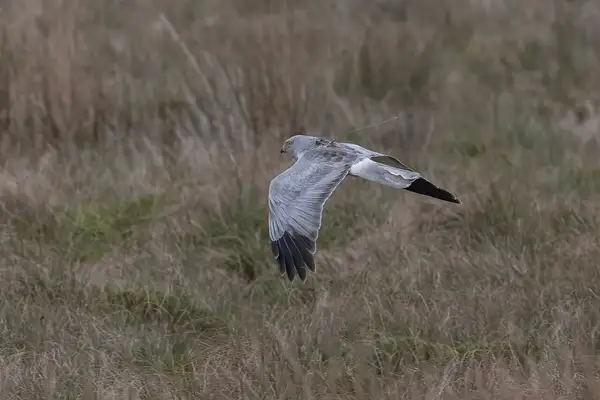
Male Montagu's Harrier in flight, with long, narrow wings open, grey above and with black tipsPhoto: Hari K Patibanda, CC BY 2.0Photo 1 of 4
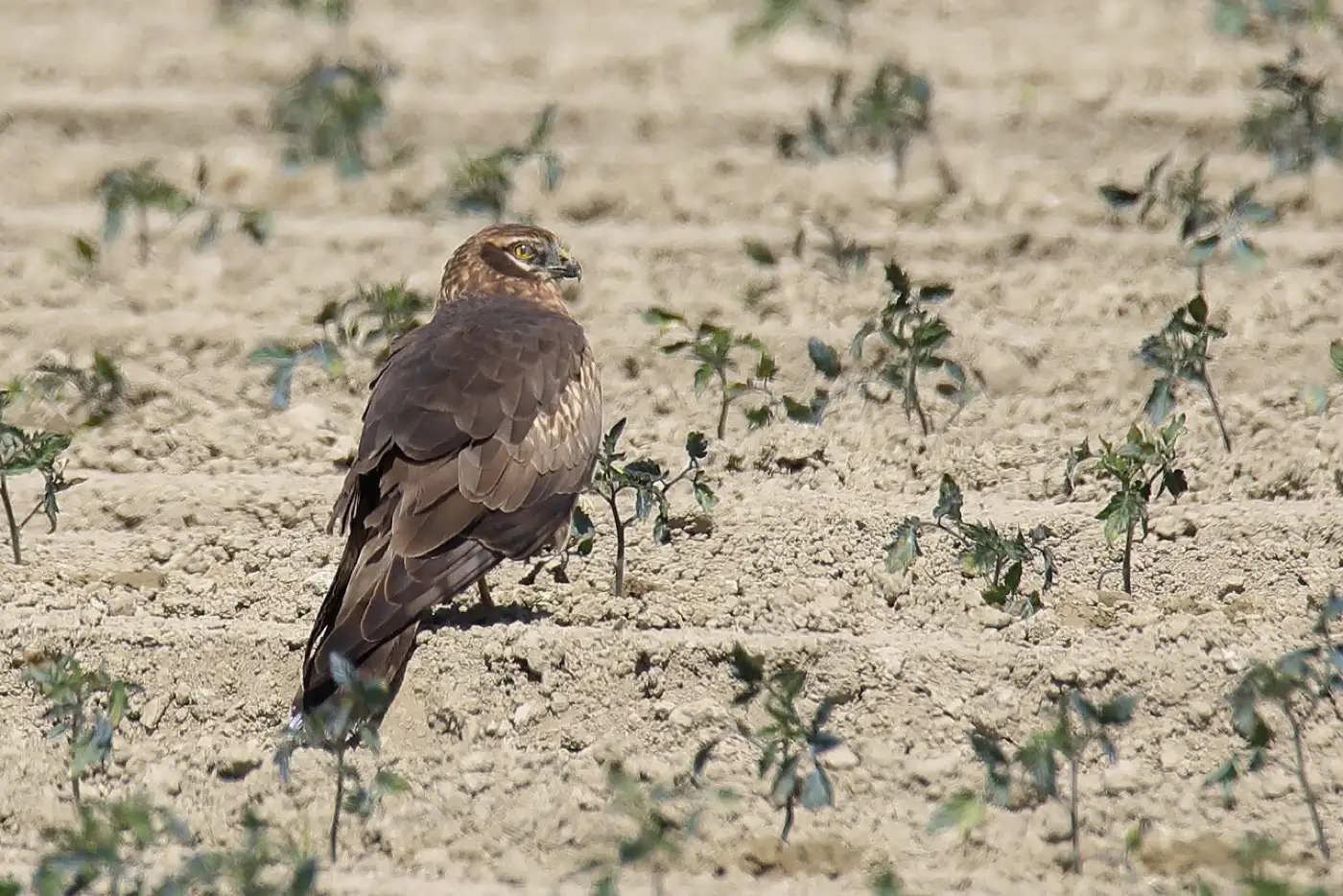
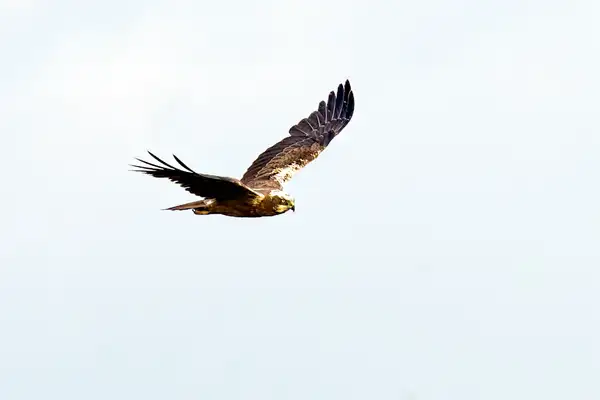
Female or young Montagu's Harrier perched in a field of crops, in brown tones, with its head turnedPhoto: Jac. Janssen from Baarlo lb, NL, CC BY 2.0Photo 4 of 4
1 / 4
Identification of Montagu’s Harrier
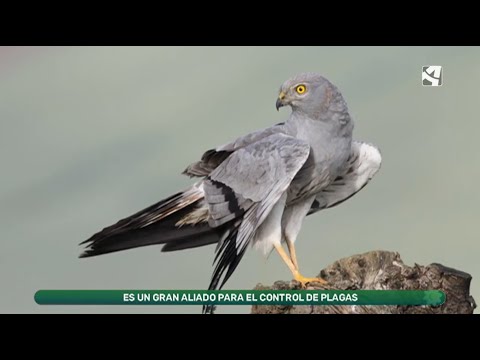
Montagu’s Harrier is a medium-sized bird of prey of particularly slender build, with long, narrow, relatively pointed wings, a very long tail and very long tarsi. Compared with the Hen Harrier, which is slightly larger, it is more graceful and streamlined. The sexes have radically different plumages: males are quite pale, and females, considerably bigger and heavier, show brownish tones. Melanistic birds are not uncommon.
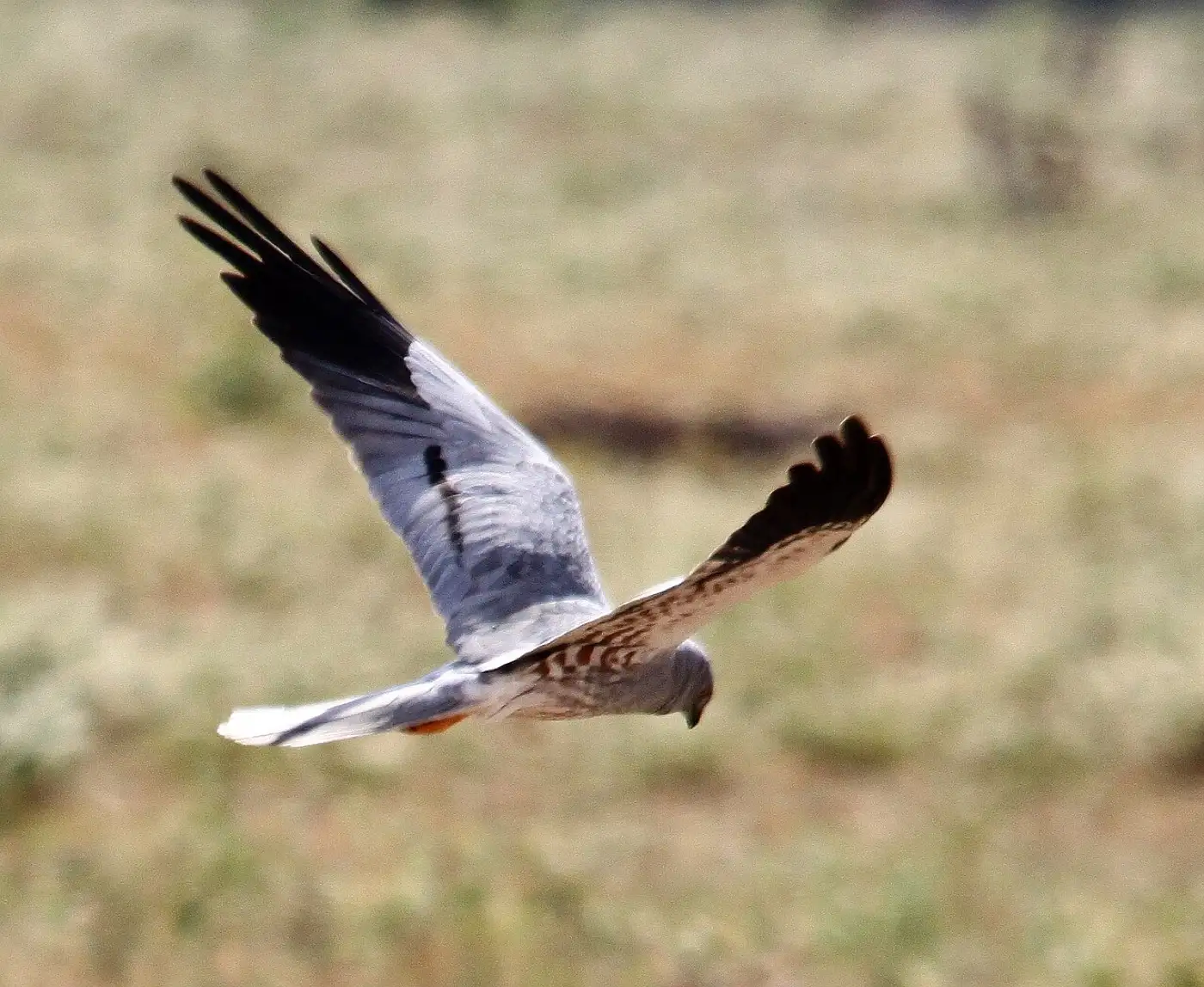
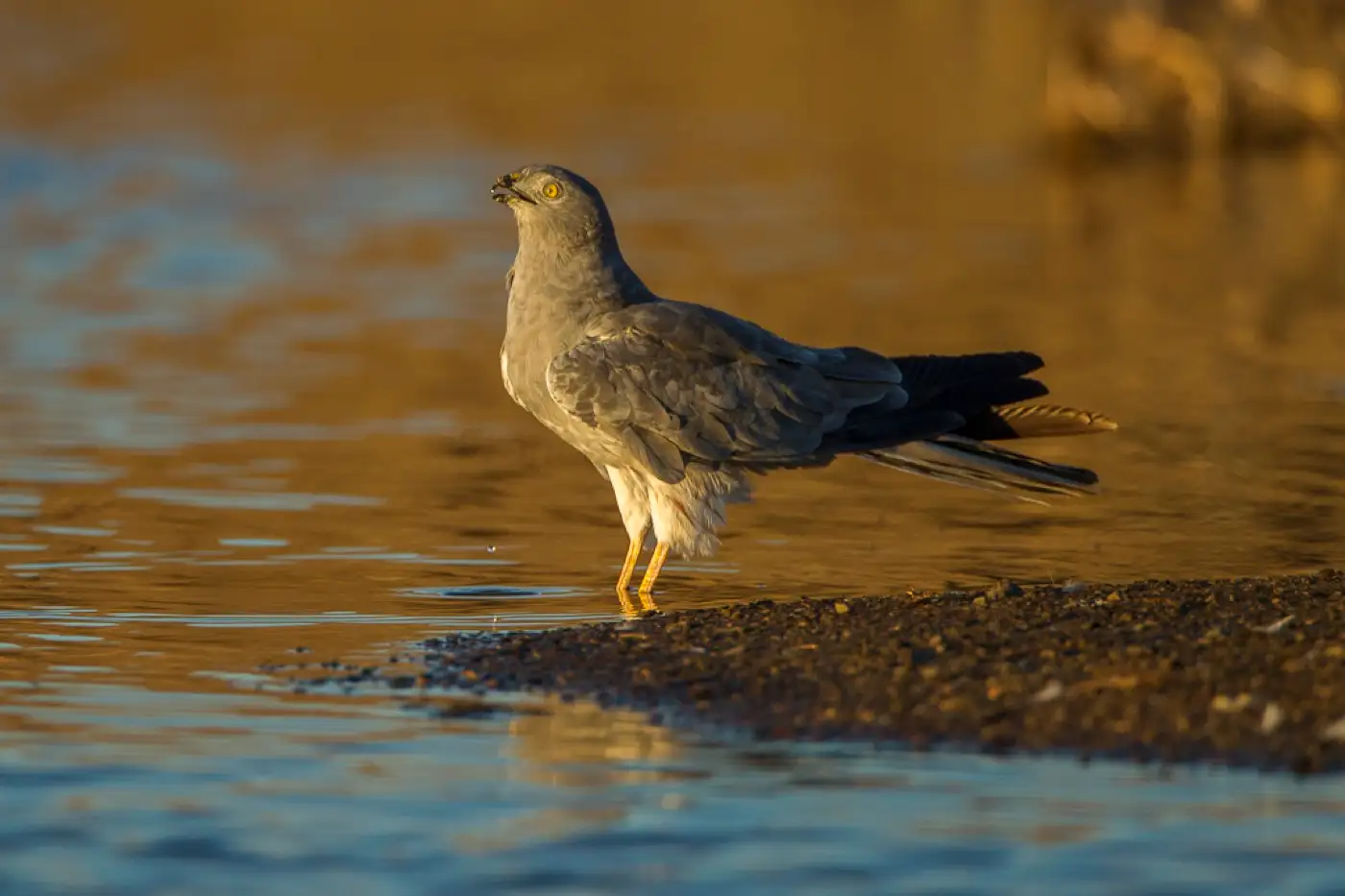
The typical adult male is ash-grey on the back, with the underparts somewhat paler and a series of elongated chestnut spots that become stronger towards the flanks. In flight, the undersides of the wings look heavily barred, with the underwing coverts crossed by reddish lines and the secondaries with three transverse bars (two broad black ones and a paler terminal one). The primaries are dark and the tail shows slight brownish barring. Above, the wings are greyish, with dark primaries and a black bar along the secondaries.
The typical adult female has brownish tones, ochre-pale underparts with abundant reddish-brown streaking, and in flight heavily streaked underwing coverts and densely barred flight feathers and tail. The upperparts are relatively dark and the white rump stands out very clearly. It is sometimes hard to tell from the female Hen Harrier, but it is smaller, has a smaller rump and more evident bars on the armpits. The young bird is similar to the female, but with less streaking on the underparts, which are a very intense reddish brown, and with very dark secondaries.
Male
Ash-grey above; paler underparts with chestnut spots towards the flanks.
In flight, wings with black bars on the secondaries and dark tips.
Female and young bird
Brown female, with reddish-brown streaking and a clearly visible white rump.
Young bird similar to the female, less streaked and a very intense reddish brown below.
Habitat and distribution of Montagu’s Harrier
It is a species with a Eurasian distribution, spreading discontinuously from the Iberian Peninsula and northern Morocco to central Asia. Its best populations are in Russia, and the most numerous cores in western Europe are in France and Spain. No subspecies have been described.
As a breeder, in Spain it spreads across a good part of the peninsular territory, but it is very rare on the Cantabrian coast, over much of the Levante and the south-east and in mountain regions, where it is completely absent above 1,200 metres. The area between the southern slope of the Cantabrian range, including almost all of Galicia, and the Central System, and the Guadalquivir valley have a more even occupation today. It occasionally breeds in the Balearics and is absent from the Canaries, Ceuta and Melilla.
It is a bird of large open and, in general, treeless expanses, from mountain grassland and heathland to reedbeds. In Spain, however, it is particularly tied to cereal crops (above all wheat and barley), which are its main habitat, although a small fraction of the birds settle in scrub, pasture or wetlands, in mountain regions of the north and in coastal areas.
It is a trans-Saharan migrant, and the Iberian birds winter in West Africa. It appears from the end of March, with the greatest influx in April, and leaves the breeding areas in mid-July. Unlike other raptors, it does not concentrate only at the Strait to cross: the passage takes place on a broad front, bringing birds down on both the Moroccan and Tunisian coasts.
Areas where it is regularly recorded since 2010Squares of about 25 km where it is recorded regularly (occasional passage records are left out). Data from GBIF.org (72,348 records, retrieved October 2026); outline from Natural Earth.
Etymology of Montagu’s Harrier
«Circus» comes from the Greek «kírkos», «circle», from the circular flight of a bird of prey, probably the Hen Harrier. «Pygargus» comes from the Greek «pygargos», made of «pygé», «rump», and «argós», «bright white»: the one with the white rump.
Population of Montagu’s Harrier
The 2021 European Red List of Birds estimates that there are about 139,000–219,000 Montagu’s Harriers in Europe, with a decreasing trend. In Spain, the last census estimated about 5,000 breeding pairs (Third Atlas of Breeding Birds in Spain), close to 40 % of them in Castilla y León; Andalusia, Extremadura and Castilla-La Mancha also have important populations. That census showed a decrease of about 24 % from the previous one (2006), more marked in the Eurosiberian zone (Galicia included) and the southern Mediterranean (with Extremadura and Andalusia). The main threats are related to its dependence on cereal crops and to agricultural intensification: mechanised harvesting and early-ripening varieties prevent the chicks from completing their development before the harvest, with the loss of numerous broods under the blades.
Nest of Montagu’s Harrier
The nests, widely scattered within the colony, are small heaps of vegetation (basically cereal stems), set directly on the ground and lined with grasses. The females, who prepare them, flatten the surrounding stalks to make access easier.
Courtship and breeding of Montagu’s Harrier
It is colonial when breeding, although it also breeds alone, with a very irregular spatial distribution. The density of occupation depends on the availability of food on return from the wintering grounds, and so it varies greatly from one year to another, even to total absence. Pairs form in early April, when the females return to the breeding territories previously occupied by their mates. Laying takes place between the end of April and mid-May, and usually consists of four or five bluish-white eggs, which the female incubates for 27–40 days, while the male provides her food. The chicks are cared for by the female and fed by both adults, and make their first flights at a little over a month old; they are independent a week later.
Diet of Montagu’s Harrier
The diet is quite varied and depends on the local and seasonal supply of prey. The most important catches are small and medium-sized vertebrates, above all mice and voles, but also lizards, snakes and small and medium-sized birds, which it supplements with large quantities of insects, above all locusts and grasshoppers. It includes more small mammals in the north of the Peninsula and more invertebrates in the south. Large concentrations of locusts in the wintering regions are an essential source of food.
Curious facts about Montagu’s Harrier
Few raptors are as tied to human activities as Montagu’s Harrier: lacking large grasslands, it sets its nests in wheat and barley crops and, in return, removes huge numbers of voles, mice, locusts and seed-eating birds. It was declared Bird of the Year 2023 by SEO/BirdLife.
Montagu’s Harrier in Cabañeros
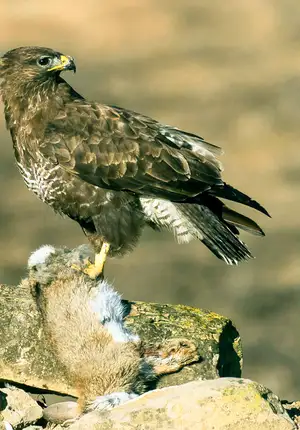
This website’s page on grasslands lists it, together with the Common Buzzard, among the raptors that in summer consume a high percentage of insects in the grasslands of Cabañeros.
Where to see Montagu’s Harrier in Cabañeros
In the grasslands and the raña of Cabañeros, in spring and summer.
When
From March to September: it arrives at the end of March and leaves in mid-July.
What time
Throughout the day, gliding low over farmland and meadows.
Where
In large open expanses, above all wheat and barley crops.
What to look for
A slender grey or brown raptor that glides low over the cereal with its wings in a «V».
They are similar in song and appearance1. It is slightly larger, less graceful, with comparatively broader wings; the female can be confused with Montagu’s, but is bigger and has a larger rump.




 Same family
 Same family
 Same family
 Same family
 Also in grasslands and rañas
 Also in grasslands and rañas
 Also in grasslands and rañas
 Also in grasslands and rañas





