Wingspan compared with a person with arms outstretched.
Length
35–39 cm
Wingspan
54–60 cm
Weight
140–170 g
Social life
Brood parasite: it lays its eggs in Magpie and other corvid nests; one pair may parasitise up to 25 nests in a season
Lifespan
About 6 and a half years maximum age in the wild (oiseaux.net)
Conservation status
LC
NT
VU
EN
CR
EW
EX
Global (IUCN)
Least Concern
Spain
Least Concern (LC) in the Red Book of the Birds of Spain; included in the List of Wild Species under Special Protection and not in the Spanish Catalogue of Threatened Species
When to see it
Summer visitor
Months of the year when it is present
J
F
M
A
M
J
J
A
S
O
N
D
In Iberia
no
yes
yes
yes
yes
yes
yes
yes
yes
no
no
no
Song or voice of the Great Spotted Cuckoo
It is a boisterous, garrulous species, which gives various sounds to communicate: a repetitive croak like the corvids’, «arr, arr, arr»; a ringing «ki-ki-kri-krie-krie», whose rhythm slows towards the end of the phrase; and a grating «cherr-cherr, chi-chi, cherrrr». The recording is from Chozas de Abajo (León).
SongGreat Spotted Cuckoo
0:00 / 0:09
10 kHz5
The sonogram draws the sound: time runs from left to right, and the higher a trace sits, the higher the note.Recording by João Tomás, Wikimedia Commons (CC BY 4.0).
Flight of the Great Spotted Cuckoo
It is very like the Common Cuckoo, from which it differs by its more slender look, its longer tail and the colouring of the plumage. It is migratory: the post-breeding migration is quite early, may start in July and runs until September.
Flight typeAmong trees, in open areas with magpies
It leaves a branch in open or semi-wooded areas, with crop fields, copses and dehesas, giving a repetitive croak, «arr, arr, arr».
It flies from one tree to another through areas where magpies abound, whose nests it parasitises; the long tail and the white spots on the back and wings can be seen.
It lands on a branch, with the crest slightly erectile; it is a boisterous, garrulous species, which feeds almost exclusively on caterpillars.
Photo gallery of the Great Spotted Cuckoo
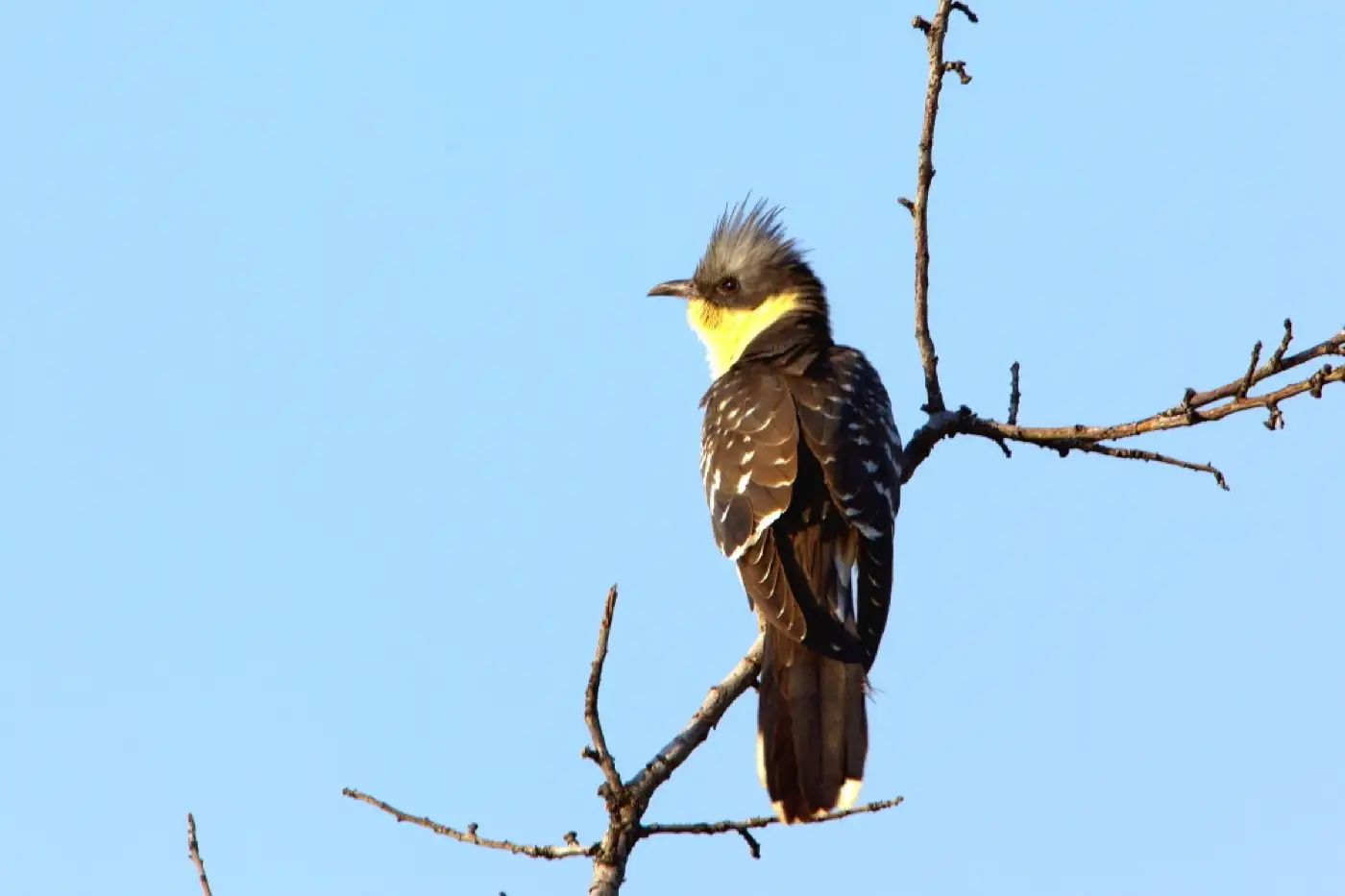
Great Spotted Cuckoo perched on a bare branch against the blue sky, with crest erect, yellow throat and long tailPhoto: Carles Pastor, CC BY-SA 4.0Photo 1 of 4
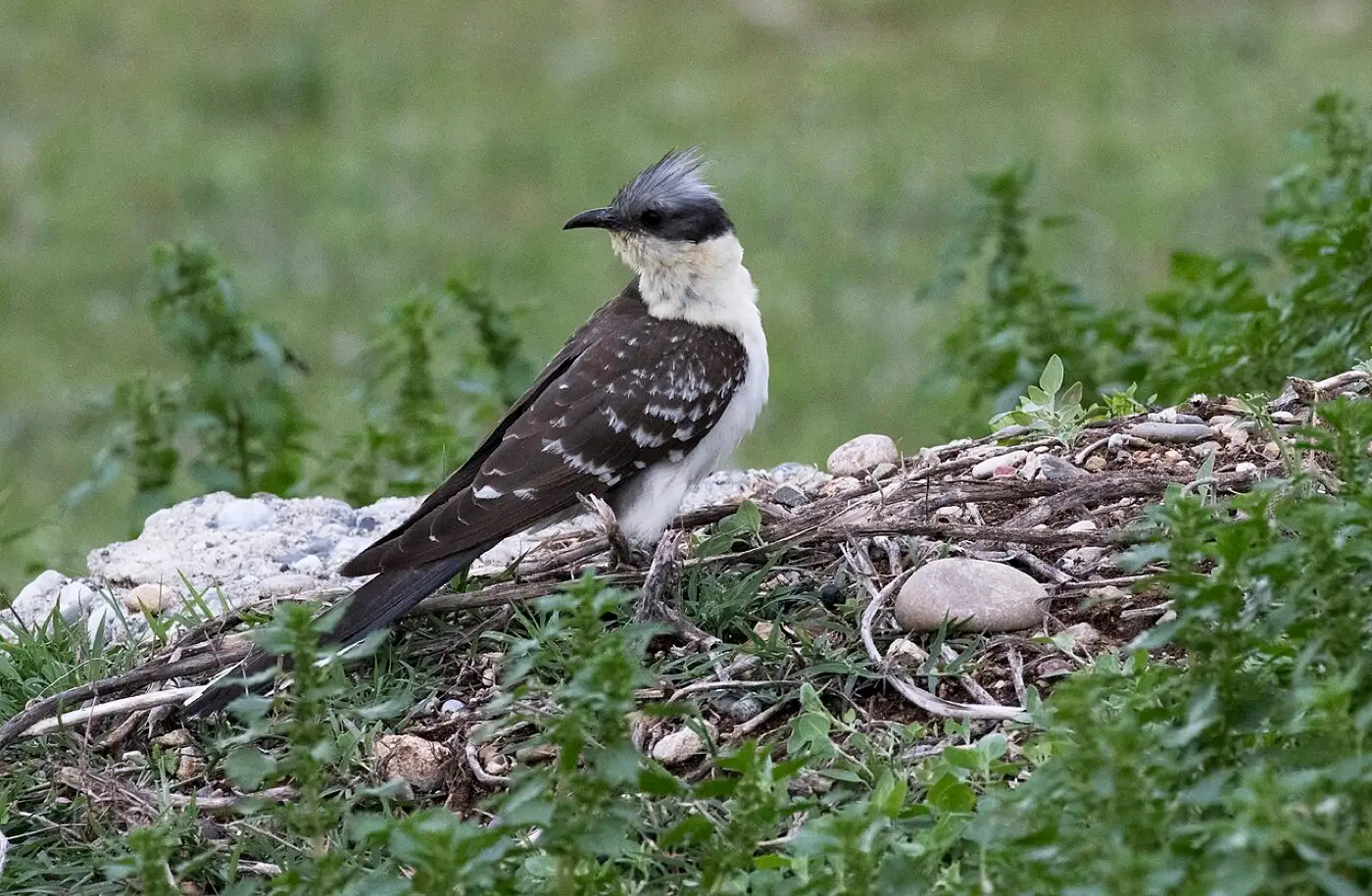
Great Spotted Cuckoo on a pasture, with silver-grey cap, crest and brown back spotted with whitePhoto: Zeynel Cebeci, CC BY-SA 4.0Photo 4 of 4
1 / 4
Identification of the Great Spotted Cuckoo
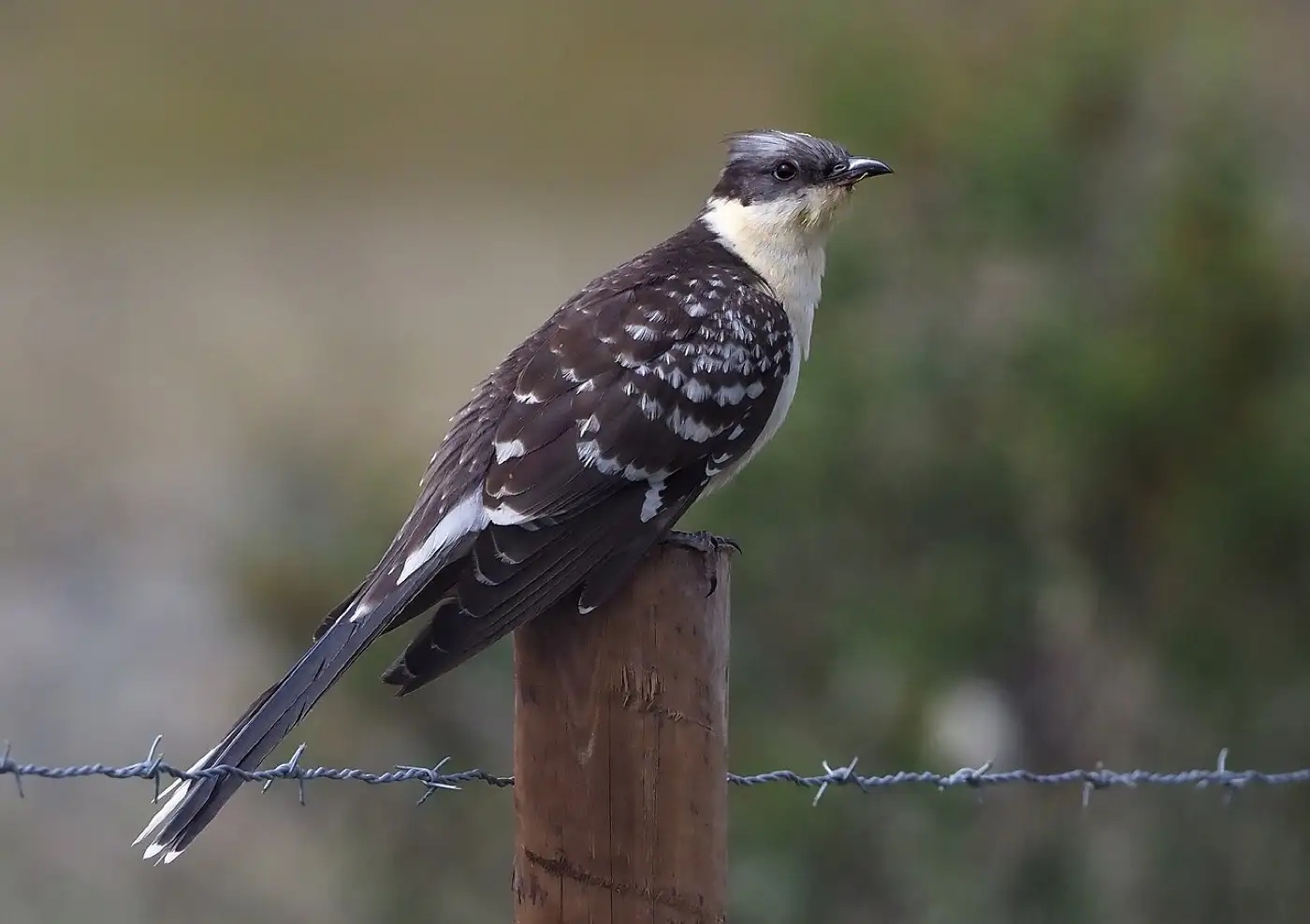
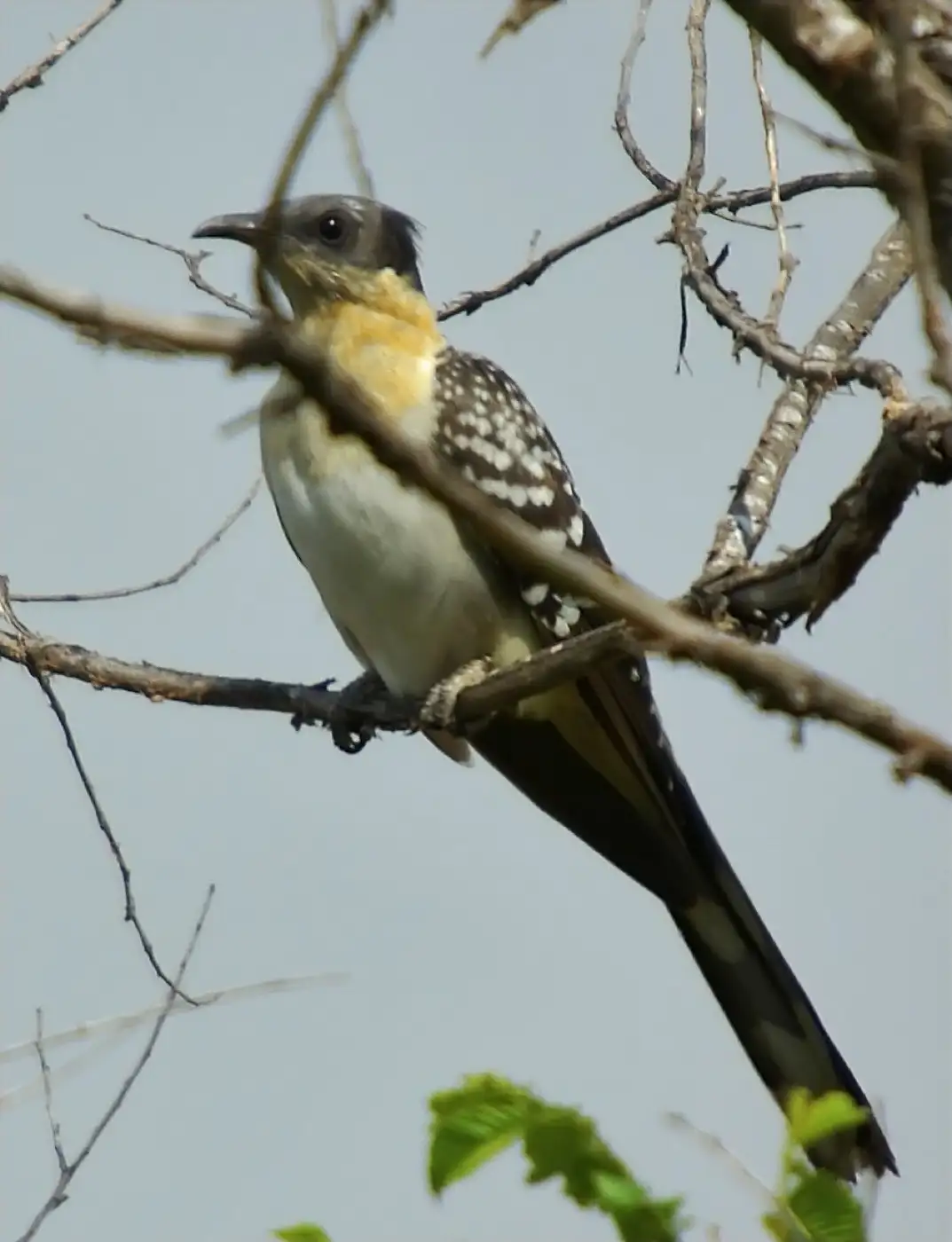
The Great Spotted Cuckoo is a medium-sized bird, morphologically very like the Common Cuckoo, from which it differs by its more slender look, its longer tail and the colouring of the plumage. This is greyish brown on the upperparts, sprinkled with white spots, as are the wing feathers. The underparts are whitish, with the throat tinged yellowish ochre. On the head it wears a silver-grey cap, topped with a small, slightly erectile crest, and a red eye-ring.
The young bird has even showier colouring than the adults: a deep chocolate colour with abundant white spots on the back and white underparts, which turn yellowish ochre on the breast and neck. The flight feathers are a showy reddish colour, the cap is black and the eye-ring more conspicuous than the adults’.
Adult
Greyish-brown back spotted with white; underparts whitish and throat yellowish ochre.
Silver-grey cap with slightly erectile crest and red eye-ring.
Young bird
Chocolate colour with white spots; reddish flight feathers and black cap.
Habitat and distribution of the Great Spotted Cuckoo
The species is distributed across different regions of central and southern Africa, with some isolated populations in the north of the continent and in the Middle East. In Europe it is a summer visitor that appears in different regions of the Mediterranean basin, such as the Iberian Peninsula, Turkey, southern France, Italy and Cyprus. Several subspecies are recognised, of which «glandarius» is the one present in Europe and the northern half of Africa.
In Spain it is distributed across much of the peninsular territory, although very scarce along the whole northern strip and Galicia, and it avoids high-altitude mountain areas. In the southern half its distribution is quite fragmentary, although it can be abundant in some places. It does not appear as a breeder in the Canaries, Ceuta and Melilla; in the Balearics it is found occasionally, but does not breed. Its distribution overlaps largely with that of the species it parasitises, the Eurasian Magpie and the Carrion Crow, and its expansion towards the coastal areas of Cádiz and Málaga seems to run parallel to that of its main host, the Magpie.
It settles where the species it parasitises abound, in particular the Magpie, so it is more frequent in open or semi-wooded areas, with crop fields, copses of different species (preferably pine woods), dehesas, river plains and mosaic farming landscapes, from sea level to 1,300 metres.
The most distant populations in the range (Mediterranean and southern African) migrate and winter in the tropical regions of Africa; it is possible that a small number of birds spend the whole winter in the south of the Peninsula. The return to the breeding areas takes place through February.
Areas where it is regularly recorded since 2010Squares of about 25 km where it is recorded regularly (occasional passage records are left out). Data from GBIF.org (14,419 records, retrieved October 2026); outline from Natural Earth.
Etymology of the Great Spotted Cuckoo
«Clamator» is a Latin word meaning «shouter», from «clamare», «to shout». «Glandarius» is the Latin «of the acorns»: Linnaeus described it as «Cuculus glandarius», and the genus Clamator was introduced later, in 1829.
Population of the Great Spotted Cuckoo
In the 2021 European Red List of Birds the European breeding population is estimated at between 293,000 and 316,000 mature individuals, with a decreasing trend. Most of the European birds are in Spain, about 120,000 individuals. Although the trend on the Peninsula is considered stable, since 2008 a decline has been recorded, which might be due to the fall in insect populations through climate change and the abuse of insecticides and pesticides, or to a desynchronisation, caused by climate change, between its breeding and that of its hosts. It has already disappeared from some of its breeding areas, such as North Africa.
Nest of the Great Spotted Cuckoo
It does not build a nest: it practises brood parasitism, that is, it lays its eggs in the nest of another bird, normally a Magpie, which acts as host, incubating and then feeding the cuckoo’s offspring. Besides the Magpie, it can also parasitise other corvids, such as crows, jays or Iberian Magpies.
Courtship and breeding of the Great Spotted Cuckoo
Its breeding biology is closely tied to the Magpie’s life cycle: when Magpies begin their clutches, the cuckoo female produces a high number of eggs, and a single pair can parasitise up to 25 Magpie nests in a season. The eggs imitate those of the parasitised species perfectly and must be placed during their owners’ absence: it is common for the male to draw the attention of the Magpie pair while the female lays one to three eggs in the nest, not without first damaging or throwing out part of the legitimate clutch. After 11–15 days of incubation by the host, the parasite eggs hatch five or six days ahead of the Magpie’s. The cuckoo chicks usually soon do away with the Magpie chicks that have hatched, not by pushing them out of the nest as the Common Cuckoo does, but through competition for food or by suffocation and crushing, thanks to their greater development and bulk. They demand the parasitised pair’s care for a little under three weeks and, a few days after leaving the nest, join their biological parents, with whom they set off on migration to Africa.
Diet of the Great Spotted Cuckoo
It feeds basically on caterpillars of butterflies and moths, including species with stinging or toxic defences that other birds do not touch, so it avoids competition for resources. It commonly rubs certain caterpillars, such as the pine processionary, one of its habitual prey, against the ground or tree bark to strip them of their stinging hairs. It completes its diet with ants, grasshoppers, molluscs and the odd small vertebrate.
Curious facts about the Great Spotted Cuckoo
Spain has the largest European population of the species. It is able to eat caterpillars with stinging or toxic hairs, which no other bird touches. A single pair can parasitise up to 25 Magpie nests in a season.
The Great Spotted Cuckoo in Cabañeros
This website’s page on dehesas lists it as a parasite of Magpie nests and a species of Ethiopian affinity present in the dehesas of the park, and the one on grasslands counts it among the early «lookout» insectivores, on the raña of Cabañeros, together with the tits.
Where to see the Great Spotted Cuckoo in Cabañeros
In the dehesas and the raña of Cabañeros, where there are magpies.
When
From February to September: it arrives as early as February and leaves from July.
What time
Throughout the day, and its croak gives away its presence.
Where
In open or semi-wooded areas with magpies: crop fields, copses (above all pine woods), dehesas and river plains.
What to look for
A slender, crested cuckoo, spotted with white, with a yellowish throat and grey cap, among magpies.
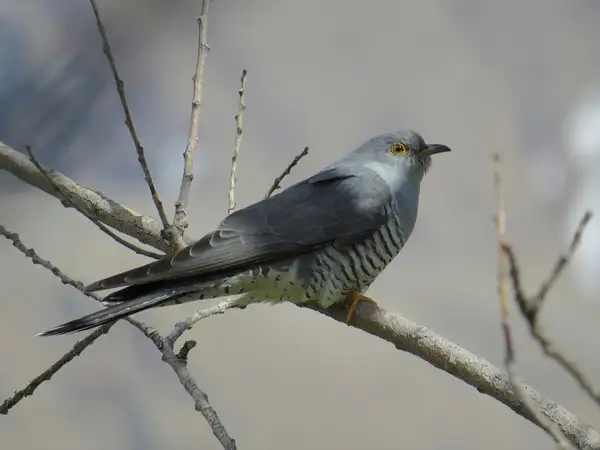
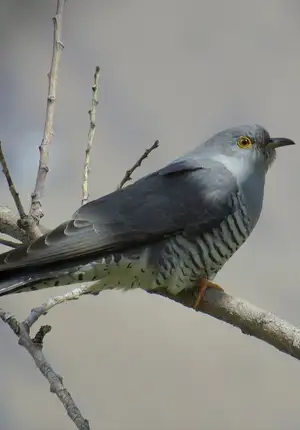
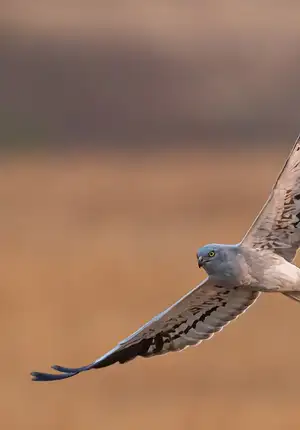
They are similar in appearance1. It is medium-sized and of slender look, with a long tail and pointed wings; the male is grey, above all on the back, head and neck, with the underparts white and finely barred.
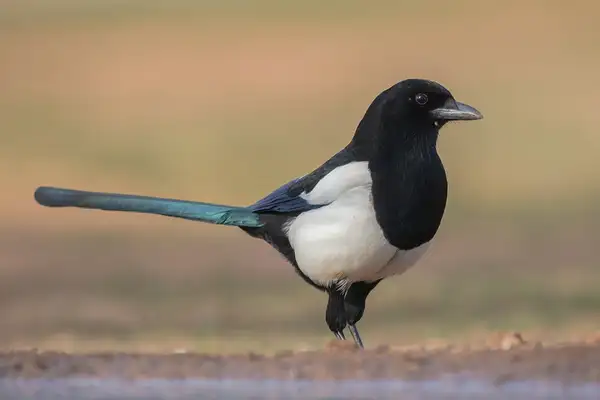
It does not look like it: it is the main host of the Great Spotted Cuckoo. It is mentioned because the cuckoo’s distribution overlaps largely with the Magpie’s, and its eggs imitate the Magpie’s perfectly.
Photo: Diego Delso, CC BY-SA 4.0
Other birds
Birds related to the Great Spotted Cuckoo or sharing its habitats in Cabañeros.



 Same family
 Also in dehesas (wood pasture)
 Also in dehesas (wood pasture)
 Also in grasslands and rañas
 Also in dehesas (wood pasture)
 Also in dehesas (wood pasture)
 Also in dehesas (wood pasture)
 Also in grasslands and rañas





