Wingspan compared with a person with arms outstretched.
Length
38–51 cm
Wingspan
0.89–1.13 m
Weight
0.3–1.5 kg
Social life
Marked reversed sexual dimorphism: the female is quite a bit larger; in February the pair performs noisy display flights
Lifespan
Record of 21 years and 10 months in the wild according to EURING (a bird ringed in Great Britain and Ireland)
Conservation status
LC
NT
VU
EN
CR
EW
EX
Global (IUCN)
Least Concern
Spain
Near Threatened (NT) in the 2021 Red Book of the Birds of Spain; on the List of Wild Species under Special Protection; the Canarian Barbary Falcon is Vulnerable (VU) in the Red Book and Endangered in the Spanish Catalogue of Threatened Species
When to see it
Resident
Months of the year when it is present
J
F
M
A
M
J
J
A
S
O
N
D
In Iberia
yes
yes
yes
yes
yes
yes
yes
yes
yes
yes
yes
yes
Song or voice of the Peregrine Falcon
It gives a repeated «kchap kchiap» and various cries, «wiaaaa wiaaaa» or «ki ki ki ki», both in flight and perched. In the recording a long series of those calls can be heard.
CallPeregrine Falcon
0:00 / 0:15
10 kHz5
The sonogram draws the sound: time runs from left to right, and the higher a trace sits, the higher the note.Recording by Sternanita3, Wikimedia Commons (CC BY-SA 4.0).
Flight of the Peregrine Falcon
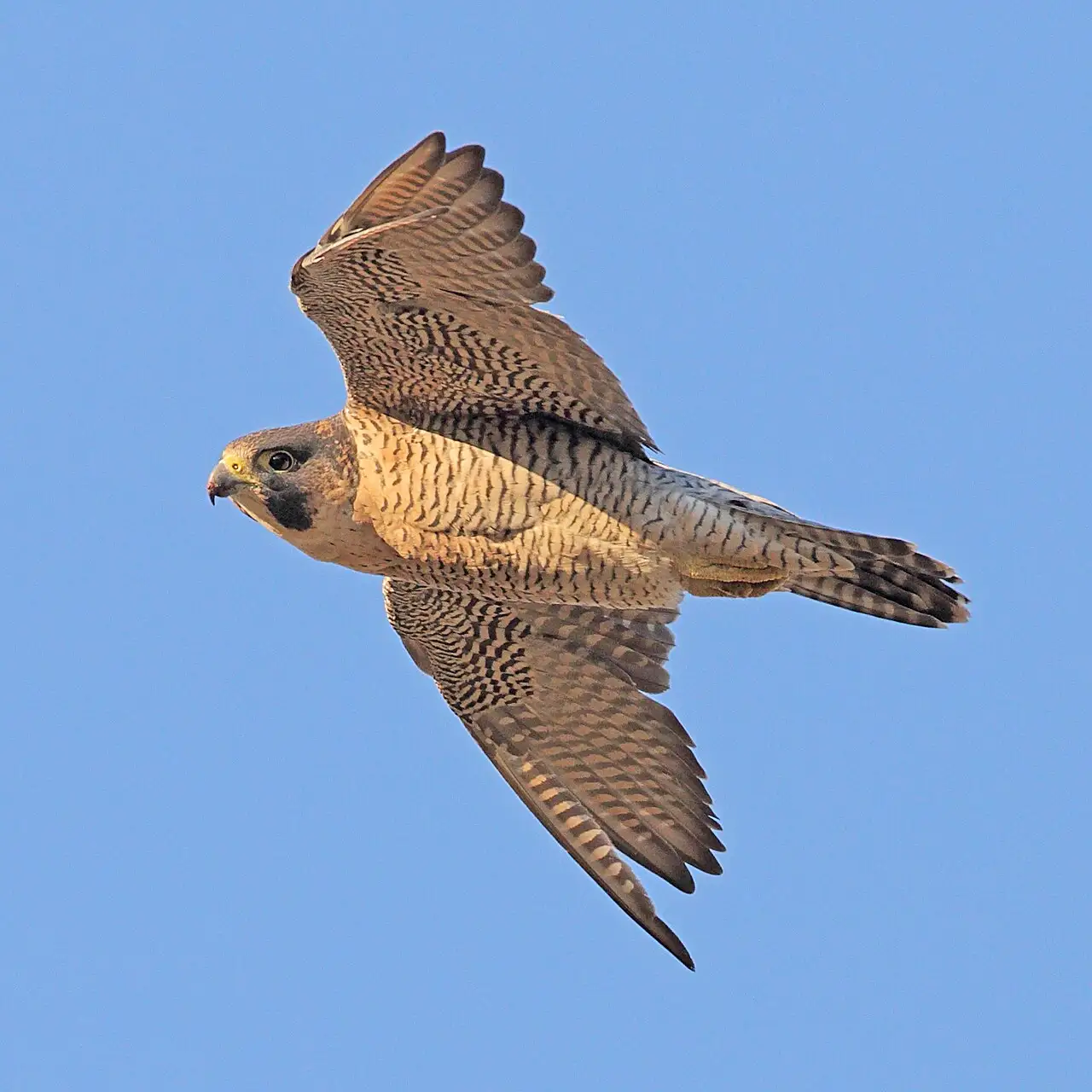
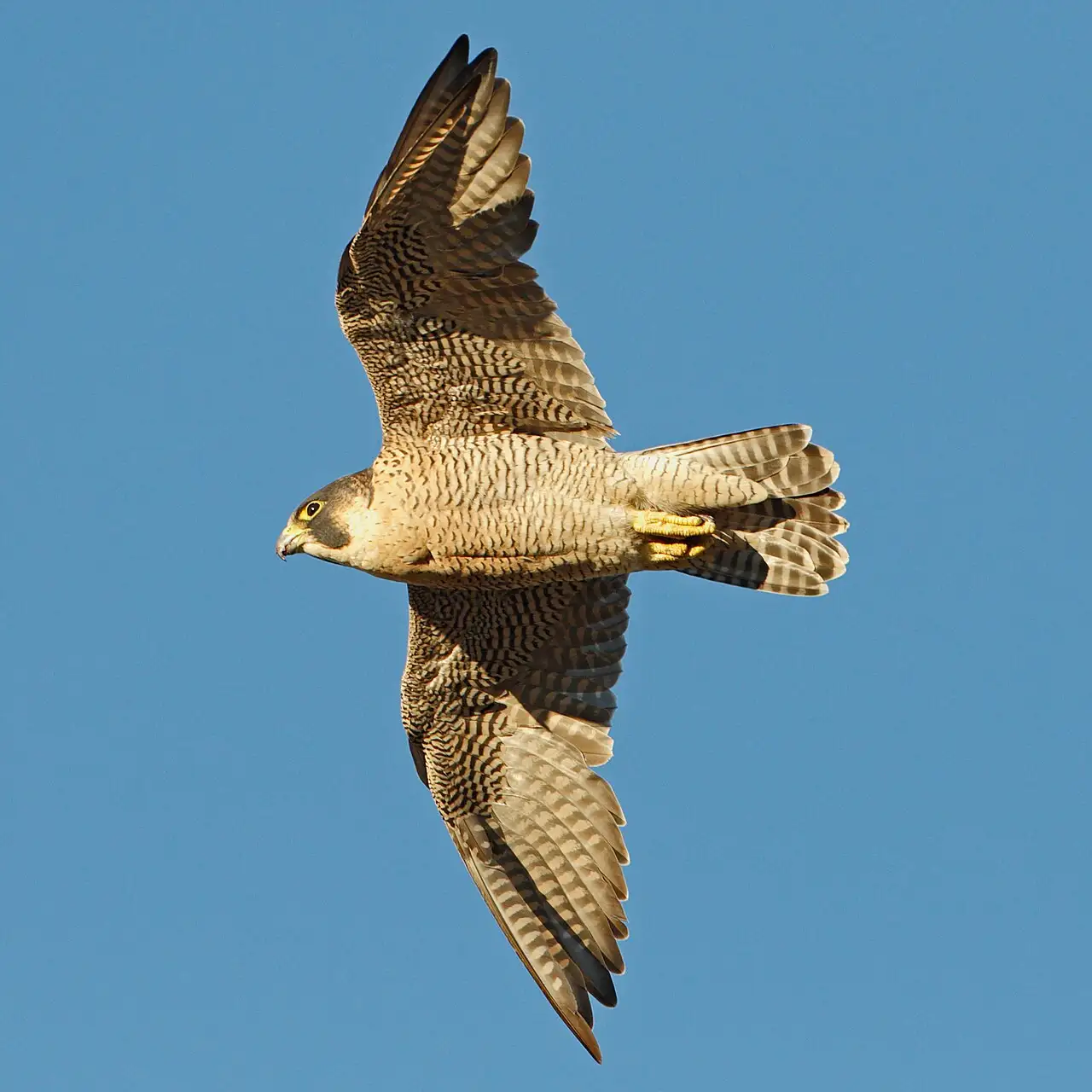
Its flight is fast and powerful, and alternates glides with nervous wingbeats, thanks to very powerful pectoral muscles. The wings are rather short, like the tail, and much broader at the base, beside the broad chest, than at the tip, where they narrow a lot.
Flight typeFast and powerful, with glides and nervous wingbeats
It needs only an open space to hunt in, abundant prey and a cliff, a bank or a building to breed in.
Its flight is fast and powerful, with glides and nervous wingbeats; everything in its body is at the service of speed.
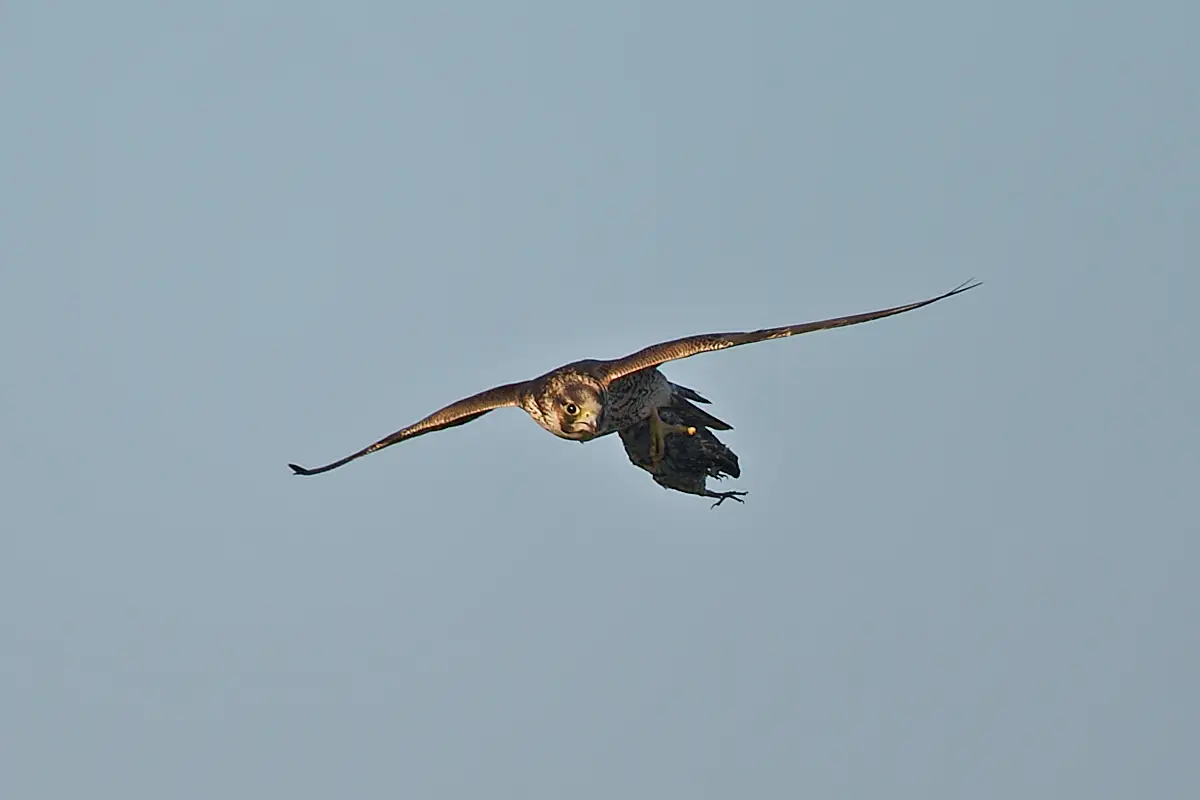
It hunts birds of very different sizes, above all pigeons, which it usually strikes down in flight.
Photo gallery of the Peregrine Falcon
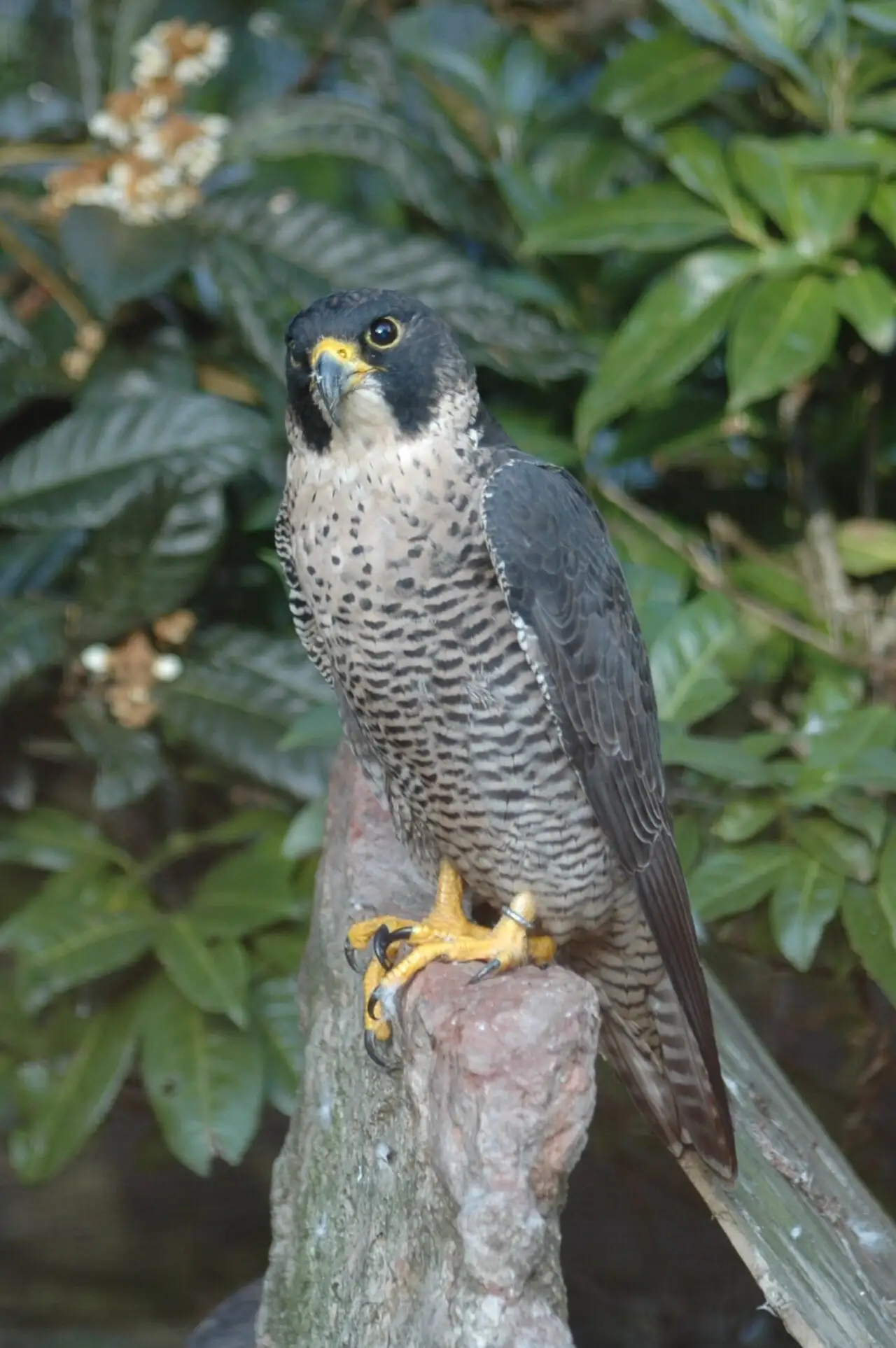
Adult Peregrine Falcon perched on a stump, with slate-grey back, black moustache, white cheeks and finely barred breastPhoto: Francisco M. Marzoa Alonso, CC BY-SA 2.5Photo 1 of 4
Peregrine Falcon in flight with wings spread and a prey in its talons, against the grey skyPhoto: Juan Lacruz, CC BY-SA 3.0Photo 2 of 4
Peregrine Falcon in flight seen from below, with barred wings, short tail and ochre belly with fine barringPhoto: Juan Lacruz, CC BY-SA 3.0Photo 3 of 4
Peregrine Falcon in flight against the blue sky, with wings broad at the base and pointed, and the tail spreadPhoto: Juan Lacruz, CC BY-SA 3.0Photo 4 of 4
1 / 4
Identification of the Peregrine Falcon
It is a medium-sized, robust raptor of compact appearance, with marked reversed sexual dimorphism: females are quite a bit larger and heavier than males. Adults have the upperparts a fairly uniform slate grey, with the edges of the coverts somewhat paler, and the underparts pale, sometimes heavily tinged with ochre or pink, with fine horizontal barring that also extends across the wings. On the head the short but powerful bill stands out, and an extensive moustachial stripe that frames the white cheeks and the eyes, very dark and ringed with yellow. Females usually have coarser breast barring and a broader moustache.
Adult
Slate grey above, pale and finely barred below.
Broad moustache and white cheeks.
Dark eye with yellow ring.
Young bird
Very brown, with the head much less contrasting.
Ochre below, with abundant vertical streaking, and dark brown back with a scaly look.
Habitat and distribution of the Peregrine Falcon
It is a cosmopolitan species that lives on every continent except Antarctica, although it is absent or scarce where forest stops it hunting. Some of its best populations are on the islands of the North Pacific, Australia, the Iberian Peninsula and the British Isles. On the Peninsula, the Balearics, Ceuta and Melilla the subspecies «brookei» breeds, and in the Canaries, «pelegrinoides», the Barbary Falcon; in winter birds of the races «peregrinus» and «calidus» also arrive.
It occupies a good part of Spain with uneven densities. It is more continuous in the Cantabrian area, the Pyrenees, the upper Ebro, the Iberian System, the Betic ranges and the Balearics, and seems more abundant in the eastern half of the Peninsula, where limestones with ledges abound, and on cliffed coasts. It is much more localised on the southern plateau, the Ebro valley, western Andalusia and inland Galicia.
It is not very demanding: it needs only open spaces to hunt in, abundant prey and a site for the nest, such as a cliff, a sandy bank or even a building. That is why it lives in open and cultivated fields, marshes, scree, river gorges, coasts and even cities. It is resident on the Peninsula and the Balearics; young birds make short dispersal movements and in winter birds arrive from northern Europe.
Areas where it is regularly recorded since 2010Squares of about 25 km where it is recorded regularly (occasional passage records are left out). Data from GBIF.org (86,857 records, retrieved October 2026); outline from Natural Earth.
Etymology of the Peregrine Falcon
According to Wikipedia, «Falco peregrinus» means in Latin «travelling falcon» or «wandering falcon», for the migratory habits of many northern populations, like its name in Spanish. The Latin term «falco» is related to «falx», «sickle», from the silhouette of its long, pointed wings in flight. In other languages it is called «falcó pelegrí» in Catalan, «falcón peregrino» in Galician, «belatz handia» in Basque and «peregrine falcon» in English1.
Population of the Peregrine Falcon
According to the 2021 European Red List of Birds, the European population is estimated at between 32,200 and 62,100 birds, with an increasing trend. In Spain, the only census, from 2008, gave between 2,462 and 2,804 pairs; Castilla y León, Aragon, Andalusia and Catalonia account for half of the territories, but the highest densities are in the Canaries, Cantabria, the Balearics, the Basque Country and Murcia. Its range grew by 9 % between the II and III Atlas, with new occupations in the Guadalquivir valley, northern Albacete, Guadalajara and Madrid, although its evolution is uncertain for lack of comparable censuses. The Canarian Barbary Falcon numbered some 230 pairs in 2020.
Its main problem is contamination with agricultural biocides, which accumulate in its prey and cause it sterility, damage to several organs and sometimes death; in North America or Finland it was brought almost to extinction. It is also affected by collisions with power lines and wind turbines, disturbance in the breeding areas from climbing, canyoning, paragliding, photography and drones, the hostility of pigeon fanciers and hunters and competition with the Eurasian Eagle-Owl.
Nest of the Peregrine Falcon
It usually breeds on cliffs of different kinds, but it is not rare for it to do so in old corvid or raptor nests, in buildings of all kinds, such as ruins, castles, cathedrals or skyscrapers, or on the ground itself. It chooses one of the several sites it has in its territory, and the female lays directly on the substrate.
Courtship and breeding of the Peregrine Falcon
Its cycle starts quite early: already in February it is usual to see the pair’s noisy display flights. The female lays three or four cream eggs, heavily speckled with reddish, which both sexes incubate for 29–32 days, although she spends more time at it. The female cares for and feeds the chicks while the male brings the prey. At a little under a month they already move about the ledge, but do not complete their development until 35–42 days, and are not independent until at least two months after their first flights.
Diet of the Peregrine Falcon
It is a hunter specialised in birds of all sizes, from goldcrests to Grey Herons or geese, which it usually strikes down in flight thanks to its enormous speed. Its most usual prey, and the most rewarding, are medium-sized birds, above all Rock, Common Wood and Stock Pigeons and doves, as well as thrushes, blackbirds, sandgrouse, larks, starlings, partridges, waders or gulls, depending on what is abundant in each area.
Curious facts about the Peregrine Falcon
It is one of the raptors best known since Antiquity for its use in falconry, and as a bird in which everything is at the service of speed1. EURING lists a Peregrine Falcon ringed in Great Britain and Ireland that lived 21 years and 10 months.
The Peregrine Falcon in Cabañeros
The habitat pages of this website do not mention it, but the Cabañeros National Park Bulletin of November–December 2022 tells how on 30 November of that year a Peregrine Falcon was released at the Casa Palillos Visitor Centre: a young male rescued by the Guardia Civil’s SEPRONA, which arrived severely undernourished at the El Chaparrillo recovery centre, in Ciudad Real, and recovered after a month and a half of care. GBIF.org records 24 observations of the Peregrine Falcon in Cabañeros and its surroundings.
Where to see the Peregrine Falcon in Cabañeros
In Cabañeros and its surroundings, throughout the year, on cliffs and rock faces and over open fields.
When
All year round: it is resident; in February, the pair performs its noisy display flights.
What time
By day, hunting on the wing over open spaces.
Where
On rocky cliffs, river gorges, open and cultivated fields and, sometimes, in villages and cities.
What to look for
Look for the slate-grey back, the broad moustache and the compact silhouette with wings broad at the base and pointed.



 Same family
 Same family
 Same family
 Same family
 Same season in the park
 Same season in the park
 Same season in the park
 Same season in the park






