Wingspan compared with a person with arms outstretched.
Length
26–33 cm
Wingspan
55–69 cm
Weight
148–342.5 g
Social life
Both adults look after the chicks after hatching
Lifespan
Record of 12 years and 8 months in the wild (a bird ringed in Great Britain and Ireland, found dead)
Conservation status
LC
NT
VU
EN
CR
EW
EX
Global (IUCN)
Least Concern
Spain
Least Concern (LC) in the Red Book of the Birds of Spain; included in the List of Wild Species under Special Protection and not in the Spanish Catalogue of Threatened Species
When to see it
Winter visitor
Months of the year when it is present
J
F
M
A
M
J
J
A
S
O
N
D
In Iberia
yes
yes
yes
yes
no
no
no
yes
yes
yes
yes
yes
Song or voice of the Merlin
It is a fairly silent bird, although it gives a ringing «kikikiki» as an alarm in the breeding season.
CallMerlin
0:00 / 0:22
10 kHz5
The sonogram draws the sound: time runs from left to right, and the higher a trace sits, the higher the note.Recording by Aves Córdoba, Wikimedia Commons (Vídeo de YouTube, con atribución).
Flight of the Merlin
It has short wings, broad at the base and pointed towards the tip, with which it performs a fast, powerful flight. It chases its prey at low height, sometimes even at ground level.
Flight typeFast and powerful, low down, after small birds
It is a wintering falcon of open, flat areas: cereal steppes, moors, wasteland and mosaic landscapes.
It chases its prey in a fast, powerful flight, at low height and sometimes at ground level; linnets, goldfinches, larks, Calandra larks and pipits are usual prey.
It specialises in small and medium-sized birds, although occasionally it catches large insects and small mammals.
Photo gallery of the Merlin
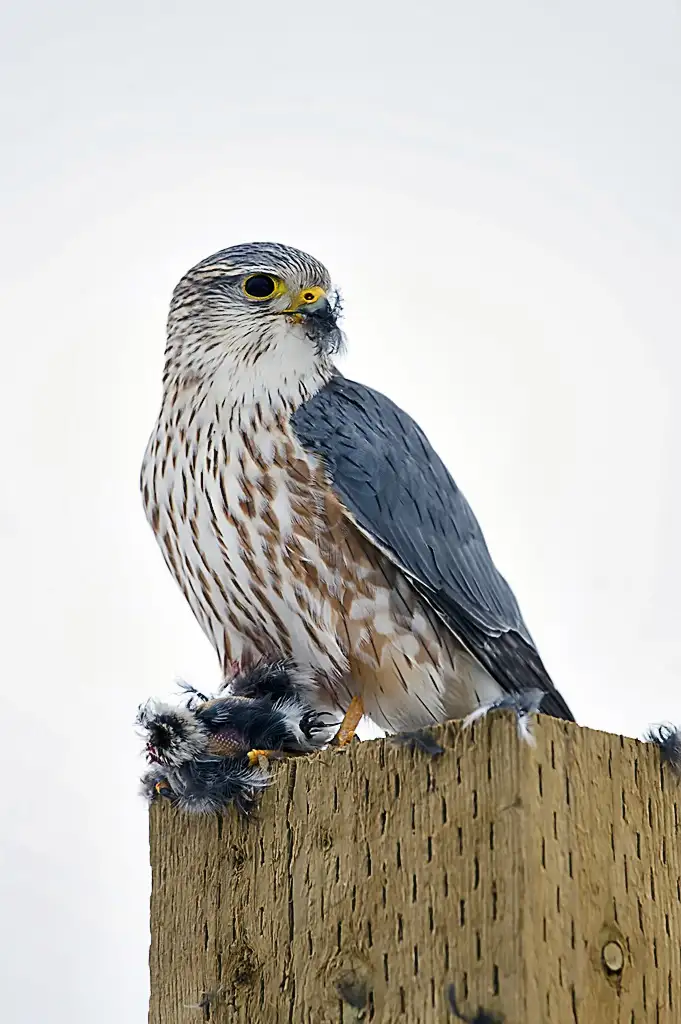
Male Merlin perched on a wooden post with the remains of a prey, with blue-grey back and streaked rufous breastPhoto: Raj Boora from Edmonton, Canada, CC BY 2.0Photo 1 of 4
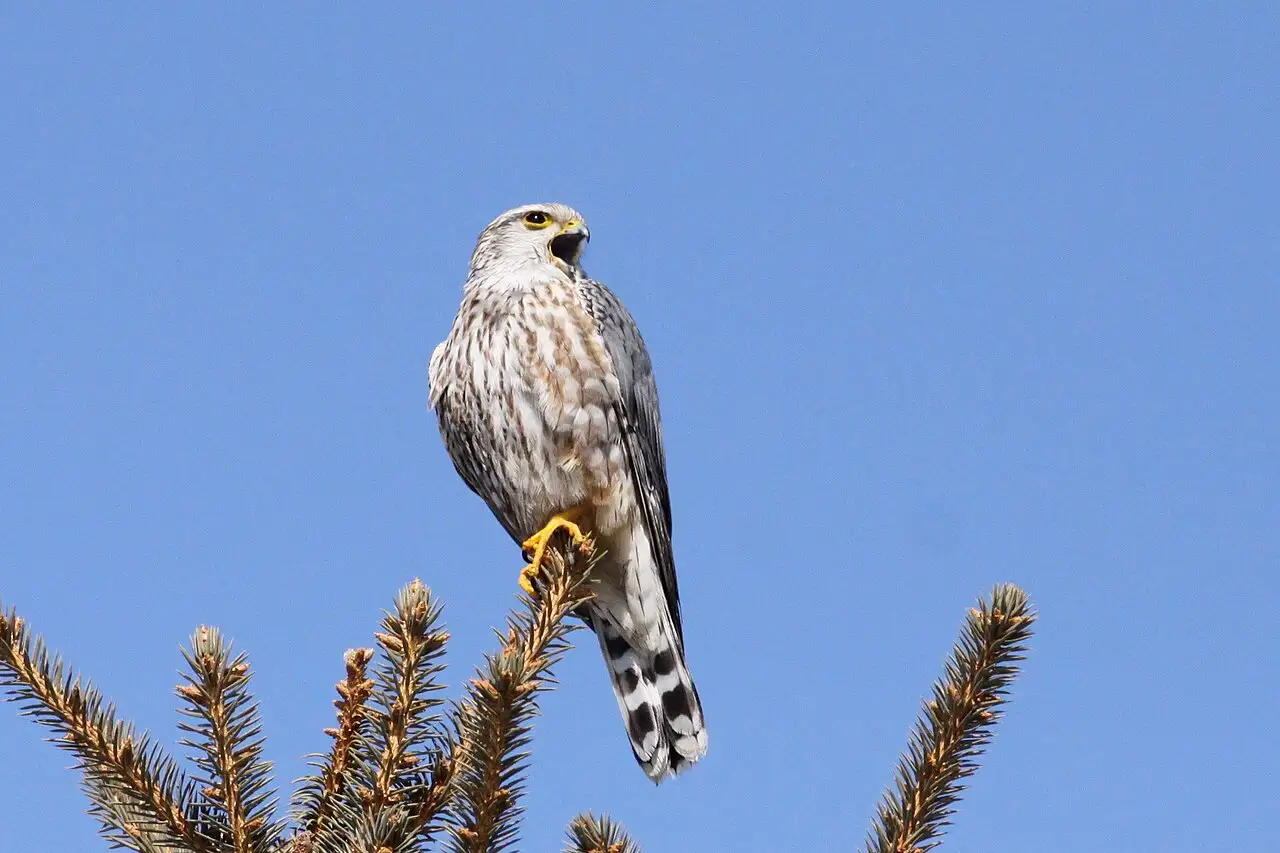
Male Merlin perched on the tip of a conifer, with blue-grey back, streaked breast and yellow legsPhoto: dfaulder, CC BY 2.0Photo 2 of 4
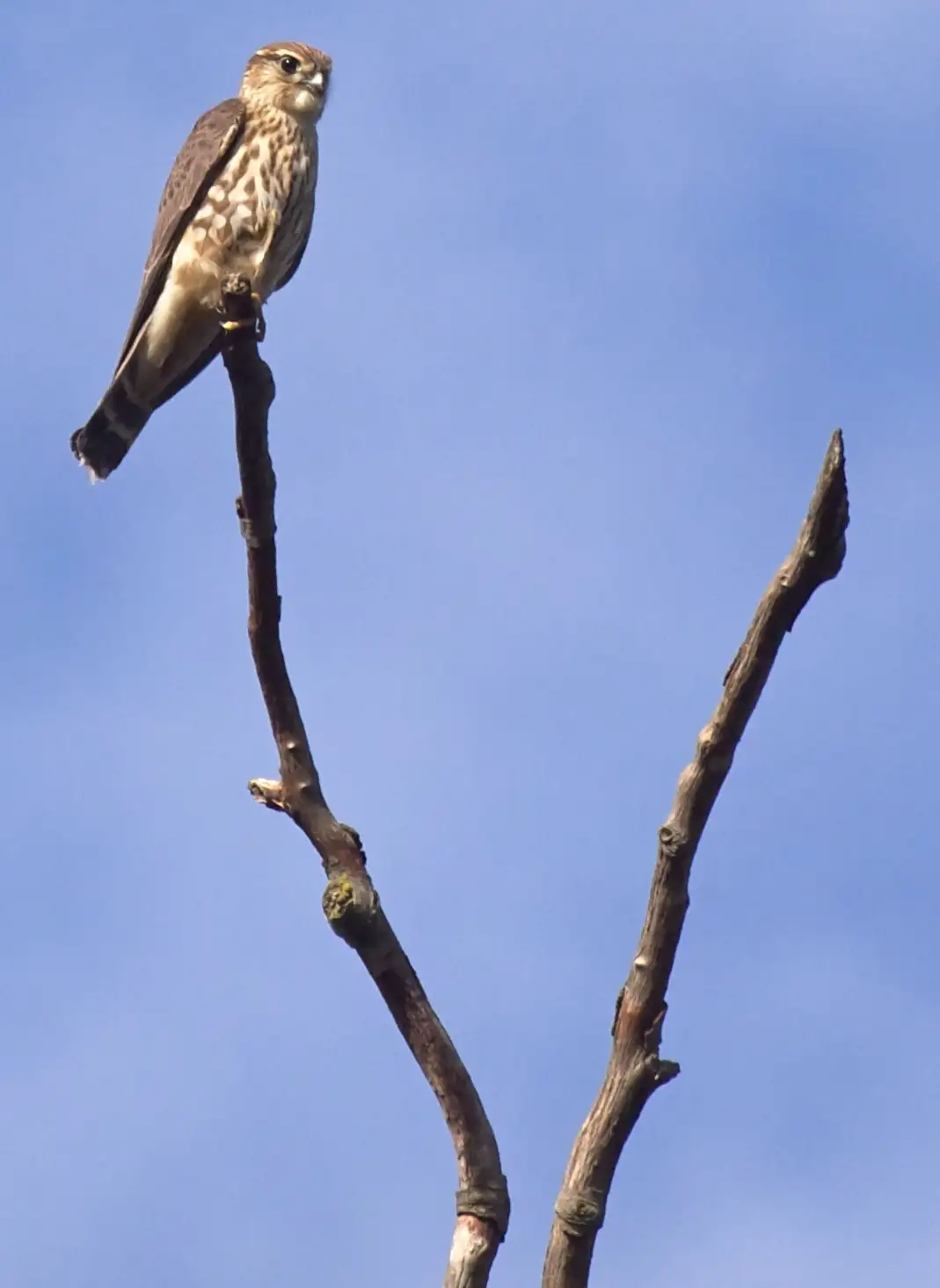
Female Merlin perched on the highest branch of a dry tree, with brown back and barred tailPhoto: Ingrid Taylar, CC BY 2.0Photo 3 of 4
It is a compact, small bird: the smallest falcon in Europe. It has short wings, broad at the base and pointed towards the tip, with which it performs a fast, powerful flight.
The plumage shows marked sexual dimorphism. Adult males have the back and crown blue-grey and the underparts rufous and heavily spotted. Females wear a much less contrasting dress, in which brown and reddish tones dominate on the back and white, notably marked with lengthwise streaks, on the underparts. Immatures resemble the female, with the feathers more irregularly barred than hers and an overall tone somewhat less grey.
Adult male
Back and crown blue-grey.
Underparts rufous, heavily spotted.
Female
Back brown and reddish.
Underparts white, with lengthwise streaks.
Immature
Like the female, with the feathers more irregularly barred and less grey.
Habitat and distribution of the Merlin
Its breeding range extends across northern Europe, the British Isles, Iceland, central Asia and North America. European birds winter in central and southern Europe. Several subspecies are recognised.
In Spain it is an exclusively wintering raptor: it settles in open, flat areas of the Peninsula, mainly on the northern plateau and, to a lesser extent, on the southern plateau and in the Ebro valley. In the Balearics wintering birds may also appear, though more sporadically. Two of the recognised subspecies winter here: «aesalon», from the Faroe Islands, the British Isles and northern Europe, and «subaesalon», which breeds in Iceland.
It is a raptor of large open or sparsely wooded expanses, so it avoids forest areas and very mountainous regions. During winter on the Peninsula it keeps its preference for flat, clear places: it selects cereal steppes and moors, as well as some wetlands and mosaic landscapes where crops alternate with sparse scrub, wasteland and floodplains.
The species is migratory over almost all of its range, although some populations are resident (above all in Great Britain) and others make short-range movements towards the coasts. The first Merlins to come to the Peninsula, mostly Scandinavian, arrive in August, but the bulk of the contingent does not appear until the second half of October. The return journey takes place between February and mid-April. A scant passage is detected through the Strait of Gibraltar, basically between September and October.
Areas where it is regularly recorded since 2010Squares of about 25 km where it is recorded regularly (occasional passage records are left out). Data from GBIF.org (19,630 records, retrieved October 2026); outline from Natural Earth.
Etymology of the Merlin
In other languages it is called «esmerla» in Catalan, «falcón esmerillón» in Galician, «belatz txikia» («small falcon») in Basque and «merlin» in English1. Two subspecies winter on the Peninsula, «aesalon» and «subaesalon».
Population of the Merlin
In the 2021 European Red List of Birds, the European breeding population is estimated at between 40,100 and 83,400 mature individuals, without its demographic trend having been established. In Spain there are no precise data on the number of wintering birds. The most serious threat cited is pesticides, which poison some individuals and significantly reduce the available food. They are also victims of illegal hunting in winter.
Nest of the Merlin
Outside Spain, where it breeds, it usually nests on the ground, generally on land with a slight slope and abundant plant cover, in particular heath. The nest is a small hollow lined with stems of nearby vegetation and some other material. Occasionally it may nest on some rocky cliff or make use of old corvid nests.
Courtship and breeding of the Merlin
The start of the breeding period varies greatly from one place to another across its extensive range, and does not take place in Spain. Laying occurs from late April to early June and consists of three to five pale buff eggs, heavily speckled with reddish brown, which the female mainly incubates for 28–32 days. After the chicks hatch, both adults look after feeding them until, after 25–32 days, they reach full development.
Diet of the Merlin
It is a specialist in eating small and medium-sized birds, which it chases in its fast flight at low height, sometimes even at ground level. Among its main prey are small birds of open spaces, such as linnets, goldfinches, larks, Calandra larks or pipits, although it can hunt birds the size of a magpie. Occasionally it catches large insects and small mammals.
Curious facts about the Merlin
It is the smallest falcon of the European fauna and, in winter, feeds on the enormous larder that the millions of larks, finches, pipits and other small and medium-sized birds of wasteland, moors and stubble fields represent. The longest-lived ringed bird, found dead in Great Britain and Ireland, reached 12 years and 8 months.
The Merlin in Cabañeros
This website’s page on grasslands cites it among the winter predators of the raña, together with the unusual Black-winged Kite and young Spanish Imperial Eagles, and describes it as «a great hunter of birds on these plains».
Where to see the Merlin in Cabañeros
In the grasslands and ploughed areas of the raña, in winter.
When
From autumn to spring: it is a winter visitor; the first arrive in August and the bulk in the second half of October.
What time
In good light, scanning the raña with binoculars.
Where
On open, treeless plains, moors, stubble fields and wasteland.
What to look for
It is fairly silent: look for a small falcon chasing the birds of open spaces at low height.
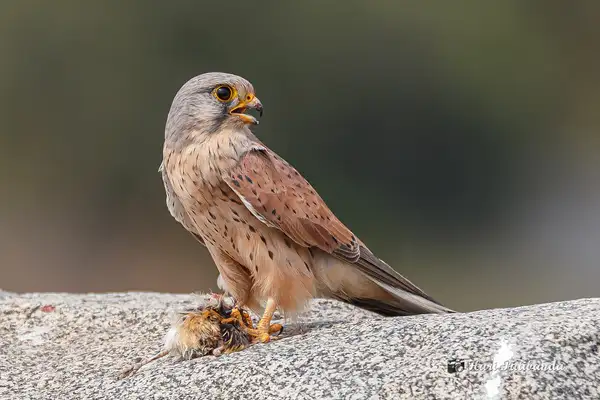
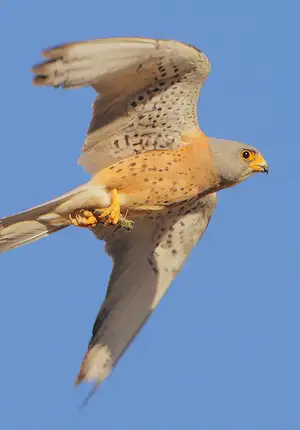
It is similar in appearance1. It is also a small falcon and the male has a grey head, but the kestrel has a reddish, spotted back, a long grey tail with a black band, and is a resident that hovers over the fields.



 Same family
 Same family
 Same family
 Same family
 Also in grasslands and rañas
 Also in grasslands and rañas
 Also in grasslands and rañas
 Also in grasslands and rañas






