Wingspan compared with a person with arms outstretched.
Length
29–33 cm
Wingspan
74–83 cm
Weight
211 g
Social life
A late-breeding raptor; young birds usually return to where they were born to breed in the same area
Lifespan
Record of 14.9 years in the wild according to AnAge; EURING lists a bird found dead in Great Britain at 14 years and 11 months
Conservation status
LC
NT
VU
EN
CR
EW
EX
Global (IUCN)
Least Concern
Spain
Endangered (EN) in the 2021 Red Book of the Birds of Spain, with an estimated decline of 72.7 % between 1998 and 2018; on the List of Wild Species under Special Protection, but not in the National Catalogue of Threatened Species
When to see it
Summer visitor
Months of the year when it is present
J
F
M
A
M
J
J
A
S
O
N
D
In Iberia
no
no
no
yes
yes
yes
yes
yes
yes
yes
no
no
Breeding season
no
no
no
no
yes
yes
yes
yes
yes
no
no
no
Song or voice of the Eurasian Hobby
It gives a «kiu-kiu-kiu», similar to the Eurasian Wryneck’s, although of very variable rhythm1. In flight it shouts a repeated, agitated, high-pitched «kit-chit»1. The recording (call, also in flight) is by SonoNatura and was made at Burgohondo – El Tiemblo – Cebreros (Alberche Valley and Tierra de Pinares) (near La Rinconada), Ávila, Castilla y León (xeno-canto XC796338, quality A). It lasts 9 seconds and is a trimmed section of the original, without repeating or lengthening, from which we have removed the bass below 300 Hz, reduced the background noise and adjusted the volume; neither pitch nor speed has been changed.
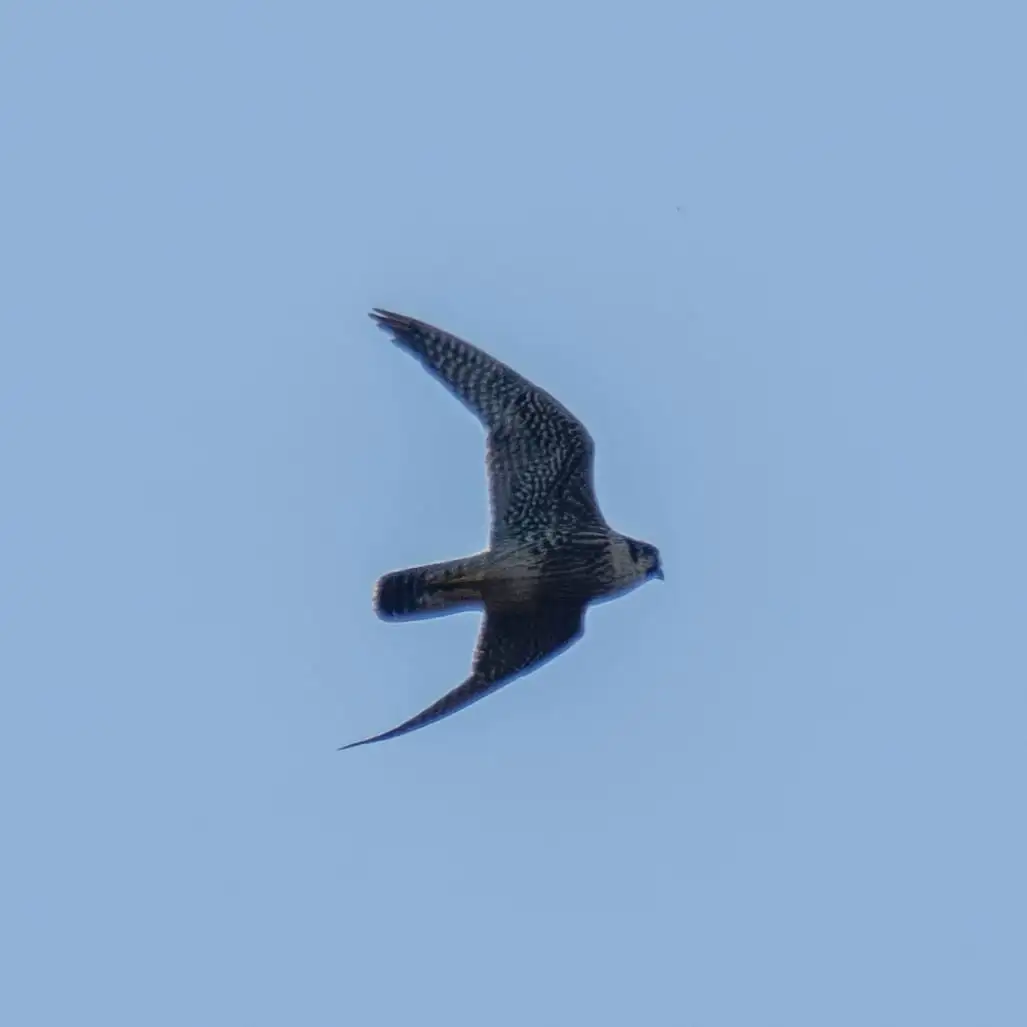
In flight it resembles a big swift: the adult looks very dark with very pointed wings, and the rusty lower feathers at the base of the tail and the thighs stand out1. It reaches the Peninsula during April and early May; the autumn passage through the Strait of Gibraltar starts in the last week of August and concentrates between late September and early October.
Flight typeWith very pointed wings, like a big swift
A small falcon with very long wings and a very sleek silhouette, in flight it looks like a large swift: the adult looks very dark with very pointed wings.
It feeds mainly on insects, such as dragonflies, grasshoppers and beetles, but also on not very large birds, such as swifts and swallows, and on bats.
When it flies it cries a repeated, agitated, high «kit-chit».
Photo gallery of the Eurasian Hobby
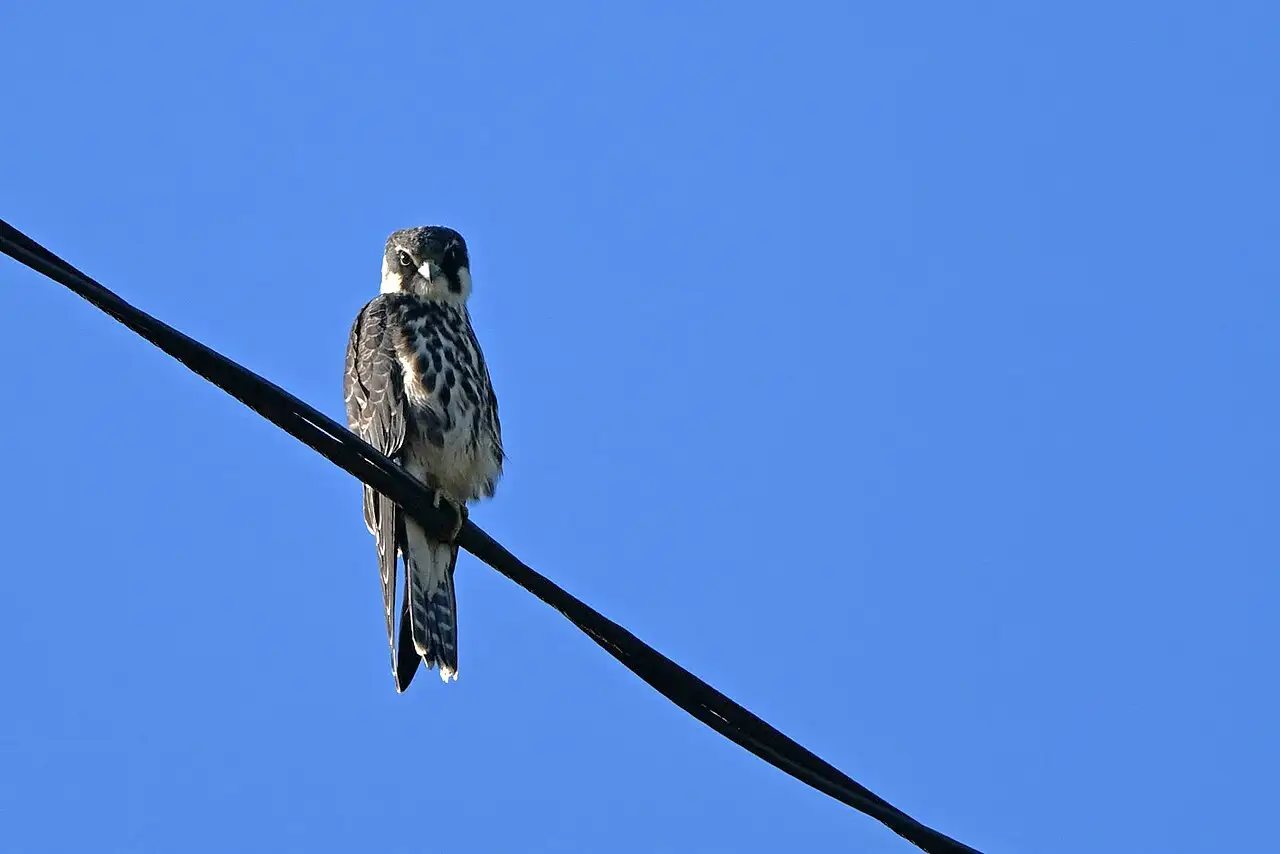
Eurasian Hobby perched on a wire against a blue sky, from the front, with whitish breast streaked with black and pale cheeks with the dark moustachePhoto: Pierre-Marie Epiney, CC BY-SA 2.0Photo 1 of 5
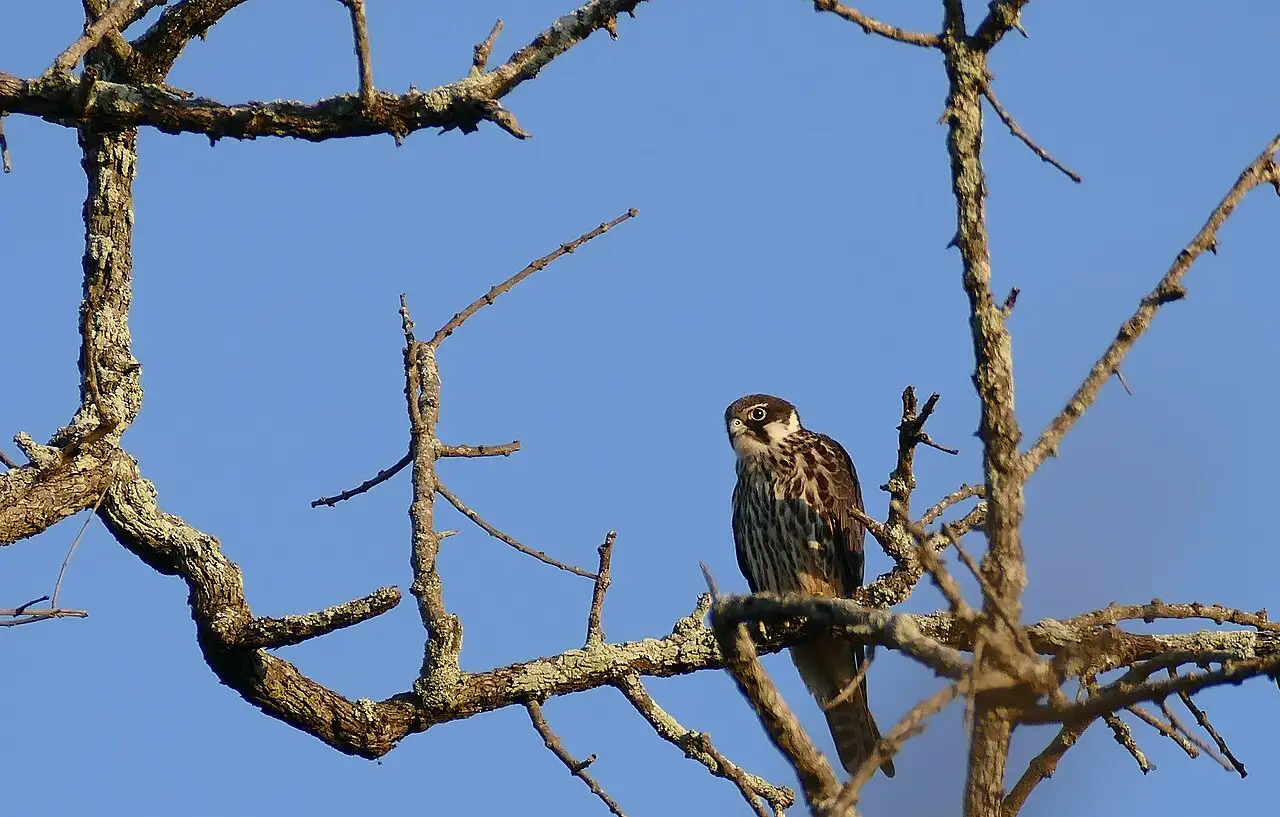
Eurasian Hobby perched on a dry branch covered in lichens against a blue sky, with dark grey back and black moustachePhoto: Bernard DUPONT from FRANCE, CC BY-SA 2.0Photo 2 of 5
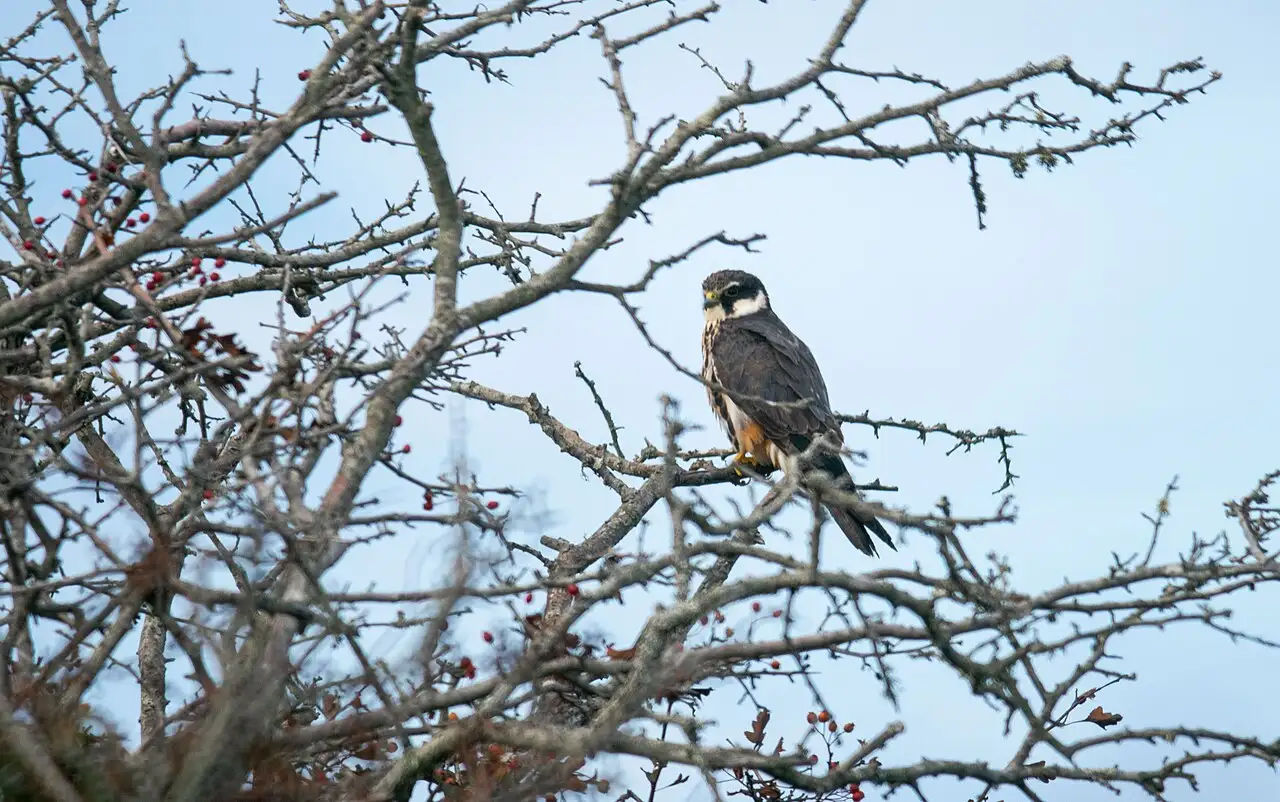
Eurasian Hobby perched among the bare branches of a hawthorn, in the distance, with dark back and black eye-maskPhoto: TRinaud, CC BY 4.0Photo 3 of 5
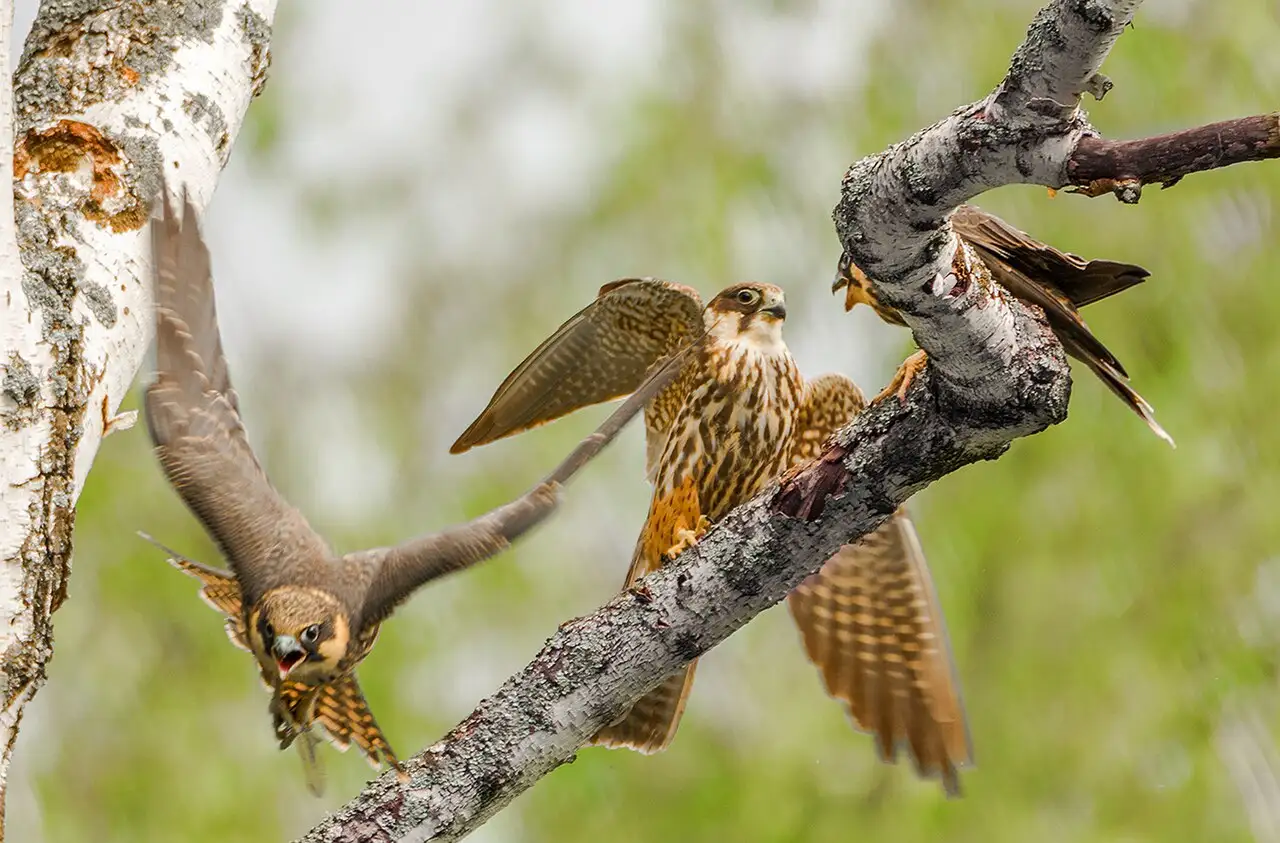
Adult Eurasian Hobby arriving in flight at a birch branch where the chicks wait, already feathered and in orange-brown plumagePhoto: Alpharius Omegon, CC BY 4.0Photo 4 of 5
Eurasian Hobby in flight, with long, sharp wings and a short tail, against the blue sky (Catalonia)Photo: Lluís Amat, CC BY-NC 4.0Photo 5 of 5
1 / 5
Identification of the Eurasian Hobby
The Eurasian Hobby is a small falcon with very long wings and a very slender silhouette. The adult has the back, flight feathers and crown a strongly dark grey; the feathers of the «thighs» and the undertail coverts are rusty; the breast and belly whitish, with quite marked dark lengthwise streaks, and the cheeks very pale, contrasting with a broad dark eye-mask and «moustache». In flight it looks fairly dark with very pointed wings, and the rusty feathers at the base of the underside of the tail and on the thighs stand out. The young bird has a general greyish-brown tone, without the grey back or the rusty lower feathers.
Adult
Back, flight feathers and crown very dark grey; pale cheeks with dark eye-mask and moustache.
Whitish breast and belly with dark streaks; rusty «thighs» and undertail coverts.
Young bird
Greyish brown, without the grey back or the rusty lower feathers.
Habitat and distribution of the Eurasian Hobby
It is distributed across the whole Palaearctic in the breeding season. It winters in the southern third of Africa and the north of the Indian subcontinent. It has several subspecies, and in Spain the nominate one, «subbuteo», occurs, which occupies Europe and North Africa.
In Spain its distribution is very uneven: in the northern half it is more widespread, and in the south it is found more patchily1. It appears widely in Castilla y León, La Rioja, Navarre, the Basque Country, Galicia, Cantabria and Asturias; it is also seen in Aragón, Catalonia and Madrid, although it is absent from large regions. It is scarce and irregular in the Valencian Community and more restricted in Murcia, Castilla-La Mancha, Extremadura and Andalusia. It is not in the Canaries.
It breeds in small woodland patches, such as pine copses or isolated trees on cereal plains, in dehesas, river groves and Pyrenean oak patches in more mountainous areas, or at the edges of woods, copses and wooded farmland on the Cantabrian strip. Those wooded areas are always close to open areas, such as crops, farmland or wetlands, which it uses as hunting ground.
It is a summer visitor on the Peninsula: it arrives during April and early May, and the autumn passage through the Strait of Gibraltar starts in the last week of August and concentrates between late September and early October.
Areas where it is regularly recorded since 2010Squares of about 25 km where it is recorded regularly (occasional passage records are left out). Data from GBIF.org (26,020 records, retrieved October 2026); outline from Natural Earth.
Etymology of the Eurasian Hobby
According to Wikipedia, «Falco» comes from the late Latin «falx», «falcis», «sickle», from the profile of the wings, and «subbuteo» comes from the Latin «sub», «below» or «less than», and «buteo», «buzzard». In other languages it is called «falcó mostatxut europeu» in Catalan, «falcón pequeno» in Galician, «zuhaitz-belatza» in Basque and «Eurasian hobby» in English1. We have not found a source explaining the origin of the Spanish name, so we do not venture one.
Population of the Eurasian Hobby
The 2021 European Red List of Birds estimates about 280,000–437,000 individuals, with a stable trend. In Spain there is no precise information on the size of the population, because it is a hard raptor to census: the Third Atlas of Breeding Birds estimates a range of 800–1,100 pairs from a non-specific 2003 census and the mean annual rate of decline (−5.4 %) of the SACRE programme between 1998 and 2018.
The decline for 1998–2018 reaches 72.7 %, that there are confirmed local extinctions and that the species has declined by more than 70 % in three generations1. Among its main threats stand out the loss and degradation of forest habitat by fires, the destruction of river groves, the removal of scattered trees in farmland and the urbanisation of feeding areas, and in farming environments, the decline of passerines and insects through land consolidation, biocides and the disappearance of field margins. To these are added poaching, above all in the half-season, electrocution on power lines and pesticides1. Because it breeds very late, it is affected by disturbance from the half-season and from forestry work. Among the measures, it is proposed to leave 30 % of arable land untilled and untreated for at least two years1.
Nest of the Eurasian Hobby
It usually reuses old Carrion Crow nests, which can influence its distribution, although it also occupies nests of other corvids or of medium-sized forest raptors.
Courtship and breeding of the Eurasian Hobby
It is a late-breeding raptor, which settles in its nesting areas during May. Laying, generally of three eggs, occasionally two and rarely four, matt yellowish brown and finely speckled with reddish brown, normally takes place in June. The female, with occasional help from the male, incubates for 28–31 days, and hatching runs from mid-July to mid-August. The chicks are looked after by the female while the male hunts, develop in about 28–34 days and stay in the nest until late August or early September. When they become adults, young birds usually return to their birthplace to breed in the same area. May–September is a summary of the national cycle, not a local date.
Diet of the Eurasian Hobby
It feeds mainly on insects, such as dragonflies, grasshoppers and locusts, beetles and bees, but also on not very large birds, such as swifts, swallows, small steppe birds or waders in wet areas, and on bats. It usually feeds the chicks with small birds.
Curious facts about the Eurasian Hobby
It is the scarcest of the falcons widely distributed across our territory, and says that in flight it looks like a big swift1. Its longevity record in the wild is 14.9 years according to AnAge, the same as EURING’s 14 years and 11 months.
The Eurasian Hobby in Cabañeros
The habitat pages of this website do not mention it, but it does appear in the bird list of the «Visitor guide to Cabañeros National Park» (OAPN, page 104). That list vouches for its presence in the Park, not for breeding there. GBIF.org records 6 observations of the Eurasian Hobby in Cabañeros and its surroundings. It is more restricted in Castilla-La Mancha, and dehesas are among its breeding habitats1. None of those observations falls within the Park boundary (according to OpenStreetMap): all are from the surroundings.
Where to see the Eurasian Hobby in Cabañeros
In Cabañeros and its surroundings, from spring to autumn, in dehesas, groves and copses beside open areas.
When
It arrives in April and early May; it leaves between late August and early October.
What time
By day, hunting insects and birds in flight; it concentrates in September and October on migration.
Where
In dehesas, river groves, copses and wooded farmland near crops and wetlands.
What to look for
Look for the long, pointed wings, like a big swift's, and the rusty thighs; listen for the «kiu-kiu-kiu».



 Same family
 Same family
 Same family
 Same family
 Same season in the park
 Same season in the park
 Same season in the park
 Same season in the park






