Wingspan compared with a person with arms outstretched.
Length
55–65 cm
Wingspan
0.88–1.06 m
Weight
350–550 g
Social life
Colonial: its breeding cores can total hundreds of pairs, which normally share a site with Cattle Egrets, Night Herons or other waders
Lifespan
Record of 20 years and 11 months according to EURING (a bird ringed in Spain and shot); AnAge gives up to 22.3 years
Conservation status
LC
NT
VU
EN
CR
EW
EX
Global (IUCN)
Least Concern
Spain
Least Concern (LC) in the Red Book of the Birds of Spain, both as a breeder and as a winter visitor or migrant; on the List of Wild Species under Special Protection, but not in the Spanish Catalogue of Threatened Species
When to see it
Resident
Months of the year when it is present
J
F
M
A
M
J
J
A
S
O
N
D
In Iberia
yes
yes
yes
yes
yes
yes
yes
yes
yes
yes
yes
yes
Song or voice of the Little Egret
Silent outside the colonies, on other occasions (above all in flight) it gives a sort of hoarse, dull bark: «wuorj» or «juaooj».
CallLittle Egret
0:00 / 0:16
10 kHz5
The sonogram draws the sound: time runs from left to right, and the higher a trace sits, the higher the note.Recording by Joost van Bruggen, xeno-canto XC432219 (Isla Mayor, Sevilla) (CC BY-SA 4.0).
Flight of the Little Egret
In flight it is completely white and adopts the characteristic silhouette of the herons, with the neck folded into an «S» and the legs stretched out sticking out behind the short tail.
Flight typeWith neck in an «S» and legs behind the short tail
It looks for its prey actively, walking along muddy shores and nervously stirring the silt with its feet to flush them from their hiding places.
In flight it is completely white and adopts the silhouette of the herons, with the neck folded into an «S» and the legs stretched out sticking out behind the short tail.
Silent outside the colonies, sometimes, above all in flight, it gives a sort of hoarse, dull bark.
Photo gallery of the Little Egret
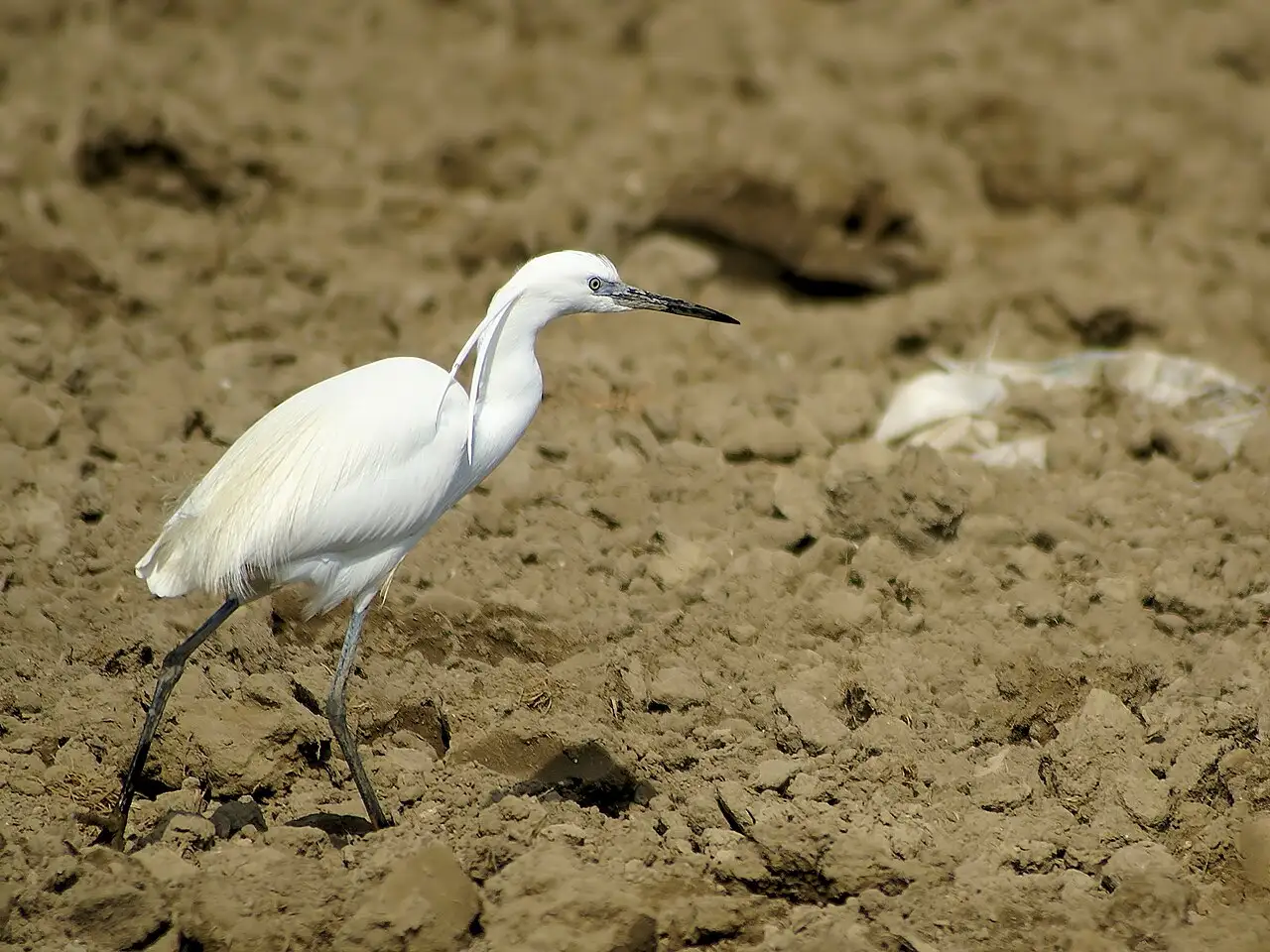
White Little Egret walking on dry mud, with the elongated nape plumes, the black legs and the dagger-shaped black billPhoto: Hans Hillewaert, CC BY-SA 3.0Photo 1 of 4
Little Egret in flight over some rocks with waves, with wings open, black legs dangling and yellow toesPhoto: Arnstein Rønning, CC BY-SA 3.0Photo 2 of 4
The Little Egret is a medium-sized heron, always white-plumaged, with long black legs apart from the toes, which are yellow, and a long, black, dagger-shaped bill. In flight it is completely white and adopts the characteristic silhouette of the herons, with the neck folded into an «S» and the legs stretched out sticking out behind the short tail.
Breeding adult
A pair of elongated feathers on the nape and a group of filamentous, frayed plumes on the breast and back.
Above all in the courtship period, a small area of bare skin in front of the eye, of an intense yellowish tone.
Non-breeding and young bird
Non-breeders lack those ornaments, and the bare skin next to the eye is bluish or greenish grey.
The young bird is similar to the non-breeder, but with a somewhat brownish bill.
Habitat and distribution of the Little Egret
It is widely distributed, although discontinuously, across southern Europe, Africa, eastern and southern Asia and Oceania. Several subspecies have been described; in Spain «garzetta» lives, of Eurasian and African distribution.
In Spain it breeds in various wetlands and rice fields of the Levante and the Ebro basin, with populations that reach the Cantabrian coast, and in cores of the west and south-west of the Peninsula: western Andalusia, Extremadura, Castilla-La Mancha, Castilla y León and Madrid. Wintering is detected mainly in the south-western quadrant of the Peninsula and on the coasts, with a very scarce presence on the Cantabrian fringe.
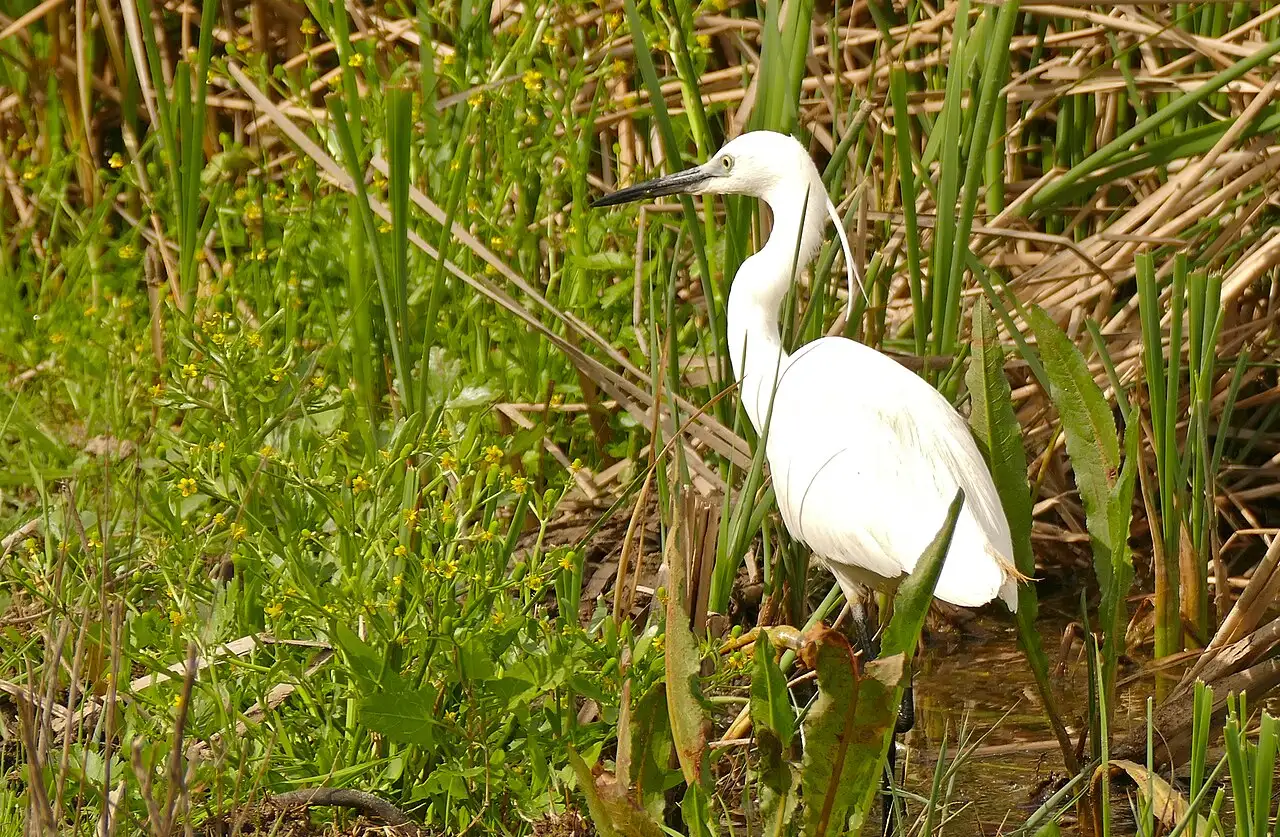
It breeds in a great variety of aquatic environments, always of shallow, calm water, such as marshes, lagoons and fens with abundant tree and marsh vegetation. Outside the breeding season, and when looking for food, it frequents all kinds of natural or artificial wetlands: floodable land, reservoirs, river pools, salt pans, irrigation canals and, very especially, rice fields, above all when farm work there exposes many of the small prey it eats.
It is resident in Spain, although very many birds disperse or migrate. Many often head north on the Peninsula after breeding or cross the Strait to winter in tropical Africa, and some even end up on the American coasts. The Peninsula and the Balearics are, besides a wintering area, a stopover for numerous European egrets, above all French ones from the colonies of the Camargue. Passage is detected through the Strait of Gibraltar from July, with a peak in September, and the European birds return from early March.
Areas where it is regularly recorded since 2010Squares of about 25 km where it is recorded regularly (occasional passage records are left out). Data from GBIF.org (440,607 records, retrieved October 2026); outline from Natural Earth.
Etymology of the Little Egret
According to Wikipedia, «Egretta» comes from Provençal «aigrette» («little heron»), a diminutive of «aigron» («heron»), and the epithet «garzetta» is the Italian name of this bird, «garzetta» or «sgarzetta». In other languages it is called «martinet blanc comú» in Catalan, «garzota común» in Galician, «koartzatxo txikia» in Basque and «little egret» in English1.
Population of the Little Egret
According to the 2011 national census, in Spain there are 9,347 breeding pairs and 17,545 wintering birds, concentrated mainly in Andalusia, the Valencian Community and Catalonia. Its numbers rose greatly in the last decade of the 20th century, surely through the increase in rice-field area, but that trend has stopped and today the population is considered stable. In the 2021 European Red List of Birds the European breeding population shows a decreasing trend. It was the victim of intense persecution for its ornamental plumes, used in hats. Today the threats are the degradation of wetlands or the reduction of their area and, in the short term, excessive dependence on rice fields, if the areas or farming models change.
Nest of the Little Egret
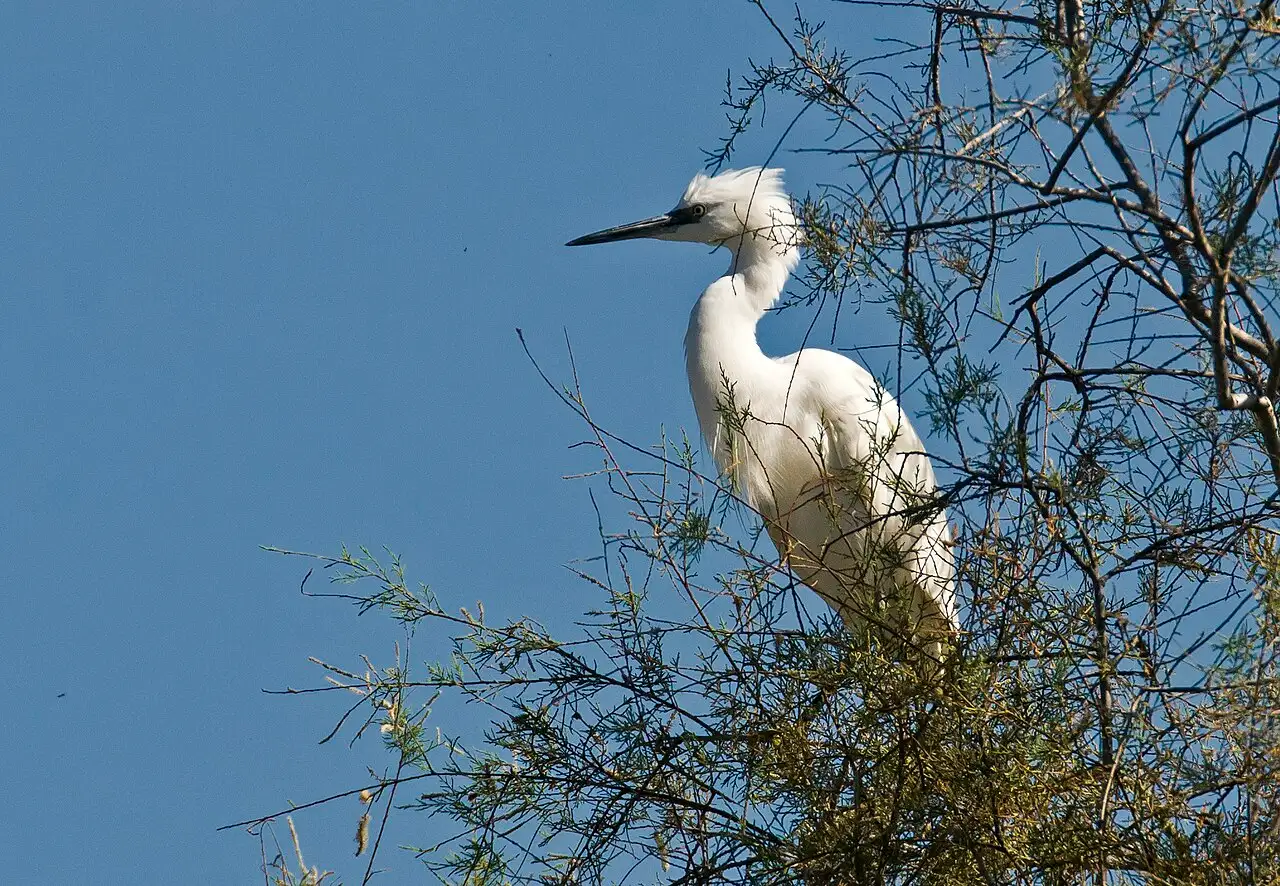
The nest is set in shrubs or trees, at a variable height of up to 20 metres, or among marsh vegetation. It is an untidy platform of branches and stems some 30–35 centimetres across and 10–15 high, built by the female with material brought by the male.
Courtship and breeding of the Little Egret
It is a colonial species. Laying takes place from mid-April and consists of three to five eggs (up to eight) of a bluish green, matt and speckled at the ends, which fade during incubation. This lasts 21 or 22 days (there are records that extend it to 25) and is carried out by both sexes. The chicks are cared for and fed by both adults, leave the nest to scramble about the nearby vegetation at about 30 days of life and complete their development in some 40–45 days.
Diet of the Little Egret
Like all herons, it is carnivorous. Its diet is based on small fish, amphibians and aquatic and terrestrial insects (larvae and adults), and to a lesser extent it eats crustaceans, lizards, earthworms, snails, small mammals and snakes. It normally looks for its prey actively, walking along muddy shores and nervously stirring the silt with its feet to flush them from their hiding places.
Curious facts about the Little Egret
On the freshly puddled expanses of the rice fields of the Levante, Catalonia, Andalusia and Extremadura it is common to see large groups of birds bustling about in the mud, and among them some slender, completely white herons that stir the water with their feet: Little Egrets, which depend on the rice field more closely than other herons1. EURING lists a bird ringed in Spain that lived 20 years and 11 months.
The Little Egret in Cabañeros
The habitat pages of this website do not mention it. GBIF.org records 67 observations of the Little Egret in Cabañeros and its surroundings.
Where to see the Little Egret in Cabañeros
In Cabañeros and its surroundings, throughout the year, in lagoons, ponds and shores of shallow water.
When
All year, because it is resident, although many birds move or migrate.
What time
In good light; in the breeding season the nape feathers are better seen.
Where
In wetlands of shallow, calm water, reservoirs, pools, salt pans, irrigation canals and rice fields.
What to look for
Look for the black bill, the black legs with yellow toes and, in flight, the legs sticking out behind the short tail.




 Same family
 Same family
 Same family
 Same family
 Same order
 Same order
 Same season in the park
 Same season in the park






