Wingspan compared with a person with arms outstretched.
Length
45–52 cm
Wingspan
82–95 cm
Weight
340–390 g
Social life
Colonial in the breeding season, often mixed with other herons and waders in noisy colonies that can gather several thousand pairs
Lifespan
Record of 18 years and 8 months in the wild according to EURING (a bird ringed in Spain); AnAge gives up to 23 years in the wild
Conservation status
LC
NT
VU
EN
CR
EW
EX
Global (IUCN)
Least Concern
Spain
Least Concern (LC) as a winter visitor and breeder in the Red List of the Birds of Spain; on the List of Wild Species under Special Protection, but not in the Spanish Catalogue of Threatened Species
When to see it
Resident
Months of the year when it is present
J
F
M
A
M
J
J
A
S
O
N
D
In Iberia
yes
yes
yes
yes
yes
yes
yes
yes
yes
yes
yes
yes
Breeding season
no
no
no
no
yes
yes
no
no
no
no
no
no
Song or voice of the Western Cattle Egret
It gives various croaks in the colonies and in flight, which sound like an «ag-ag-ag». The recording is from a colony, so several birds can be heard at once.
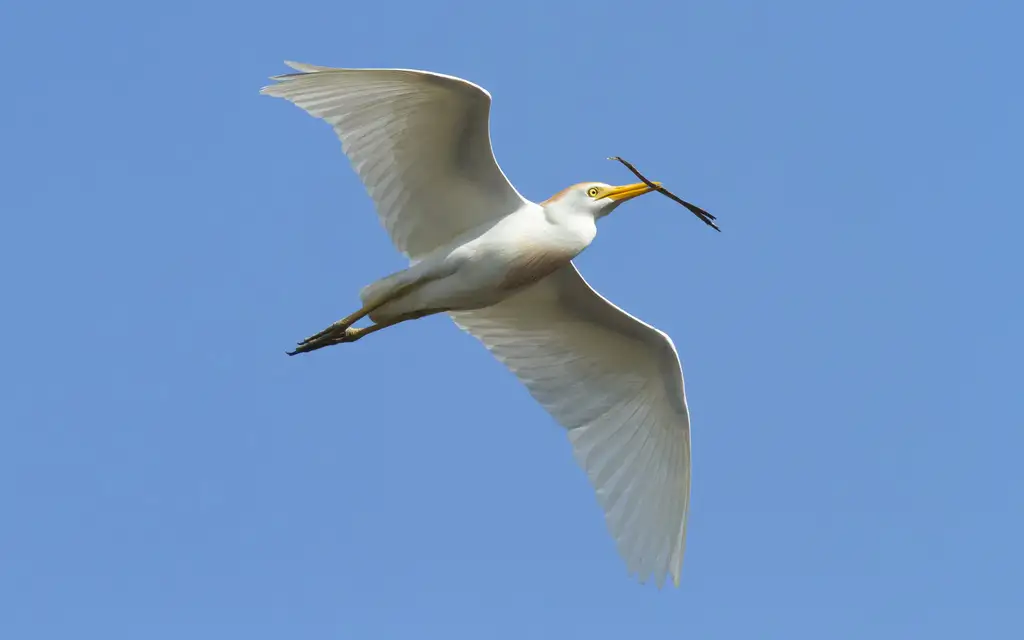
In flight it looks very white and stocky, with more compact shapes than other herons.
Flight typeDirect, very white and stocky, more compact than other herons
Much less aquatic than other herons, it frequents grasslands with abundant livestock, dehesas, ploughed fields and crops, and uses cows and sheep as a lookout.
In flight it looks very white and stocky, with more compact shapes than other herons.
It gives various croaks in the colonies and in flight, like an «ag-ag-ag».
Photo gallery of the Western Cattle Egret
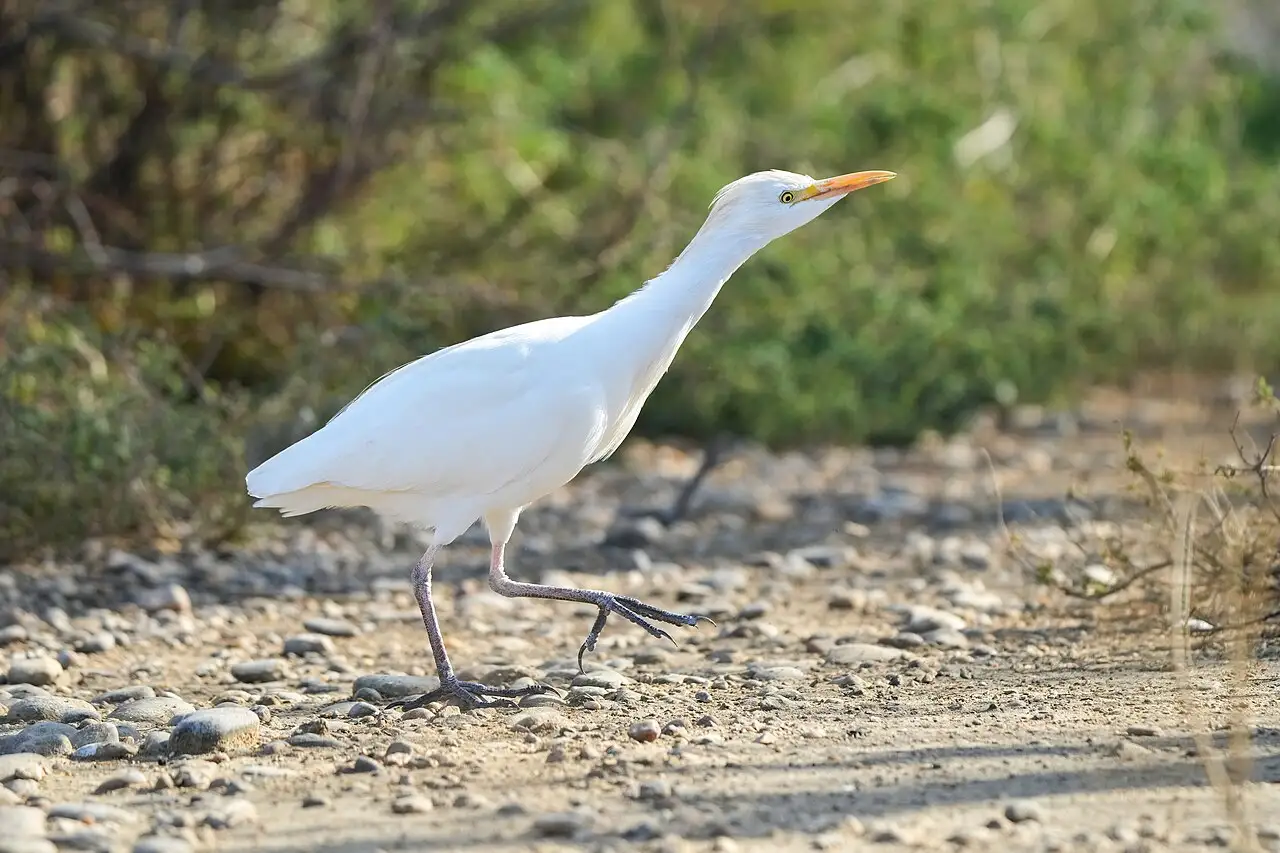
White Western Cattle Egret walking along a gravel track, with neck stretched out and yellow billPhoto: Giles Laurent, CC BY-SA 4.0Photo 1 of 4
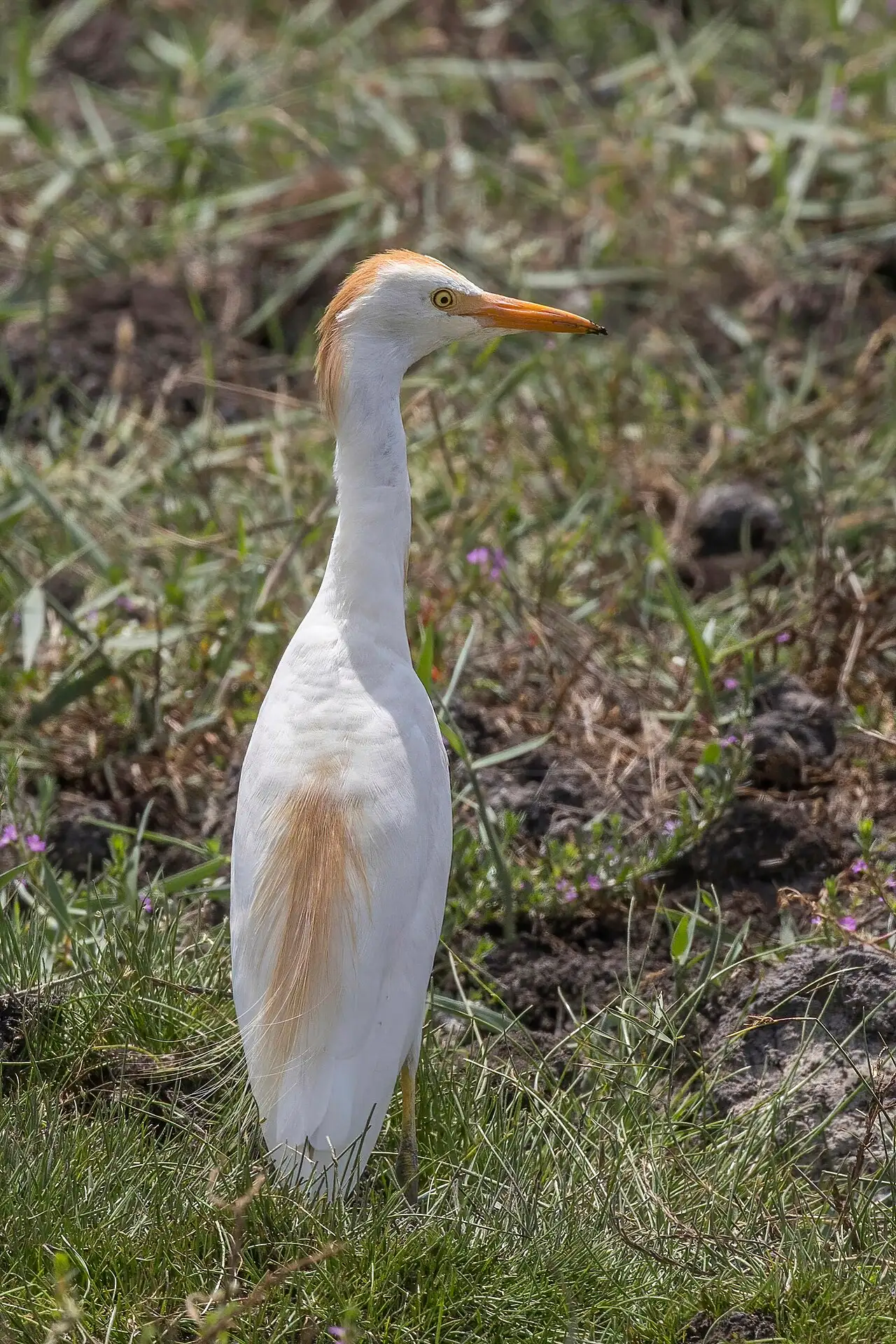
Western Cattle Egret standing among the grass in breeding plumage, with orange tones on the crown, nape, breast and backPhoto: Charles J. Sharp, CC BY-SA 4.0Photo 2 of 4
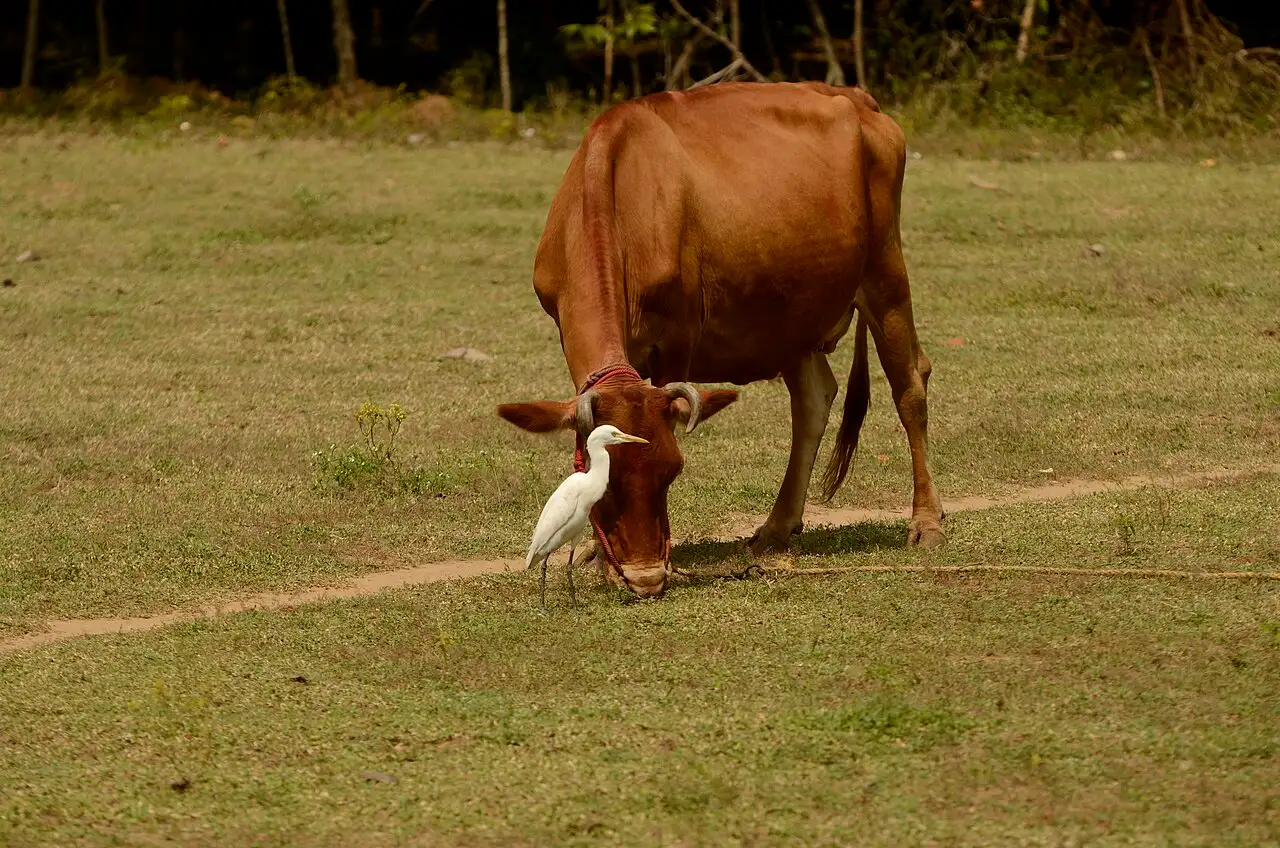
Western Cattle Egret beside the head of a cow grazing in a meadowPhoto: PJeganathan, CC BY-SA 4.0Photo 4 of 4
1 / 4
Identification of the Western Cattle Egret
It is a small or medium-sized heron of fairly compact shape, with a relatively short neck, legs and bill and almost entirely white plumage, in which there are hardly any differences between the sexes. In the breeding season the adult is still white, but adorned with ochre-to-orange tones on the crown, nape, breast and back, and wears an intense reddish colour on the bill, eye and legs. Outside that season it is much paler, with a slight ochre tinge on the crown, the bill yellow and the legs of a very variable colour.
Adult
In the breeding season, white with ochre or orange tones on the crown, nape, breast and back; bill, eye and legs reddish.
Outside the breeding season, paler, with the bill yellow.
Young bird
Like the non-breeding adult, but completely white.
Habitat and distribution of the Western Cattle Egret
Until the second half of the 19th century it lived in numerous tropical and subtropical areas of Africa, but at the beginning of the 20th century it embarked on a surprising process of colonisation, which is still going on, and today it is almost cosmopolitan: it ranges across south-west Europe, Africa, India, America, Australia, New Zealand and Hawaii, where it was introduced. It entered the Peninsula from North Africa, settled in the great wetlands of the south and from there has gone on advancing.
In Spain it occupies two areas: a western one, more abundant, with colonies in the basins of the west of the Peninsula (western Andalusia, Extremadura, Castilla-La Mancha, Castilla y León and Madrid), and an eastern one, with colonies in the Levante, Aragon, Navarre and the Basque Country, as well as the Balearics. It has recently bred in Lanzarote too. The subspecies that lives in our country is «ibis».
It is much less aquatic than other herons: to feed it frequents grasslands with abundant livestock, dehesas, ploughed fields and crops, although it is also found in floodable areas and shallow lagoons. It is resident on the Peninsula, but very mobile: outside the breeding season it moves around the colonies and even disperses over medium distances, and it has been shown that some Iberian birds winter in other countries and that there is some passage through the Strait of Gibraltar, with a peak in August.
Areas where it is regularly recorded since 2010Squares of about 25 km where it is recorded regularly (occasional passage records are left out). Data from GBIF.org (305,991 records, retrieved October 2026); outline from Natural Earth.
Etymology of the Western Cattle Egret
According to Wikipedia, «Bubulcus» is the Latin word for «herdsman», the one who looks after oxen, because of its relationship with cattle, just like its name in Spanish or English. The epithet «ibis» is a Latin and Greek word that designated another white wetland bird, the sacred ibis, and was applied to it by mistake. Today some lists place it in the genus «Ardea». In other languages it is «esplugabous» in Catalan, «garza boieira» in Galician, «koartzatxo itzaina» in Basque and «cattle egret» in English1.
Population of the Western Cattle Egret
In the 2021 European Red List of Birds the European breeding population is estimated at between 147,000 and 184,000 mature individuals, with an increasing trend. However, despite its geographical expansion, in Spain it seems to show a continued decline: in Andalusia the breeding population has fallen by almost 30 %, in the Valencian Community by 70 % and in Murcia by 50 %; the Extremaduran one also seems to be declining, and in Madrid it has practically disappeared as a breeder. Only the population of the Cantabrian range and that of the Canaries are growing steadily, and Castilla y León is holding its counts. On Lanzarote it has grown so much that it behaves as an invasive species.
Its main threats are the loss of quality of wetlands, the destruction of colonies for human reasons and the closure or changes in the management of landfills, on which some populations depend.
Nest of the Western Cattle Egret
It breeds in colonies, often mixed with other herons and waders, which can hold several thousand pairs. Nests are placed in trees, sometimes quite far from the water, or among marsh vegetation. They are built by the female with material brought mainly by the male: an untidy pile of roots, stems and branches, of variable solidity, some 20–45 centimetres across and 12–25 high, sometimes lined with a little grass.
Courtship and breeding of the Western Cattle Egret
Laying usually takes place between mid-May and late June, and consists of four or five eggs (three to nine), white with a greenish or bluish tinge and speckled at one end. Both sexes incubate them for 22–26 days. Both adults tend the chicks, which at about 20 days already wander the branches near the nest and complete their development at about one month of life.
Diet of the Western Cattle Egret
It is quite opportunistic and undemanding, and adapts at all times to what the environment offers. In the breeding season its diet is dominated by grasshoppers, locusts and cicadas, to which it adds beetles, flies, dragonflies and other invertebrates, as well as lizards, small snakes, amphibians and small mammals. It is often seen at landfills, attracted by the insects, behind tractors when they plough, waiting for the little animals left exposed, or riding on cows and sheep, which serve it as a lookout from which to pounce on what they stir up as they pass.
Curious facts about the Western Cattle Egret
Its astonishing capacity for colonisation stands out: in the 20th century it went from Africa to South America and from there to Central and North America, and reached Australia and New Zealand, perhaps helped by introductions1. EURING lists a Cattle Egret ringed in Spain that lived 18 years and 8 months; AnAge gives a somewhat higher figure, 23 years in the wild.
The Western Cattle Egret in Cabañeros
The habitat pages of this website do not mention it, and we have not found any other published source on it in the Park. GBIF.org records 46 observations of the Western Cattle Egret in Cabañeros and its surroundings.
Where to see the Western Cattle Egret in Cabañeros
In Cabañeros and its surroundings, in grasslands with livestock, dehesas and ploughed fields.
When
All year round: it is resident on the Peninsula, although it moves a lot outside the breeding season.
What time
By day, while it looks for food among the cattle or behind tractors when they plough.
Where
In grasslands with livestock, dehesas, ploughed fields and crops, and also in floodable areas and shallow lagoons.
What to look for
Look for its compact white silhouette and its yellow bill, and look for it beside cows and sheep.



 Same family
 Same family
 Same family
 Same family
 Same order
 Same order
 Same season in the park
 Same season in the park






