Wingspan compared with a person with arms outstretched.
Length
60–70 cm
Wingspan
1.5–1.7 m
Weight
1.6–2.2 kg
Social life
Both members of the pair incubate and care for the chicks, which stay about three months with their parents
Lifespan
Record of 20 years in the wild according to EURING (a bird ringed in Spain and later recaptured); AnAge gives 20 years in captivity
Conservation status
LC
NT
VU
EN
CR
EW
EX
Global (IUCN)
Least Concern
Spain
Vulnerable (VU) in the 2021 Red Book of the Birds of Spain and in the Spanish Catalogue of Threatened Species
When to see it
Resident
Months of the year when it is present
J
F
M
A
M
J
J
A
S
O
N
D
In Iberia
yes
yes
yes
yes
yes
yes
yes
yes
yes
yes
yes
yes
Song or voice of Bonelli’s Eagle
It is a silent bird, although some barks and shrill cries have been recorded in breeding areas. The recording (call, also in flight) is by SonoNatura and was made at Vega de Toledo (near Toledo), Toledo, Castilla-La Mancha (xeno-canto XC792286, quality A). It lasts 9 seconds and is a trimmed section of the original, without repeating or lengthening, from which we have removed the bass below 300 Hz, reduced the background noise and adjusted the volume; neither pitch nor speed has been changed.
In flight a contrast can be seen between the whitish body and the dark underside of the wings, and the tail is pale, with a broad dark terminal band.
Flight typeIn flight the whitish body contrasts with the dark underside of the wings
It sets its territories in sierras, rolling terrain or plains, as long as there are rock faces to breed on, although some pairs nest in trees or electricity pylons.
In flight the contrast can be seen between the whitish body and the dark underwings, with the pale tail and a broad dark terminal band.
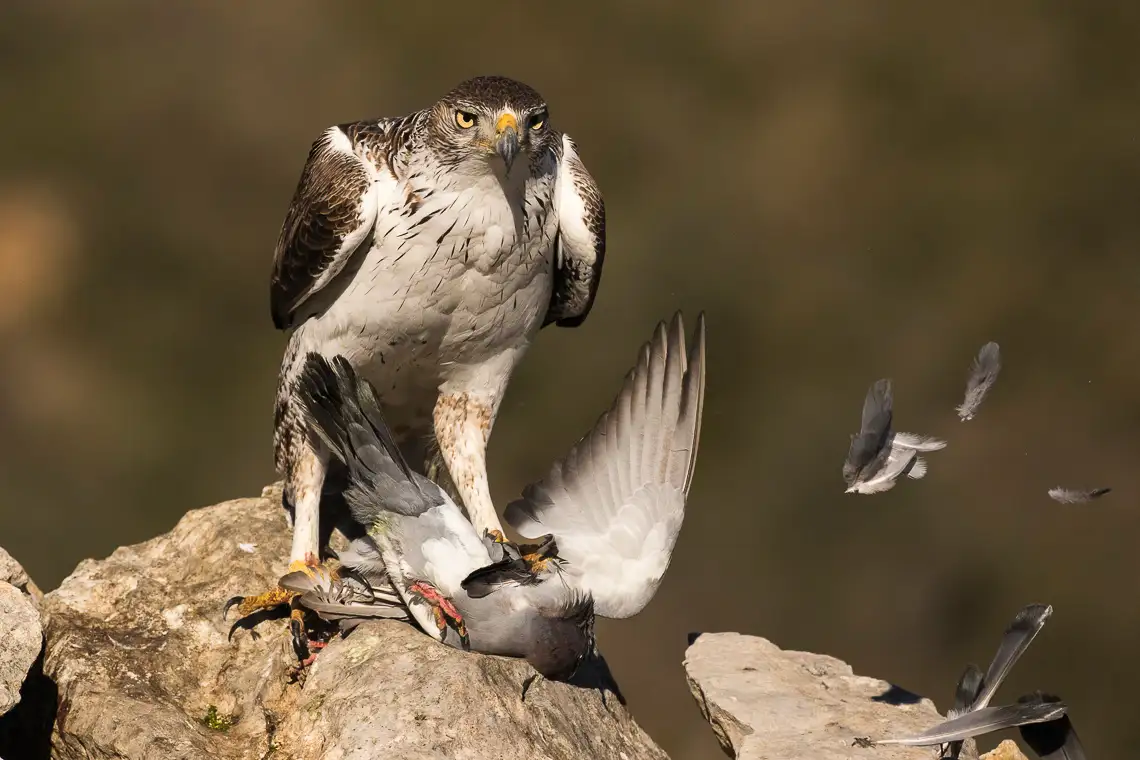
Of the large eagles it is the most agile, which lets it hunt many medium-sized birds; the Red-legged Partridge and the Western Jackdaw are staples between August and April, and the rabbit during breeding.
Photo gallery of Bonelli’s Eagle
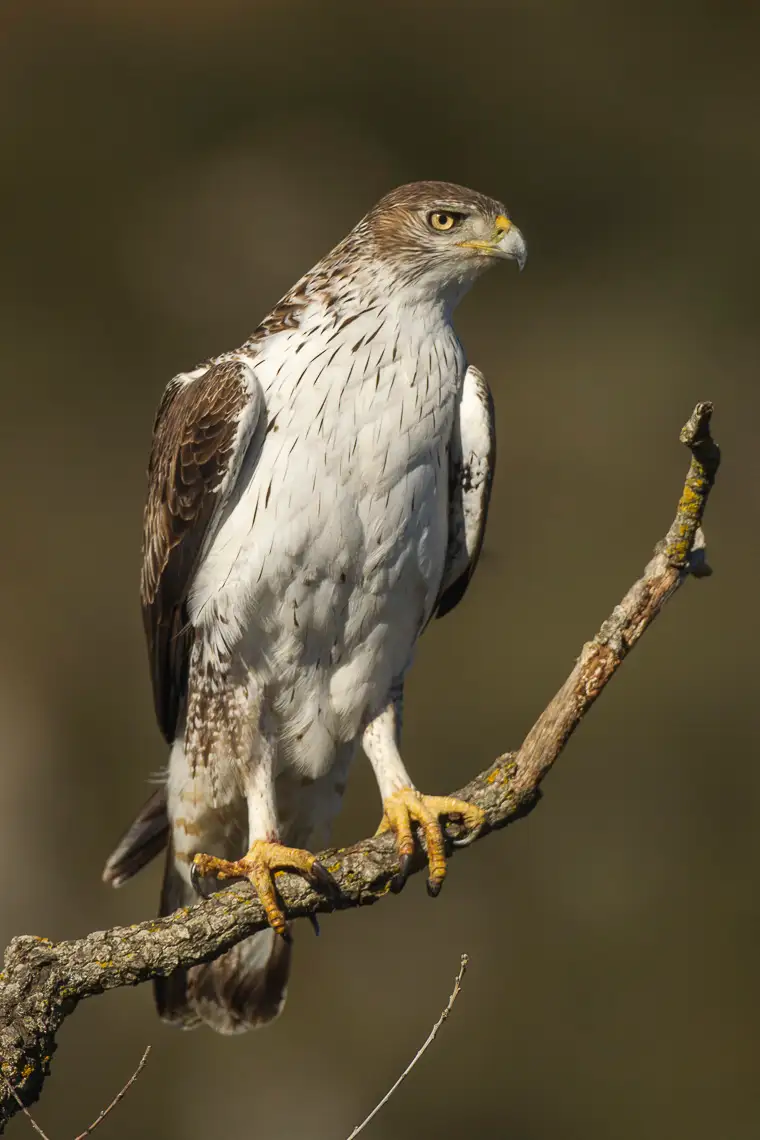
Adult Bonelli's Eagle perched on a branch, with pale underparts, dark brown upperparts and a white mark on the backPhoto: Francesco Veronesi from Italy, CC BY-SA 2.0Photo 1 of 4
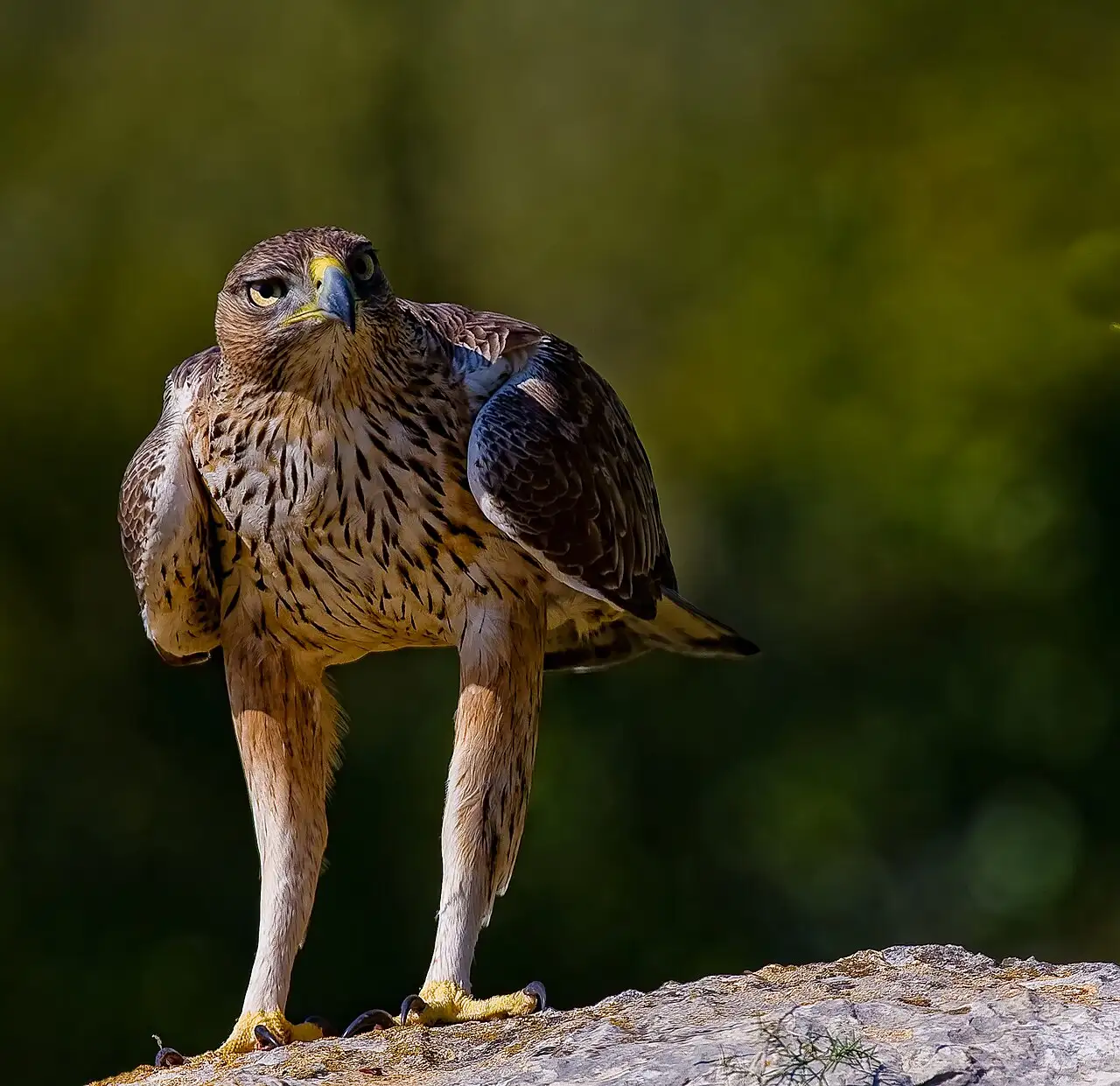
Bonelli’s Eagle is a large bird of slender build. The adult has pale underparts, with elongated streaks arranged lengthwise, and dark brown upperparts, with a white mark on the back. In flight a contrast can be seen between the whitish body and the dark underside of the wings, and the tail is pale, with a broad dark terminal band. The young bird of the year has cinnamon underparts from the throat, and the streaks appear in its second year, while the upperparts are browner. In flight, the flight feathers and tail are pale, with fine barring, the primaries show dark tips and the body coverts are orange.
Adult
Pale underparts, with elongated streaks.
Dark brown upperparts, with a white mark on the back.
Pale tail with a broad dark terminal band.
Young bird
Cinnamon underparts from the throat; the streaks appear in the second year.
Browner upperparts, and in flight, pale flight feathers and tail with fine barring.
Habitat and distribution of Bonelli’s Eagle
It is distributed across southern Asia to the Mediterranean basin, where the Iberian and Maghreb populations stand out. It has no subspecies.
In Spain it is present above all in the coastal Mediterranean sierras, the Betic sierras, Sierra Morena and Extremadura, and also in the centre and north, although more irregularly. It is in the Balearics thanks to an important reintroduction effort, and is absent from the Canaries, Ceuta and Melilla. Outside the breeding areas there are other areas of great importance for its conservation, because dispersing young birds settle in them: the Lleida depression, the Sierra de Escalona, the Albacete countryside, south-west Madrid, Toledo, the holm oak woods of Trujillo, La Serena and La Janda.
It sets its breeding territories in sierras, rolling terrain or plains, provided there are rocky cliffs of varying size to breed on, although some pairs put the nest on trees (cork oaks, pines and eucalyptus) or electricity pylons, especially in the south and west of the peninsula.
It is resident on the Peninsula. Territorial birds are usually tied to their breeding area all year, although where there is less food they may move some tens of kilometres outside the breeding season. Young birds from the north move south and south-east and stay in dispersal areas without adults and with a great abundance of prey, above all rabbit and partridge.
Areas where it is regularly recorded since 2010Squares of about 25 km where it is recorded regularly (occasional passage records are left out). Data from GBIF.org (14,761 records, retrieved October 2026); outline from Natural Earth.
Etymology of Bonelli’s Eagle
According to Wikipedia, the genus «Aquila» is Latin for «eagle», perhaps from «aquilus», «dark-coloured», and the epithet «fasciata» comes from the late Latin «fascia», «band» or «stripe». The English name, «Bonelli’s eagle», recalls the Italian ornithologist and collector Franco Andrea Bonelli, to whom the collection of the type specimen is attributed, probably in Sardinia. In other languages it is called «àguila cuabarrada» in Catalan, «aguia perdigueira» in Galician, «Bonelli arranoa» in Basque and «Bonelli’s eagle» in English1.
Population of Bonelli’s Eagle
The 2021 European Red List of Birds estimates about 2,100–2,500 Bonelli’s Eagles on the European continent, with a stable trend. According to the Third Atlas of Breeding Birds in Spain, the last national census (2018) counted 711–745 pairs, of which more than 317 were in Andalusia. There is an important decline, of 50 % between the last two censuses, in provinces such as Álava, La Rioja, Navarre and Toledo, and more moderate declines in Zaragoza, Teruel, Ciudad Real or Huesca; on the other hand, there are increases in Badajoz, Tarragona and the Balearics, from where it became extinct in the first half of the 20th century and where it has been successfully reintroduced.
It suffered a severe decline in the last decades of the 20th century that has recently been halted thanks to conservation efforts, although the overall trend is still negative: between the 2005 and 2018 censuses a decrease of roughly 3 % was detected. Its main threat is the high adult mortality from direct persecution (shooting, traps or poison on small-game estates) and from electrocution and collision with power lines. It is also affected by habitat transformation, food shortage from rabbit diseases and human disturbance in breeding areas, and competition with the Griffon Vulture and the Golden Eagle for nesting sites has been cited.
Nest of Bonelli’s Eagle
Breeding areas are on the fringes of mountain massifs or sierras. The nest is set anywhere from more than 100 metres up on the cliffs of large massifs to a few metres off the ground in small sierras. It is a pile of branches that can reach 180 centimetres across and as much in height, lined with a thin layer of grasses; the female builds it with the male’s contributions, and its construction takes three or four months.
Courtship and breeding of Bonelli’s Eagle
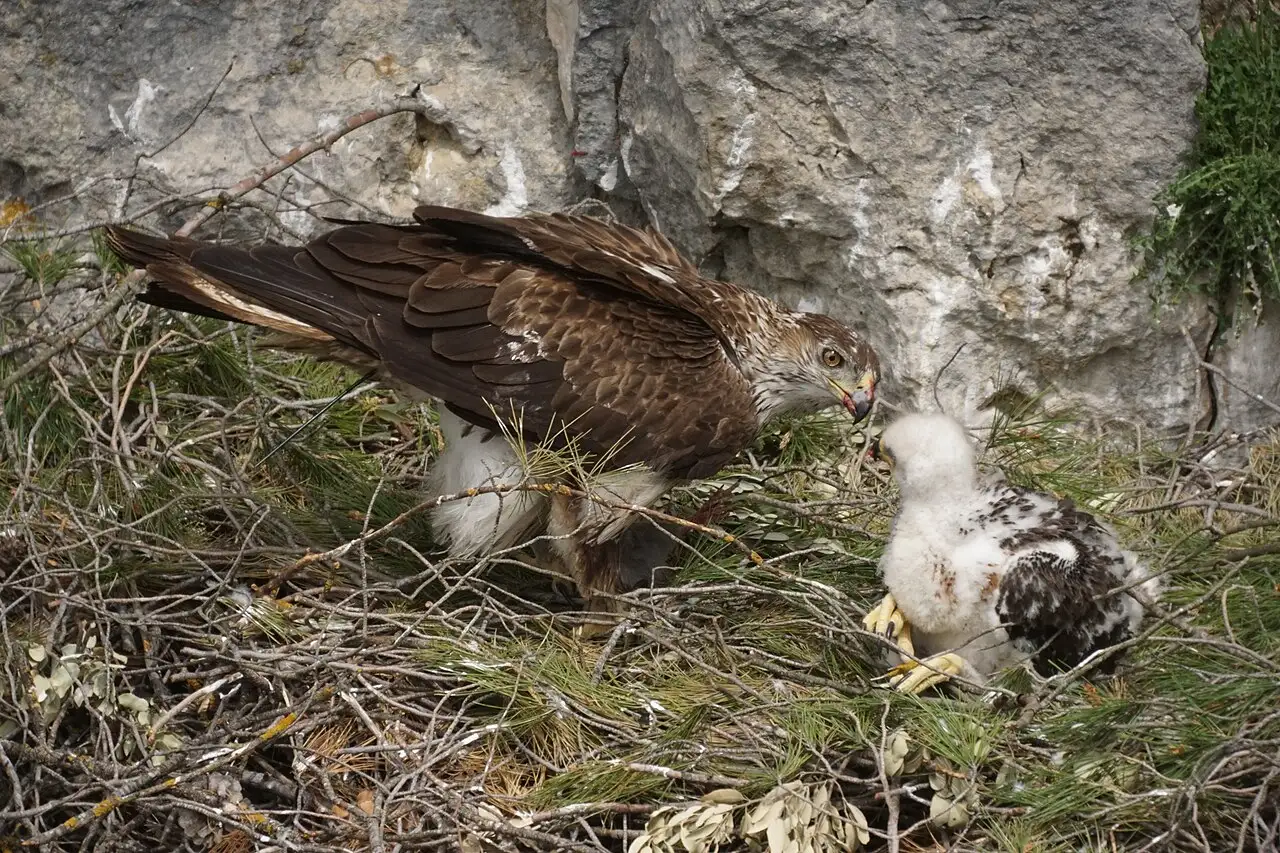
The clutch normally consists of two eggs, although it varies between one and three (rare), whitish with some dark spots or fine streaks. Both members of the pair incubate them, though with greater dedication from the female, for 37–40 days. The chicks are cared for by both parents and feed themselves from 45–50 days; at 60–65 days their plumage is fully developed and they fly a few days later, although they stay another three months with their parents, after which they disperse to between 100 and 1,000 kilometres from the birthplace. During the immature period they make continual movements through dispersal areas.
Diet of Bonelli’s Eagle
It is based on medium-sized mammals and birds and, to a lesser extent, on reptiles. On the Peninsula, the Red-legged Partridge and the Western Jackdaw are staple prey between August and April, and in the breeding season the rabbit plays a fundamental role. The ocellated lizard can be an important substitute prey if the main catches are scarce.
Curious facts about Bonelli’s Eagle
It is the most agile of the large eagles, which lets it hunt a large number of medium-sized birds, and also as the palest in colour1. It is very well known because it has been the subject of many doctoral theses and intensive conservation programmes.
Bonelli’s Eagle in Cabañeros
The habitat pages of this website do not mention it, and we have not found any other published source on it in the Park. Toledo is among the settlement areas of dispersing young birds, and a 50 % decline is recorded in that province between the last two censuses, and a more moderate one in Ciudad Real1. GBIF.org records 14 observations of Bonelli’s Eagle in Cabañeros and its surroundings.
Where to see Bonelli’s Eagle in Cabañeros
In Cabañeros and its surroundings, all year, in sierras with rocky cliffs and in open areas with rabbit and partridge.
When
All year; it is resident, and young birds disperse far from the place of birth.
What time
By day; it is a very agile raptor and can be seen hunting.
Where
In sierras, rolling terrain or plains with rocky cliffs to breed on.
What to look for
Look for the contrast between the whitish body and the dark wings below, and the pale tail with the broad dark band.



 Same family
 Same family
 Same family
 Same family
 Same order
 Same season in the park
 Same season in the park
 Same season in the park






