Wingspan compared with a person with arms outstretched.
Length
85–100 cm
Wingspan
1.45–1.7 m
Weight
0.7–1.5 kg
Social life
Colonial species that may mix at breeding cores with other herons or waders
Lifespan
Record of 20 years and 6 months according to EURING (a bird ringed in Germany and found dead); AnAge gives up to 22.8 years
Conservation status
LC
NT
VU
EN
CR
EW
EX
Global (IUCN)
Least Concern
Spain
Least Concern (LC) as a winter or passage visitor and Near Threatened (NT) as a breeder in the Red Book of the Birds of Spain; on the List of Wild Species under Special Protection, but not in the Spanish Catalogue of Threatened Species
When to see it
Winter visitor
Months of the year when it is present
J
F
M
A
M
J
J
A
S
O
N
D
In Iberia
yes
yes
yes
yes
yes
yes
yes
yes
yes
yes
yes
yes
Song or voice of the Western Great Egret
It is a fairly silent bird, except in the breeding colonies, although it sometimes gives a dry croak.
CallWestern Great Egret
0:00 / 0:06
10 kHz5
The sonogram draws the sound: time runs from left to right, and the higher a trace sits, the higher the note.Recording by Stanislas Wroza, Wikimedia Commons (CC BY 4.0).
Flight of the Western Great Egret
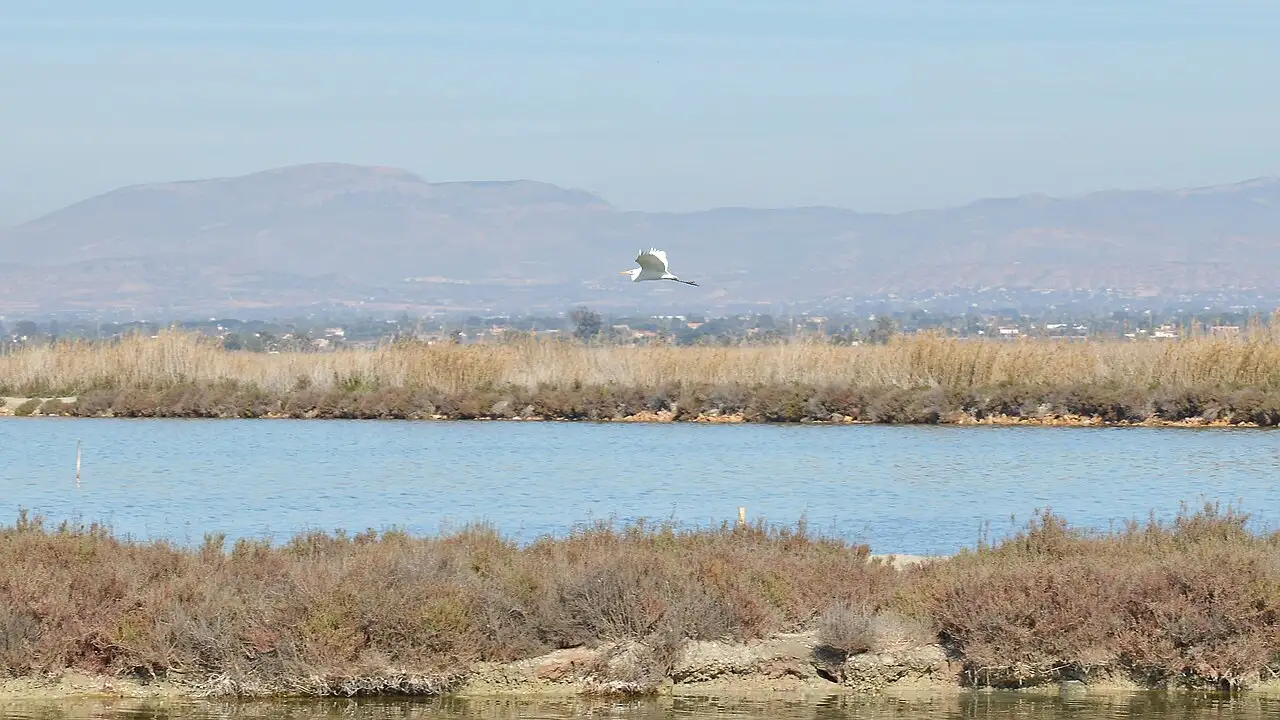
In flight it looks very large. It carries the neck folded and the wings arched, while the legs stick out long behind the tail.
Flight typeWith neck folded and long legs behind the tail
It is associated with extensive inland or coastal wetlands, such as lagoons, marshes, coastal lagoons, deltas and rice fields; in winter it also appears in small inland pools.
In flight it looks very large: it carries the neck folded and the wings arched, while the legs stick out long behind the tail.
It feeds on animal matter, basically fish and aquatic insects, and is a fairly silent bird, except in the breeding colonies.
Photo gallery of the Western Great Egret
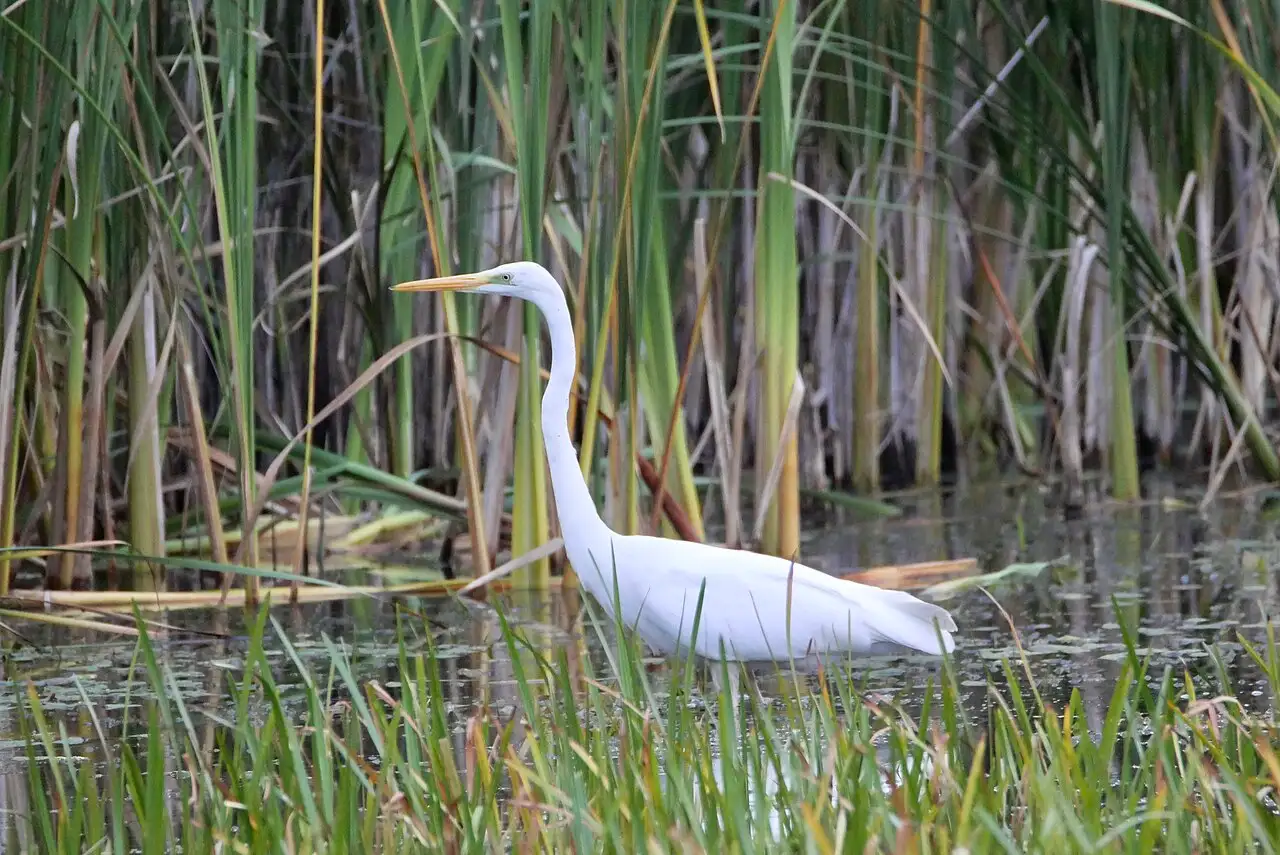
White-plumaged Western Great Egret, wading among marsh vegetation, with the long neck in an S and the yellow dagger-shaped billPhoto: Aleksander.Rękawek, CC BY-SA 4.0Photo 1 of 4
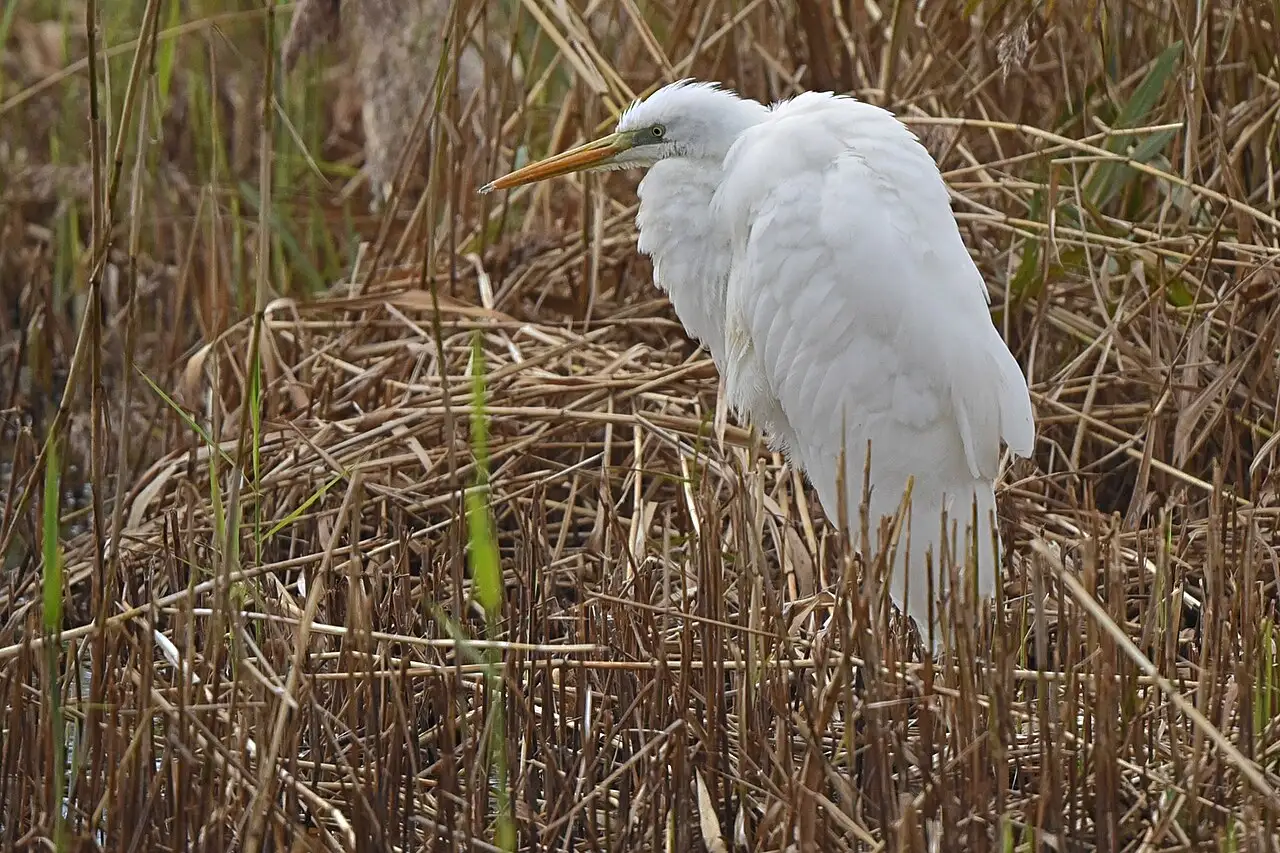
Western Great Egret perched among dry reeds, with somewhat ruffled white plumage and yellow billPhoto: Pierre-Marie Epiney, CC BY-SA 2.0Photo 2 of 4
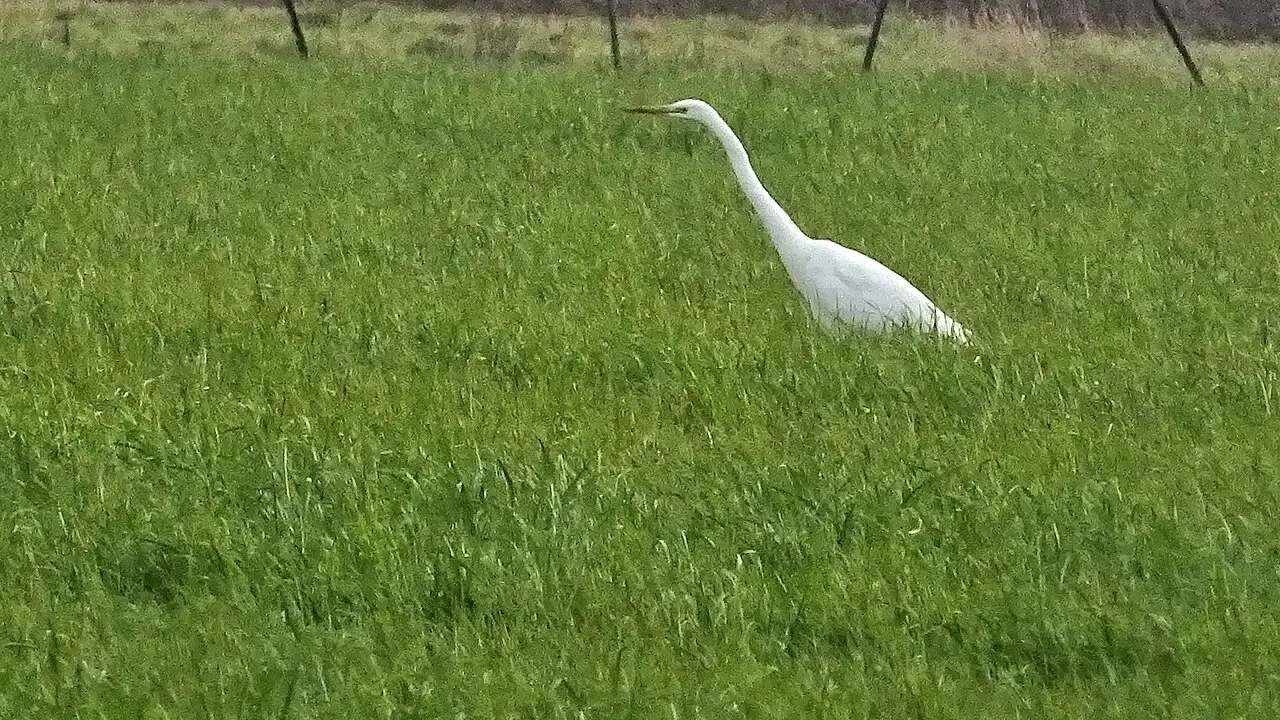
Western Great Egret walking across a green meadow, with neck stretched out and white bodyPhoto: José Véron-Durand, CC0Photo 3 of 4
Western Great Egret in flight over the salt pans of Santa Pola, with a sierra in the backgroundPhoto: Ryan Hodnett, CC BY-SA 4.0Photo 4 of 4
1 / 4
Identification of the Western Great Egret
The Western Great Egret is a large heron, very slender and with a particularly long neck, which wears entirely white plumage. It has a strong, elongated, dagger-shaped bill. The adult has a greenish bare area next to the eye, which is yellow, and yellow legs, sometimes orange during breeding.
Breeding adult
Long feathers on the throat and base of the neck; on the back, very long and frayed, extending like a mantle over the flight feathers and tail.
Bill dark, sometimes with a yellowish base, or completely orange in some subspecies.
Non-breeding and young bird
Without ornamental plumes and with a yellow or orange bill.
Yellow tibiae and dark greenish-grey tarsi; in the young bird, yellowish-green tibiae.
Habitat and distribution of the Western Great Egret
It is distributed across practically every continent. In Europe its population is concentrated mainly in the south-east (the Danube delta, Turkey and wetlands around the Black and Adriatic seas). Several subspecies are recognised, and in Spain the subspecies «alba» lives, which ranges over the central area of Eurasia.
Its breeding cores in Spain are very scarce and are located in the Ebro delta, the Guadalquivir marshes and, probably, the Albufera of Valencia. Wintering takes place mainly in the Levante, with good numbers in the Ebro delta, and it is also present in the Atlantic and Mediterranean wetlands of Andalusia, in the Valencian Community, the Balearics, the Ebro delta, the Ebro valley and the Guadiana and Tagus basins in Extremadura, Castilla-La Mancha and Madrid. In the Canaries it appears only accidentally.
It is normally associated with extensive inland or coastal wetlands, such as lagoons, marshes, coastal lagoons, deltas and rice fields. In winter it is somewhat less demanding and may also appear in small inland pools or in estuaries.
It is fundamentally a winter visitor on the Peninsula and the Balearics, although it is also present during migration passage, and there are observations throughout the year. In general, the European population is a short-distance migrant: many birds winter in the Mediterranean basin, others in North Africa and even cross the Sahara. Young birds disperse in all directions after becoming independent, around July, and travel up to 400 kilometres. European colonies are abandoned between late September and early November and reoccupied from late February to early April.
Areas where it is regularly recorded since 2010Squares of about 25 km where it is recorded regularly (occasional passage records are left out). Data from GBIF.org (138,066 records, retrieved October 2026); outline from Natural Earth.
Etymology of the Western Great Egret
According to Wikipedia, the scientific name comes from Latin: «ardea» means «heron» and «alba», «white». In other languages it is called «agró blanc» in Catalan, «garza branca» in Galician, «koartza zuria» in Basque and «great egret» in English1.
Population of the Western Great Egret
In the 2021 European Red List of Birds the European breeding population has an increasing trend. The Spanish population is around 53 breeding pairs and also shows an upward trend. In winter it cannot be considered an abundant bird: without precise data, a winter population of some 1,500 individuals is estimated, and since the 1970s the wintering numbers on the Peninsula and the Balearics have been rising. It was once heavily persecuted for its breeding plumes, used in hats and ornaments, which caused a notable decline in its populations. Today the threats are the generic ones of wetland birds: the reduction or alteration of flooded areas, the destruction of plant cover, pollution and poaching.
Nest of the Western Great Egret
Nests are usually located among marsh vegetation, sometimes in contact with the water, although they are also set in low trees or shrubs and even in cork oaks, as happens in Doñana. The platforms, built by both sexes, are an untidy pile of branches and sticks about a metre across and some 20 centimetres high, lined with small stems and other fine material. They are often used for several years.
Courtship and breeding of the Western Great Egret
It is a colonial species. The clutch consists of three to five eggs (it varies between two and six) of pale blue, which both sexes incubate for 25 or 26 days. The chicks are cared for by both members of the pair. After some 20 days they climb easily on the branches near the nest and, at about 42 days, reach full development.
Diet of the Western Great Egret
Like all ardeids, it feeds on animal matter, basically fish and aquatic insects. It may also swallow small mammals, land insects and even lizards and young birds, if no other prey is available.
Curious facts about the Western Great Egret
Until relatively recently this large ardeid only visited us occasionally during the winter1. Today, with its recovery in Europe, we receive more and more birds and some even breed among us, in the Ebro delta and the Guadalquivir marshes1. EURING lists a bird ringed in Germany that lived 20 years and 6 months.
The Western Great Egret in Cabañeros
The habitat pages of this website do not mention it. GBIF.org records 83 observations of the Western Great Egret in Cabañeros and its surroundings.
Where to see the Western Great Egret in Cabañeros
In Cabañeros and its surroundings, mostly in winter, beside lagoons and ponds.
When
In winter, when it is most abundant; there are observations in every month.
What time
In good light, beside the water; in winter it accepts small inland ponds.
Where
In wetlands: lagoons, marshes, coastal lagoons, deltas, rice fields and, in winter, small ponds.
What to look for
Look for the entirely white plumage, the very long neck and the dagger-shaped bill; in flight, the legs sticking out behind the tail.



 Same family
 Same family
 Same family
 Same family
 Same season in the park
 Same season in the park
 Same season in the park
 Same season in the park






