Wingspan compared with a person with arms outstretched.
Length
84–102 cm
Wingspan
1.55–1.75 m
Weight
1–2.1 kg
Social life
Very gregarious in the breeding season: it nests in colonies, sometimes with other herons or storks
Lifespan
Record of almost 38 years in the wild (a bird ringed in the Netherlands)
Conservation status
LC
NT
VU
EN
CR
EW
EX
Global (IUCN)
Least Concern
Spain
Included in the List of Wild Species under Special Protection; not in the Spanish Catalogue of Threatened Species
When to see it
Resident
Months of the year when it is present
J
F
M
A
M
J
J
A
S
O
N
D
In Iberia
yes
yes
yes
yes
yes
yes
yes
yes
yes
yes
yes
yes
Song or voice of the Grey Heron
Besides other calls, which it gives mainly in the company of other herons within the breeding colonies, it gives a very characteristic sound, like an «aarj», harsh and very loud. The recording we hear is a flight call.
Flight callGrey Heron
0:00 / 0:22
10 kHz5
The sonogram draws the sound: time runs from left to right, and the higher a trace sits, the higher the note.Recording by Joost van Bruggen, Wikimedia Commons (CC BY-SA 4.0).
Flight of the Grey Heron
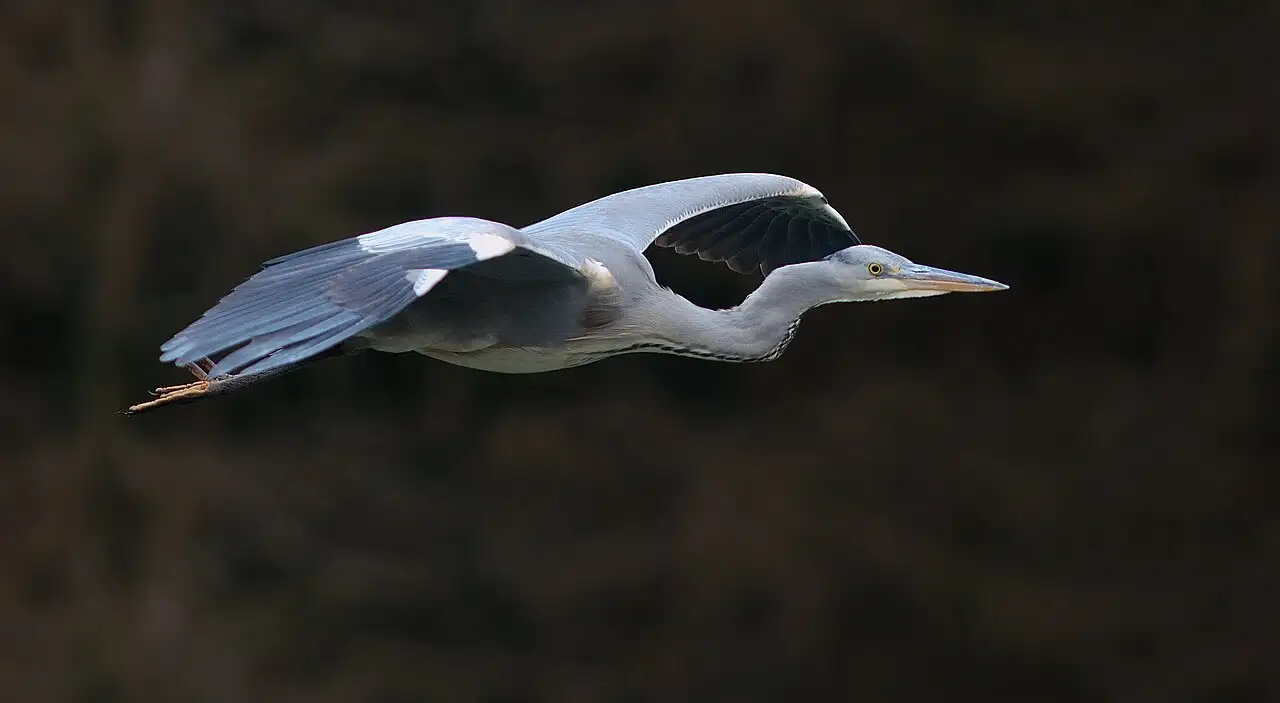
In flight it adopts the characteristic posture of herons, with the neck tucked into an «S» and the legs stretched out, sticking out behind the tail. Its great size sets it apart from the rest of its relatives. In the illustration the neck is stretched out, like a crane’s; the Grey Heron actually carries it folded.
Flight typeWith the neck tucked into an S and the legs stretched back
It takes off with slow, deep wingbeats, from the bank of the river or reservoir where it was waiting for prey.
In flight it adopts the characteristic posture of herons: neck tucked into an «S» and legs stretched out, sticking out behind the tail. Its great size sets it apart from the others.
It glides with wings open, stretches out its feet and lands beside the water, where it stays motionless, stalking.
Photo gallery of the Grey Heron
Grey Heron in flight, with neck tucked into an S, wings open and legs stretched backPhoto: Luc Viatour, CC BY-SA 3.0Photo 1 of 4
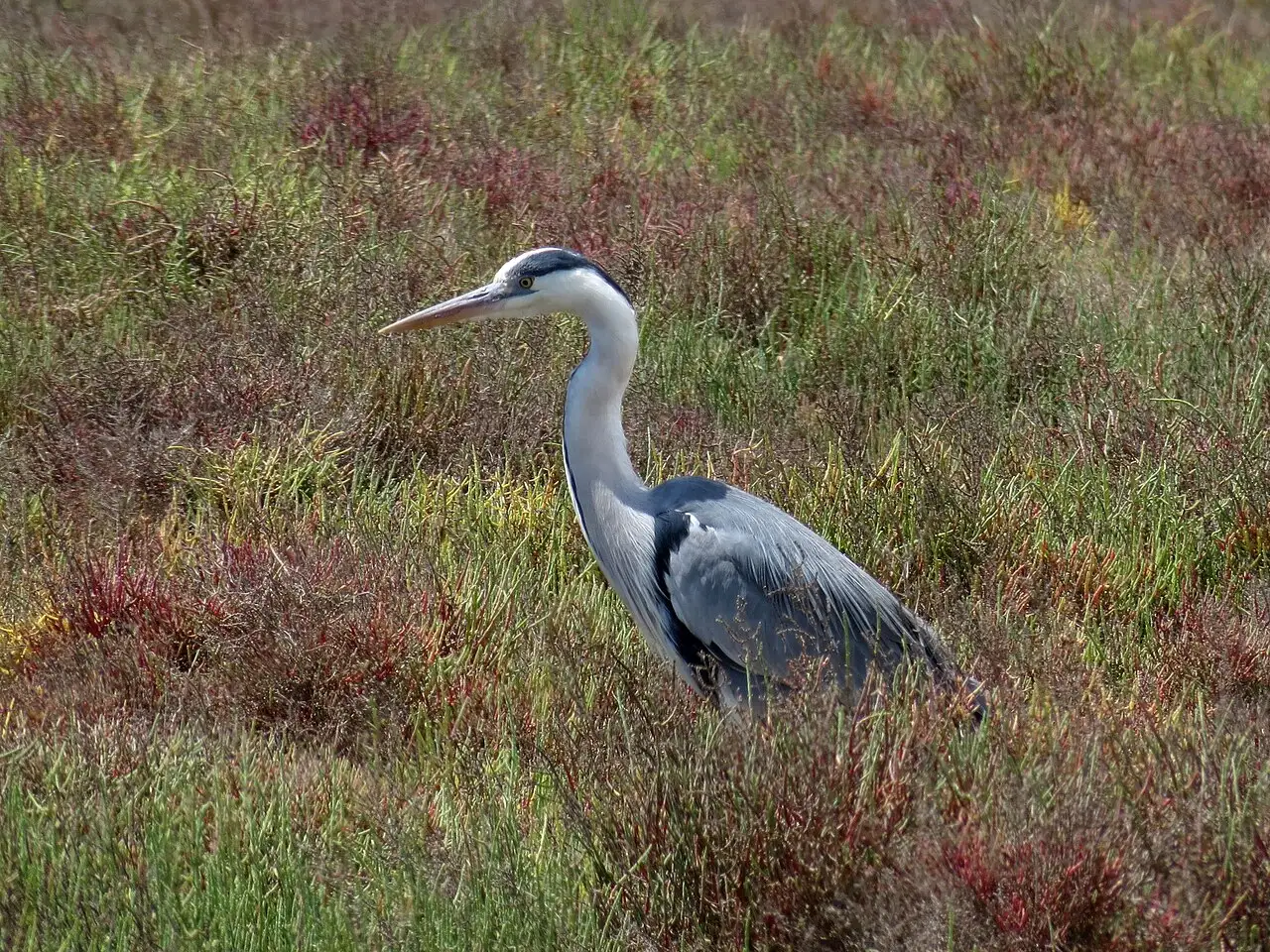
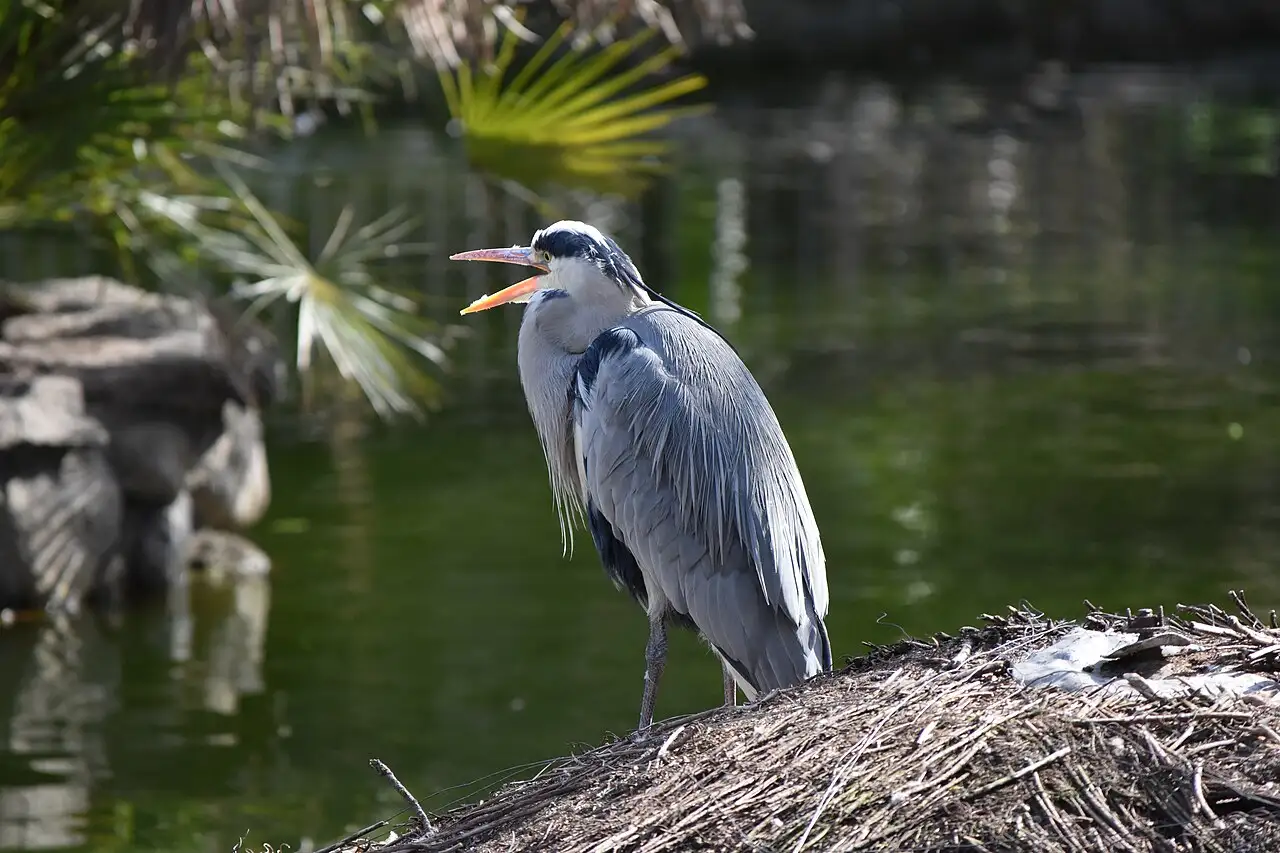
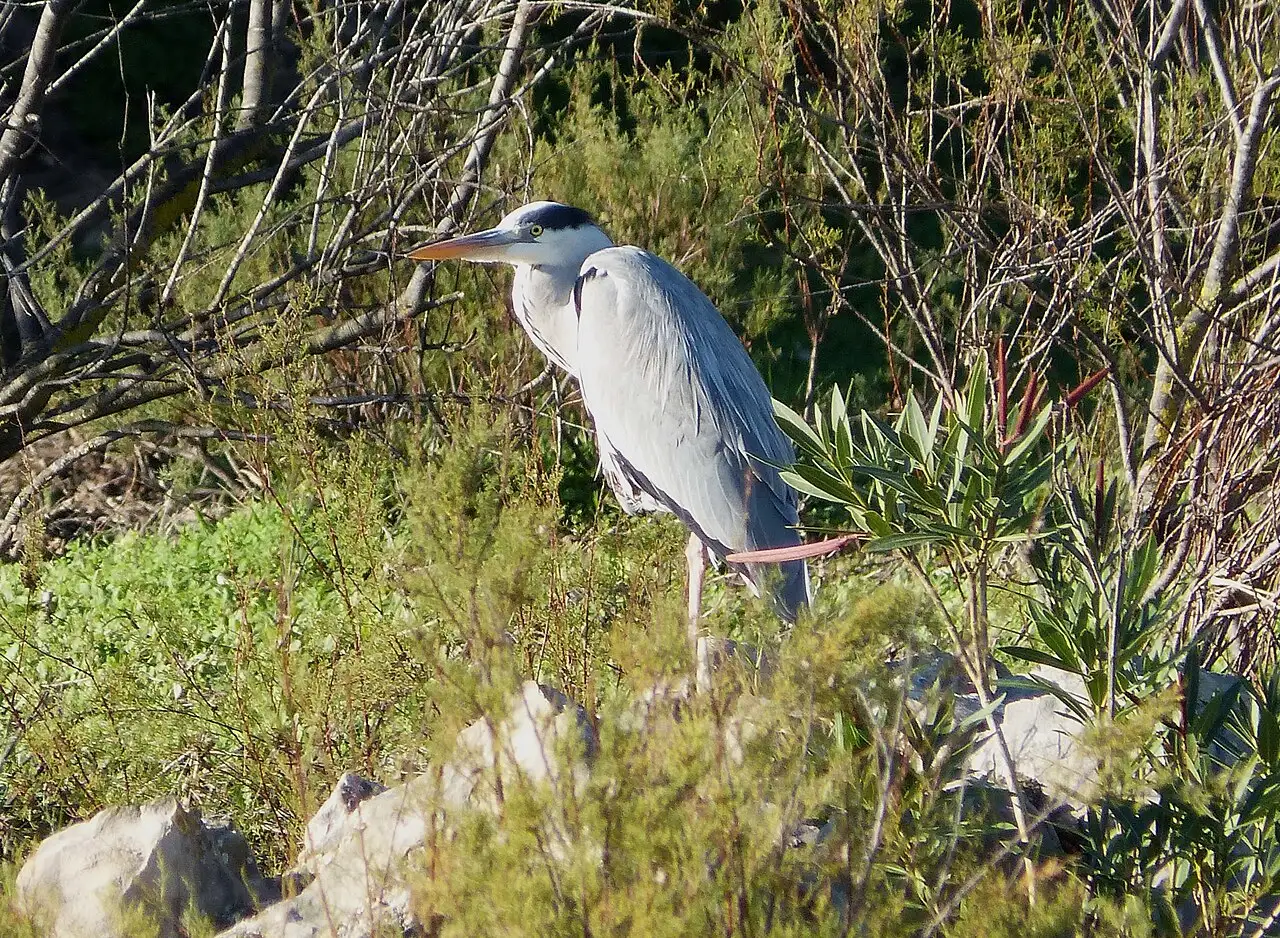
It is a large bird, the largest of the ardeids that frequent our country, of slender figure, long neck and overall greyish colouring, with a pattern that changes with age and time of year. In the breeding period, the head of adults is white and bears a black line and a pair of long, also black, plumes, and the white neck is marked by two parallel blackish bands. The long, sharp bill is reddish, the upperparts are mainly ash grey and there is a striking black patch on the shoulders. Outside the breeding season the pattern is less contrasting, without the ornamental feathers on the head and with the bill yellowish.
Breeding adult
White head and neck, with black line and plumes.
Reddish bill, ash-grey back and black patch on the shoulders.
Outside the breeding season
Less contrasting pattern, without ornamental plumes and with a yellowish bill.
Habitat and distribution of the Grey Heron
It is widely distributed across the whole Palearctic: the subspecies «cinerea» breeds over most of Europe, Asia and Africa, including Madagascar, and winters in numerous European regions, in Africa and in southern Asia. Several subspecies are recognised.
In Spain the number of breeding pairs has increased considerably: 6,994 pairs in 241 colonies and 44 isolated pairs in the 2011 census, above all in Andalusia, Extremadura, Castilla y León and the Valencian Community, and more and more in the Cantabrian regions. In the breeding season it frequents lagoons, marshes or freshwater banks with emergent vegetation and nearby trees in which to set the nests. In winter and on migration passage it is undemanding and occupies all kinds of wetlands, natural or artificial (rice fields, salt pans, irrigation canals, fish-farm ponds), and also grasslands, meadows or beaches. Only the most northerly populations make long-range migrations; the rest of the European breeders are sedentary or make short movements. The Peninsula is the main destination or the obligatory passage towards Africa, and in the Strait of Gibraltar a very important migratory flow is detected every year, in October and November. Some 17,364 individuals are estimated to winter in Spain, above all in the south-western quadrant.
Areas where it is regularly recorded since 2010Squares of about 25 km where it is recorded regularly (occasional passage records are left out). Data from GBIF.org (589,187 records, retrieved October 2026); outline from Natural Earth.
Etymology of the Grey Heron
«Ardea» is the Latin name for the heron, and «cinerea» comes from «cinis», «ash»: «the ash-coloured one», for its grey plumage.
Population of the Grey Heron
In the 2021 European Red List of Birds the European breeding population is estimated at between 492,000 and 700,000 mature individuals, with a decreasing trend. In Spain, with 6,994 breeding pairs, the trend is positive and clearly growing; on the northern fringe, the Ebro valley and the Guadiana basin it has increased greatly in recent years. It is classified as Least Concern, both as a winter visitor and as a breeder. The main problems are the fluctuations in the water levels of wetlands, the scarcity of nesting sites and possible direct persecution by fishermen.
Nest of the Grey Heron
It nests in colonies, which other herons and even storks join, in small riverside groves or in copses near a wetland, where total uproar reigns. Male and female rebuild the nest of other seasons with sticks and branches, and finish the platform by lining it with grasses and leaves.
Courtship and breeding of the Grey Heron
In mid-February, when they already wear breeding plumage, male and female come to the colony. After a ritualised courtship, in which neck contractions dominate and calls are frequent, the female lays three to five green or pale blue eggs, which both adults incubate for 25 to 28 days, generally from the laying of the first. The chicks move around the nest’s surroundings a few days after hatching, but still depend on their parents’ food. At 45 or 55 days, with full plumage, they fly.
Diet of the Grey Heron
Its basic food is fish, but it is opportunistic and also eats amphibians, reptiles, chicks of other birds or small mammals, crustaceans, molluscs, earthworms, large insects and even plant matter. Its most usual technique is to stay motionless, stalking, beside the water until prey passes; then, with a lightning movement of the neck, it grabs it with the bill and swallows it.
Curious facts about the Grey Heron
It breeds little here, but in winter and on migration passage it is much more abundant, because many European birds stop over in our territory on their way to Africa. It hunts without moving: it waits motionless beside the water until the prey passes, and everything is decided in a lightning movement of the neck.
The Grey Heron in Cabañeros
The habitat pages of this website cite it in the lagoons of Cabañeros, of sparse birdlife, where it appears on migration passage.
Where to see the Grey Heron in Cabañeros
In the lagoons and on the banks of rivers and ponds of Cabañeros, above all during migration passage.
When
All year round; in winter and on migration passage there are many more. The passage through Gibraltar is in October and November.
What time
During the day, while it waits motionless for prey.
Where
On the banks of lagoons, rivers and reservoirs, motionless in shallow water.
What to look for
A large, grey and white bird, with long neck and sharp bill, motionless beside the water; in flight, with the neck in an S.
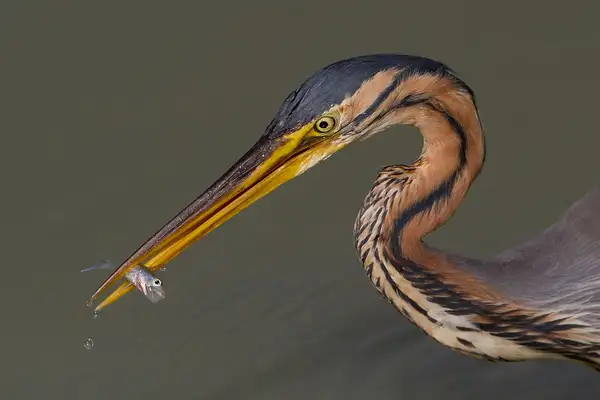
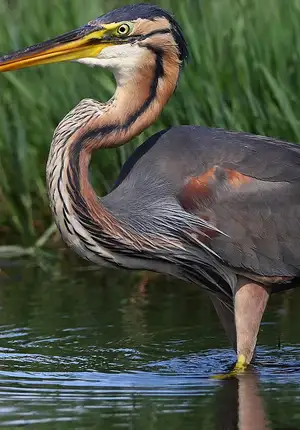
Very slender, of extraordinarily sleek silhouette, with chestnut, purple and greyish tones, black and white lengthwise bands on the neck and a blackish cap with greenish iridescence.
Photo: Pierre Dalous, CC BY-SA 3.0
Other birds
Birds related to the Grey Heron or sharing its habitats in Cabañeros.



 Same family
 Same family
 Same family
 Same family
 Also in wetlands
 Also in wetlands
 Also in wetlands
 Also in wetlands






